
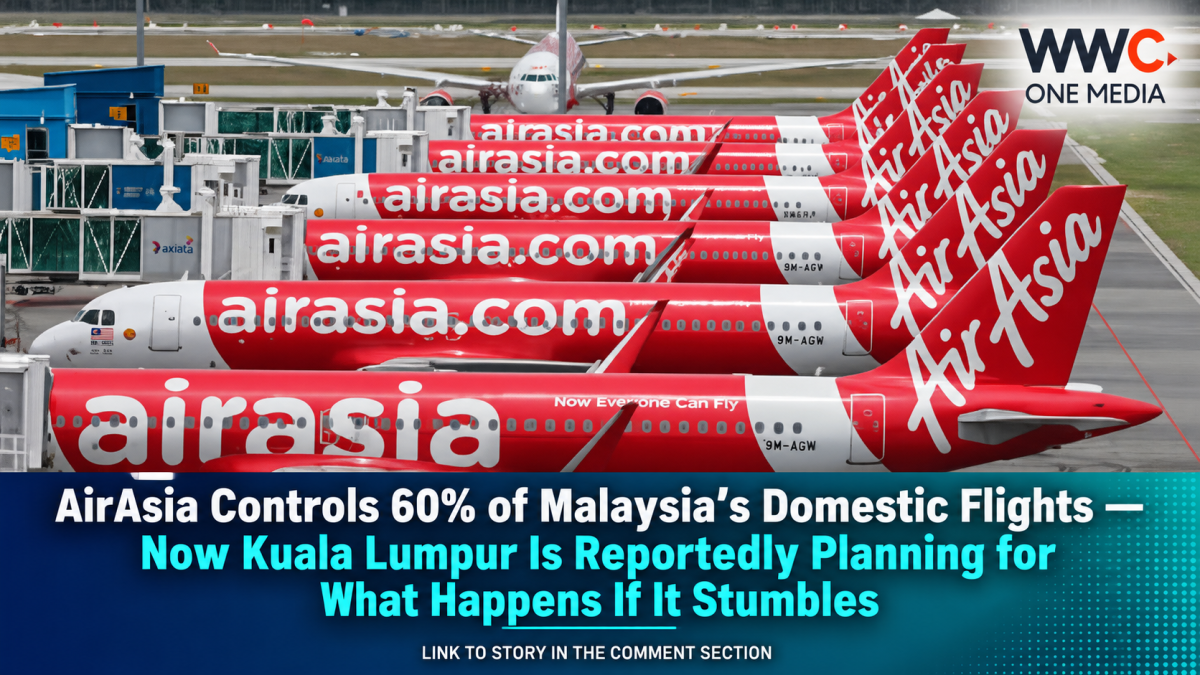
KUALA LUMPUR — Malaysia is reportedly preparing for a scenario few travelers would have imagined during AirAsia’s rise into Southeast Asia’s dominant low-cost airline: what happens if the carrier becomes unable to maintain its enormous share of the country’s flights?
The Malaysian government has asked Malaysia Airlines and Batik Air about their ability to absorb routes and passengers currently served by AirAsia, according to Reuters, citing two people familiar with discussions that have intensified in recent weeks.
The talks are described as contingency planning, not evidence that AirAsia is about to stop flying or that a takeover has been agreed.
Malaysia’s Finance Ministry, Malaysia Airlines and Batik Air declined to comment to Reuters, while airport operator Malaysia Airports Holdings Berhad said it routinely discusses capacity and route opportunities with airlines.
AirAsia, meanwhile, says it remains focused on maintaining stable operations and business continuity across its markets.
But the fact that such scenarios are reportedly being examined underscores the scale of AirAsia’s importance to Malaysia.
The airline says it accounts for roughly 40% of Malaysia’s total aviation market and about 60% of domestic flying.
That means financial problems at AirAsia would not be just a corporate issue.
They could quickly become a national connectivity problem.
Why Malaysia is watching AirAsia so closely
AirAsia has been battered by an extraordinary rise in fuel costs in 2026.
The airline said average jet fuel prices reached about US$183 per barrel during the second quarter, while its fuel expense jumped 58% from a year earlier.
AirAsia Group still generated RM5.1 billion in quarterly revenue, despite cutting capacity by 11%, and reported positive EBITDA of RM442.6 million.
But the company ended the quarter with a RM830.5 million net loss.
Foreign-exchange movements accounted for RM331 million of that loss. Excluding those forex losses, AirAsia said its second-quarter net loss would have been approximately RM499.6 million.
The airline has responded by raising fares and fuel surcharges, reducing capacity and aggressively attacking costs.
AirAsia said revenue per available seat kilometre rose 11% year on year during the quarter, while non-fuel unit costs fell 7%.
Its Malaysian and Cambodian short-haul operations remained profitable, but operations in Thailand, Indonesia and the Philippines, along with Malaysia’s long-haul business, were under heavier financial pressure.
The problem is that fuel costs have risen faster than airlines can always pass them on to passengers.
Budget carriers are particularly vulnerable because price-sensitive customers may simply refuse to travel if fares rise too sharply.
Reuters reported in August that the fuel shock was already pushing several Southeast Asian low-cost airlines into losses or aggressive cost reductions.
The balance sheet is attracting even more attention
AirAsia’s financial position is now under scrutiny beyond its quarterly loss.
As of June 30, the airline had RM18.4 billion in current liabilities, according to Reuters’ report, compared with RM954 million in cash and bank balances.
Sources familiar with its financial arrangements also told Reuters that AirAsia owed Malaysia Airports at least RM500 million for services including landing and parking fees.
The airport operator was said to have granted repayment extensions.
Malaysia Airports declined to discuss specific commercial arrangements, while AirAsia did not confirm the reported amount owed. It instead said it maintains a strong and constructive relationship with the airport operator.
Those distinctions matter.
The RM500 million figure comes from Reuters sources familiar with the matter rather than an AirAsia or Malaysia Airports public disclosure acknowledging that specific debt.
AirAsia is trying to raise fresh financing
AirAsia says it is already addressing its financial structure.
The group is pursuing up to US$1 billion from international debt markets plus RM700 million in Malaysian credit facilities.
AirAsia says that money is intended primarily to restructure and refinance debt and strengthen its balance sheet, rather than simply cover operating losses.
The company also said it successfully raised approximately US$300 million in March 2026.
Reuters reported that two people familiar with the situation estimated AirAsia could require at least US$3 billion in fresh capital to fully address its financial position.
AirAsia disputes that assessment.
The carrier says its own targeted financing package is sufficient for its requirements.
That is one of the most important points in the story:
US$3 billion is an estimate from people cited by Reuters—not a financing requirement acknowledged by AirAsia itself.
Malaysia has reportedly brought in aviation advisers
The Malaysian government is also trying to determine how serious the situation is.
Reuters reported earlier in September that the Finance Ministry had hired Alton Aviation Consultancy to assess AirAsia’s funding requirements.
The reported review comes because of AirAsia’s importance not only to Malaysian tourism but also to jobs, domestic connectivity and affordable regional air travel.
The Finance Ministry has not announced that it intends to bail out the airline.
Reuters reported that officials had considered possible forms of government endorsement that could help AirAsia secure external financing, although no specific structure has been publicly confirmed.
That is substantially different from a direct government rescue.
For now, Malaysia appears to be studying options rather than announcing one.
What Malaysia Airlines and Batik Air reportedly told the government
According to Reuters’ sources, Malaysia Airlines and Batik Air indicated that they could expand organically if AirAsia reduced flying, adding services on routes where capacity disappeared.
But taking over AirAsia’s operations on a much larger scale would be more complicated.
Both airlines reportedly indicated that any large-scale assumption of AirAsia’s operation would also need to include access to its aircraft leases.
The reason is straightforward.
An airline cannot suddenly absorb millions of passengers merely by putting its name on AirAsia routes.
It needs aircraft, pilots, cabin crews, maintenance resources, airport slots and operating infrastructure.
Without additional airplanes, replacing a carrier responsible for roughly 60% of Malaysia’s domestic market would be extraordinarily difficult.
No such transfer has been agreed.
The discussions, according to the sources, remain part of contingency planning.
AirAsia is already shrinking parts of its network
AirAsia is not simply waiting for fuel prices to fall.
It has been restructuring.
The carrier has cut weaker routes, renegotiated agreements with suppliers and is returning 25 older aircraft to lessors, Reuters reported.
Its second-quarter strategy prioritized higher fares and profitability over passenger volume.
Capacity was cut 11%, while revenue remained almost flat at RM5.1 billion because stronger yields partly offset the reduction in seats.
AirAsia called the second quarter the likely “trough quarter” of the year and said its operational changes and higher fares should improve its position during the second half.
That means there are two competing narratives.
The government is reportedly planning for downside scenarios because AirAsia is too important to ignore.
AirAsia, meanwhile, argues it is actively restructuring its finances and operations and remains capable of managing the crisis.
Both can be true at the same time.
Contingency planning does not mean collapse is imminent.
Malaysia Airlines is in a very different financial position
The most obvious carrier that could absorb some AirAsia capacity is Malaysia Airlines.
And its financial position has improved dramatically compared with its own crisis years.
Parent company Malaysia Aviation Group recorded RM137 million in net profit after interest and tax in 2025, more than double its RM54 million profit in 2024.
Revenue rose 6% to RM14.5 billion, EBITDA more than doubled to RM1.6 billion, and the group carried 18.6 million passengers with an 81% passenger load factor.
MAG said 2025 marked its fourth consecutive year of operating profit.
But that does not mean Malaysia Airlines could effortlessly take on AirAsia’s network.
The flag carrier is confronting the same fuel crisis.
Malaysia Aviation Group said this month that fuel costs have placed significant pressure on its finances and prompted a roughly 5% targeted reduction in destinations.
Fuel now represents around 40% of its costs, according to the group, with every US$1 increase in fuel prices potentially adding roughly RM50 million to annual expenses.
MAG has one major protection AirAsia has struggled to replicate to the same degree: fuel hedging.
Earlier this year, the group said roughly one-third of its 2026 fuel requirements were hedged, with even greater coverage during some quarters.
That provided a buffer when jet fuel prices surged.
Malaysia Airlines is profitable—but 2026 is still difficult
Even Malaysia Airlines’ management has warned against assuming its recent profitability guarantees an easy 2026.
MAG CEO Captain Nasaruddin A Bakar has said persistently elevated fuel prices could produce billions of ringgit in additional costs.
The group has continued hedging fuel and adjusting its network to protect margins.
That complicates any theoretical plan to replace large amounts of AirAsia capacity.
Malaysia Airlines may be financially healthier than it was several years ago, but absorbing a major portion of Malaysia’s largest low-cost airline would place additional demands on aircraft, staffing and capital.
Batik Air would face similar capacity constraints.
That is why the aircraft-leasing question reportedly surfaced in government discussions.
This is also not the old Capital A story
There is another point that can easily confuse readers.
AirAsia’s airline operations are no longer sitting inside Capital A in the same way they were historically.
The airline businesses were consolidated under AirAsia Group, formerly AirAsia X, while Capital A now focuses mainly on businesses such as aircraft maintenance, logistics, travel technology, branding and food.
Capital A itself reported a RM25 million profit after tax for the second quarter of 2026 and said it had more than RM500 million in shareholder equity following the airline disposal and its exit from PN17 status.
So reports about AirAsia Group’s airline liabilities should not automatically be treated as equivalent to Capital A’s current standalone financial position.
Why AirAsia matters beyond Malaysia
AirAsia’s importance extends well outside its home country.
The group operates airline businesses and routes throughout Southeast Asia and has spent more than two decades making short-haul flying affordable for millions of passengers.
Its low-cost model helped transform regional aviation by opening international and domestic routes that were previously expensive or poorly served.
That scale now creates a dilemma.
When a small carrier struggles, competitors can often replace its capacity gradually.
When an airline with around 60% of Malaysia’s domestic flying faces sustained financial pressure, the government has stronger reasons to think ahead—even if the airline continues operating normally.
The fuel crisis is bigger than AirAsia
AirAsia is also not alone.
The extraordinary increase in aviation fuel costs is reshaping airline economics across multiple regions.
Reuters reported that budget carriers have been hit particularly hard because fuel represents a large proportion of their expenses while their passengers are especially sensitive to fare increases.
Europe has seen financially weaker airlines pushed toward restructuring, while carriers across Asia have cut flights, imposed surcharges and reconsidered routes.
AirAsia therefore represents an extreme version of an industry-wide problem rather than an isolated case.
No takeover has been announced
For passengers, the most important distinction may be the simplest one.
AirAsia continues to operate.
It has not announced that it will stop flying.
Malaysia has not announced a bailout.
Malaysia Airlines and Batik Air have not announced that they are taking over AirAsia.
And the reported government discussions do not establish that any of those outcomes will occur.
AirAsia deputy group CEO Farouk Kamal said the company does not comment on speculation about unannounced financial or operational arrangements but stressed that operations remain stable and underlying demand remains strong.
What has changed is the level of official attention.
Malaysia is reportedly no longer looking only at AirAsia’s financial statements.
It is also thinking about the country’s aviation system without all of AirAsia’s existing capacity.
That is a much bigger question.
Because when one airline carries around six of every 10 domestic passengers by market share, protecting connectivity becomes more than a question of whether that company can raise another billion dollars.
It becomes a question of who could keep Malaysia flying if it could not.




Leave a Reply