SYDNEY, Australia — November 4, 2026 | WWC ONE MEDIA | Global Business, Economy & Financial Markets
Australian consumers are spending more than economists expected, but behind the surprise rebound lies a troubling question: are households becoming more confident, or are they simply paying higher prices for everyday necessities?
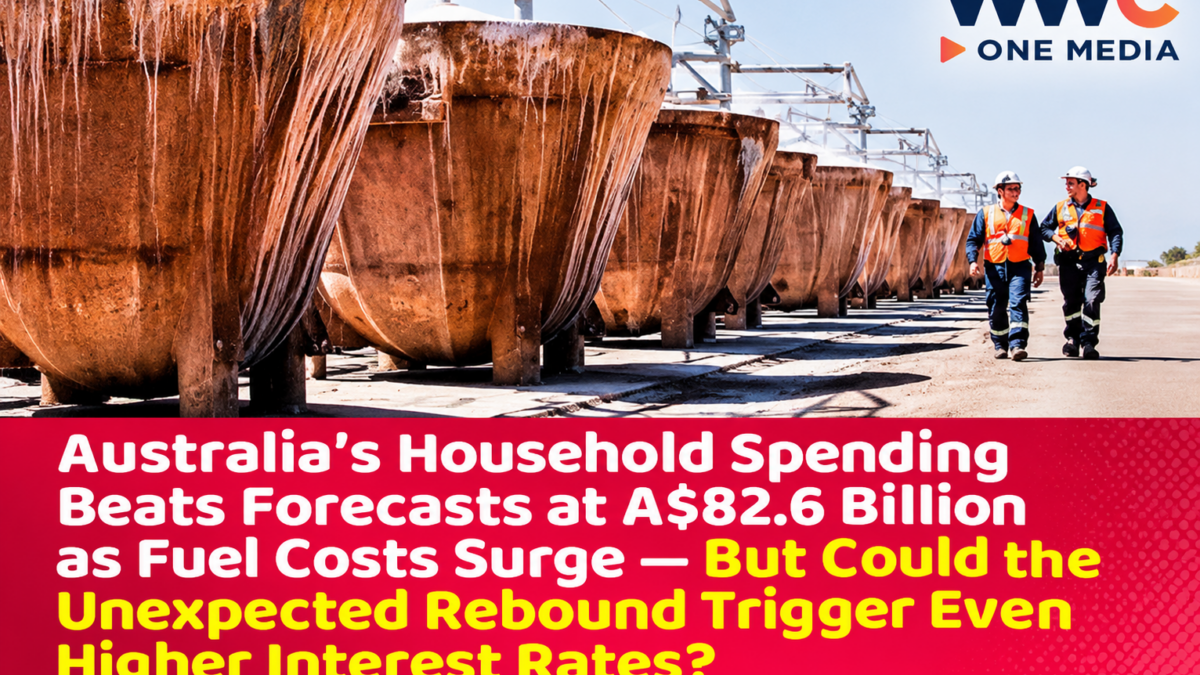
Australia’s household spending increased 0.6% in September 2026 to approximately A$82.6 billion, according to Australian Bureau of Statistics (ABS) data reported by Reuters and Bloomberg.
The result was three times the 0.2% monthly increase forecast by economists, offering fresh evidence that consumer expenditure has remained resilient despite rising borrowing costs and persistent inflation.
Annual spending growth reached 6.8%, while inflation-adjusted household spending increased 0.7% during the September quarter.
But the figures arrived just one day after the Reserve Bank of Australia (RBA) increased its benchmark interest rate to 4.85%, the highest level in approximately 18 years.
The central bank is attempting to contain inflation that has accelerated to 4.3%, well above its 2%–3% target.
The contradiction is becoming harder to ignore: Australians are spending more even as interest rates rise and fuel prices squeeze household budgets.
Could this unexpected strength convince policymakers that the economy needs further monetary tightening—or does the headline spending increase conceal a growing cost-of-living problem?
Australia’s A$82.6-Billion Spending Surprise
The September figures exceeded market expectations.
Economists had anticipated monthly household spending growth of approximately 0.2%, but the reported increase reached 0.6%.
The improvement followed weaker spending during August, when consumers were already contending with higher petrol prices and pressure on household finances.
The year-on-year increase of 6.8% suggests nominal expenditure remained elevated.
However, the distinction between nominal and real spending is particularly important.
Nominal spending measures the amount of money consumers pay, without removing the effects of inflation.
Real spending adjusts for price changes to provide a better indication of the volume of goods and services purchased.
A family spending more on petrol because fuel prices increased may contribute to stronger nominal spending even if it purchased the same quantity of fuel—or less.
This means the headline increase cannot automatically be interpreted as stronger purchasing power.
The September result nevertheless provides evidence that overall consumer spending held up better than forecasters expected.
Fuel Prices Are Driving Part of the Increase
One of the biggest pressures facing Australian households has been the cost of transportation.
The continuing Middle East conflict has disrupted international petroleum markets, contributing to higher crude prices and additional fuel-related expenses.
Australia’s earlier August spending figures already illustrated this problem.
According to the ABS, fuel spending jumped 8.1% in August following the restoration of full fuel excise duty.
Without the increase in fuel expenditure, total household spending would have fallen by 0.3% that month, according to the agency’s published analysis.
Experimental ABS estimates also suggested that the physical volume of fuel purchased declined.
This is a crucial distinction.
Households can spend more money on petrol without driving farther or consuming more fuel.
September’s stronger spending figures therefore need to be examined alongside price changes before concluding that consumers have substantially increased their discretionary purchases.
The energy-market backdrop was previously examined by WWC ONE MEDIA in its report on ANZ raising its Brent oil forecast to $105.
That report highlighted how disruptions to global petroleum supply and shipping routes could keep fuel prices elevated.
Higher energy costs create a particularly difficult environment for households because transportation is often an unavoidable expense.
Air Travel and Sporting Events Support Spending
Not all the reported spending strength was linked to essential purchases.
Reuters reported that air travel benefited from major sporting events, contributing to the broader increase in consumer expenditure.
Travel and recreation spending can provide useful evidence of discretionary demand because households generally have more flexibility over these purchases than they do over essential expenses.
However, temporary spending associated with sporting events does not necessarily indicate a lasting change in consumer confidence.
Large events can shift the timing of expenditure.
Households may spend more during one month and then reduce discretionary purchases afterward.
For economists, the question is whether September’s strength represents sustained demand or a temporary combination of higher fuel costs and event-related spending.
That distinction matters for the Reserve Bank of Australia.
RBA Raises Interest Rates to 4.85%
The stronger spending report comes immediately after the RBA’s November 3 decision to lift its cash rate target by 25 basis points to 4.85%.
The move followed another acceleration in consumer inflation.
According to the ABS, headline inflation reached 4.3% in the 12 months to September 2026.
Trimmed mean inflation, which seeks to reduce the influence of unusually large price movements, reached 3.6%.
Both exceeded the RBA’s inflation target.
The central bank said higher global energy prices and persistent domestic cost pressures were contributing to the problem.
WWC ONE MEDIA previously examined the decision in Australia Raises Interest Rates to 18-Year High of 4.85% as Inflation Surges — But Could a Housing Crash Be the Price of Victory?.
The report explored how tighter monetary policy could affect mortgage holders, housing demand and consumer spending.
The September spending data add another complication.
If consumers continue spending more than expected, the RBA may see evidence that economic demand remains resilient.
But if expenditure is rising mainly because prices are higher, the central bank must be careful not to confuse inflation-driven spending with stronger underlying consumption.
Why the Latest Data Could Complicate Interest Rate Decisions
Central banks raise interest rates to reduce inflationary pressures by making borrowing more expensive and encouraging saving.
Higher mortgage repayments and financing costs can leave households with less disposable income for other purchases.
Businesses may also delay investments when borrowing becomes more expensive.
Over time, weaker demand can reduce the pressure on companies to raise prices.
However, the effectiveness of higher interest rates depends partly on why inflation is occurring.
If prices rise because of excessive domestic demand, tighter monetary policy can help slow spending.
If prices rise because of a global oil supply disruption, higher interest rates cannot directly produce additional petroleum.
The RBA must therefore manage imported inflation while avoiding unnecessary damage to employment and economic growth.
Its November monetary policy statement warned that inflation could remain above the target range for longer than previously expected.
The central bank now anticipates a slower return to its inflation objective, with the midpoint of the target range expected around mid-2028.
That outlook reinforces the possibility of restrictive monetary policy remaining in place for an extended period.
Higher Spending Does Not Mean Households Feel Wealthier
The latest figures may appear encouraging for businesses, but many Australian consumers continue facing financial pressure.
The RBA’s November economic assessment noted that household consumption growth had slowed earlier in the year.
Real household disposable income growth had also moderated.
Meanwhile, consumer sentiment remained close to historically weak levels.
This suggests that headline expenditure and household confidence may be telling different stories.
Some Australians may continue spending because essential costs have increased.
Others may be maintaining discretionary purchases by reducing savings or changing spending priorities.
Still others may be financially comfortable enough to keep traveling, dining out and participating in leisure activities.
These different behaviors can coexist.
National spending totals do not reveal whether the financial circumstances of lower-income households are improving or deteriorating.
For that reason, economists must examine income, employment, savings and inflation-adjusted consumption alongside the headline spending figure.
Australia’s Housing Market Faces Additional Pressure
The RBA’s interest rate increases also carry implications for Australian property markets.
Higher mortgage rates generally increase borrowing costs for households with variable-rate mortgages.
They can also reduce the amount prospective homebuyers qualify to borrow.
The RBA reported that housing prices had weakened and new housing lending had fallen sharply.
In its November economic outlook, the central bank said housing prices in September were almost 5% below their March peak.
Although the household spending report suggests consumers are still making purchases, that does not mean housing affordability pressures have disappeared.
Indeed, spending more on fuel and other necessities can leave households with less money available for mortgage repayments or home deposits.
For policymakers, the risk is that persistent inflation and higher interest rates place additional pressure on an already softening housing market.
Oil Market Volatility Creates Another Inflation Threat
Australia’s consumer outlook is also closely tied to developments in international energy markets.
Oil prices have experienced significant fluctuations as investors respond to the possibility of diplomatic progress involving the United States and Iran.
WWC ONE MEDIA reported on the latest reversal in Oil Prices Crash Nearly 8% as Iran Peace Talks Send Brent to $104 — But Could One Failed Deal Trigger a $140-a-Barrel Shock?.
The report examined how renewed hopes for negotiations reduced part of the geopolitical premium in crude markets.
However, lower international oil prices do not automatically produce immediate relief at petrol stations.
Retail fuel prices depend on refined-product costs, taxes, transport expenses and the timing of adjustments.
A sustained decline could eventually ease pressure on Australian households.
But renewed disruption to Middle Eastern energy supplies could have the opposite effect.
For the RBA, this creates an additional source of uncertainty that domestic interest rates cannot directly eliminate.
What the Latest Data Mean for Asian Economies
Australia’s spending report also provides insight into the wider challenges facing economies across the Asia-Pacific region.
Several central banks are dealing with the combination of elevated energy costs, inflation and pressure on household purchasing power.
In the Philippines, the Bangko Sentral ng Pilipinas has also faced difficult decisions over inflation and monetary tightening.
WWC ONE MEDIA previously examined those pressures in BSP Has Room for More Rate Hikes as Inflation Risks From El Niño and Oil Persist.
The Philippine and Australian economies have different monetary frameworks, inflation patterns and household borrowing structures.
Their policy settings should not be treated as interchangeable.
Nevertheless, both countries illustrate the challenge of responding to price increases influenced by global energy conditions.
Higher interest rates may help manage domestic demand, but they cannot fully insulate consumers from international supply shocks.
What Other Reports Reveal
Bloomberg’s November 4 article highlighted Australia’s stronger-than-expected household spending, with fuel costs contributing to the increase.
Reuters separately reported the 0.6% September rise, the A$82.6-billion spending total, the 0.2% market forecast and the 6.8% annual increase.
The Australian Bureau of Statistics’ earlier spending reports show how fuel-price increases affected nominal expenditure, particularly in August.
The RBA’s November monetary policy statement provides important context about inflation, borrowing costs, consumer demand and the economic outlook.
These sources reinforce the main conclusion: Australian household spending has remained resilient in dollar terms, but the figures should not be interpreted as evidence that the cost-of-living crisis has ended.
The precise balance between inflation-driven spending and genuine growth in consumption remains critical.
The Bigger Question: Is Australia Spending Its Way Into More Rate Hikes?
Australia’s September household spending figures present a difficult economic puzzle.
Consumers spent A$82.6 billion, exceeding economists’ expectations.
The monthly increase of 0.6% suggests that expenditure remained stronger than anticipated despite higher borrowing costs.
Yet fuel prices, inflation and mortgage pressures continue squeezing household finances.
The RBA has already raised its benchmark interest rate to 4.85% and warned that inflation may remain elevated for longer.
For policymakers, the immediate challenge is determining whether the latest spending figures signal genuine economic resilience or simply reflect households paying more for essential purchases.
For businesses, the result offers some encouragement about customer demand, but also highlights the risk that consumers may eventually reduce discretionary spending.
For households, the most important issue is whether wages and income can keep pace with rising costs.
The Bottom Line
Australia’s stronger-than-expected household spending provides fresh evidence of an economy that has not yet experienced a broad collapse in consumer expenditure.
But higher spending alone does not prove that Australians are financially better off.
With inflation running at 4.3%, interest rates at 4.85% and global fuel costs remaining volatile, the country faces a difficult balancing act.
As Australians continue spending more despite expensive fuel and higher mortgage costs, will the surprise rebound convince the Reserve Bank to keep tightening monetary policy—or could the apparent consumer strength be masking a deeper cost-of-living crisis waiting to emerge?