MANILA, Philippines — November 4, 2026 | WWC ONE MEDIA | Philippine News, Energy & Government Accountability
A collapsed electricity transmission tower in Cavite has triggered fresh scrutiny of the National Grid Corporation of the Philippines (NGCP), raising questions about construction safety, contractor qualifications and the protection of the country’s critical power infrastructure.
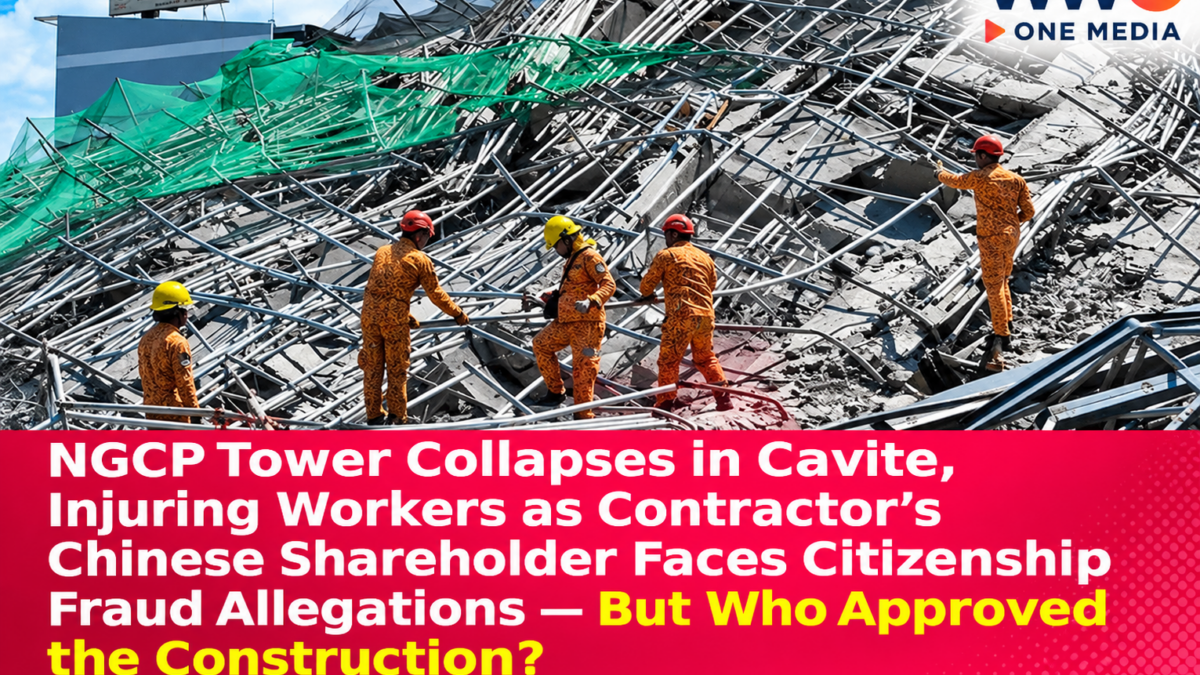
The incident occurred on October 31, 2026, in Barangay Guyam Malaki, Indang, Cavite, where a transmission structure collapsed shortly before 1 p.m., reportedly injuring several construction workers and damaging a nearby structure.
But the controversy has taken another turn.
According to a November 3 investigation by Bilyonaryo News Channel (BNC), the contractor identified as responsible for constructing the tower is Maxipro Development Corporation, a company whose president and majority shareholder, Lawrence Ke Sy, was arrested earlier this year over allegations that he misrepresented himself as a Filipino citizen.
Corporate records reviewed by BNC reportedly show that Sy owned 88.8% of Maxipro in 2026.
The company has also listed 17 NGCP projects on its website, including 11 completed and six ongoing developments.
These revelations have renewed questions about how contractors are selected to build infrastructure essential to the Philippines’ electricity supply.
But as investigators determine what caused the Cavite tower collapse, a larger question is emerging: were the country’s contractor screening, engineering inspections and construction safeguards strong enough to identify potential problems before workers were injured?
NGCP Tower Collapses in Indang, Cavite
The October 31 incident unfolded in a residential area of Barangay Guyam Malaki.
Residents interviewed by Bilyonaryo News Channel described hearing loud metallic noises before seeing sections of a transmission structure and its cables fall.
One witness said a portion of a more distant tower appeared to give way before another structure collapsed near an adjoining property.
Several workers were reportedly injured.
Witnesses described workers suffering apparent fractures, while others were left suspended by their safety harnesses.
However, the precise number of injured workers, the severity of their injuries and their medical conditions have not yet been officially confirmed in the reports reviewed.
These details remain important because investigations into industrial accidents must consider both structural safety and worker protection.
The tower was reportedly completed approximately a year earlier, while some transmission cables had been installed only one to one and a half months before the incident.
The timeline raises engineering questions, but it does not establish what caused the collapse.
Residents Question Whether Substandard Steel Was Used
Following the accident, witnesses questioned the strength of the steel components used in the transmission structure.
One resident interviewed by BNC expressed concern that the materials might have been insufficient to withstand the loads placed on the tower.
The allegation quickly attracted attention because electricity transmission towers must withstand significant mechanical forces.
Their structural requirements depend on several factors, including tower geometry, conductor loads, wind conditions, foundation performance and installation procedures.
However, determining whether a particular tower failed because of defective steel requires engineering evidence.
Investigators would need to examine material specifications, construction drawings, load calculations, installation records and physical evidence recovered from the site.
Possible contributing factors could include structural design, fabrication, foundation conditions, erection procedures or cable installation.
These are investigative possibilities, not findings about the Cavite incident.
As of November 4, there is no publicly verified technical conclusion establishing that substandard materials, contractor negligence or faulty construction caused the collapse.
The distinction is essential.
A witness’s suspicion may justify closer examination, but it cannot replace an official engineering investigation.
Maxipro Development Corporation Identified as Contractor
According to BNC, a source familiar with the project identified Maxipro Development Corporation as the contractor behind the collapsed structure.
Maxipro is involved in power infrastructure construction, including transmission lines and substations.
The company has reported substantial involvement in NGCP projects.
Its website lists 17 transmission-related projects, with 11 marked completed and six ongoing.
Among the projects previously identified in reporting about Maxipro are the Mindanao-Visayas Interconnection Project, the Eastern Albay Line Project Stage 1 and the Cebu-Negros-Panay Backbone Project Stage 3.
Those projects involve important components of the national electricity network.
However, Maxipro’s reported participation in these developments does not establish that any of its other projects contain defects.
Each project’s performance would require separate evaluation.
The immediate question is whether the construction, inspection and acceptance procedures associated with the collapsed Cavite tower complied with applicable technical and contractual requirements.
Contractor’s Majority Shareholder Was Arrested in June
The controversy surrounding Maxipro predates the Cavite accident.
On June 27, 2026, the Bureau of Immigration arrested Lawrence Ke Sy over allegations that he had misrepresented himself as a Filipino citizen.
The arrest was publicly reported in August.
According to immigration authorities cited by BNC and the South China Morning Post, investigators discovered Philippine identification documents that they suspected had been fraudulently obtained.
These reportedly included a Philippine passport, birth certificate, marriage certificate and records associated with other government agencies.
Authorities also identified an Alien Certificate of Registration Identity Card issued in 2009 that listed Sy as a Chinese national born in Fujian, China.
The Bureau of Immigration said the case involved alleged misrepresentation of citizenship.
However, the legal status and final disposition of the proceedings were not established in the November 3 reporting.
An arrest is not proof of criminal guilt.
More importantly, the citizenship allegations have not been shown to have caused, contributed to or otherwise explained the tower collapse.
They are a separate issue that may be relevant to contractor ownership, eligibility and due diligence.
Corporate Records Show an 88.8% Ownership Stake
BNC reported that Maxipro’s 2026 General Information Sheet filed with the Securities and Exchange Commission identified Lawrence Ke Sy as the company’s president and majority shareholder.
According to the documents reviewed by the news organization, Sy owned 88.8% of the company’s shares in 2026.
His reported ownership stake was 98.8% in the company’s 2025 filing.
The figures raise questions about the company’s ownership history and whether its corporate records and representations complied with applicable laws.
However, the nationality of a shareholder does not by itself establish that a company is operating illegally.
Ownership restrictions depend on the nature of the business, the relevant statutory requirements and the specific activities involved.
Any finding that Maxipro violated foreign ownership or corporate registration rules would require examination by the appropriate authorities.
The SEC previously indicated that its enforcement office was prepared to cooperate with law enforcement agencies concerning Maxipro if formally requested.
The available reporting does not establish a final SEC ruling against the company over these allegations.
Maxipro’s Project Portfolio Raises Contractor Vetting Questions
The combination of the tower collapse and the earlier immigration investigation has intensified scrutiny of NGCP’s contractor selection procedures.
For critical power infrastructure, contractor evaluation can involve technical qualifications, financial capacity, professional licensing, construction experience and compliance with relevant laws.
Engineering firms may also be subject to performance monitoring, site inspections, quality assurance procedures and contractual obligations.
But the key issue is not simply whether a contractor has experience building transmission facilities.
It is whether all applicable requirements were satisfied when the contract was awarded and during construction.
Questions that may require examination include whether ownership information was verified, whether materials complied with approved specifications and whether construction inspections were properly documented.
The available reporting does not establish that NGCP knowingly engaged an ineligible contractor.
Nor does it establish that a deficiency in ownership verification contributed to the structural failure.
Those matters remain separate investigative questions.
Why NGCP’s Role Matters to Philippine Electricity Consumers
NGCP operates and maintains the Philippine electricity transmission network under a long-term concession arrangement.
The transmission system carries electricity from power plants to distribution utilities and other customers across the country.
NGCP’s shareholders include Filipino investors associated with Henry “Big Boy” Sy Jr. and China’s State Grid Corporation.
Because transmission infrastructure is essential to economic activity, construction standards and operational reliability are matters of public interest.
A defective or delayed transmission project can potentially affect grid connections, system capacity and electricity reliability.
However, the Cavite collapse has not been shown in the reviewed reporting to have caused a widespread power outage.
It would therefore be inaccurate to attribute unrelated electricity interruptions to this incident.
The immediate consequences involve the reported injuries, damage and questions about construction integrity.
The wider significance concerns the safeguards applied to infrastructure that supports the national electricity network.
Government Is Already Reviewing NGCP’s Transmission Responsibilities
The Cavite incident comes as Philippine authorities examine how critical transmission infrastructure is developed and delivered.
In October, the Department of Justice issued an opinion affirming that the government can establish frameworks allowing qualified third parties to participate in building transmission facilities without automatically invalidating NGCP’s concession agreement.
WWC ONE MEDIA previously reported on the development in DOJ Opinion Allows Third Parties to Build Power Transmission Projects Despite NGCP Concession.
The opinion responded to government concerns about delays affecting important power infrastructure projects.
However, the DOJ opinion was not a ruling on the Cavite collapse or Maxipro.
Its relevance lies in the broader question of how transmission construction responsibilities and oversight can be organized.
Allowing additional qualified companies to participate may increase construction capacity.
But it also reinforces the importance of ensuring that contractor eligibility, engineering standards and accountability remain consistent.
Previous Grid Failures Have Already Triggered Congressional Scrutiny
NGCP’s performance has attracted attention from lawmakers on other occasions.
In May 2026, the House of Representatives announced a proposed investigation into major transmission-line tripping events that contributed to power interruptions across parts of Luzon and the Visayas.
House Resolution No. 1024 called for scrutiny of the May 13 tripping of the Tayabas-Ilijan and Dasmariñas-Ilijan transmission lines.
According to the House announcement, the disruption involved the sudden loss of more than 2,462 megawatts and affected approximately 3.9 million customers.
Those events were separate from the October Cavite tower collapse.
They nevertheless help explain why transmission reliability and operational oversight remain important public policy issues.
The House’s concerns focused on whether the country’s infrastructure systems were sufficiently reliable to support electricity demand.
The Cavite incident adds construction safety and contractor accountability to that wider discussion.
Grid Reliability Remains a National Challenge
The Philippines has also experienced electricity supply alerts involving the Visayas and Mindanao grids.
WWC ONE MEDIA examined those problems in Visayas and Mindanao Are Back Under Red Alert — But the Bigger Test Comes When the Next Power Plant Goes Offline.
That report described power supply pressures arising from generation outages and limited available capacity.
Those conditions should not be confused with the structural collapse in Cavite.
Generation shortages and transmission construction failures have different immediate causes.
Nevertheless, both demonstrate the importance of maintaining a reliable electricity system.
New transmission projects must be delivered efficiently, but speed cannot come at the expense of construction quality or worker safety.
Renewable Energy Expansion Makes Transmission Infrastructure More Important
The Philippines is expanding renewable energy development, increasing the importance of reliable grid connections.
Solar and wind projects frequently require new transmission facilities before they can deliver electricity to customers.
Delays in connecting generation facilities can prevent new capacity from reaching the market.
But new infrastructure must also meet demanding engineering requirements.
WWC ONE MEDIA previously examined another dimension of grid management in NGCP Wants Rooftop Solar Tracked as Unrecorded Systems Raise Grid Stability Concerns.
That report focused on NGCP’s concerns about incomplete information on distributed solar installations.
Although it addressed a different issue, it highlights the increasing complexity of managing the Philippine electricity network.
For transmission operators and contractors, technical reliability becomes more important as additional energy sources and infrastructure are integrated into the grid.
Could Weak Construction Oversight Become an Energy Security Risk?
The Cavite accident also raises a broader question about the security of critical infrastructure.
Power transmission towers are not ordinary commercial structures.
Their failure can pose risks to workers, nearby properties and, depending on the circumstances, electricity operations.
This makes engineering standards, materials verification and construction supervision essential.
Contractors working on such facilities need to demonstrate that their work meets approved specifications.
Project owners and operators must also maintain appropriate inspection and acceptance procedures.
However, security concerns should not be confused with evidence of deliberate wrongdoing.
The Cavite collapse has not been established as sabotage.
There is no verified evidence connecting the citizenship allegations against Maxipro’s shareholder to intentional damage to the power grid.
The proper focus is on determining what actually failed and whether any preventable violations occurred.
Financial Accountability Also Matters
The controversy arrives while energy regulators are examining costs and responsibilities across the transmission and electricity markets.
WWC ONE MEDIA previously reported on ERC Freezes Power Reserve Market as Visayas Electricity Costs Explode — But Will Filipino Consumers Finally Get Relief?.
That separate regulatory action concerned reserve-market costs rather than the Cavite tower.
Its relevance is the principle that electricity-sector expenditures and operating arrangements remain subject to regulatory scrutiny.
When transmission infrastructure is funded or recovered through regulated charges, questions about prudence, compliance and proper completion can carry financial implications for the wider system.
However, no publicly verified finding has established that the Cavite project’s costs were improperly recovered from electricity consumers.
Any such conclusion would require project-specific financial and regulatory evidence.
What Other News Outlets Confirm
Bilyonaryo’s November 3 report identified Maxipro as the contractor linked to the collapsed tower, citing a BNC source.
BNC published a more detailed eyewitness account describing the collapse in Barangay Guyam Malaki, the reported worker injuries and concerns about construction materials.
Abante TNT separately covered the incident, including the October 31 date, witness accounts and the fact that an investigation had not yet produced an official conclusion.
The South China Morning Post independently reported in August on Lawrence Ke Sy’s arrest and his association with Maxipro, citing Philippine immigration authorities.
BNC also previously reviewed Maxipro’s corporate filings, reporting an 88.8% ownership stake in 2026 and the company’s involvement in numerous NGCP projects.
These reports establish the separate elements of the controversy.
However, the specific identification of Maxipro as the Cavite project’s contractor still relies primarily on BNC’s sourcing.
No publicly available engineering report was located establishing the cause of the failure.
The reviewed reporting also does not establish a final judicial decision on the citizenship allegations.
Five Questions That Need Answers
The investigation should address several distinct issues.
First: What caused the transmission tower to collapse?
A technical examination must determine whether design, materials, foundations, installation procedures or other factors contributed to the failure.
Second: Were the appropriate inspections and acceptance procedures completed?
Investigators should review construction records, testing results and relevant project documentation.
Third: What is the confirmed number and condition of injured workers?
Authorities should clarify the occupational safety consequences and whether required precautions were observed.
Fourth: Did Maxipro satisfy all applicable contractor eligibility and ownership requirements?
This question requires examination of corporate records, licensing and the unresolved citizenship allegations.
Fifth: What corrective measures will prevent a similar accident?
Any recommendations should be based on established technical and administrative findings rather than speculation.
The Bottom Line: Contractor Accountability Is Now Under the Spotlight
The collapse of an NGCP transmission structure in Indang, Cavite, has raised serious questions about construction safety and contractor oversight.
The reported involvement of Maxipro Development Corporation has attracted additional scrutiny because its majority shareholder previously faced allegations of misrepresenting his citizenship.
But these issues must not be conflated.
The cause of the tower collapse remains undetermined.
The citizenship allegations are subject to separate legal proceedings.
And the available evidence does not establish that NGCP, Maxipro or any individual deliberately caused the accident.
What the incident does establish is the need for a thorough, transparent investigation that addresses the safety of workers and the reliability of infrastructure.
For NGCP, the challenge is demonstrating that contractor qualification procedures and construction safeguards are rigorous enough to protect critical power facilities.
For government regulators, the challenge is ensuring that accountability follows verified findings.
The Philippines is investing heavily in infrastructure needed to keep electricity flowing across the country. But when a transmission tower collapses and its contractor becomes the subject of separate legal scrutiny, public confidence depends on answers—not assumptions.
Will the Cavite investigation uncover a preventable engineering failure, deficiencies in contractor oversight or an unforeseen structural problem—and will NGCP and regulators act decisively once the evidence is established?