
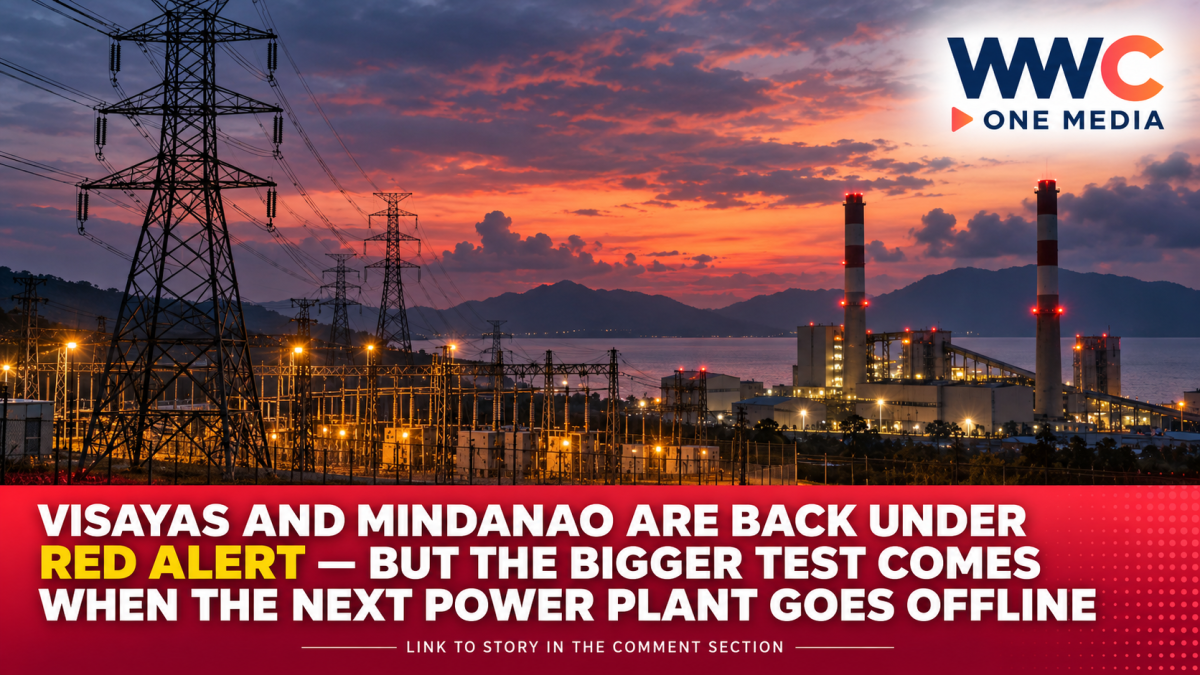
MANILA — Electricity supplies in the Visayas and Mindanao came under severe pressure again as prolonged power-plant outages and reduced generating capacity pushed both grids into red-alert conditions, raising the threat of rotational brownouts across large parts of the central and southern Philippines.
The National Grid Corporation of the Philippines (NGCP) placed the Visayas grid under red alert from 1 p.m. to 10 p.m. on September 9, with a yellow alert following from 10 p.m. to 11 p.m. The grid had only about 2,124 megawatts of available capacity against projected peak demand of 2,555 MW.
That meant the Visayas was entering its highest-demand hours with hundreds of megawatts less generation than consumers were expected to require — before even accounting for the reserves needed to keep the system stable when another generating unit suddenly fails.
Among the biggest problems were the continued unavailability of Therma Visayas Inc. Unit 1 and Panay Energy Development Corp. Unit 3. Therma Visayas Unit 2 also went offline during the day, while electricity imports from Mindanao remained constrained.
NGCP reported that 11 Visayas generating plants were already on forced outage in September. Several other units had been unavailable for months or even years, while more than a dozen plants were operating below their normal rated capacity.
Combined, outages and derated operations removed roughly 982.6 MW from the Visayas grid — an enormous loss for a system whose peak demand was forecast at just over 2,500 MW.
Mindanao also loses its safety margin
Mindanao initially faced tight reserves, but conditions deteriorated during the day.
NGCP’s updated advisory placed the Mindanao grid under red alert from 2 p.m. to 4 p.m. and again from 5 p.m. to 8 p.m. Yellow-alert periods covered noon to 2 p.m., 4 p.m. to 5 p.m., and 8 p.m. to 10 p.m.
Available capacity stood at about 2,641 MW against expected peak demand of 2,591 MW — leaving only a narrow buffer once the system’s regulating and contingency requirements were considered.
Mindanao was also dealing with multiple generating-unit problems. NGCP cited reduced generating capacity from thermal, diesel and hydroelectric facilities, while numerous plants remained on forced outage or were running below their full capabilities.
Eight plants were operating at derated capacity, while the overall unavailable capacity in Mindanao reached about 827.7 MW, according to NGCP data reported by GMA News.
The situation matters beyond Mindanao itself.
The Visayas increasingly depends on electricity transfers through the interconnected national grid when its own generating capacity becomes insufficient. But when Mindanao is struggling with shortages of its own, it has less surplus electricity available to send north — removing an important safety valve for the Visayas.
Why a red alert matters
A yellow alert does not automatically mean consumers will lose electricity. It means the grid no longer has enough operating margin to satisfy its required contingency reserve.
A red alert is more serious. It is declared when available supply is insufficient to meet consumer demand together with the transmission system’s regulating requirement.
If the shortage becomes severe enough, NGCP may order manual load dropping, forcing distribution utilities and electric cooperatives to temporarily cut electricity in selected areas to prevent instability from spreading across the grid.
For households and businesses in the Visayas, such interruptions are no longer an isolated event.
DOE data showed that from January through September 7, the Visayas had already recorded 96 yellow alerts and 33 red alerts, while Mindanao recorded 12 yellow and three red alerts over the same period.
DOE races to bring major plants back
The Department of Energy is now trying to restore enough generating capacity to ease the pressure.
Energy Secretary Sharon Garin said several large generating units are scheduled to return to service over the coming weeks.
Cebu Energy Development Corp. Unit 1 returned to operation on September 5. Therma Visayas Unit 1, with about 169 MW of capacity, was targeted to return on September 15, while the 150-MW PEDC Unit 3 in Iloilo was scheduled for October 3.
In Mindanao, the DOE identified Therma South and GNPower Kauswagan units among the plants expected to return, potentially giving Mindanao more breathing room and eventually allowing more electricity to flow toward the Visayas.
The government is also working with private generators to deploy about 253 MW of battery energy storage capacity across Cebu, Panay, Negros and Leyte. DOE simulations indicate that this additional reserve could eliminate more than half of the Visayas grid’s recent red and yellow alerts if the facilities become consistently available.
Consumers could feel the crisis in their bills, too
The supply squeeze is not only creating blackout risks.
It is also hitting wholesale electricity prices.
Independent Electricity Market Operator of the Philippines data showed average Wholesale Electricity Spot Market prices in the Visayas climbed 64.9 percent to P18.59 per kilowatt-hour in August, while Mindanao prices surged 88.2 percent to P19.56 per kWh.
Those were described as the highest levels recorded since the Philippine spot market began commercial operations in 2006.
That raises a second concern for consumers: even if electricity remains available, prolonged shortages can increase the cost of power purchased from the spot market and potentially feed into future electricity bills, depending on the supply contracts and purchasing mix of individual distribution utilities.
The immediate battle is therefore no longer simply about keeping the lights on.
The real test will be whether major generating units return on schedule, battery reserves arrive fast enough, and Mindanao regains enough surplus capacity to support the Visayas — before another major plant failure pushes the interconnected grids back toward the brink.




Leave a Reply