
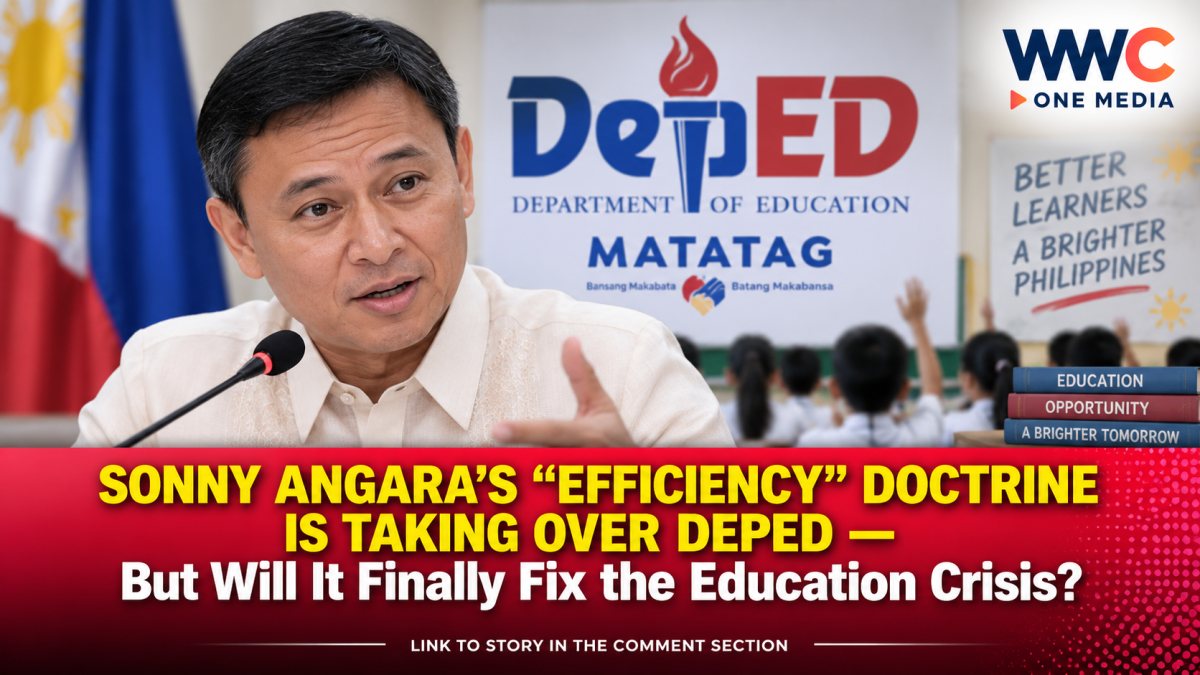
MANILA, Philippines — Education Secretary Juan Edgardo “Sonny” Angara is putting a strong emphasis on one word as the Department of Education (DepEd) pushes through a broad reform agenda: efficiency.
The approach is increasingly visible in how DepEd is tackling some of the country’s most persistent education problems—from classroom shortages and learning gaps to teacher support, digital transformation and the delivery of programs to millions of learners.
The strategy comes at a critical time. The Philippines continues to face major challenges in basic education, while the latest international assessments have underscored the need for sustained improvements in learning outcomes. InsiderPH has highlighted Angara’s push to make the department’s enormous bureaucracy more responsive and execution-focused.
“EFFICIENCY IS NOT OPTIONAL”
One of the clearest expressions of Angara’s approach came during a February 2026 presentation to business leaders, where he argued that efficiency should be treated as an essential requirement—not simply an administrative preference.
“Efficiency is not optional. It is a moral imperative,” Angara said while discussing DepEd’s plans to use public-private partnerships to accelerate school construction.
The statement captures a larger strategy: instead of relying exclusively on conventional government procurement and processes, DepEd is looking for ways to shorten timelines and bring outside partners into areas where the government faces capacity constraints.
THE CLASSROOM SHORTAGE IS ONE OF THE BIGGEST TESTS
One of Angara’s biggest challenges is infrastructure.
DepEd has identified a classroom shortage of more than 100,000 rooms, with InsiderPH reporting a deficit of around 165,000 classrooms in the broader education-system diagnosis.
To address the backlog, DepEd is pursuing Public-Private Partnership for School Infrastructure Projects (PSIP) III, IV and V, which together target roughly 106,000 classrooms.
The first 16,000 classrooms under PSIP III have already received approval, according to InsiderPH.
The logic is straightforward: if conventional procurement can require years and thousands of individual procurement processes, a bundled PPP approach could potentially deliver infrastructure at greater speed and scale.
That is where Angara’s efficiency doctrine faces its first major real-world test.
LEARNING RECOVERY IS ANOTHER PRIORITY
Infrastructure, however, is only one piece of the problem.
DepEd has also been concentrating on foundational learning, particularly reading and early-grade education.
The department’s Academic Recovery and Accessible Learning (ARAL) Program has become a major part of that effort. An independent evaluation cited by the Philippine Daily Inquirer reported that during School Year 2025–2026, the program was associated with 4.5 million fewer struggling readers and 2.5 million more learners reaching grade-level readiness.
DepEd is now looking to refine the program rather than simply expand it mechanically, including better learner grouping, protected classroom time for literacy and a stronger emphasis on teacher coaching.
That is another important element of Angara’s approach: use data to determine which interventions are actually producing results, then adjust implementation.
TEACHERS ARE ALSO PART OF THE EQUATION
Angara’s reforms extend beyond students.
DepEd has been implementing the Expanded Career Progression (ECP) program to give teachers greater opportunities for advancement.
According to the Philippine Information Agency, Angara said around 81,000 teachers had already been promoted through the program since 2022, with another 25,000 promotions awaiting processing by the Department of Budget and Management.
For a department employing hundreds of thousands of teachers, improving career pathways is potentially significant—not only for morale but also for retaining experienced educators.
DIGITALIZATION AND AI ENTER THE PICTURE
DepEd is also moving toward greater use of technology and artificial intelligence.
The department has been developing the Education Center for AI Research (ECAIR) to support evidence-based policymaking and system-wide reforms.
The broader digital strategy is designed to make education management more data-driven, while reducing inefficiencies in how information and interventions move through the country’s massive school system.
The challenge will be making sure technology becomes a tool for reducing bureaucracy, rather than another layer of paperwork for teachers and school heads.
DEPED IS ALSO CHANGING HOW THE SCHOOL YEAR WORKS
For School Year 2026–2027, DepEd introduced several major reforms, including a three-term school calendar, new learning-continuity policies for emergencies, revised lesson planning and learning design, updated assessment and grading policies, and the nationwide rollout of the strengthened Senior High School curriculum.
DepEd says the three-term calendar is intended to improve lesson pacing while creating more room for consolidation, remediation and enrichment.
The agency estimates that its package of reforms could affect more than 26 million learners and nearly 900,000 teachers nationwide.
BUT THERE IS A MAJOR OBSTACLE: MONEY
Efficiency can make government programs faster—but it cannot eliminate the need for resources.
That reality became clear this week when Angara acknowledged that DepEd’s proposed 2027 budget of ₱975.96 billion may not be enough for the Philippines to catch up with other Southeast Asian countries in education quality.
The proposed amount is lower than DepEd’s actual 2026 allocation of about ₱1.012 trillion, although it remains higher than the department’s original 2026 National Expenditure Program allocation.
Angara has said DepEd will prioritize foundational learning under the proposed budget, including reading among young children.
But lawmakers have also raised concerns about reductions in several programs, including school-based feeding, infrastructure, textbooks and instructional materials.
That creates a delicate balancing act for Angara.
The department is being asked to do more with limited resources—while simultaneously being expected to deliver faster and better results.
WHY ANGARA’S EFFICIENCY DOCTRINE MATTERS
The education crisis cannot be solved by one program.
It requires classrooms, teachers, learning materials, nutrition, technology, effective curriculum, reliable data and—perhaps most importantly—consistent implementation.
Angara’s approach attempts to connect those pieces under a broader strategy: identify bottlenecks, simplify processes, bring in partners where government capacity is limited, measure results and redirect resources toward interventions that work.
But the ultimate measure will not be the number of reforms announced.
It will be whether Filipino children actually learn more, read better and leave school better prepared for work and further education.
And that is where the real test of Angara’s efficiency doctrine begins.



Leave a Reply