NEW YORK, UNITED STATES / MANILA, PHILIPPINES — November 5, 2026 | WWC ONE MEDIA | Global Business, US Politics, Real Estate, Taxation and Legal Affairs
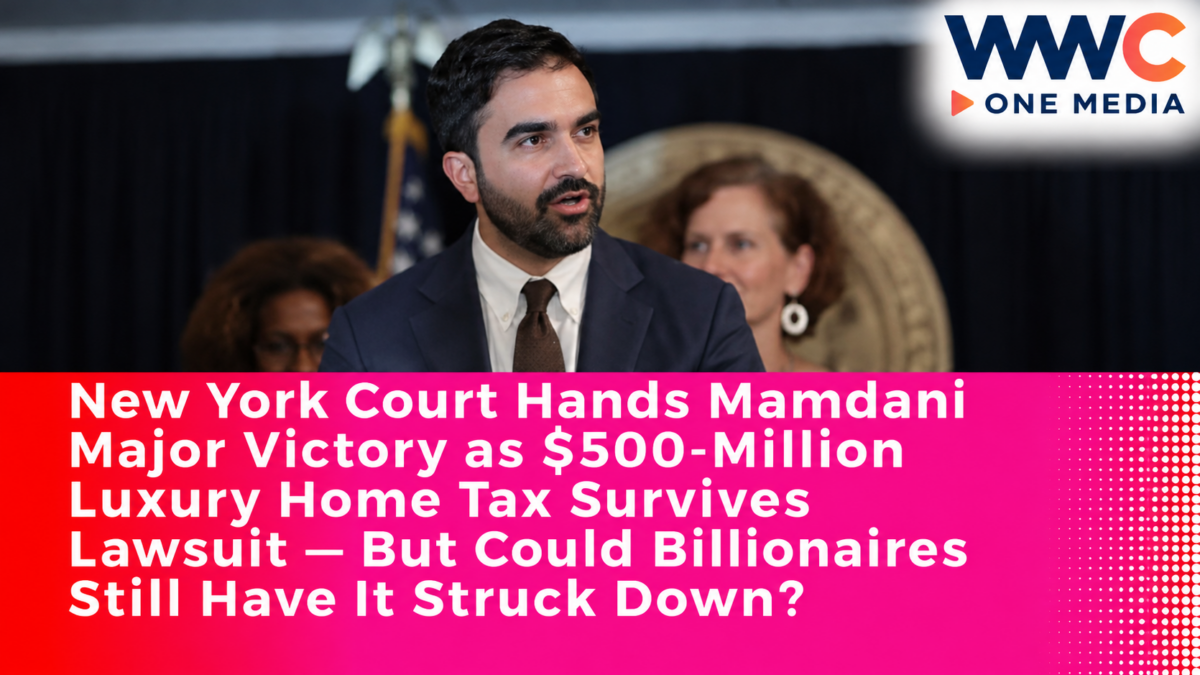
New York City Mayor Zohran Mamdani has secured a major courtroom victory in his campaign to tax expensive second homes after a state appeals court dismissed a lawsuit challenging the rollout of the city’s controversial pied-à-terre surcharge.
The November 4 decision allows New York to continue implementing a tax that Mamdani says could generate approximately $500 million annually from qualifying luxury properties.
But the ruling does not guarantee that the money will materialize—or that the tax will ultimately survive.
According to Bloomberg’s November 4 report, Appeals Court Dismisses Suit Over NYC Pied-A-Terre Tax Rollout, a four-judge appellate panel in Brooklyn unanimously overturned a lower-court decision that had challenged the way city officials identified and notified potentially affected property owners.
The judges concluded that the homeowners who brought the lawsuit lacked legal standing because they failed to demonstrate that the city’s administrative procedures had caused them a sufficiently concrete injury.
The decision reverses a significant September setback for Mamdani’s administration.
However, separate constitutional lawsuits remain pending, including challenges associated with billionaire casino developer Steve Wynn and former US Commerce Secretary Wilbur Ross.
Those lawsuits raise broader questions about whether New York can lawfully impose an additional property-tax burden based on a home’s value and its use as a secondary residence.
The stakes are substantial.
City officials initially sent approximately 17,000 notices to potentially affected property owners and published a supplemental property roll containing information on roughly 900,000 properties.
Meanwhile, New York’s comptroller has estimated that the tax could raise up to $380 million annually, below the mayor’s $500-million projection.
The biggest question now is whether Mamdani’s victory will pave the way for a lasting new source of public revenue—or whether wealthy property owners can still defeat the tax in a more consequential constitutional battle.
New York Appeals Court Dismisses Lawsuit Over Luxury Second-Home Tax
The Appellate Division of the New York Supreme Court, Second Department, ruled on Wednesday that seven homeowners challenging the tax’s implementation had not demonstrated the legal injury necessary to bring their case.
The unanimous decision reversed a September 29 judgment issued by Staten Island Supreme Court Justice Wayne Ozzi.
Ozzi had concluded that New York City improperly handled aspects of its tax rollout, including the publication of a supplemental property list and the requirement that homeowners seek exemptions.
He ordered the city to redo key parts of its implementation process.
However, the city challenged that ruling, and the appellate court had previously stayed the lower court’s orders.
The November 4 decision went further by dismissing the underlying administrative lawsuit.
The appellate judges concluded that receiving a notice about possible tax liability does not, by itself, amount to a legally sufficient injury.
They also rejected the argument that appearing on a publicly available property list automatically establishes harm.
The ruling is a significant victory for City Hall.
But it is essential to understand its limits.
The court decided whether these plaintiffs had standing to pursue their particular claims. It did not issue a final ruling approving every aspect of the tax’s underlying constitutionality.
What Is New York City’s Pied-à-Terre Tax?
A pied-à-terre is a home maintained primarily as a secondary residence rather than an owner’s main place of residence.
In New York, that might include a luxury Manhattan condominium used during occasional business trips, a high-value apartment maintained for part-time visits or another qualifying residence whose primary occupant lives elsewhere.
The new surcharge targets certain expensive properties that do not qualify as primary residences.
Under the applicable rules, the principal valuation thresholds include:
- One-, two- and three-family homes valued at $5 million or more.
- Condominiums and cooperative apartments valued at $1 million or more.
The relevant values are determined under the city’s property-tax assessment rules.
Importantly, owning a property above one of those thresholds does not automatically mean a homeowner owes the surcharge.
The property’s use, ownership circumstances and applicable exemptions also matter.
An eligible property serving as a primary residence may qualify for relief even if its assessed value exceeds the threshold.
The tax was enacted through New York state legislation signed by Governor Kathy Hochul in May 2026 and has become a signature component of Mamdani’s effort to increase revenue from high-value property ownership.
Seven Homeowners Challenge the City’s Implementation
The legal dispute began when homeowners objected to New York City’s method of identifying properties that might be subject to the surcharge.
The Department of Finance published a supplemental roll containing information on approximately 900,000 properties.
It also sent notices to roughly 17,000 homeowners indicating that they might be subject to the new tax.
The plaintiffs argued that the system unfairly shifted the burden onto owners to prove that their homes were exempt.
They maintained that some recipients were being asked to establish primary-residence status even though city officials could have used government records to make more accurate initial determinations.
The homeowners also raised concerns about the public release of property information.
Justice Ozzi initially agreed that the rollout was flawed.
But the appeals court concluded that the plaintiffs had not shown enough concrete harm to challenge the process in this case.
The distinction is important: a government process can be controversial or confusing without every affected person necessarily possessing the legal standing required to sue.
Court Rules Tax Notices Alone Are Not Proof of Injury
One of the central issues was whether receiving a notice from the Department of Finance constituted a legal injury.
The appellate panel determined that the notices served an informational purpose.
They did not establish that each recipient owed the tax.
Nor did they automatically create a legally enforceable financial obligation against someone whose property was exempt.
The court also considered the homeowners’ complaints about the time and expense of applying for exemptions.
It found that the plaintiffs had not adequately documented or quantified those costs.
Ordinary administrative burdens associated with tax compliance were insufficient, on the record presented, to establish the required injury.
The judges also noted that property-assessment information is already routinely published by New York authorities.
The homeowners had not shown that the supplemental publication caused actual misuse of their personal information or another sufficiently specific injury.
These conclusions formed the basis for the dismissal.
They did not necessarily resolve every question about the accuracy or fairness of the underlying administrative procedures.
Five Homeowners Receive Exemptions as Court Examines Their Claims
The appellate decision also examined the circumstances of the seven plaintiffs.
According to Fortune’s detailed review of the ruling, two homeowners did not allege that they had received notices.
The other five received exemptions after filing their lawsuit.
The city argued that the exemptions made the dispute moot.
However, the appellate court did not accept every argument presented by City Hall.
Instead, it dismissed the lawsuit on the narrower ground that the homeowners had not demonstrated sufficient legal standing.
The panel also declined to resolve whether the Department of Finance acted improperly in selecting some notice recipients using particular tax records.
That means the decision should not be characterized as a sweeping judicial declaration that the city’s rollout was flawless.
The immediate legal outcome is that this particular challenge has been dismissed.
Mamdani Celebrates Victory Over Luxury Property Owners
Mamdani welcomed the ruling as a victory for his economic agenda.
The Democratic mayor has argued that owners of expensive secondary residences should contribute more toward the public services that support New York’s economy and quality of life.
His administration says the surcharge could help fund services such as street maintenance, parks and other municipal priorities.
Supporters frame the tax as an effort to distribute the costs of maintaining the city more fairly.
They argue that wealthy owners may benefit from New York’s infrastructure and property market while using their residences only occasionally.
Opponents reject the implication that second-home owners are failing to contribute.
They point out that these owners already pay existing property taxes and may support local businesses through their spending and investments.
The disagreement reflects a broader political conflict over how cities should raise revenue and whether additional taxation of high-value real estate is an effective approach.
Wealthy Homeowners Warn of Unfair Tax Treatment
Attorney Randy Mastro, who represents homeowners challenging the surcharge, criticized the appellate decision.
He argued that the court had resolved the case on a procedural issue rather than addressing what he considers flaws in the city’s rollout.
The homeowners’ position is that people who do not owe the tax should not face unnecessary administrative burdens simply because the city issued broadly targeted notices.
Property owners and real-estate industry representatives have also raised concerns about how the surcharge could influence the luxury housing market.
Additional recurring taxes can increase the cost of maintaining second homes.
That may affect decisions about purchasing, selling or renting expensive properties.
However, there is not yet sufficient evidence to conclude that the tax has already caused a substantial decline in New York luxury real-estate prices.
The potential market effects remain uncertain and will depend on how many properties ultimately qualify, the amounts assessed and the behavior of buyers and owners.
New York’s $500-Million Tax Revenue Projection Faces Scrutiny
One of the central economic questions concerns how much the surcharge will actually raise.
Mamdani has promoted a potential annual revenue figure of approximately $500 million.
That amount could provide meaningful support to municipal finances.
But New York City Comptroller Mark Levine has offered a more cautious estimate.
According to Fortune and local reporting, Levine’s office estimated that the surcharge could generate up to approximately $380 million annually from around 11,200 qualifying properties.
The difference is substantial.
It underscores the uncertainty involved in estimating revenue before final eligibility determinations, exemptions and collections are completed.
A tax projected to raise $500 million may ultimately generate less because some listed owners qualify for exemptions, valuations differ from expectations or market behavior changes.
Neither the $500-million nor the $380-million figure represents confirmed tax receipts.
For city budget planning, the difference between projected and collected revenue will be essential.
Why 900,000 Properties on a List Do Not Mean 900,000 Taxpayers
The enormous supplemental property roll became one of the most controversial parts of the rollout.
But the number of properties listed should not be confused with the number of properties actually liable for the surcharge.
The list covered roughly 900,000 property records.
The city separately sent around 17,000 initial notices to owners whose properties might qualify.
Those notices were preliminary.
Some recipients subsequently established that they should be exempt.
Fortune reported that the Department of Finance had processed more than 8,800 exemption requests.
The city also revised its approach after receiving additional state tax information.
At one point, officials cleared approximately 1,210 property owners and planned further communications to roughly 10,800 others.
The process demonstrates why the original administrative list was not a reliable count of taxpayers.
Eligibility depends on more than property value alone.
For homeowners, that distinction can determine whether they face a substantial annual bill or owe no surcharge at all.
WWC ONE MEDIA Previously Covered the Earlier Court Battle
The November 4 decision represents an important development in a legal dispute that had already produced temporary rulings.
WWC ONE MEDIA previously reported on the case in New York City Wins Temporary Court Victory Over Luxury Second-Home Tax — But a Bigger Legal Battle Could Still Derail the Plan.
That earlier report explained how the appeals court had suspended the Staten Island judge’s order while considering the city’s challenge.
At that stage, the administration had obtained permission to continue implementing the surcharge, but the lawsuit itself remained unresolved.
The November 4 decision is different.
The appellate court has now reversed the lower-court judgment and dismissed the homeowners’ rollout challenge.
That distinction is critical for accurate reporting.
What had been a temporary procedural victory has become a final appellate dismissal in this particular case, although other legal proceedings remain.
Steve Wynn and Wilbur Ross Bring a Bigger Constitutional Challenge
The next stage of the legal battle could be more consequential.
Casino entrepreneur Steve Wynn and former US Commerce Secretary Wilbur Ross are associated with a separate lawsuit challenging the constitutionality of the surcharge.
Their case argues that the tax unfairly discriminates against property owners who maintain their primary residences outside New York.
Other opponents have challenged the measure under state constitutional restrictions governing real-estate taxation.
These claims raise different questions from those addressed in the November 4 ruling.
Rather than focusing primarily on notices and exemption procedures, they challenge whether the surcharge is legally permissible.
The lawsuits could therefore threaten the tax more directly.
A successful constitutional challenge might require substantial changes to the measure or potentially invalidate it.
However, the plaintiffs’ constitutional arguments have not been established by a final ruling.
The legality of the tax remains contested.
December Court Proceedings Could Determine the Tax’s Future
Attorneys involved in the constitutional litigation have indicated that significant proceedings are expected in December.
The disputes include cases pending in Suffolk County.
Those proceedings may examine the tax’s treatment of residents and nonresidents, as well as its consistency with state constitutional limitations.
Mamdani’s administration says it will continue defending the surcharge.
Opponents say they remain confident that the law cannot survive constitutional review.
Neither side’s confidence should be confused with a court ruling.
The November 4 dismissal strengthened the city’s position in one case, but it did not dispose of the separate constitutional actions.
For affected homeowners and investors, the upcoming proceedings could be more important than the administrative challenge that has just been dismissed.
Could New York’s Luxury Housing Market Be Affected?
A recurring surcharge on expensive secondary residences could influence how investors evaluate New York property.
Owners generally consider mortgage costs, property taxes, maintenance expenses, insurance and potential resale values.
A new annual charge adds another cost.
Some owners may decide that maintaining a property used only occasionally is no longer economically attractive.
Others may seek qualifying exemptions, change how properties are occupied or consider selling.
At the same time, New York’s luxury market remains influenced by global wealth, employment opportunities, cultural attractions and its role as an international financial center.
It would be premature to predict a market collapse from the surcharge alone.
An international comparison is Hong Kong, where luxury housing demand has been influenced by interest rates, mainland Chinese investment and changing property-market policies.
WWC ONE MEDIA examined those dynamics in Hong Kong Home Prices Could Surge 15% in 2026 as Buyers Return and Property Market Rebounds.
The two cities have different legal and tax systems.
But both demonstrate how housing-market conditions can be influenced by a combination of government policy, financing costs and wealthy buyers’ investment decisions.
Mamdani’s Progressive Economic Agenda Faces a Major Test
The pied-à-terre surcharge is part of Mamdani’s broader approach to affordability and public spending.
His political movement supports stronger public services, expanded affordability programs and greater financial contributions from high-income households.
But implementation requires cooperation among city officials, state lawmakers, courts and taxpayers.
The November 4 court victory arrives as progressive politics gains greater influence across New York.
WWC ONE MEDIA recently examined this shift in Brad Lander Wins New York House Seat After Crushing Democratic Incumbent in Primary — But Could Mamdani’s Progressive Movement Reshape Congress?.
Lander’s victory illustrates the growing political strength of progressive candidates aligned with Mamdani.
However, electoral success does not automatically guarantee that tax proposals will withstand legal challenges.
The surcharge will need to survive judicial scrutiny and demonstrate that its collection system operates fairly and effectively.
Housing Affordability Requires More Than Taxing Second Homes
Supporters of the surcharge argue that revenue from wealthy property owners could help fund public services and address financial pressures.
But New York’s housing affordability problem has several causes.
These include limited housing supply in desirable areas, construction expenses, zoning restrictions and strong demand.
A luxury second-home tax may influence ownership decisions and raise revenue.
It does not automatically produce new housing units or lower apartment rents.
Some critics argue that expanding residential construction and reforming zoning rules would provide more direct relief.
Supporters respond that housing development and progressive taxation need not be mutually exclusive.
The policy challenge is determining which combination of measures can improve affordability without creating excessive administrative costs or discouraging investment.
New York’s Relationship With Washington Also Matters
The city’s housing and affordability agenda depends partly on federal policies and investment.
Mamdani has engaged with President Donald Trump on development and infrastructure issues despite major political disagreements.
WWC ONE MEDIA previously covered one such meeting in With World Leaders Waiting at the UN, Trump Meets New York Mayor Zohran Mamdani.
The discussions included housing and the proposed redevelopment of Sunnyside Yards.
That issue is separate from the pied-à-terre tax litigation.
But it highlights the wider challenge facing New York: raising revenue locally while also securing cooperation and investment for major development projects.
Tax policy, housing construction and infrastructure financing are interconnected parts of the city’s economic future.
What Happens Next for Homeowners?
The immediate effect of the appellate decision is that New York City can continue administering the surcharge without complying with the September lower-court order requiring a restart of the rollout.
However, homeowners still need to determine whether their properties qualify for the tax.
A property’s value alone is not sufficient.
Owners should review official Department of Finance information about the relevant property classifications, exemptions and filing procedures.
Those who receive notices should not assume they owe the tax without examining the applicable requirements.
Likewise, they should not ignore official communications merely because the law remains under legal challenge.
Any future judicial order could affect implementation, but no such order should be presumed in advance.
Property owners with complex ownership arrangements, including trusts or corporate entities, may face additional questions about primary-residence eligibility.
What Happens Next for New York City’s Finances?
For the administration, the next challenge involves implementing the surcharge and determining how much revenue it can realistically generate.
The city’s initial figures suggested a potential $500 million annually.
The comptroller’s lower estimate points to the risk of overestimating collections.
Officials must also continue reviewing exemption requests and correcting inaccurate preliminary determinations.
The process must operate within the applicable legal framework.
If the remaining lawsuits fail, the city could gain a recurring revenue source from qualifying secondary residences.
If challengers succeed, officials may need to revise the tax or identify alternative ways to address budget pressures.
The ultimate financial outcome remains uncertain.
The Bigger Question: Can Mamdani Make New York’s Richest Property Owners Pay More?
The November 4 ruling marks a major victory for New York City.
A four-judge appellate panel rejected a lawsuit challenging the tax’s rollout.
The decision overturned an earlier lower-court judgment and allowed the administration to continue implementing its surcharge on qualifying expensive second homes.
But the broader controversy is far from resolved.
Property owners continue to challenge the measure’s legality.
The city’s projected $500 million in annual revenue has yet to be collected.
Thousands of exemptions demonstrate that administrative estimates can change substantially.
And the remaining constitutional lawsuits may pose a more direct threat to the tax than the dispute just dismissed.
For Mamdani, the victory strengthens his argument that New York can require wealthy second-home owners to contribute more toward public services.
For opponents, the next phase offers an opportunity to challenge the law itself rather than merely its rollout.