BEIJING / SHANGHAI / HONG KONG / MANILA — November 5, 2026 | WWC ONE MEDIA | Global Business, China Stock Market, Artificial Intelligence and Financial Markets
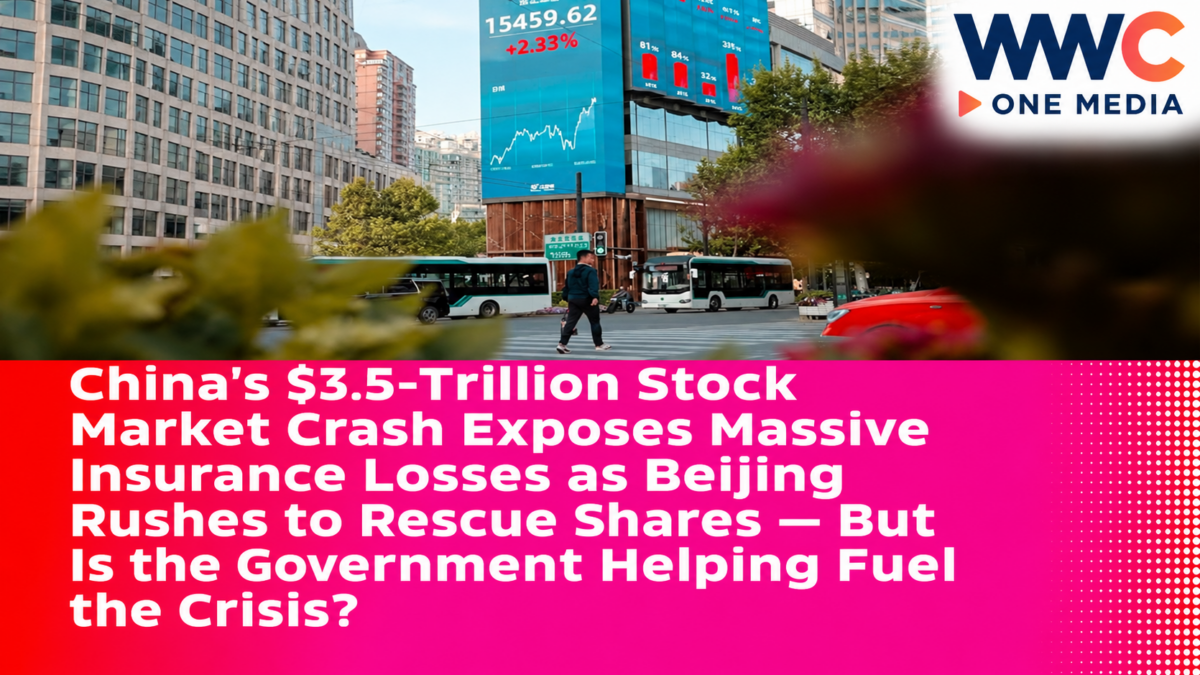
China’s stock market is facing another devastating confidence crisis after an estimated $3.5 trillion in market value disappeared from its earlier peak, exposing massive investment losses at some of the country’s largest insurance companies and raising uncomfortable questions about Beijing’s repeated attempts to rescue falling share prices.
The selloff has pushed China’s benchmark CSI 300 Index into bear-market territory, while the technology-heavy STAR 50 Index has plunged as much as 48% from its midyear highs.
October was particularly punishing.
The CSI 300 dropped 8.5%, its worst monthly performance in more than a decade, as artificial intelligence stocks, semiconductor manufacturers and other once-popular investments suffered heavy selling.
Now, an unexpected group is being drawn into the controversy: China’s insurance giants.
According to Bloomberg Opinion columnist Shuli Ren’s November 4 analysis, Why China’s Stock Market Keeps Crashing, policymakers may be confronting an unintended consequence of their own efforts to encourage long-term institutional investment.
Insurance companies had increased their holdings of Chinese equities as Beijing urged financial institutions to provide more stable capital to the market.
But when share prices collapsed, their growing exposure created significant pressure on earnings and investment-risk management.
The result has become a difficult contradiction.
The same institutions Beijing hoped would stabilize its stock market may now be facing financial incentives to reduce exposure when prices fall.
For investors already unsettled by weak consumer spending, China’s property downturn and growing doubts about AI profitability, the controversy raises a much bigger question.
Could the policies intended to protect China’s stock market actually be making its recurring crashes harder to prevent?
China’s $3.5-Trillion Stock Rout Raises New Alarm
China’s equity-market decline has been extraordinary in scale.
Bloomberg reported in late October that approximately $3.5 trillion in market capitalization had disappeared from China’s broader stock market since its May peak.
That figure represents the estimated reduction in the aggregate market value of listed shares. It is not the same as investors collectively realizing $3.5 trillion in cash losses.
The CSI 300, which tracks major stocks listed in Shanghai and Shenzhen, entered bear-market territory after declining more than 20% from its June peak.
The losses were particularly severe among companies associated with artificial intelligence.
Semiconductor manufacturers, robotics developers and other technology businesses had benefited earlier in the year from expectations of strong demand and Chinese technological self-reliance.
But those expectations became increasingly difficult to justify as investors reassessed valuations, future profits and the cost of expanding AI infrastructure.
WWC ONE MEDIA previously examined the reversal in China’s AI Hardware Selloff Deepens as Valuation Fears Hit Tech Darlings — But the Earnings Boom Isn’t Over Yet.
The earlier report explained how even companies operating in promising industries can suffer substantial share-price declines when investors have already priced in extraordinary future growth.
The latest selloff demonstrates how quickly that optimism can reverse.
Hedge Fund Founder Points Finger at China’s Insurance Companies
The debate over who is selling Chinese stocks intensified after Hong Liang, founder of Shiva Capital Group, criticized insurance companies in a communication to investors.
According to Bloomberg Opinion, Liang alleged that insurers accumulated technology shares near their July highs and subsequently reduced positions during September’s decline.
He described the reported behavior as difficult to understand, particularly given the insurers’ role as supposed long-term investors.
The accusation is politically sensitive.
China has previously blamed market instability on hedge funds, quantitative traders and foreign investors.
Now, the focus has shifted toward large domestic financial institutions, some with substantial state ownership.
However, Liang’s accusation has not been independently established as a comprehensive explanation for the market crash.
A sharp stock-market decline can involve many different sellers and underlying economic pressures.
Insurance-company transactions may have contributed to volatility without being its sole or principal cause.
Liang also leads a hedge fund with its own financial exposure to market conditions, making it important to distinguish his interpretation from independently documented trading data.
China’s Insurance Giants Report Enormous Third-Quarter Losses
The financial difficulties facing China’s insurance sector are well documented.
According to a November 2 report from Yicai Global, three of the country’s five major listed insurers reported net losses during the third quarter.
China Life Insurance recorded a net loss of approximately 45.1 billion yuan, equivalent to around $6.8 billion.
People’s Insurance Company of China reported a loss of approximately 4.9 billion yuan.
New China Life Insurance posted a loss of approximately 511 million yuan.
The other two major insurers remained profitable, but their earnings deteriorated sharply.
Ping An Insurance reported quarterly profit of around 4.1 billion yuan, down 94% year over year.
China Pacific Insurance Group reported approximately 5.6 billion yuan in profit, down 68%.
The companies’ results were affected significantly by declines in the market values of their investments.
Under applicable accounting rules, changes in the fair value of certain financial assets can be reflected in reported earnings even when those holdings have not been sold.
That means a reported investment-related loss is not automatically evidence that an insurer liquidated its entire position.
Nevertheless, the results demonstrate how strongly the stock-market slump has affected institutions responsible for managing substantial financial assets.
Why Insurers Increased Their Exposure to Stocks
China’s insurance companies have faced a difficult investment environment.
Their obligations to policyholders can extend many years into the future.
To meet those commitments, insurers typically invest in bonds, equities and other assets intended to produce adequate long-term returns.
But falling domestic bond yields have made it harder to earn attractive income from traditional fixed-income investments.
At the same time, policymakers have encouraged insurers to invest more heavily in China’s stock market.
Beijing wants a larger pool of patient institutional capital capable of reducing the market’s dependence on speculative trading.
China Life illustrates the shift.
According to Bloomberg Opinion, its equity allocation reached approximately 19.2% by the end of June 2026, compared with 16.9% in 2025.
That increase may have supported returns during market rallies.
But it also increased the company’s vulnerability to falling share prices.
The policy dilemma is straightforward: higher equity exposure can offer better potential returns, but it generally brings greater short-term price volatility than high-quality fixed-income assets.
The Problem With Expecting Insurers to Support Falling Markets
Insurance companies may hold investments for long periods, but they cannot disregard financial risk.
They must manage solvency requirements, investment concentration, policyholder obligations and the effect of market fluctuations on their capital.
That creates an important distinction between an insurer and a government-backed market-stabilization fund.
A government-directed fund may purchase shares specifically to support market confidence.
An insurer, by contrast, has responsibilities to its policyholders and must consider its financial condition.
When share prices fall sharply, an insurance company may face pressure to rebalance its investments or limit further losses.
Such decisions can be commercially reasonable from the institution’s perspective.
But if many large investors attempt to reduce exposure simultaneously, selling pressure can deepen an existing downturn.
That is the potential contradiction identified in Bloomberg Opinion’s analysis.
Beijing wants insurers to provide long-term market stability.
Yet insurers cannot reasonably be expected to absorb unlimited losses to achieve that objective.
Beijing Reportedly Tells Institutions to Avoid Selling
Chinese authorities are once again resorting to administrative measures intended to stabilize financial markets.
Bloomberg Opinion reported that regulators have issued informal guidance to certain large insurance companies.
The guidance reportedly requires institutions to disclose their equity exposure, avoid unnecessary reductions in holdings and consider broader economic-stability objectives.
This practice is sometimes called window guidance.
Instead of announcing a formal prohibition through legislation or published regulation, officials communicate expectations to financial institutions.
The precise scope of the latest instructions has not been publicly documented in full.
Therefore, it would be inaccurate to say that all Chinese insurers are legally prohibited from selling stocks.
Reuters also reported that Chinese securities regulators had informally encouraged investment banks to pause new initial public offerings and urged major shareholders to delay large stock sales.
Reuters said it could not independently verify every detail of those reported instructions.
Together, the developments indicate the intensity of Beijing’s concern over market stability.
But administrative restrictions do not automatically resolve the economic conditions that caused investors to sell.
China’s Central Bank Revives Its Market Rescue Measures
The People’s Bank of China has introduced additional support measures to improve liquidity and encourage equity investment.
The central bank revived swap operations designed to help securities firms, fund managers and other eligible financial institutions obtain liquidity.
Business Insider reported that 31 firms had applied for more than 100 billion yuan, or approximately $15 billion, in support.
Authorities also reduced the interest rate on a relending facility intended to support corporate share repurchases to 1%.
The measures are designed to make it easier for financial institutions to obtain funding and for listed companies to buy back their shares.
Share repurchases can support demand and may improve earnings per share when the number of shares outstanding falls.
However, buybacks do not guarantee higher stock prices.
Their effectiveness depends on companies’ actual purchases, financial conditions and investor expectations.
The initial market response was disappointing.
Chinese technology shares resumed their decline shortly after the measures were announced.
The CSI 300 also struggled to sustain its brief recovery.
The market reaction suggests investors are looking for more than liquidity support.
They want evidence that corporate earnings and domestic economic activity are improving.
Why China’s Previous Stock-Market Rescues Have Not Solved the Problem
China has experienced repeated episodes of severe stock-market weakness.
Major downturns in 2018 and 2024 were followed by efforts to stabilize financial markets.
The latest crisis has renewed concerns about whether repeated interventions can deliver durable improvements.
Government buying and liquidity facilities can reduce pressure during periods of disorderly selling.
But their ability to produce sustained rallies is less certain.
Markets ultimately depend on the expected profitability of listed companies, the cost of capital and investors’ willingness to accept risk.
Reuters Breakingviews noted that the central bank’s latest measures cannot directly repair weak corporate earnings.
Chinese companies continue struggling with subdued consumer demand and intense price competition.
Analysts have also reduced expectations for future profits.
For investors, this means a stock-market rescue can provide temporary relief without eliminating the underlying reasons for lower valuations.
A durable recovery may require stronger household demand, improving earnings and greater confidence in economic policy.
The AI Boom Has Become Another Source of Financial Instability
Artificial intelligence was supposed to be one of China’s strongest investment opportunities in 2026.
Investors poured money into semiconductor manufacturers, robotics companies, optical-equipment suppliers and AI developers.
The rally was supported by genuine industrial developments and government efforts to strengthen technological self-reliance.
But valuations in some companies rose faster than their near-term earnings.
When expectations changed, highly concentrated positions became vulnerable.
Bloomberg Opinion reported that the STAR 50 Index had declined as much as 48% from its earlier peak.
That maximum reported drawdown should not be confused with the approximately 40% decline reported by other outlets at different measurement dates.
Both figures describe severe losses over several months, not a single-day crash.
The downturn also raises concerns about institutions that increased their exposure to popular technology shares near their highs.
WWC ONE MEDIA recently examined this broader concentration risk in China Warns AI Investment Is Becoming Too Concentrated — But Is the Bigger Risk a New Tech Bubble?.
That article discussed warnings from Chinese financial regulators that unusually concentrated investment in AI could create risks for financial stability.
The key distinction is that technological progress does not guarantee attractive stock-market returns at every valuation.
China’s Property Crisis Continues to Weaken Consumer Confidence
The stock-market decline also reflects deeper economic problems.
China’s property sector has been struggling for years, reducing household wealth and weakening confidence.
Property has historically represented a substantial portion of Chinese households’ assets.
When housing values decline, consumers may become more cautious about spending.
Lower household consumption can affect corporate revenue across retail, manufacturing and services.
Meanwhile, intense competition among businesses has pressured profit margins.
Companies may lower prices to maintain sales volumes, but that can reduce earnings even when overall production remains substantial.
CNN reported that China’s AI and export-related strengths have not been enough to offset weakness in domestic demand.
This matters because equity investors ultimately care about future profits.
A market can receive government financial support while continuing to decline if earnings expectations deteriorate.
China Faces a Difficult Choice Between Market Stability and Investor Freedom
The latest crisis highlights a broader debate over financial-market policy.
Beijing wants a stock market that can help finance technological development, support household wealth and strengthen economic confidence.
At the same time, regulators frequently intervene when prices become unstable.
Such measures may reassure some investors that authorities are willing to prevent disorderly conditions.
But they can also create uncertainty about when investors are free to adjust their holdings.
If institutions fear being discouraged from selling during a downturn, they may demand additional compensation for holding risky assets.
Some investors may also become less willing to increase exposure in the first place.
These are possible market consequences, not outcomes that have been conclusively measured in the latest episode.
The central policy challenge is balancing short-term stability with credible and predictable market rules.
Hong Kong’s Stock Market Is Feeling the Pressure
The consequences extend beyond mainland Chinese exchanges.
Hong Kong-listed Chinese technology companies have also experienced substantial losses.
CNN reported that the Hang Seng Index had declined more than 12% during 2026 by late October.
Weakness in mainland equities can influence international investors’ appetite for Chinese companies listed in Hong Kong.
The downturn also complicates the outlook for new stock-market listings.
WWC ONE MEDIA examined the problem in Hong Kong IPO Crisis Deepens as 1 in 4 Deals Collapse in Worst Withdrawal Wave Since 2008 — But Is Asia’s Biggest Fundraising Boom About to End?.
That report explored how falling share valuations can make it harder for companies to complete planned public offerings.
When listed shares become cheaper, investors may be reluctant to purchase newly issued shares at relatively high valuations.
Companies can respond by postponing listings, lowering their proposed valuations or seeking alternative financing.
The result can affect investment activity even outside the companies directly involved in the stock-market decline.
How China’s Market Crisis Could Affect the Philippines
China’s financial-market weakness may have implications for other Asian economies, including the Philippines.
China is an important regional trading partner and a major participant in global manufacturing supply chains.
Weaker Chinese domestic demand could affect exporters supplying products to Chinese consumers and industries.
A decline in Chinese investment activity could also influence prices of industrial commodities used in construction and manufacturing.
However, a Chinese equity selloff does not automatically produce an equivalent decline in Philippine stocks.
Market performance depends on domestic earnings, interest rates, currency movements and international capital flows.
Regional investors may also distinguish between China’s domestic economic weaknesses and the outlook for companies benefiting from global AI investment.
For Philippine businesses, the most relevant issue is whether China’s market crisis begins affecting real economic activity, trade demand and international financing conditions.
What Could Finally Stop China’s Stock-Market Decline?
Several developments could help improve investor confidence.
Stronger consumer spending would support company revenue and reduce fears about weak domestic demand.
Stabilization in the property sector could improve household confidence.
Better earnings from listed companies would provide a stronger fundamental basis for valuations.
Clearer economic policy and predictable regulation could also encourage longer-term investment.
Finally, a more balanced market, with less dependence on a small number of speculative technology themes, could reduce vulnerability to sudden reversals.
However, none of these outcomes is guaranteed.
Government liquidity support can help stabilize trading conditions, but it is not a substitute for improving the underlying economy.
Investors will therefore watch corporate earnings, insurance-company results, domestic consumption and the direction of Beijing’s next policy announcements.
The Bigger Question: Is China’s Government Fighting a Crisis It Helped Create?
China’s latest market collapse has revealed a difficult contradiction.
Beijing encouraged large insurance companies and other institutions to provide more stable long-term investment capital.
Those institutions increased their exposure to stocks.
When the market declined, insurers suffered substantial financial losses, creating pressure to manage investment risk.
Authorities then faced the possibility that institutions encouraged to buy shares might also become sellers during a downturn.
Now the government is responding with cheaper financing, market-support operations and reported informal restrictions on selling.
That combination has prompted fresh questions about the effectiveness of China’s financial-market strategy.
But assigning the entire crash to insurers would overlook broader problems.
Weak consumer spending, the prolonged property downturn, intense competition, excessive AI valuations and declining earnings expectations have all contributed to the selloff.
The central lesson is that financial institutions cannot be expected to stabilize markets indefinitely when the underlying economy fails to support the prices investors previously paid.
As China confronts a $3.5-trillion equity-market rout, severe insurance-sector losses and another round of central-bank intervention, one question could determine the next chapter of Asia’s financial markets: Will Beijing finally restore investor confidence by addressing the economy’s deeper weaknesses—or could its repeated attempts to control stock prices be contributing to the very instability it is trying to prevent?