TOKYO, JAPAN / MANILA, PHILIPPINES — November 5, 2026 | WWC ONE MEDIA | Global Technology, Gaming, Entertainment and Financial Markets
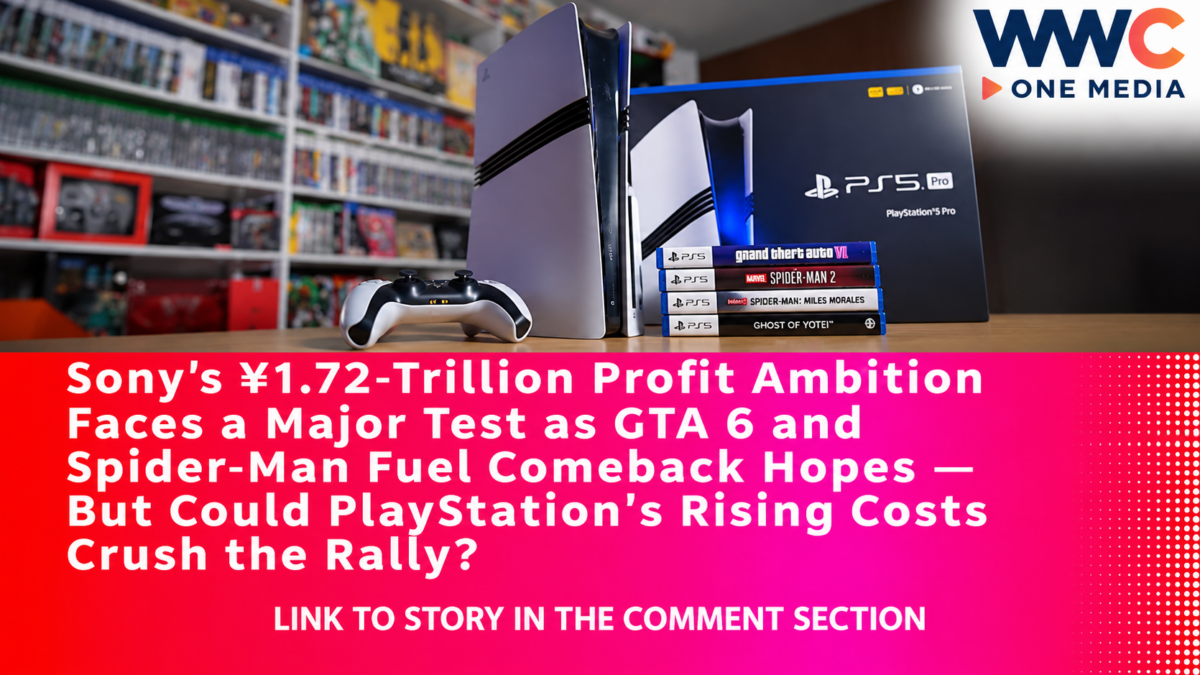
Sony Group Corporation is approaching a crucial financial turning point as investors bet that the arrival of Grand Theft Auto VI, the success of its Spider-Man franchise and expanding entertainment businesses could propel the Japanese conglomerate’s stock market recovery.
But a blockbuster video game and a Hollywood superhero may not be enough to convince investors that Sony can deliver sustainable profit growth.
According to Bloomberg’s November 4 report, Sony Needs More Than GTA and Spider-Man to Lift Stock Further, investors are seeking stronger evidence of long-term earnings stability before embracing a sustained rally in Sony shares.
The timing could hardly be more important.
Sony is scheduled to release its fiscal second-quarter earnings on November 5, with analysts watching whether the company can maintain its ambitious operating-profit forecast of ¥1.72 trillion for the financial year ending March 2027.
The company already delivered a strong start to its financial year.
Operating profit jumped 40% to ¥476.5 billion during the April–June quarter, prompting management to raise its full-year earnings outlook.
Yet Sony faces growing concerns about expensive memory chips, weakening PlayStation hardware sales, production costs and the impact of artificial intelligence on entertainment.
Meanwhile, Grand Theft Auto VI is scheduled to launch on November 19, creating the possibility of one of the gaming industry’s biggest sales events.
The question confronting Sony shareholders is whether the company’s entertainment empire can turn the excitement surrounding major releases into dependable earnings — or whether escalating costs will prevent another sustained stock-market rally.
Sony Stock Rebounds, but Investors Want More Than Two Blockbusters
Sony’s US-listed shares closed at $25.95 on November 4, advancing 2.21% during the session, according to MarketWatch.
The gain reflected improving market sentiment, but it did not eliminate the company’s longer-term challenges.
The stock remained below its previous 52-week high, highlighting the gap between short-term investor optimism and sustained confidence.
Bloomberg’s latest analysis focuses on that distinction.
Investors have reasons to anticipate stronger demand for Sony’s entertainment businesses. But a temporary surge in game purchases or movie-ticket sales does not necessarily establish a permanent improvement in profitability.
A lasting recovery depends on several businesses performing consistently, including gaming, music, film production and image sensors.
Sony has spent years transforming itself from a traditional electronics manufacturer into a global entertainment and technology company.
That strategy has created valuable intellectual property, subscription platforms and recurring revenue opportunities.
However, the shift has also increased the importance of content investment, licensing economics and consumer engagement.
For shareholders, Sony’s next challenge is demonstrating that its diversified business model can continue delivering profits even when individual products or business divisions experience setbacks.
GTA 6 Could Become PlayStation’s Biggest Sales Catalyst of 2026
Few entertainment releases carry expectations as enormous as Grand Theft Auto VI.
Developed by Rockstar Games and published by Take-Two Interactive, the title is scheduled to launch on November 19 for PlayStation 5 and Xbox Series X|S.
Sony does not own the Grand Theft Auto franchise.
Nevertheless, PlayStation could benefit substantially from the game’s commercial success.
A major release can encourage consumers to purchase consoles, subscribe to online services and spend more money on digital entertainment.
Sony may also benefit from transactions through the PlayStation Store, although its revenue share depends on commercial arrangements.
Reuters reported in July that Ampere Analysis analyst Piers Harding-Rolls projected GTA VI could sell between 30 million and 35 million copies by the end of 2026.
That was an analyst forecast, not an official sales commitment or a guarantee.
It also represented sales across supported platforms rather than PlayStation alone.
The enormous anticipation surrounding the game has created challenges for publisher Take-Two as it attempts to protect unreleased material and maintain control of its promotional strategy.
WWC ONE MEDIA previously examined those challenges in Who Is Behind the GTA VI Leaks? Take-Two Turns to Microsoft and Discord as the Hunt Intensifies.
The episode illustrates the unusually intense public attention surrounding Rockstar’s upcoming blockbuster.
But Sony faces a difficult financial reality.
Even if GTA VI becomes a record-breaking success, not every purchase will translate into an equivalent increase in Sony’s profit.
The financial benefit will depend on console demand, game-platform revenue, digital purchases and customer engagement.
PlayStation 5 Sales Are Slowing as Hardware Costs Rise
Sony’s gaming business faces a growing contradiction.
Demand for major games remains substantial, but the cost of operating and expanding the PlayStation hardware ecosystem is increasing.
Reuters reported that Sony sold approximately 1.6 million PlayStation 5 consoles in the April–June quarter, around one-third fewer than during the corresponding period a year earlier.
The decline reflects the maturing console cycle.
The PlayStation 5 is now well into its commercial lifespan, and hardware demand naturally becomes more challenging to sustain as consoles age.
At the same time, memory-chip prices have increased, partly because semiconductor manufacturers are allocating capacity toward high-value AI computing products.
For console manufacturers, more expensive components can squeeze profit margins.
Sony has already increased PlayStation prices in response to cost pressures.
In July, the company said it had secured enough memory-chip supply to meet its projected sales requirements for the current financial year.
That provides some near-term protection, but it does not remove the risk of elevated costs in subsequent years.
Investors must therefore consider whether stronger software sales can offset weaker hardware volumes and potentially higher production costs.
A blockbuster game can temporarily increase demand for existing consoles, but it cannot permanently eliminate the financial pressures associated with expensive components.
Spider-Man Shows Sony’s Hollywood Strength — But One Hit Cannot Guarantee Growth
Sony’s film business provides another important pillar of its entertainment strategy.
The company has benefited from major intellectual-property franchises, including Spider-Man.
Its 2026 release, Spider-Man: Brand New Day, has demonstrated the continuing commercial appeal of established superhero characters.
WWC ONE MEDIA previously reported on the film’s box-office performance in Practical Magic 2 Breaks Spider-Man’s Spell at the Box Office.
That coverage examined how Spider-Man: Brand New Day maintained an extended theatrical run before another major release captured the weekend’s top position.
For Sony, successful film franchises provide opportunities beyond cinema-ticket revenue.
A major movie can generate additional commercial value through digital distribution, television licensing and other agreements.
Intellectual property can also support sequels and related entertainment projects.
However, blockbuster filmmaking involves substantial risk.
Production budgets can be enormous, promotional spending is expensive, and theatrical performance remains difficult to predict.
One exceptional hit cannot guarantee that an entire film slate will be profitable.
Sony must continue producing successful films while maintaining discipline over production and marketing costs.
Its ability to repeat blockbuster success matters more to long-term shareholders than the earnings contribution from any single release.
Sony’s Entertainment Strategy Extends Far Beyond Spider-Man
The wider entertainment industry is becoming increasingly dependent on valuable intellectual property.
Studios are competing for recognizable franchises while also exploring new financing arrangements to manage production costs.
WWC ONE MEDIA previously examined that shift in Private Money Is Flooding Into Hollywood — But It Could Change Which Movies Get Made Next.
The article explored how investors are directing more capital toward film projects, entertainment assets and intellectual-property ownership.
For Sony, the broader lesson is clear.
Owning or controlling valuable entertainment rights can provide substantial commercial opportunities.
But profitable growth also requires careful decisions about spending, distribution and long-term audience demand.
Sony’s diversified entertainment portfolio gives it multiple potential sources of income.
The challenge is ensuring that those businesses generate sufficient returns to support the company’s overall valuation.
Sony Pictures Demonstrates the Global Power of Entertainment Franchises
Sony’s film properties also help the company reach international audiences beyond conventional movie theaters.
A notable example occurred in Taiwan, where Spider-Man became part of a major tourism and cultural event.
WWC ONE MEDIA reported on the collaboration in Taipei Turns Summer Into a Romance Story as Dadaocheng Festival Lights Up the Night.
The event featured a partnership involving Sony Pictures, with Spider-Man appearing in drone performances and themed attractions.
The collaboration demonstrates how entertainment franchises can support promotional partnerships and audience engagement.
Such initiatives may strengthen brand recognition and support wider commercial relationships.
However, their direct financial contribution to Sony cannot be assumed without disclosed licensing or partnership figures.
For investors, the importance lies in Sony’s ability to generate multiple commercial opportunities from recognizable entertainment properties.
Music and Image Sensors Could Become the Real Drivers of Sony’s Next Growth Phase
While GTA VI and Spider-Man attract public attention, Sony’s other divisions may prove equally important to its financial performance.
The company’s music business benefits from recorded music, publishing, streaming and other entertainment-related activities.
These revenue sources can offer a different financial profile from one-time film releases and hardware purchases.
Sony’s image-sensor business is another major growth engine.
Its camera sensors are used in smartphones and other imaging devices, giving the company exposure to global electronics demand.
Reuters reported that the strength of Sony’s gaming and image-sensor operations helped drive its 40% operating-profit increase during the April–June quarter.
The company also raised its image-sensor earnings forecast, citing improved sales expectations and favorable currency movements.
However, this business is exposed to uncertainty.
Smartphone demand can weaken, manufacturing disruptions can affect production, and competition can pressure pricing.
The July 28 Kumamoto earthquake also introduced concerns about semiconductor production and possible financial effects.
Investors will want to understand whether those challenges have been resolved or whether they could affect future earnings.
The performance of music and image sensors will help determine whether Sony’s growth is broad-based or increasingly dependent on a small number of entertainment releases.
Sony’s ¥1.72-Trillion Profit Forecast Faces a Crucial Test
Sony’s financial outlook is central to the investment case.
In July, the company raised its full-year operating-profit forecast by 8% to ¥1.72 trillion, equivalent at the time to approximately $10.7 billion.
The revision followed the company’s stronger-than-expected first-quarter performance.
Reuters reported that Sony’s April–June operating profit reached ¥476.5 billion, compared with an analyst consensus of approximately ¥361 billion.
The earnings surprise demonstrated the company’s ability to deliver strong results despite difficult market conditions.
However, investors now want reassurance that the performance can continue.
The November 5 earnings announcement will provide an opportunity to evaluate revenue growth, profit margins and updated management guidance.
Important areas include PlayStation software sales, console profitability, subscription engagement, music revenue and image-sensor demand.
Sony previously forecast fiscal-year gaming operating profit of approximately ¥660 billion.
Whether that outlook can withstand higher component prices and changing consumer spending patterns remains an important question.
Rising Memory Prices Could Threaten Sony’s Next Console Generation
A particularly difficult challenge involves semiconductor supply.
Artificial intelligence has increased demand for advanced memory and other computing components.
That demand can influence the availability and pricing of components used in consumer electronics.
Sony has indicated that its current financial-year memory requirements are covered.
But securing enough chips does not necessarily mean the company will enjoy favorable production costs indefinitely.
Future PlayStation hardware could face greater cost pressures if semiconductor prices remain elevated.
Sony must also balance the desire to introduce advanced technology against consumers’ willingness to pay higher console prices.
A more expensive gaming system may offer better performance, but higher prices can discourage potential buyers.
That presents a strategic challenge.
The company needs enough innovation to encourage customers to upgrade while maintaining hardware prices that support a sufficiently large user base.
The success of the next PlayStation generation will therefore depend on product performance, software availability, consumer affordability and manufacturing economics.
Can GTA 6 Save Sony From a Longer-Term Gaming Slowdown?
The launch of GTA VI could be a powerful event for the PlayStation ecosystem.
But an important distinction remains: Sony’s long-term financial success cannot depend entirely on a game produced by another company.
Take-Two owns the publishing business behind Grand Theft Auto VI, while Rockstar develops the title.
Sony benefits from making PlayStation an attractive platform on which to play it.
That relationship creates potential revenue opportunities but also limits Sony’s control over the game’s development, release timing and commercial strategy.
A successful launch could improve hardware demand and increase digital spending.
Nevertheless, the PlayStation business must also generate revenue through a broader catalog of games, subscriptions, services and recurring customer activity.
Investors will be watching whether stronger engagement continues after the initial excitement surrounding the release begins to fade.
A lasting increase in spending across the PlayStation ecosystem would provide stronger evidence of sustainable growth than a temporary hardware-sales surge.
Why Sony’s Shares Could Still Struggle Despite Strong Earnings
Stock prices respond not only to a company’s reported performance but also to what investors previously expected.
Sony can deliver rising profits while its shares remain under pressure if earnings growth falls short of market forecasts.
Likewise, a positive outlook may not produce a sustained rally if investors believe the good news is already reflected in the stock price.
The company’s diversified business model creates additional complexity.
Gaming can perform strongly while film profits weaken.
Image sensors can benefit from smartphone demand while hardware costs rise.
Music revenue can grow even as traditional electronics face pressure.
For shareholders, the challenge is evaluating the entire business rather than focusing on one anticipated game or movie.
Long-term confidence will depend on profit consistency, capital allocation, business execution and management’s ability to respond to changing technology costs.
What Sony’s Outlook Means for Asian Technology and Entertainment Investors
Sony is one of Japan’s most important technology and entertainment groups.
Its performance can influence sentiment toward Japanese electronics manufacturers, semiconductor suppliers and global entertainment companies.
The results also offer lessons for investors across Asia, including the Philippines.
The growing cost of AI-related hardware can affect businesses far beyond artificial intelligence itself.
When semiconductor suppliers prioritize components used in data centers, consumer-electronics manufacturers may face higher expenses.
At the same time, global entertainment franchises can create opportunities for distributors, cinemas, digital platforms and other businesses.
However, strong international product demand does not automatically translate into equivalent financial gains for companies operating in different markets.
Investors must examine individual business models and financial exposure.
Sony’s earnings therefore provide a useful illustration of how technology, entertainment and manufacturing trends increasingly overlap.
The Bigger Question: Can Sony Build a Rally That Outlasts GTA 6 and Spider-Man?
Sony has several reasons for optimism.
Its previous quarterly operating profit increased 40%.
Management raised its full-year earnings forecast.
The PlayStation ecosystem is preparing for the highly anticipated launch of Grand Theft Auto VI.
Spider-Man continues demonstrating the commercial value of major entertainment franchises.
And Sony’s music and image-sensor businesses provide additional opportunities for growth.
But the risks remain substantial.
PlayStation hardware sales have slowed.
Memory-chip costs are elevated.
The film industry faces unpredictable production economics.
And semiconductor manufacturing remains exposed to supply-chain and demand uncertainties.
The company’s November 5 financial results will help investors assess whether Sony can build on its previous earnings improvement.
Yet the larger challenge extends beyond a single quarter.
Sony must demonstrate that its entertainment and technology businesses can generate reliable profits without depending on the occasional success of a blockbuster release.
As GTA VI approaches its November 19 launch and Sony targets ¥1.72 trillion in annual operating profit, one question could determine the next major move in its stock: Will PlayStation, Spider-Man and Sony’s expanding entertainment empire deliver lasting growth — or will rising costs and uncertain earnings stop the comeback before it truly begins?