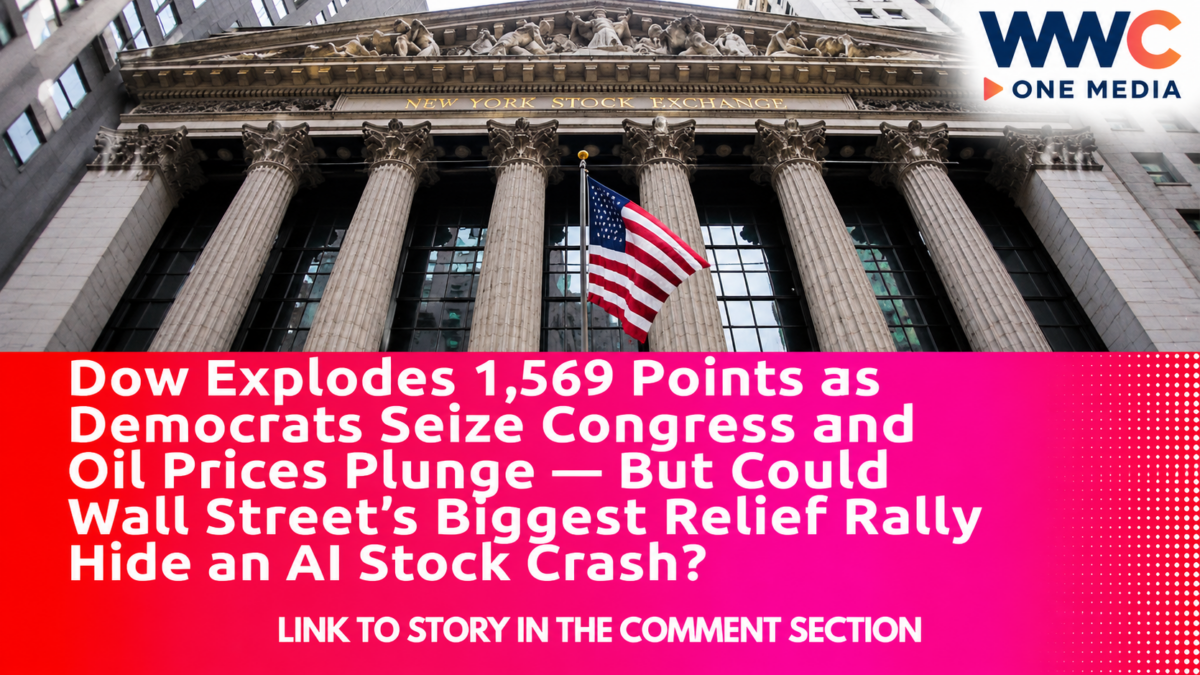
NEW YORK / MANILA — Wall Street staged a dramatic post-election rally on Wednesday, November 4, as the Dow Jones Industrial Average surged more than 1,500 points after Democrats won control of both chambers of the US Congress, reshaping expectations for President Donald Trump’s economic agenda.
The Dow jumped 1,569.40 points, or 3.03%, to close at 53,356.12, marking its strongest single-day performance since April 2025.
The S&P 500 gained 1.58% to 7,688.62, while the Nasdaq Composite rose 1.44% to 25,736.51.
The Russell 2000 index of smaller US companies also advanced 1.58%.
But behind the spectacular market gains, a deeper divide emerged.
While major technology stocks, healthcare companies and retailers attracted buyers, several businesses connected to artificial intelligence infrastructure suffered sharp declines.
Investors also dumped shares associated with President Trump and Elon Musk as the election results raised the possibility of stronger congressional scrutiny.
At the same time, falling oil prices, declining Treasury yields and a weaker US dollar helped support risk appetite across financial markets.
The question confronting Wall Street is whether the November 4 surge marks the beginning of a sustained recovery—or whether changing political priorities could expose dangerous weaknesses in America’s multitrillion-dollar AI investment boom.
Dow Surges 1,569 Points in One of Wall Street’s Biggest Rallies
The November 4 trading session produced a remarkable reversal from the uncertainty that had gripped financial markets before the midterm elections.
US stock futures initially declined as results showed Democrats making substantial gains against the Republican Party.
But investors reconsidered the implications as the election outcome became clearer.
Rather than focusing exclusively on political confrontation, traders increasingly interpreted the prospect of divided government as reducing the likelihood of major new legislative changes.
That helped fuel a broad rally.
By the closing bell, the Dow had climbed 3.03%, while the S&P 500 and Nasdaq recorded gains of approximately 1.6% and 1.4%, respectively.
The rally extended beyond America’s largest corporations.
Smaller companies also participated, with the Russell 2000 advancing to 2,856.95.
The strong performance demonstrated that investors were responding to more than a narrow rebound in technology stocks.
However, the advance was not universal.
Several industries faced significant pressure as investors reassessed how the election could affect future regulation, government spending and corporate profitability.
Democrats Win Both Chambers of Congress, Reshaping Market Expectations
The November 3 midterm elections produced a major political setback for President Trump.
Democrats secured majorities in the House of Representatives and Senate, creating a new balance of power in Washington.
The result could complicate the administration’s ability to secure congressional approval for major fiscal and legislative initiatives.
Investors immediately began reconsidering expectations for taxes, federal spending, regulation and government borrowing.
Some analysts argued that a more divided government could reduce the likelihood of additional deficit-financed stimulus.
Others suggested that political gridlock could limit sweeping policy changes that businesses find difficult to anticipate.
WWC ONE MEDIA previously examined these possibilities in Global Stocks Wobble as Investors Watch US Midterm Elections — Could a Shift in Congress Trigger a Bigger Market Shake-Up?.
That earlier report described how congressional control could influence artificial intelligence regulation, the US dollar, interest rates and international investment.
Wednesday’s market performance showed how quickly expectations can change once election uncertainty begins to fade.
However, divided government does not guarantee reduced borrowing, lower inflation or stronger corporate earnings.
Actual economic outcomes will depend on future policy decisions.
Wall Street Reverses Its Earlier Election-Day Uncertainty
The scale of the November 4 rally was particularly striking because financial markets had been cautious immediately before the election.
On November 3, the Dow fell 197.26 points to 51,786.72.
The S&P 500 rose only 0.36%, while the Nasdaq gained 0.83%.
Technology shares provided some support, but the broader market remained uneasy about corporate valuations and political uncertainty.
WWC ONE MEDIA documented the earlier atmosphere in Wall Street Futures Edge Higher as US Midterm Results Loom and Nvidia Leads a Tech Rebound — But Could Election Night Trigger Another Market Selloff?.
The November 4 session illustrated why premarket futures and early trading movements should not be confused with final results.
The major US indexes moved substantially higher despite the uncertain start.
For investors, the episode demonstrated the difficulty of predicting market performance solely from political headlines.
Falling Oil Prices Become a Powerful Market Catalyst
The election results were not the only reason stocks advanced.
Oil prices fell sharply as traders reassessed the outlook for the conflict involving the United States and Iran.
The decline strengthened hopes that energy-driven inflation might begin easing.
Lower petroleum prices can benefit airlines, transportation companies, retailers and consumers by reducing some operating and household expenses.
That can support expectations for business profitability and consumer spending.
WWC ONE MEDIA previously examined the oil-market reversal in Oil Prices Crash Nearly 8% as Iran Peace Talks Send Brent to $104 — But Could One Failed Deal Trigger a $140-a-Barrel Shock?.
The report covered a sharp November 2 decline in crude prices as renewed diplomatic hopes encouraged traders to reduce the geopolitical risk premium.
Oil weakened further during November 4 trading.
However, lower crude prices are not uniformly positive for every company.
Energy producers can face reduced revenue expectations, while the effect on fuel retailers and consumers depends on refining costs, inventories, exchange rates and domestic pricing conditions.
The market reaction therefore reflected the potential benefits of easing inflation pressures rather than proof that the global energy crisis had ended.
US Treasury Yields Fall as Investors Reassess Government Borrowing
The bond market also participated in the post-election adjustment.
The benchmark 10-year US Treasury yield fell to approximately 4.89%.
Bond yields generally move inversely to bond prices.
The decline suggested greater investor demand for government securities and changing expectations about fiscal and monetary policy.
One explanation was that congressional opposition could limit additional federal spending, potentially reducing some pressure on government borrowing.
Lower yields can also support equity valuations by reducing the discount rate used to estimate the value of future corporate earnings.
This relationship is especially important for growth companies, whose valuations often depend on profits expected many years into the future.
However, Treasury yields remain sensitive to inflation, Federal Reserve policy, government debt issuance and global investment demand.
A one-day decline does not establish that borrowing costs will continue falling.
Technology Stocks Rally, but AI Infrastructure Companies Struggle
The technology sector produced one of the day’s most important contradictions.
Large technology companies helped support the broader stock market.
But several businesses involved in building and financing AI data centers experienced sharp declines.
Reuters reported that investors were concerned a Democratic-controlled Congress could increase scrutiny of major computing facilities, particularly their electricity demands and effects on local communities.
The Wall Street Journal also reported growing opposition to data center development in several US municipalities.
Some communities approved measures restricting or banning new facilities.
Shares in companies such as CoreWeave, Core Scientific, Applied Digital and IREN faced selling pressure.
The divergence highlights an important distinction between different parts of the AI industry.
Companies selling software and cloud services may benefit from rising demand for AI applications.
Infrastructure developers, meanwhile, must fund enormous facilities and secure access to electricity, land and financing.
Those requirements create different financial risks.
AI Data Centers Face a Growing Political Backlash
The development of massive data centers has become an increasingly controversial issue across the United States.
Local governments and residents have expressed concerns about electricity demand, water consumption, property development and infrastructure costs.
Some communities worry that large computing facilities could increase household utility bills.
Others question whether promised construction jobs and tax revenues adequately compensate for environmental and infrastructure impacts.
WWC ONE MEDIA previously examined these concerns in AI Data Centers Are Setting Off Alarms in Washington — And Now Congress Is Moving on the Power Bill.
The report described congressional efforts to address how electricity infrastructure costs should be allocated between data center operators and other consumers.
The November 4 selloff among data center-related stocks suggests investors are taking these issues seriously.
However, political opposition does not mean every planned AI project will be canceled.
Future development will depend on local approvals, power availability, project economics and the specific regulations adopted.
AMD’s Strong Earnings Show AI Demand Has Not Disappeared
Despite the pressure on data center infrastructure stocks, semiconductor demand remains substantial.
Advanced Micro Devices recently reported a major increase in revenue from its data center business.
The chipmaker’s third-quarter revenue reached approximately $13.38 billion, while data center sales grew 97% from the previous year.
AMD also projected approximately $17 billion in revenue for the fourth quarter.
WWC ONE MEDIA examined the results in AMD’s $17 Billion AI Chip Forecast Crushes Wall Street Estimates as Data Center Sales Soar 97% — But Can Lisa Su Finally Challenge Nvidia’s Dominance?.
The earnings showed that customers continue purchasing large quantities of computing hardware.
However, strong chip sales and weak data center stocks are not necessarily contradictory.
A semiconductor supplier can record strong revenue from existing orders while investors grow concerned about the cost, financing or regulatory risks surrounding future facilities.
That distinction is becoming increasingly important as the AI investment cycle matures.
Investors are asking not only whether AI demand exists, but whether businesses can earn adequate returns on the money being spent to support it.
Nvidia and Other AI Stocks Face Valuation Pressure
Artificial intelligence has been one of the most powerful drivers of US equity-market growth.
Companies developing advanced processors, cloud platforms and AI software have attracted substantial investment.
But the industry’s rapid expansion has also raised valuation concerns.
Investors are increasingly examining whether revenue growth justifies the enormous capital expenditure commitments made by leading technology companies.
Some businesses are financing large infrastructure projects through debt or other arrangements that depend on sustained customer demand.
If projects are delayed or demand develops more slowly than expected, financial returns could disappoint.
The political backlash against data centers adds another risk.
Regulatory requirements could increase costs or lengthen project timelines.
That may reduce the attractiveness of companies whose valuations depend on rapid infrastructure expansion.
However, the November 4 market reaction does not establish that the AI investment boom has ended.
The industry’s outlook remains dependent on enterprise adoption, computing demand and the profitability of individual business models.
Healthcare and Renewable Energy Stocks Attract Buyers
While data center-related shares weakened, other industries benefited from the election results.
Hospital operators and businesses serving lower-income consumers were among the strongest performers, according to the Associated Press.
Investors also increased exposure to renewable energy companies.
Shares associated with solar power, battery technology and other clean-energy activities advanced as investors considered the possibility of more favorable congressional policy.
Companies mentioned in market coverage included First Solar, Sunrun and other businesses tied to renewable-energy development.
However, congressional control does not automatically reverse existing executive policies or trade restrictions.
The direction of future energy legislation will depend on negotiations between Democrats and the White House.
Renewable-energy companies also face challenges involving financing, supply chains and competition.
The day’s gains therefore reflected changing investor expectations rather than confirmed future subsidies or regulatory decisions.
Trump- and Musk-Linked Companies Come Under Pressure
The market also reassessed the outlook for businesses closely associated with President Trump and Elon Musk.
Trump Media shares fell sharply during the November 4 session.
Tesla and other Musk-associated investments also faced pressure.
The election results increased speculation about congressional investigations, government contracts and potential regulatory scrutiny.
Musk had spent substantial amounts supporting Republican candidates and political causes during the election cycle.
His political involvement contributed to investor interest in how the new congressional balance might affect companies connected to him.
However, political associations do not by themselves establish wrongdoing or determine a company’s future earnings.
The financial effect of potential investigations or policy changes would depend on actual government actions and their consequences.
For shareholders, the episode demonstrates how political exposure can become an additional source of market volatility.
Gold Rallies as the Dollar Weakens
The post-election rally extended beyond stocks.
Gold climbed approximately 3% on November 4, returning above $4,000 per troy ounce.
The weaker US dollar and lower Treasury yields helped improve the metal’s appeal.
Gold does not pay interest, so declining yields can reduce the opportunity cost of holding it.
A weaker dollar can also make dollar-denominated commodities relatively more affordable for international buyers.
The rally illustrates how different asset classes can respond simultaneously to changing monetary-policy expectations.
Stocks may benefit from lower borrowing-cost expectations, while gold may attract demand as the dollar weakens.
However, neither relationship is automatic.
The next US inflation and employment reports could change interest-rate expectations and reverse some of these moves.
What the Rally Means for Asian Investors
The US market rebound has implications beyond Wall Street.
Asian stock markets are connected to American technology demand, global capital flows and the direction of the US dollar.
Companies in Taiwan and South Korea supply advanced semiconductors, memory chips and electronic components used in AI infrastructure.
Changes in expectations for US data center development could influence demand forecasts for these businesses.
For the Philippines, movements in the dollar and international oil prices may affect imported goods, inflation and currency-market expectations.
A sustained decline in global oil prices could eventually ease some cost pressures.
But local retail prices depend on many other factors, including exchange rates, taxes and refining costs.
Similarly, a strong US stock-market session does not guarantee that Philippine equities will rise.
Local earnings, interest rates and economic conditions remain important.
The November 4 rally should therefore be viewed as a significant global market development rather than a direct prediction of regional returns.
Could Political Gridlock Trigger Another Market Selloff?
Wall Street’s initial interpretation of the election result was broadly positive.
Investors appeared to welcome the possibility of fewer sudden legislative changes and reduced fiscal expansion.
But political gridlock can also create risks.
Disagreements over federal spending, government funding and the debt ceiling can produce uncertainty.
Congressional investigations may affect companies and industries linked to the administration.
Trade policy and tariffs can remain contentious even under divided government.
The Federal Reserve also operates within an economic environment shaped by inflation, labor-market conditions and government finances.
For investors, the question is whether lower political uncertainty will outweigh the potential complications of legislative confrontation.
A single trading session cannot resolve that issue.
Three Critical Developments Investors Should Watch
First, the next US economic data releases.
Employment and inflation figures could influence Treasury yields and expectations for Federal Reserve interest rates.
Second, the new Congress’s priorities.
Technology regulation, energy policy, government spending and oversight of major corporations may become important market catalysts.
Third, corporate earnings and AI investment returns.
Large technology companies must demonstrate that spending on chips, data centers and AI services can generate sustainable revenue and profits.
These factors will help determine whether the post-election rally becomes a longer-lasting advance.
The Bigger Picture: Is Wall Street Entering a New Market Cycle?
The Dow’s extraordinary 1,569-point rally on November 4 reflects a major shift in investor expectations.
Democrats won both chambers of Congress.
Oil prices declined sharply.
Treasury yields fell.
And investors moved into a broad range of American stocks.
Yet the gains also revealed a market undergoing an important reassessment.
Some technology companies benefited from the improved financial environment.
Others faced selling pressure because of political concerns over AI infrastructure.
Healthcare, retail and renewable-energy businesses attracted renewed interest.
And stocks closely associated with the Trump administration declined.
The session demonstrated that Wall Street’s direction is increasingly influenced by the interaction of politics, energy prices, interest rates and corporate earnings.
But the rally does not eliminate financial risks.
High valuations, government debt, geopolitical conflict and uncertainty surrounding the AI investment boom remain significant concerns.
As the Dow surges 1,569 points and the S&P 500 rebounds following the Democrats’ congressional victory, can Wall Street extend its post-election rally—or could tougher AI regulation, political gridlock and another interest-rate shock turn investors’ sudden optimism into the next market selloff?