WASHINGTON, UNITED STATES / MANILA, PHILIPPINES — November 5, 2026 | WWC ONE MEDIA | Global Energy, US Politics, Oil Markets and Financial News
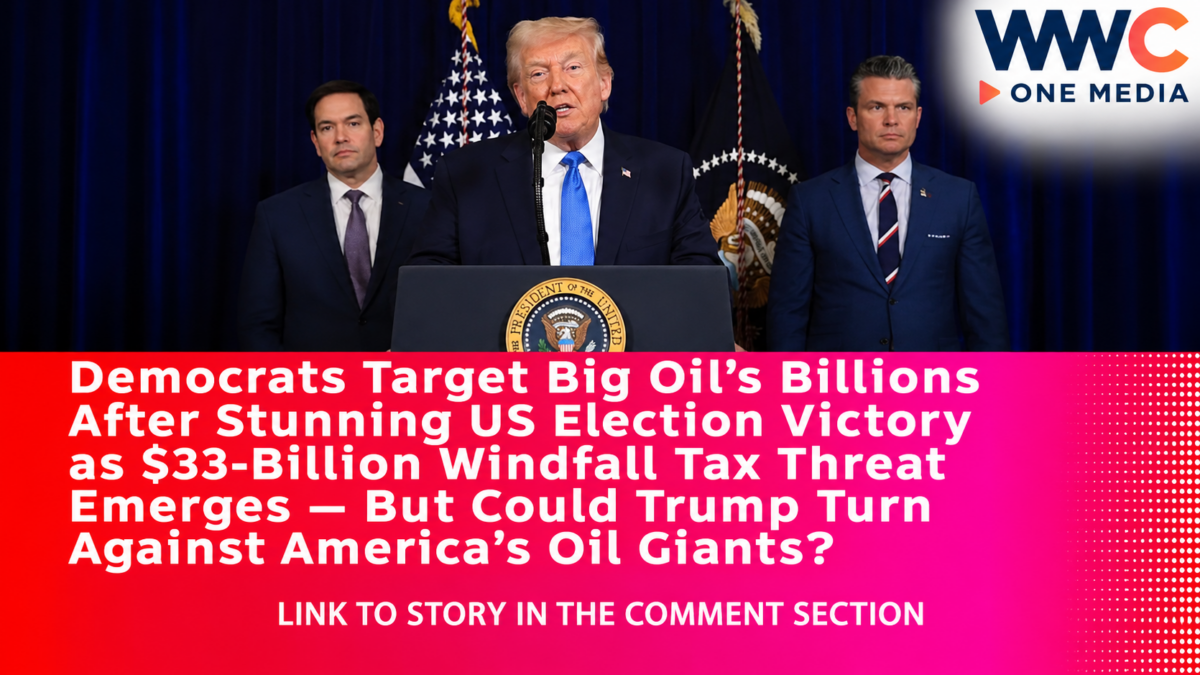
America’s largest oil companies are confronting a major new political threat after Democrats captured both chambers of Congress in the November 3 midterm elections, reviving the possibility of a multibillion-dollar windfall-profits tax on energy producers benefiting from the Iran war.
The proposed legislation could raise approximately $33 billion annually if crude oil averages $100 per barrel, with revenue intended to finance rebate payments for American households struggling with higher fuel costs.
According to Bloomberg’s November 4 report, oil industry executives and Washington lobbyists are preparing for the possibility that Democrats could use their newly strengthened political position to negotiate a tax agreement with President Donald Trump.
The development comes as energy companies face increasing public scrutiny over profits generated during the Middle East conflict.
ExxonMobil and Chevron reported extraordinary earnings as oil prices surged, while American motorists faced substantially higher gasoline and diesel costs.
But a new tax is far from guaranteed.
The White House has rejected speculation that Trump is considering an agreement with Democrats to impose a windfall-profits levy.
Meanwhile, energy industry representatives warn that additional taxation could discourage investment and threaten future domestic production.
The central question is whether Democrats can persuade Trump to make America’s oil giants return part of their extraordinary profits to consumers — or whether the president will defend an industry that has benefited financially from his administration’s energy policies.
Democrats’ Election Victory Creates a New Threat for Big Oil
The November 3 congressional elections dramatically changed Washington’s political landscape.
Democrats secured majorities in the House of Representatives and the Senate, ending the Republican Party’s control of both chambers.
The newly elected Congress is scheduled to convene in January 2027.
For energy companies, the results create the prospect of more aggressive investigations, hearings and legislative scrutiny.
Democratic lawmakers have criticized the financial gains enjoyed by major oil producers as the Iran conflict pushed global petroleum prices higher.
They argue that households have absorbed the economic consequences of the war while producers have benefited from higher selling prices.
Bloomberg reported that oil industry executives fear windfall-profits taxation could become part of wider negotiations involving consumer relief, government spending and other legislative priorities.
However, Democratic control of Congress does not automatically result in new taxes.
Any legislation would still need to pass both chambers and receive presidential approval, or overcome a presidential veto under the constitutional requirements.
The political balance will therefore depend on negotiations between congressional leaders and the White House.
How the Proposed $33-Billion Oil Windfall Tax Would Work
The proposal attracting renewed attention is the Big Oil Windfall Profits Tax Act, introduced in March 2026 by Democratic Senator Sheldon Whitehouse and Representative Ro Khanna.
Under the legislation, qualifying oil companies would face a quarterly excise tax linked to the price of Brent crude.
The proposed rate would equal 50% of the difference between the relevant quarterly average Brent price and the benchmark average for 2025.
The 2025 benchmark was approximately $68 per barrel.
For example, if Brent averaged $100 per barrel during a quarter, the difference would be approximately $32.
Applying the proposed 50% rate would produce an illustrative levy of around $16 per taxable barrel.
The precise amount would depend on the statutory formula, relevant benchmark adjustments, qualifying production or imports, and the final form of any enacted legislation.
The proposal targets major producers and importers handling at least 300,000 barrels per day, including companies meeting the threshold during 2025.
Smaller producers would generally be excluded under the proposed framework.
Importantly, the bill would impose a tax on qualifying barrels using a crude-price formula. It should not be confused with a straightforward 50% tax on a company’s accounting profits.
The proposed tax has not become law, and its eventual terms could change during legislative negotiations.
Could American Families Receive Hundreds of Dollars in Oil Rebates?
The bill’s sponsors argue that revenue from the proposed tax should be returned to consumers.
According to the US Senate Environment and Public Works Committee, the legislation could generate approximately $33 billion annually if crude oil averaged $100 per barrel.
Under that illustrative scenario, eligible individual taxpayers could receive approximately $216 annually, while qualifying joint filers could receive roughly $324.
The rebates would be subject to income-related phaseouts.
The proposed thresholds begin at annual income levels of $75,000 for single filers and $150,000 for joint filers.
Supporters argue that these payments could help offset the extraordinary costs families have faced during the Iran war.
However, these amounts are legislative estimates rather than approved government benefits.
There is no confirmed nationwide rebate program under the proposed windfall tax.
Actual payments would depend on congressional approval, implementation details, tax collections and eligibility rules.
ExxonMobil and Chevron Face Scrutiny Over Soaring Profits
The renewed tax debate follows extraordinary earnings at America’s largest publicly traded oil producers.
According to The Washington Post’s October 30 reporting, ExxonMobil recorded approximately $17.5 billion in quarterly profit, up 130% from the corresponding period a year earlier.
Chevron earned approximately $10.4 billion, an increase of 185%.
Together, the two companies generated roughly $27.9 billion in quarterly profit.
The results reflect how elevated crude and refined-product prices can strengthen the earnings of large, integrated energy companies.
Oil producers generally benefit when the prices they receive for petroleum increase faster than their operating expenses.
Refining businesses may also benefit when margins on gasoline, diesel and other fuels improve.
But elevated profits have become politically controversial as Americans face higher living costs.
Democratic lawmakers argue that consumers should receive a share of the extraordinary gains associated with wartime price increases.
Oil producers, by contrast, maintain that earnings depend on market conditions and that profitability enables continued investment in supply, infrastructure and energy security.
The competing arguments are likely to become central to the next congressional debate.
Trump Sends Mixed Signals About Big Oil’s Profits
President Trump’s position adds considerable uncertainty.
Bloomberg reported that Trump has previously criticized large energy companies for earning excessive profits.
In August, he questioned the scale of earnings reported by ExxonMobil and Chevron following their strong second-quarter results.
However, he has also praised oil-industry profitability as a benefit to the American economy.
During a recent campaign rally, Trump celebrated the financial gains generated by energy companies amid the Middle East conflict.
These contrasting statements have encouraged speculation that the president could consider a compromise involving consumer relief.
Nevertheless, a White House official dismissed suggestions that an agreement with Democrats on a windfall tax had been discussed.
That denial is important.
There is currently no verified agreement between Trump and congressional Democrats to impose the proposed levy.
The possibility remains a political scenario rather than an established administration policy.
Analysts See a 30% Chance of an Oil Tax or Fossil-Fuel Tax Changes
Energy analysts are already assessing the implications of the election.
Bloomberg reported that Rapidan Energy Group estimated a 30% probability that Democrats would enact either a windfall-profits tax or reductions in fossil-fuel tax benefits after taking control of Congress.
The assessment does not assign a 30% probability solely to passage of the Whitehouse-Khanna bill.
It covers more than one potential policy outcome.
Rapidan also suggested that changes to energy taxation could be incorporated into a broader bipartisan agreement involving healthcare spending.
Other analysts are more skeptical.
ClearView Energy Partners analyst Kevin Book questioned whether windfall-profits taxation would rank among Trump’s political priorities.
The competing assessments illustrate how uncertain the legislative outlook remains.
Congressional Democrats may have enough political influence to hold hearings, introduce new legislation and negotiate with the administration.
But advancing a major tax proposal could prove considerably more difficult.
The final outcome will depend on congressional support, negotiations and the president’s willingness to approve a deal.
Oil Prices Plunge Nearly 9% as Democrats Win Congress
The political debate is unfolding amid extraordinary volatility in global crude markets.
On November 4, Brent crude plunged 8.7% to settle at $94.62 per barrel.
US West Texas Intermediate crude fell 8.3% to $88.12.
Reuters reported that the decline followed expectations that Democratic control of Congress could increase pressure on Trump to negotiate an end to the Iran conflict.
Investors interpreted the election results as potentially reducing the risk of prolonged military escalation and further disruptions to Middle Eastern oil supplies.
The resulting selloff pushed crude benchmarks to their lowest levels since August 31.
The sharp decline also creates a potential complication for the proposed tax.
If oil prices remain lower, the difference between current crude prices and the 2025 benchmark would narrow.
That would reduce the amount potentially collected under a price-linked windfall-tax formula, assuming the legislation were enacted.
Conversely, renewed geopolitical disruptions could send crude prices higher again, potentially increasing the proposed levy.
WWC ONE MEDIA previously covered the market’s dramatic reversal in Oil Prices Crash Nearly 8% as Iran Peace Talks Send Brent to $104 — But Could One Failed Deal Trigger a $140-a-Barrel Shock?.
The earlier report examined how expectations of diplomatic progress began removing the geopolitical risk premium from international crude prices.
But negotiations remain unresolved, and renewed military escalation could quickly reverse the decline.
Iran War Turns Oil Profits Into a Major Election Issue
The conflict involving the United States, Israel and Iran has substantially affected global energy markets.
Disruptions to production, transportation and shipping through the Persian Gulf have contributed to higher oil prices.
The Strait of Hormuz remains especially important because it is one of the world’s most strategically significant petroleum shipping corridors.
When transportation through the region becomes uncertain, traders may demand higher prices to account for potential supply interruptions.
American households have experienced the consequences through more expensive fuel.
The Washington Post reported that average US gasoline prices had reached approximately $4.23 per gallon before the midterm elections, around 39% higher than before the war began.
These costs became politically damaging as voters increasingly focused on affordability.
Democrats argued that the administration’s military policies contributed to higher energy expenses.
Republicans emphasized energy production and the possibility that prices could fall if the conflict ended.
The election results have now given Democrats stronger opportunities to scrutinize both the war and its economic consequences.
Oil Companies Warn a Windfall Tax Could Hurt American Energy Security
The American Petroleum Institute has strongly opposed the proposed taxation.
Industry representatives argue that windfall taxes could reduce incentives for companies to invest in domestic oil production, refining capacity and energy infrastructure.
From that perspective, additional taxation during periods of elevated prices could discourage projects that require substantial upfront capital.
Oil exploration and production investments often take years before generating revenue.
Companies therefore consider expected after-tax returns when deciding whether to develop new reserves or expand existing operations.
Industry advocates also point to America’s experience with a federal oil windfall-profits tax introduced in 1980 during the Carter administration.
The historical levy was repealed in 1988.
The American Petroleum Institute argues that the earlier policy raised less revenue than anticipated and discouraged domestic production.
Supporters of a new tax dispute the conclusion that additional taxation would necessarily damage supply.
They argue that carefully designed legislation could exempt smaller producers, preserve essential investment incentives and return exceptional gains to consumers.
Whether a new tax would reduce investment, affect production or influence fuel prices would depend on its actual provisions and industry responses.
Neither side’s predictions should be treated as a guaranteed outcome.
Environmental Groups Push Democrats to Act
Environmental organizations are urging congressional Democrats to make windfall-profits taxation a priority.
Oil Change International argues that the extraordinary earnings generated during the Iran conflict should be redirected toward households facing higher energy costs.
Supporters view the proposal as a mechanism to prevent major companies from retaining all the financial benefits associated with sudden geopolitical price shocks.
They also argue that existing energy policies have exposed consumers to the consequences of volatile international fossil-fuel markets.
Opponents counter that taxing oil companies does not directly increase petroleum supplies or guarantee lower prices at gasoline stations.
The dispute reflects a wider disagreement over how governments should respond when energy companies become highly profitable during supply disruptions.
Possible responses include targeted consumer subsidies, tax changes, investments in alternative energy sources and measures intended to improve domestic supply security.
Each approach involves financial and economic tradeoffs.
Why the Philippines Should Watch America’s Oil Tax Debate
Although the proposal concerns US taxation, the political developments could have wider implications for energy-importing countries, including the Philippines.
The Philippines depends heavily on imported petroleum and refined fuel products.
Changes in US oil production, energy investment and international crude prices can influence global market conditions.
However, a tax imposed on American oil companies would not automatically result in higher or lower Philippine pump prices.
Its international effect would depend on whether it changed production decisions, investment levels or physical oil supply.
The peso-dollar exchange rate, regional refined-product prices and domestic fuel taxes would remain important factors.
WWC ONE MEDIA recently reported on the contrasting price adjustments experienced by Filipino motorists in Gasoline Jumps Up to ₱3.50 a Liter on Nov. 3 as Diesel and Kerosene Roll Back.
The report highlighted how gasoline, diesel and kerosene prices can move differently even during the same pricing period.
For Philippine consumers, international crude volatility remains a more immediate influence than the uncertain possibility of a future US windfall-profits tax.
Philippine Fuel Tax Relief Shows a Different Approach to Energy Prices
The US debate also offers a comparison with Philippine energy policy.
While American Democrats are considering additional taxes on large producers, Philippine authorities have explored temporary reductions in petroleum excise taxes to relieve consumers.
WWC ONE MEDIA previously examined the country’s emergency tax-relief mechanism in Oil Just Smashed the Philippines’ $80 Tax-Relief Trigger — But Gasoline and Diesel Drivers May Not Get the Cut They Expect.
Under Republic Act No. 12316, the Philippine government may temporarily reduce or suspend qualifying fuel excise taxes when specified international oil-price conditions are met.
The mechanism is not automatic and requires government action.
The policy difference is significant.
The proposed US measure would collect additional revenue from qualifying oil companies and distribute rebates to eligible households.
The Philippine mechanism is designed to reduce certain existing fuel taxes during periods of unusually elevated crude prices.
Both approaches seek to address the financial burden of expensive energy, but they use different methods and create different fiscal consequences.
Oil Supply Security Remains a Bigger Global Challenge
Beyond taxation, governments continue confronting the larger challenge of ensuring reliable petroleum supplies.
The Iran conflict has demonstrated how disruptions in a major producing region can affect economies worldwide.
For the Philippines, the government has been examining overseas oil reservation agreements and additional strategic storage capacity.
WWC ONE MEDIA covered the initiative in Philippines Moves to Secure Oil Reserves Abroad as Middle East Conflict Threatens Fuel Supply — But Will It Prevent Another Price Shock?.
The proposed arrangements could improve access to petroleum during emergencies.
However, negotiations remain ongoing, and no completed overseas reservation agreement covering a confirmed volume has been established in the reporting reviewed.
The initiative highlights a fundamental distinction between energy affordability and energy security.
Tax relief may help consumers manage high prices.
Strategic reserves may help reduce the risk of physical shortages.
But neither measure can independently eliminate the global market’s exposure to geopolitical disruptions.
What Happens Next to the US Windfall Tax Proposal?
Several political developments will determine whether the proposed legislation advances.
The newly elected Congress is expected to convene in January 2027, giving Democrats greater control over legislative priorities and committee investigations.
Lawmakers could revive existing legislation, introduce revised proposals or negotiate changes to fossil-fuel tax provisions.
They may also investigate profits earned by energy companies during the Iran conflict.
But the most important uncertainty concerns the White House.
Trump has criticized major oil companies over their profits, yet his administration has not endorsed a windfall-profits tax.
A bipartisan agreement would require significant compromises.
Oil companies will almost certainly continue lobbying against measures they believe could reduce investment incentives or profitability.
Environmental groups and consumer advocates, meanwhile, are likely to intensify pressure for financial relief.
The changing direction of crude prices will also influence the debate.
If the Iran conflict ends and fuel prices fall sharply, political demand for a windfall tax could weaken.
If energy costs remain elevated, calls for consumer compensation may become more difficult for lawmakers to ignore.
The Bigger Question: Will Washington Tax Big Oil or Protect Its Profits?
The November 3 elections have created a new source of uncertainty for America’s energy industry.
Democrats are preparing to take control of Congress.
Major oil companies have reported extraordinary profits.
American households have faced elevated gasoline prices.
And a proposed windfall tax could potentially generate billions of dollars to finance consumer rebates.
Yet the path toward enacting the legislation remains uncertain.
The White House has denied that a windfall-tax agreement is under discussion.
Industry leaders warn that additional taxation could discourage investment.
And lower crude prices could weaken both the projected revenue and the political urgency surrounding the proposal.
For ExxonMobil, Chevron and other major energy producers, the immediate challenge is assessing how the new political environment might affect future profitability.
For American consumers, the question is whether congressional action will translate into meaningful financial relief.
And for global energy markets, the debate introduces another uncertainty alongside oil-price volatility, geopolitical tensions and future production decisions.
As Democrats prepare to take control of Congress and America’s oil giants confront the possibility of a multibillion-dollar windfall tax, one question could reshape the US energy industry in 2027: Will Donald Trump strike an unexpected deal to make Big Oil share its profits with American families — or will the proposed crackdown collapse before a single rebate check is issued?