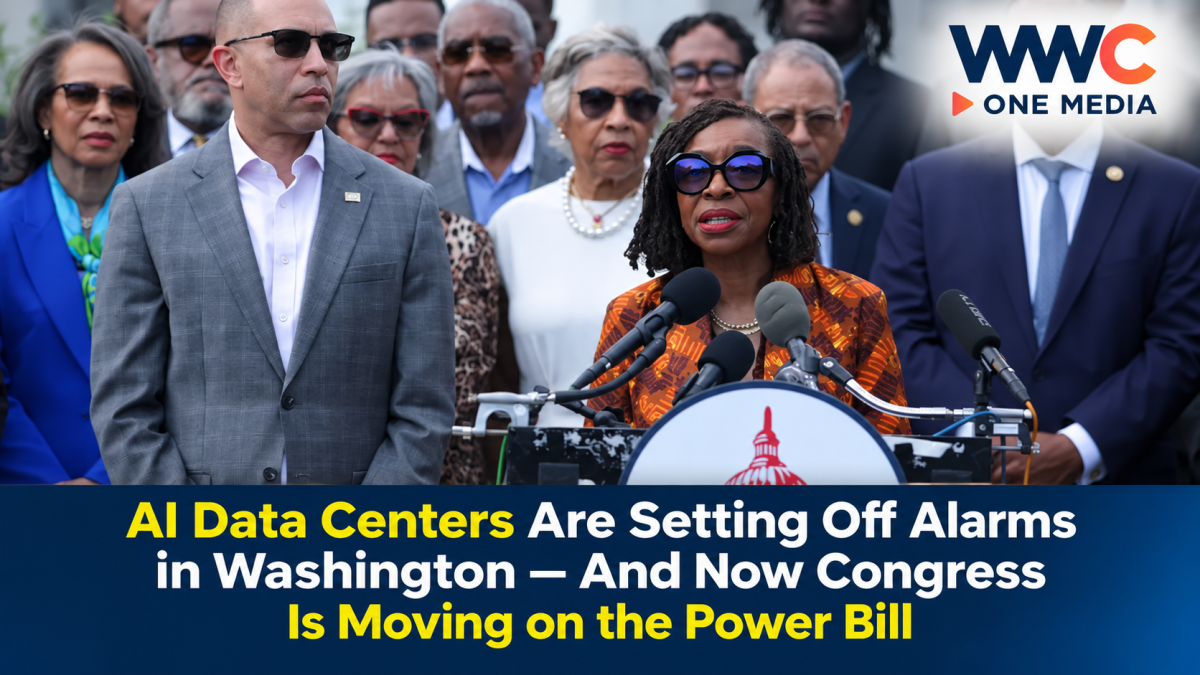
America’s artificial-intelligence boom is running into a very physical problem: the enormous amount of electricity needed to power the data centers behind it.
What was once largely a technology-industry discussion has rapidly become a Washington policy fight, with lawmakers confronting questions about electricity bills, grid upgrades, water consumption and whether the companies building massive AI facilities should pay the infrastructure costs created by their demand.
The issue reached a new level this week when the U.S. House overwhelmingly approved legislation aimed at preventing data-center expansion from shifting new power and transmission costs onto households and other electricity customers.
The Ratepayer Protection Act passed 417-3, marking one of Congress’ most significant bipartisan actions yet on the economic impact of the AI data-center boom.
But the legislation immediately ran into a roadblock in the Senate.
And that exposes the bigger problem facing Washington: lawmakers broadly agree that consumers should not be unfairly burdened by AI’s electricity demand, but they remain divided over how aggressively the federal government should intervene.
AI’s infrastructure problem is becoming impossible to ignore
The rapid expansion of generative AI has created an equally rapid demand for computing infrastructure.
AI models require enormous clusters of specialized chips, servers and cooling systems. Those facilities consume large quantities of electricity and can require major investments in generation, transmission and distribution infrastructure.
That has placed data centers at the center of a growing debate over who ultimately pays for America’s AI buildout.
The House legislation would encourage states to establish standards requiring large data centers to cover the incremental costs associated with new power generation, transmission and other infrastructure needed to serve them.
Supporters describe the approach as a way to protect ordinary electricity customers from subsidizing the expansion of large industrial power users.
Critics argue that the legislation does not go far enough because the federal government would largely be asking states to consider adopting such standards rather than imposing a nationwide mandatory regime.
The House vote was overwhelmingly bipartisan
The 417-3 vote was striking because AI policy has become increasingly polarized in Washington.
Yet data-center electricity costs have produced an unusual area of bipartisan agreement.
The legislation was sponsored by Republican Rep. Gabe Evans of Colorado and Democratic Rep. Kathy Castor of Florida.
The measure focuses on data centers with very large electricity requirements and seeks to establish a framework under which state regulators can consider whether those facilities should bear the costs of additional infrastructure created by their electricity demand.
The political appeal is straightforward: voters care about their electricity bills even if they have little interest in the technical details of AI infrastructure.
That has transformed data centers from a niche technology issue into a broader economic and local-development debate.
Then the Senate fight began
The House victory did not translate into immediate legislation.
On Sept. 17, the Senate stalled the measure after Sen. Martin Heinrich, a Democrat from New Mexico and the Senate Energy and Natural Resources Committee’s ranking member, objected to moving the House bill forward by unanimous consent.
Heinrich argued that the House approach was too weak because it would effectively ask states to consider standards rather than requiring large data-center operators to pay the costs directly.
He backed a separate proposal, the GRID Savings Act, that would require large industrial electricity users to finance the grid infrastructure necessary to serve their demand.
Sen. Bernie Moreno, a Republican from Ohio, subsequently objected to Heinrich’s attempt to advance his alternative.
The result was a legislative standoff over how much responsibility should fall directly on data-center developers and operators.
Why electricity has become such a big AI issue
The economics of AI depend heavily on computing capacity.
Companies building frontier AI systems are investing billions of dollars in data centers, chips and related infrastructure.
The problem is that the U.S. electric grid was not designed around the sudden arrival of enormous new industrial loads concentrated in particular regions.
Grid operators therefore face a complicated balancing act: accommodate new demand quickly enough to support economic growth while maintaining reliability and preventing infrastructure costs from being unfairly distributed.
The North American Electric Reliability Corp. has also been working on standards specifically addressing the reliability impacts of rapidly growing computational loads.
On Sept. 19, NERC said preliminary results showed its foundational Computational Loads Reliability Standards had passed an initial ballot. The standards are intended to address the distinctive operating characteristics and reliability risks associated with large computational loads, including data centers.
Data centers are also becoming a state-level battleground
The Washington debate is happening alongside an expanding fight in state capitals.
The Washington Post found that state lawmakers had introduced at least 375 data-center-related bills in 2026 through July 15, compared with 243 in all of 2025 and 75 in 2024.
Roughly three-quarters of the 2026 bills analyzed by the newspaper sought to restrict data-center development in some way.
The shift reflects changing public attitudes toward large facilities.
Data centers can bring construction activity, jobs, tax revenue and infrastructure investment to communities. But residents and local officials have increasingly raised concerns about electricity demand, water consumption, noise, land use and environmental impacts.
The result is a policy debate that no longer fits neatly into traditional partisan categories.
Virginia is taking a different approach
Virginia provides one of the clearest examples of how the debate is moving from Washington into state government.
Gov. Abigail Spanberger announced a package of policies on Sept. 18 designed to put additional conditions around future data-center development.
Her executive order includes measures aimed at increasing transparency, preventing certain state officials from entering secrecy agreements with developers, improving local negotiating tools and encouraging data-center operators to invest in local energy projects to offset potential grid impacts.
The governor also said she plans to pursue additional legislation.
Virginia is particularly important because it has become one of the world’s largest data-center hubs.
That makes the state a real-world test of the central question facing policymakers nationwide: how can governments accommodate rapidly expanding computing infrastructure while addressing its impact on communities and energy systems?
Water is becoming another flashpoint
Electricity is not the only resource creating concern.
Large data centers can also require substantial amounts of water for cooling, depending on their design and local climate.
That has expanded the political debate from electricity bills to broader questions about resource consumption.
The House’s Ratepayer Protection Act focuses primarily on electricity and grid costs, which critics say leaves other data-center impacts insufficiently addressed. Environmental groups have argued that water use, pollution and community impacts also require attention.
That means even if Congress ultimately settles the electricity question, the broader data-center debate is unlikely to disappear.
Washington is trying to balance AI competition with infrastructure reality
The political backdrop is America’s race to maintain leadership in artificial intelligence.
President Donald Trump has repeatedly argued that the United States should accelerate AI development rather than slow down because of concerns about China.
That position has increasingly collided with local and congressional concerns over the physical infrastructure required to support the AI industry.
The tension is becoming particularly visible as lawmakers from both parties respond to constituents worried about electricity prices and data-center expansion.
The debate is therefore no longer simply:
How fast can America build AI?
It is becoming:
How fast can America build the electricity, transmission lines, water systems and other infrastructure required to support it — and who pays for that expansion?
The AI boom is now a power-grid story
The data-center debate highlights an important change in the economics of artificial intelligence.
For years, the AI race was primarily associated with algorithms, semiconductor chips and software.
Now, physical infrastructure is increasingly becoming a constraint.
The companies with the most advanced models still need land, electricity, cooling systems, transmission capacity and data-center equipment.
That means America’s ability to expand AI may depend not only on technological breakthroughs but also on how quickly the country can expand its energy infrastructure.
The emergence of specialized grid standards, bipartisan congressional legislation and a growing number of state restrictions shows how quickly that issue has moved up the political agenda.
The next fight may be even bigger
The House vote demonstrated that there is substantial bipartisan support for protecting electricity customers from potentially higher infrastructure costs associated with massive new loads.
The Senate stalemate demonstrated that agreement ends quickly when lawmakers debate exactly how those protections should work.
Meanwhile, data-center development continues, states are writing their own rules, utilities are planning for higher demand and technology companies are racing to expand computing capacity.
The result is a growing collision between AI ambitions and America’s physical infrastructure limits.
Washington now has to determine whether the country’s AI buildout should move at the speed demanded by the technology industry, the speed allowed by the power grid, or some combination of the two.
For the AI industry, the answer could determine how quickly the next generation of data centers gets built.
For consumers, it could determine something much more immediate:
who ultimately receives the bill for America’s AI boom.