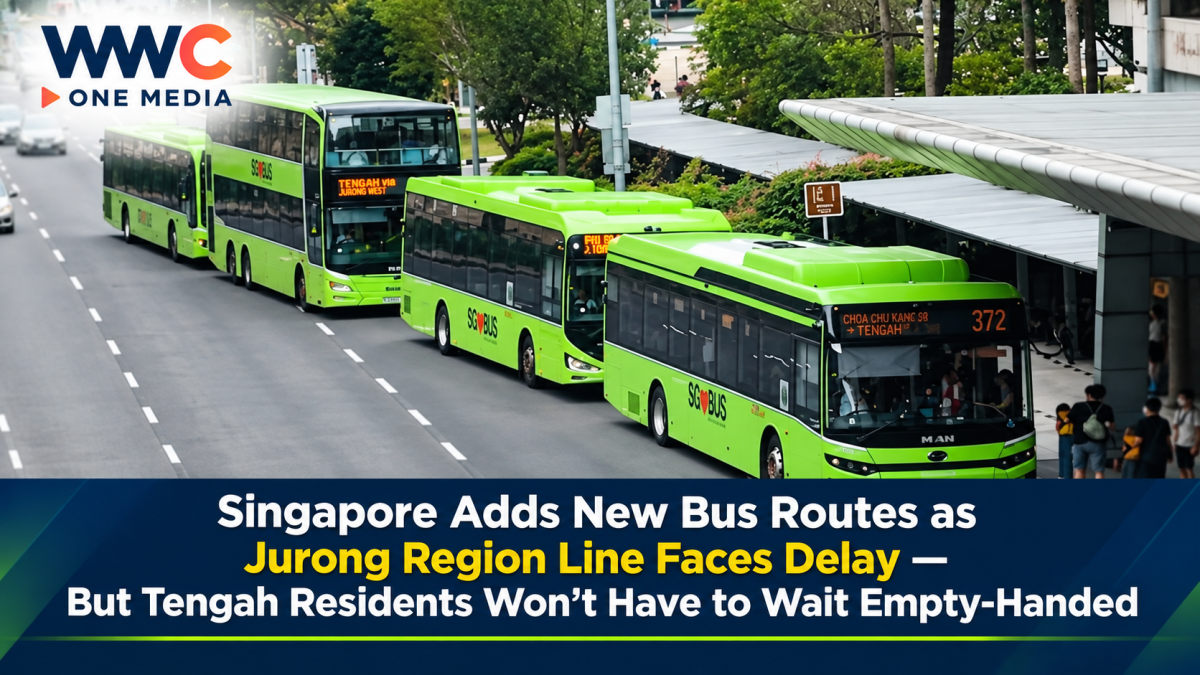
Singapore is moving to strengthen public transport connections in some of its fastest-growing western and northern estates, with three new bus services planned for Tengah, Choa Chu Kang and Woodlands.
The move comes as residents in Tengah continue to grow rapidly and the Jurong Region Line (JRL) faces a delay, with its first stage now expected to open around mid-2028 instead of the previous end-2027 target.
In the meantime, the government plans to introduce interim shuttle bus services that will largely follow the future JRL alignment, giving residents another transport option while they wait for the MRT line to become operational.
The announcements were made by Transport Minister Jeffrey Siow on Sept. 20 as Singapore responds to the rapid development of Tengah and growing demand for public transport in the area.
Tengah’s population has more than doubled
The scale of Tengah’s growth is putting immediate pressure on its transport network.
Siow said Tengah’s population has grown from about 12,000 residents a year ago to approximately 28,000 today.
And the number is expected to rise sharply again.
The transport minister said Tengah could reach about 57,000 residents within another two years, effectively doubling its population again.
That rapid expansion is happening alongside the arrival of new amenities, including Parc Point shopping mall and Tengah Polyclinic.
For residents, however, having homes and amenities is only part of the equation.
They also need reliable connections to MRT stations, employment centres and neighbouring towns.
Two new bus services will start in October
Two of the newly announced services are scheduled to begin on Oct. 25, 2026.
The first, Service 873/873M, will connect Tengah with Bukit Gombak, Hillview and Hume MRT stations.
The second, Service 874, will connect Tengah with Choa Chu Kang.
The new routes are intended to give residents additional links to existing rail services while the Jurong Region Line is still under construction.
For residents who currently rely heavily on buses to reach MRT stations, those additional connections could reduce the need to make lengthy transfers or travel through neighbouring estates.
Woodlands is also getting a new connection
A third service, Service 968, is planned for the Woodlands area.
The route will operate from the Woodlands Temporary Bus Interchange, located near Woodlands MRT station, and connect residents with Woodlands North, Woodlands South and Admiralty MRT stations.
The timing is significant because Woodlands is preparing for the opening of the Johor Bahru-Singapore Rapid Transit System (RTS) Link, which will connect Woodlands North with Bukit Chagar in Johor Bahru.
The new bus service is expected to strengthen connections within Woodlands as the area undergoes further development.
The bigger story: buses will temporarily shadow the JRL
Perhaps the most significant announcement for Tengah and Choa Chu Kang residents is the planned introduction of interim bus services along much of the future Jurong Region Line.
These services are expected to begin from the second half of 2027, ahead of the railway’s new mid-2028 opening target.
The concept is relatively straightforward: instead of residents waiting for the delayed MRT line, buses will provide connections that broadly follow the eventual JRL route.
That gives commuters an interim option while construction and testing continue.
The temporary services will not be a replacement for the MRT in terms of capacity or travel characteristics, but they are designed to bridge the gap between today’s network and the future rail system.
Why was the Jurong Region Line delayed?
The JRL’s first stage was originally targeted for completion by the end of 2027.
In March 2026, Singapore’s Acting Transport Minister said the opening would be pushed back by about six months to mid-2028, citing construction delays and the additional time required for testing.
A new station is also being added between Tengah Central and Choa Chu Kang West, increasing the complexity of the project.
The first stage of the JRL will eventually provide new rail connections through areas including Tengah and Choa Chu Kang, creating links to the wider western transport network.
The delay has therefore created a particularly important challenge for a town whose population is growing faster than originally anticipated.
Tengah’s transport network has already expanded rapidly
The latest announcement is not Singapore’s first attempt to improve Tengah’s connectivity.
The authorities have been progressively adding and extending bus services as the new town develops.
LTA previously introduced Service 872 between Tengah and Jurong East, while other services were extended to serve the estate.
In March 2026, Services 97 and 97e were also extended to Tengah, providing direct connections toward key employment areas including Labrador Park, HarbourFront and the Central Business District.
The government’s broader Bus Connectivity Enhancement Programme has been designed to adjust bus routes and capacity according to changing travel patterns.
LTA has said it will continue to introduce new services where needed.
Why Tengah needs more than just buses
Tengah’s transport challenge is partly a consequence of how quickly the new town is being built.
When early residents began moving into Tengah, the estate had limited commercial facilities and only a small number of bus services.
Since then, the Tengah Bus Interchange has opened, additional bus routes have been introduced and more amenities have been added.
But residents have previously told CNA that some journeys remain lengthy because existing buses sometimes travel through neighbouring estates before reaching major transport nodes.
The rapid growth means Singapore’s transport authorities have to build the network while people are already living in the town — rather than waiting until the estate is fully developed.
Road capacity is another part of the equation
Siow said Tengah currently relies heavily on Bukit Batok Road, which is its only major trunk road.
A new road linking Choa Chu Kang and Tengah is being constructed.
Once that connection is ready, authorities will be able to reconfigure the bus network and introduce additional services without creating excessive congestion on existing roads, according to Siow.
That road connection could therefore become an important piece of the area’s longer-term public transport strategy.
The JRL will eventually change the picture
When the Jurong Region Line begins operations, residents will have a rail network designed specifically to serve western communities that have experienced significant development.
For Tengah, the JRL is particularly important because the town is being developed around a new urban structure rather than simply being added onto an established estate.
LTA’s broader rail-development plans describe the JRL as part of the expansion of Singapore’s rail network and its effort to improve connectivity between emerging towns and existing employment and transport centres.
The line is therefore expected to play a major role in reducing the area’s reliance on buses once it opens.
Residents now face a different kind of countdown
For commuters, the latest announcement creates two timelines.
The first is immediate:
new buses are coming.
The second is longer term:
the JRL is coming — but later than originally planned.
The interim shuttle services are intended to bridge those two timelines.
That could be particularly important as Tengah approaches the projected 57,000 residents cited by the transport minister.
The challenge for Singapore is making sure the transport network grows quickly enough to keep pace with that population.
Singapore’s west is entering a major transport transformation
The changes in Tengah, Choa Chu Kang and Woodlands are part of a much larger transformation of Singapore’s transport network.
New housing estates are increasing demand for buses, while new MRT lines are being constructed to provide higher-capacity connections.
At the same time, areas such as Woodlands are becoming increasingly important international transport gateways because of their connection to Malaysia.
For residents, the immediate question is simple: how quickly can they get where they need to go?
The answer, for now, will increasingly involve buses.
But the longer-term answer is the Jurong Region Line.
And with the MRT opening now targeted for mid-2028, Singapore is betting that a stronger bus network can keep the rapidly expanding western estates connected until the trains finally arrive.