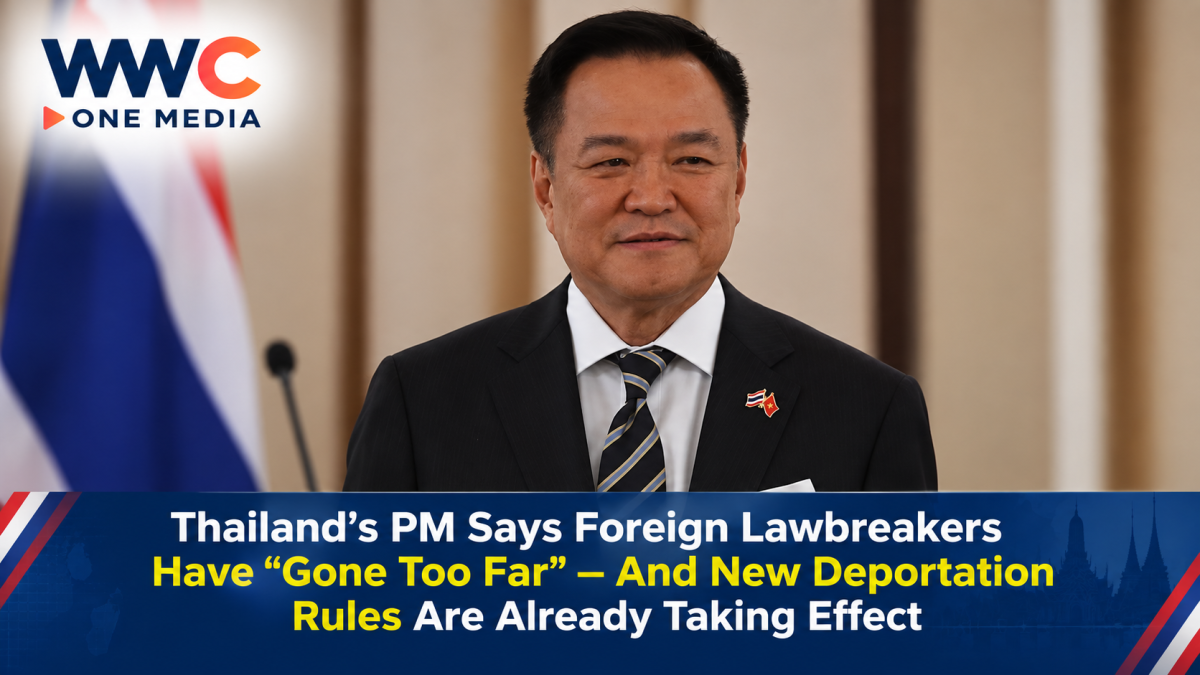
Thailand is escalating its crackdown on foreigners accused of breaking the law, operating illegal businesses or exploiting Thai citizens, with Prime Minister and Interior Minister Anutin Charnvirakul ordering provincial authorities to use the country’s new deportation framework more aggressively.
Speaking to officials on Sept. 17, Anutin delivered an unusually blunt warning to foreigners who violate Thai laws or take advantage of local communities.
He said foreigners who come to Thailand should make an honest living and respect Thai society, but those who threaten, intimidate, exploit or engage in illegal activities should face enforcement action.
The comments come amid growing public scrutiny of foreign-owned businesses, property arrangements and the behaviour of some foreign nationals in major tourist destinations including Phuket and Koh Samui.
But the government’s campaign is broader than any single nationality.
Thai authorities have repeatedly said the rules apply to foreigners generally, while legitimate tourists, residents and investors remain welcome if they comply with Thai law.
Anutin: The situation has “gone too far”
Anutin’s remarks came during a meeting on the implementation of Interior Ministry policies.
He directed provincial governors and local officials to act against foreigners whose conduct meets the legal criteria for enforcement, particularly those involved in illegal businesses, nominee arrangements, unauthorised employment, land-related violations or activities that threaten or exploit Thai people.
He also singled out issues involving private religious premises and a reported request for a private cemetery.
Anutin described the cemetery issue as having gone beyond what authorities could accept and said foreigners should not use Thailand’s hospitality or investment opportunities to circumvent local laws.
His comments have attracted international attention because of their unusually forceful language.
But behind the rhetoric is a more concrete policy change: Thailand has already introduced a new formal mechanism intended to make deportation decisions faster.
New deportation rules are already in force
Thailand’s new deportation regulation took effect on Aug. 28, 2026, after being published in the Royal Gazette.
The regulation establishes procedures for removing foreign nationals whose conduct violates Thai law or is considered harmful to public order, good morals or public welfare.
It also establishes coordination procedures between government agencies so that deportation decisions can be processed more efficiently.
Under the regulation, deportation can apply to foreigners involved in several categories of offences, including:
- Unlawful entry or stay in Thailand
- Illegal employment
- Illegal business operations under the Foreign Business Act
- Forgery or use of forged official documents
- Certain serious offences carrying prison sentences of at least five years
- Acting as a principal offender, instigator or supporter in specified offences
The rules also allow authorities to consider prohibiting a deported foreigner from re-entering Thailand for a specified period.
Importantly, deportation decisions must still take account of applicable Thai law, Cabinet resolutions and Thailand’s international obligations.
Phuket and Koh Samui are under particular scrutiny
The crackdown comes as Thai authorities intensify enforcement in some of the country’s most popular tourist destinations.
Phuket has become a major focus because of allegations involving foreign-controlled businesses, nominee shareholders and land arrangements designed to circumvent restrictions on foreign ownership.
Thailand has previously launched large-scale investigations into suspected nominee networks in Phuket, Phang Nga and Krabi.
In one June operation, authorities inspected 89 land plots worth about 1.053 billion baht as part of an investigation into suspected foreign nominee networks.
The wider campaign has also targeted businesses where Thai nationals are allegedly listed as shareholders on paper while foreigners exercise effective control.
These arrangements are particularly sensitive because Thai law restricts foreign ownership of certain businesses and land.
What is a “nominee” arrangement?
A nominee arrangement generally refers to a situation in which a Thai national is formally listed as a shareholder or owner while allegedly holding the interest on behalf of a foreigner who is the real beneficiary or controller.
Thai authorities have been increasing scrutiny of these arrangements because they can potentially be used to circumvent foreign-ownership restrictions.
The Department of Business Development has previously identified nominee structures as a major enforcement concern in tourist areas such as Phuket and Pattaya.
Authorities are also examining whether Thai shareholders actually provided the capital attributed to them and whether they genuinely exercise ownership rights.
The issue therefore extends beyond tourism.
It touches property, restaurants, hospitality businesses, construction, professional services and other sectors where foreign ownership restrictions may apply.
Thailand says the crackdown is not about nationality
The political and social backdrop has made this distinction increasingly important.
Recent public anger has particularly focused on some Israeli nationals and incidents involving foreign visitors in tourist destinations.
Hundreds of protesters gathered outside the Israeli Embassy in Bangkok on Sept. 10 amid calls for authorities to respond to alleged misconduct by some Israeli nationals. Thailand’s foreign minister subsequently discussed concerns with Israel’s ambassador.
But Thai officials have stressed that enforcement is not supposed to target one nationality.
Anutin said the people involved in the cases under discussion came from various parts of the world, including Asia, the Middle East, Central Asia, Europe and Africa.
That distinction matters because Thailand remains heavily dependent on international tourism and foreign investment.
The stated government position is that foreigners who follow the law and contribute legitimately to the economy remain welcome.
Deportation could become faster
One of the biggest changes is not simply the government’s tougher rhetoric but the machinery now available to provincial authorities.
The new regulation creates a formal process for reviewing cases and coordinating information between agencies.
For foreign prisoners approaching the end of a sentence, relevant information can be sent to the Interior Ministry so officials can consider whether a deportation order should be issued without unnecessary delay.
The regulation also addresses situations involving suspended sentences or fines.
In certain circumstances, authorities can consider deportation rather than simply allowing a foreign offender to remain in Thailand after completing the applicable legal process.
This is part of Anutin’s argument that Thailand should not continue spending public resources housing foreign offenders when the law permits their removal.
Anutin tells governors not to hesitate
The prime minister has urged provincial governors to use their legal powers rather than allowing administrative concerns to delay action.
He specifically dismissed worries about who would pay for deportation as a reason for failing to act when legal criteria are met.
According to The Nation’s account of his remarks, Anutin said provinces could advance costs and seek reimbursement through the established process.
He also told officials not to be deterred simply because a deportation decision could be appealed.
That does not mean every foreigner accused of wrongdoing can automatically be expelled.
Rather, officials still have to operate within the legal framework and satisfy the relevant criteria.
The crackdown also reaches foreign-owned land and businesses
Thailand’s campaign is occurring alongside a broader effort to strengthen enforcement of its foreign-business and land-ownership rules.
Authorities have investigated foreign nationals suspected of using Thai nominees to acquire or control land in areas where direct foreign ownership is restricted.
In June, officials said they had identified dozens of companies and land holdings in Phuket that warranted further investigation.
The government has also been examining suspected illegal businesses and foreign nationals working without appropriate permits.
That means the current crackdown is not limited to tourists behaving badly.
It also reaches foreigners who live in Thailand, operate businesses or acquire property.
Thailand is trying to close legal loopholes
The campaign follows months of efforts to tighten enforcement around foreign ownership and immigration.
Earlier reporting has documented increased scrutiny of visa practices, nominee companies and foreign-controlled businesses.
In June, Al Jazeera reported that Thai authorities were investigating hundreds of companies allegedly linked to nominee arrangements, including businesses in tourism-heavy provinces.
The government has increasingly framed the issue as one of protecting Thailand’s legal and economic system rather than simply restricting foreign participation.
The challenge is ensuring that enforcement targets genuine violations without creating uncertainty for legitimate foreign businesses and residents.
The economic balancing act
Thailand faces a difficult balance.
Foreign tourists generate substantial spending, while foreign businesses and investors contribute capital, jobs and economic activity.
Anutin himself acknowledged that tourism and foreign investment bring economic benefits.
But his argument is that those benefits do not give foreigners permission to circumvent Thai law.
The government is therefore attempting to draw a line between legitimate foreign participation and conduct it considers unlawful or exploitative.
How that line is enforced will be closely watched by Thailand’s tourism and business communities.
A new phase in Thailand’s foreigner policy
The latest developments suggest Thailand’s approach is moving from individual enforcement cases toward a more systematic framework.
The new deportation regulation provides the legal and administrative machinery.
Provincial governors are being instructed to use it.
And investigations into nominee businesses, illegal employment, land ownership and other alleged violations are expanding.
For foreign nationals living in Thailand, the message from the government is increasingly clear: legal status, lawful employment, genuine business ownership and compliance with Thai rules matter more than ever.
At the same time, the government continues to insist that lawful foreigners are welcome.
The controversy surrounding Anutin’s remarks therefore goes beyond one provocative speech.
It reflects a larger question facing Thailand as it tries to protect its domestic laws while remaining one of Asia’s biggest tourism and foreign-investment destinations:
How aggressively can Thailand tighten enforcement without undermining the legitimate international activity on which its economy depends?
For now, Anutin has signalled that his government intends to push enforcement further — and the new deportation framework gives provincial authorities another tool to do it.