NEW YORK / MANILA — November 4, 2026 | WWC ONE MEDIA | Global Business, Stock Markets & US Politics
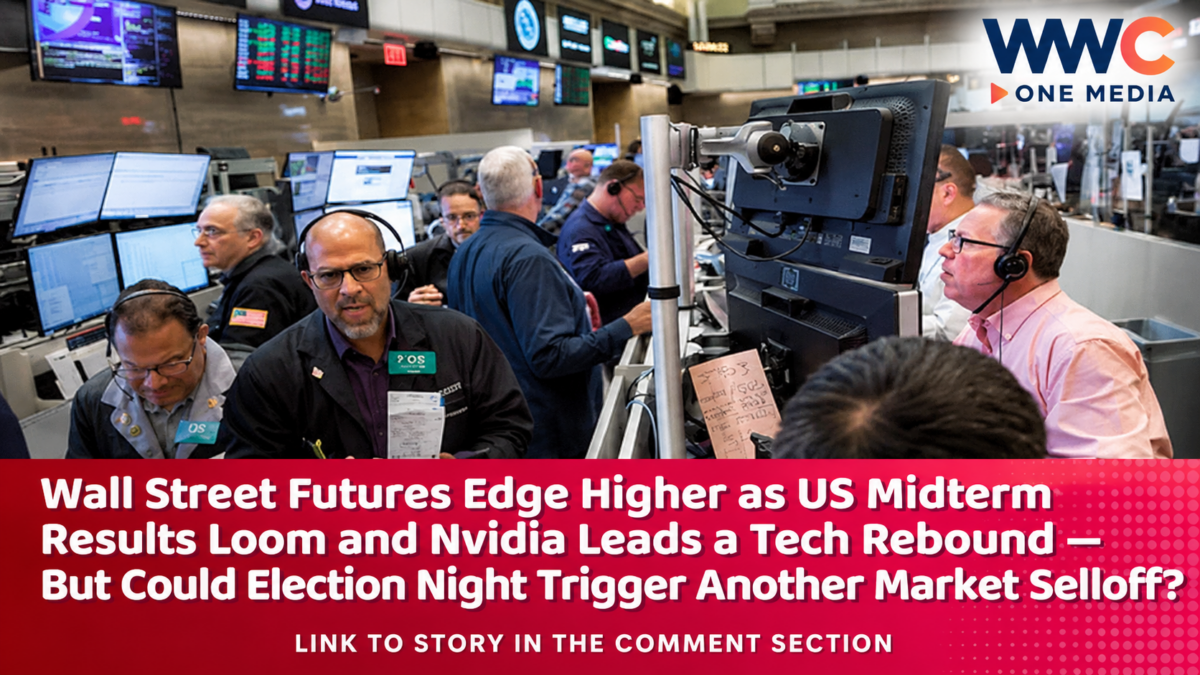
Wall Street is entering one of its most politically sensitive trading periods of 2026, with US stock futures edging higher as investors await the results of the midterm elections that could reshape Congress and President Donald Trump’s economic agenda.
The tentative rebound comes after weeks of volatility involving artificial intelligence stocks, rising borrowing costs, corporate earnings disappointments and uncertainty surrounding the conflict with Iran.
According to Bloomberg’s November 4 market coverage, US equity futures advanced modestly as investors monitored incoming election results.
MarketWatch separately reported that S&P 500 and Nasdaq-100 futures moved higher in late Tuesday trading, while futures linked to the Dow Jones Industrial Average slipped.
The moves followed a mixed regular trading session on November 3.
The S&P 500 gained 0.36% to close at 7,568.92, while the Nasdaq Composite advanced 0.83% to 25,372.01.
The Dow Jones Industrial Average, however, declined 0.38% to 51,786.72.
Technology stocks helped support the broader market, with Nvidia rising 2.3% and Broadcom gaining approximately 3.1%.
But the rally was far from universal.
Apple fell 1.9% after warning that rising memory-chip costs could squeeze future profit margins.
The mixed performance revealed a market struggling to decide whether political uncertainty is nearing its end or whether deeper financial risks remain.
With control of Congress at stake and the artificial intelligence boom facing growing scrutiny, investors are confronting a crucial question: will election clarity unlock another Wall Street rally—or could the next market shock arrive just as political uncertainty begins to fade?
US Equity Futures Rise, but Investors Remain Cautious
The latest movement in US stock futures suggests that investors are cautiously positioning for the political and economic developments expected after Election Day.
Futures contracts allow traders to gain exposure to stock indexes before the regular market session begins.
They can provide an early indication of investor sentiment, but their prices change continuously.
A modest overnight increase does not guarantee that Wall Street will open or close higher.
MarketWatch reported that futures for the S&P 500 and Nasdaq-100 advanced in late Tuesday trading as investors awaited election results.
Dow futures moved slightly lower.
The divergence reflects the different composition of the indexes.
The Nasdaq has substantial exposure to large technology companies, while the Dow includes businesses from a wider range of industries and uses a price-weighted calculation.
As a result, strong gains in Nvidia and other technology stocks can lift the Nasdaq even when many companies elsewhere in the market are falling.
The futures rebound should therefore be interpreted as tentative optimism rather than confirmation of a broad market recovery.
Nvidia Leads a Technology Rebound After the AI Selloff
Artificial intelligence stocks provided much of the support for the November 3 session.
Nvidia gained 2.3%, while Broadcom advanced approximately 3.1%.
Micron Technology rose around 2.6%, and major technology companies including Microsoft, Amazon and Meta also recorded gains exceeding 2%.
The rebound followed a difficult period for the technology sector.
Reuters reported that the Nasdaq-100 had entered correction territory after falling more than 10% from its October 6 record closing level.
Investors had become increasingly concerned about the enormous investments required to develop AI infrastructure.
Data centers need specialized semiconductors, electricity, cooling systems and networking equipment.
These investments may create substantial opportunities over the long term.
However, building the infrastructure is expensive, and some investors are questioning how quickly companies can generate sufficient revenue to justify the spending.
WWC ONE MEDIA previously examined the market’s uncertainty in Wall Street’s Midterm Rally Faces an AI Reality Check as Tech Stocks Slide — But Could Nvidia Decide Whether the Market Rebounds or Crashes Again?.
That report explored warnings that the midterm elections might not be enough to revive technology stocks if investors remain dissatisfied with the financial returns from AI development.
The November 3 rebound indicates that buyers have not abandoned the sector.
But one positive session does not establish that the correction has ended.
Apple’s Decline Shows Why Strong Earnings Are No Longer Enough
While Nvidia and several semiconductor companies rallied, Apple faced renewed selling pressure.
The iPhone maker declined approximately 1.9% during the November 3 regular session.
The weakness followed its latest earnings announcement, which included record quarterly revenue but warned about pressure on profit margins.
Apple reported approximately $114.48 billion in revenue for its fiscal fourth quarter.
However, its guidance indicated that rising memory-chip costs could reduce profitability during the important holiday shopping period.
WWC ONE MEDIA previously reported on the results in Apple Posts Record $114.5-Billion Quarter, but China Sales Miss Wall Street Forecasts — Could Rising AI Chip Costs Derail the iPhone Boom?.
The contrast between record sales and a falling share price illustrates an important feature of financial markets.
Investors do not value companies solely on their latest revenue figures.
They also assess expected earnings, future margins, competitive risks and whether the share price already reflects optimistic assumptions.
Apple’s decline demonstrates why an earnings beat does not guarantee a stock market rally.
For the wider technology sector, the concern is whether higher infrastructure and component costs will begin reducing profitability.
Trump’s Midterm Elections Become Wall Street’s Biggest Political Test
The November 3 US midterm elections are expected to determine which party controls the House of Representatives and Senate.
Republicans entered the contest controlling both chambers of Congress.
Democrats are seeking to capture enough seats to challenge President Trump’s legislative agenda during the remaining two years of his term.
For investors, the result could influence expectations about government spending, corporate taxes, industry regulation and federal oversight.
A Democratic-controlled House could make it more difficult for the administration to advance certain legislative priorities.
If Republicans retain both chambers, the president may have a more favorable environment for pursuing his policy agenda.
However, neither outcome guarantees a particular stock market response.
Financial markets react to the difference between expectations and actual developments.
If investors have already anticipated a divided Congress, the eventual result may generate relatively little additional movement.
WWC ONE MEDIA previously examined the political stakes in US Midterms 2026: Six Things That Could Decide Control of Congress — Is Trump Facing a Political Turning Point?.
The report examined the battle for congressional control, voter turnout, election administration and the potential implications for Trump’s presidency.
Those political developments are important for markets, but economic fundamentals remain equally significant.
Could Divided Government Actually Help Stocks?
Some market analysts believe a divided US government could reduce the likelihood of major policy changes.
The argument is that when different parties control Congress and the presidency, passing major legislation generally requires more negotiation.
That can create a more predictable environment for some businesses.
Reuters cited Bokeh Capital Partners chief investment officer Kim Forrest discussing the potential market appeal of divided government.
But political gridlock also creates risks.
Disagreements over federal spending can produce budget disputes, government shutdown threats or delays in important legislation.
A divided government may also increase congressional investigations and regulatory scrutiny.
For that reason, investors should not assume that a Democratic victory in the House would automatically lift stock prices.
The outcome will depend on the specific policies under discussion and the broader economic environment.
Morgan Stanley analysts reportedly argued that the recent market correction could be nearing its final stages.
That assessment offers a more optimistic interpretation.
However, it remains an investment judgment rather than a guarantee of higher prices.
Why the AI Investment Boom Could Become a Political Issue
Artificial intelligence is no longer simply a technology-sector story.
The industry now involves enormous investments in electricity generation, land, data centers and infrastructure.
These developments create economic opportunities but also raise questions about environmental impacts, energy affordability and competition.
A change in congressional control could influence the extent of federal scrutiny involving AI infrastructure.
Lawmakers may examine how large technology companies finance new data centers, compete in emerging markets and manage access to electricity.
WWC ONE MEDIA previously analyzed these concerns in Big Tech’s $750-Billion AI Gamble Shakes Wall Street as Core Businesses Slow — But Will the Spending Ever Pay Off?.
The report discussed estimates that capital expenditure among several leading technology companies could approach three-quarters of a trillion dollars in 2026.
Those estimates include activities beyond AI and should not be treated as an audited measure of artificial intelligence spending alone.
For investors, the central question is whether the enormous financial commitments will generate sufficient future profits.
The election results may influence regulation and sentiment.
But they cannot independently determine whether the underlying AI investments will succeed commercially.
Oil Prices and Iran Peace Talks Add Another Major Risk
Geopolitical uncertainty is also influencing Wall Street.
Oil prices have fluctuated sharply amid diplomatic efforts involving the United States and Iran.
Investors are monitoring whether negotiations could reduce threats to energy supplies and shipping through the Middle East.
Lower oil prices may ease inflation pressures, potentially reducing the need for additional monetary tightening.
But the conflict remains unresolved.
The Associated Press reported that Brent crude settled at approximately $103.60 a barrel on November 3, a decline of roughly 1.1%.
The movement followed a much sharper oil-price decline during the preceding session.
WWC ONE MEDIA previously examined the volatility in Oil Prices Crash Nearly 8% as Iran Peace Talks Send Brent to $104 — But Could One Failed Deal Trigger a $140-a-Barrel Shock?.
The report explored how renewed diplomatic optimism had reduced part of the geopolitical risk premium in crude oil markets.
However, the possibility of a settlement does not establish that an agreement has been finalized.
A new military escalation could quickly reverse the decline in energy prices.
For US stocks, the relationship is complicated.
Lower oil prices may help consumer spending and reduce business costs.
But energy companies may face pressure if lower crude prices reduce their expected revenue.
As a result, movements in oil markets can benefit some sectors while hurting others.
Federal Reserve Policy Remains a Bigger Long-Term Concern
The Federal Reserve’s interest-rate decisions are another important influence on US stock valuations.
Higher interest rates increase borrowing costs and can reduce the present value investors assign to future corporate earnings.
Technology companies with ambitious growth expectations can be especially sensitive to changes in bond yields.
The latest US economic data also suggest that the economy remains resilient in some areas.
Bloomberg reported that job openings increased to a four-month high, while layoffs declined.
The data contributed to a rise in bond yields during November 3 trading.
For the Federal Reserve, stronger labor demand may reduce the urgency of easing monetary policy.
But investors are also concerned about inflation, particularly because the Middle East conflict has pushed energy costs higher.
A central bank that keeps interest rates elevated for longer can create additional pressure on highly valued stocks.
This means the post-election market outlook will depend on more than which party wins Congress.
The next inflation reports, labor-market figures and Federal Reserve statements could prove just as important.
Why Tuesday’s Wall Street Rally Was Narrower Than It Looked
The S&P 500 and Nasdaq both finished November 3 in positive territory.
But the gains were concentrated in a relatively small group of influential companies.
Reuters reported that declining stocks outnumbered advancing shares in the S&P 500 by approximately 1.6 to one.
That means many individual companies fell even while the benchmark index increased.
This is possible because the S&P 500 is weighted by market capitalization.
Large companies can have a disproportionate influence on the index.
When heavily weighted technology stocks rise sharply, they can offset declines in numerous smaller companies.
For investors, the difference between index performance and market breadth is important.
A stronger and more durable rally would generally involve participation across a broader range of sectors.
The November 3 session therefore provided evidence of renewed demand for selected technology stocks rather than an unambiguous recovery across Wall Street.
What Could Happen After the Election Results?
Financial markets could react in several different ways as election results become clearer.
If the outcome largely matches investors’ expectations, stocks may experience only limited political volatility.
If an unexpected party victory changes assumptions about taxes, spending or regulation, investors may rapidly adjust positions.
Close races could also delay clarity about congressional control.
That may prolong uncertainty in sectors most exposed to federal policy.
However, even a decisive election result would not resolve the economic risks facing US businesses.
Technology companies still need to demonstrate acceptable returns on AI spending.
Consumers remain sensitive to inflation.
Corporate borrowers continue facing financing costs.
And international energy markets remain vulnerable to geopolitical developments.
Historical market patterns provide context, but they do not guarantee future performance.
Some strategists note that US equities have frequently performed well in the year following midterm elections.
Past returns, however, cannot establish that the same pattern will repeat in 2026.
Why Philippine and Asian Investors Should Pay Attention
US market volatility can influence investor sentiment across Asia.
International funds often hold substantial positions in American equities, particularly large technology companies.
Changes in US interest rates and Treasury yields can also affect capital flows into emerging markets.
For Philippine investors, significant movements in Wall Street may influence global risk appetite and foreign exchange conditions.
A stronger dollar can place pressure on currencies in other economies.
Higher US bond yields may also make American fixed-income investments more attractive relative to riskier assets.
However, movements in Philippine stocks do not necessarily mirror those of the Nasdaq or S&P 500.
The Philippine market has a different industry composition, with greater exposure to banks, property companies, utilities and consumer businesses.
The effect of US political developments should therefore be evaluated alongside local corporate earnings and economic conditions.
What Independent News Outlets Confirm
Bloomberg’s November 4 headline reported that US equity futures edged higher as investors awaited the midterm election results.
MarketWatch independently described futures as mostly higher in late Tuesday trading, with S&P 500 and Nasdaq-100 contracts advancing while Dow futures declined.
Reuters confirmed that the November 3 regular session ended with the Nasdaq gaining 0.83%, the S&P 500 rising 0.36% and the Dow falling 0.38%.
The Associated Press also confirmed the closing levels and reported gains among Nvidia, Broadcom and other technology companies.
The Guardian documented the technology-sector rebound after the Nasdaq’s earlier correction.
Together, these reports support the central account of cautious market optimism.
However, the exact intraday percentages of the November 4 Bloomberg futures report could not be independently confirmed from its restricted full text.
Futures prices also change rapidly, so figures from different trading hours should not be treated as contradictory or directly interchangeable.
The Bottom Line: Political Clarity May Not Be Enough for Wall Street
US equity futures are showing tentative optimism as investors await the results of the November 3 midterm elections.
The rebound follows a mixed session in which selected AI and semiconductor stocks helped lift the S&P 500 and Nasdaq.
But the Dow declined, Apple remained under pressure and many individual companies failed to participate in the technology-led rally.
For investors, the political outcome could help resolve one major source of uncertainty.
A shift in congressional control may affect expectations about legislation, federal oversight and government spending.
However, the biggest challenges facing Wall Street extend beyond Washington.
Artificial intelligence companies must justify enormous investment commitments.
The Federal Reserve must balance inflation risks against economic growth.
And geopolitical tensions involving Iran continue to influence energy prices and financial conditions.
Wall Street may be approaching a political turning point, but the market’s financial challenges will remain long after the ballots are counted.
As stock futures edge higher and Nvidia leads technology shares into another rebound, will the US midterm results unleash the powerful rally investors have been waiting for—or could unresolved AI spending risks, higher interest rates and geopolitical instability trigger another market selloff?