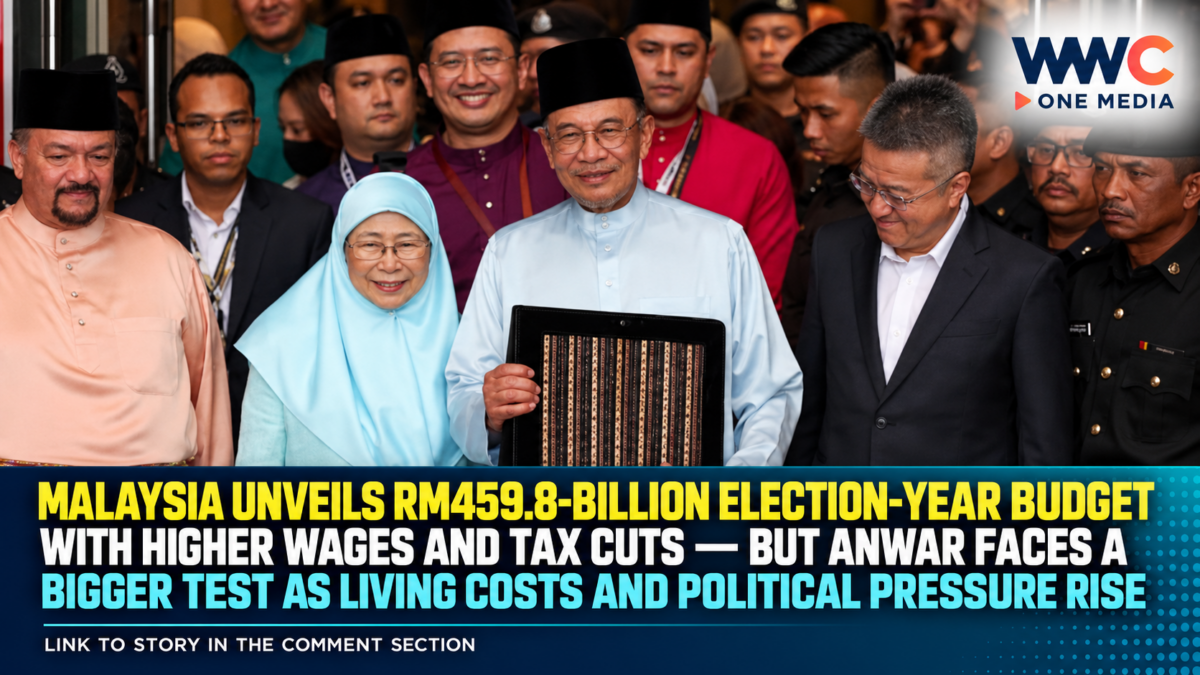
KUALA LUMPUR, MALAYSIA — Prime Minister Anwar Ibrahim has unveiled a sweeping RM459.8-billion (US$112.5-billion) national budget for 2027, promising higher minimum wages, expanded tax relief, financial assistance for millions of Malaysians and major investments in artificial intelligence. The package could provide significant relief to households struggling with rising living costs. But as a possible early general election approaches, Anwar faces a tougher challenge: delivering these benefits while reducing government borrowing, controlling costly fuel subsidies and convincing voters that Malaysia’s economic growth is improving their daily lives.
Malaysia is preparing for a critical economic and political year after Anwar Ibrahim, who also serves as finance minister, presented his fifth national budget to parliament on Friday, October 9.
The proposed 2027 spending plan totals RM459.8 billion, equivalent to approximately US$112.5 billion.
The package brings together measures aimed at workers, middle-income taxpayers, gig-economy participants, farmers, first-time homebuyers and businesses.
It also signals a renewed commitment to digital infrastructure, artificial intelligence and higher-value economic activity.
According to Channel NewsAsia and Reuters, the budget comes at a sensitive moment for Anwar’s administration.
Malaysia’s next general election must be held by February 2028, although the government could call an election earlier.
That makes the 2027 spending plan potentially the final full budget presented by Anwar’s administration before voters return to the polls.
But the political challenge goes beyond offering financial assistance.
The government must demonstrate that its promises can be implemented without undermining efforts to improve Malaysia’s finances.
1. Malaysia Raises Minimum Wage to RM2,000 From June 2027
One of the budget’s most important announcements is an increase in Malaysia’s monthly minimum wage.
The government plans to raise the wage floor from RM1,700 to RM2,000 beginning in June 2027.
The increase amounts to RM300 per month, or approximately 17.6%.
Anwar said more than four million workers are expected to benefit.
The move is intended to address the growing pressure on lower-paid employees as household expenses rise.
For workers earning the existing minimum wage, the proposed adjustment represents a meaningful improvement in gross monthly income.
However, the increase will not immediately apply to every business.
Micro, small and medium-sized enterprises with annual sales below RM50 million will be exempted initially to allow them time to adjust.
This qualification is crucial.
It means the headline figure of four million potential beneficiaries should not be interpreted as proof that every Malaysian worker will receive a RM300 pay increase.
The actual effect will depend on the implementation rules, employer eligibility and existing wage arrangements.
For businesses, higher wages may support household spending but also increase labor costs.
The government’s challenge will be balancing stronger worker incomes with the financial capacity of employers.
2. Government Targets Higher Starting Salaries for Graduates and Semi-Skilled Workers
The budget includes another wage-related reform aimed at workers who have qualifications but may struggle to secure adequate starting salaries.
Anwar announced a new minimum monthly starting salary benchmark of RM2,500 for semi-skilled workers and graduates.
The move is part of a broader effort to strengthen Malaysia’s wage structure and improve the relationship between skills and earnings.
The initiative responds to concerns that educational qualifications and productivity growth have not always translated into sufficiently higher pay.
Separately, government-linked companies and government-linked investment companies have committed to increasing their living-wage benchmark from RM3,100 to RM3,400 per month.
According to the government, approximately 230,000 workers could benefit.
However, these measures have different scopes.
The RM2,000 statutory minimum wage, the RM2,500 starting-salary initiative and the RM3,400 government-linked-company living-wage benchmark should not be treated as one universal wage rule covering every employee.
Each is intended for a different category of workers or employers.
3. Middle-Income Malaysians Could Save Up to RM1,600 Through Tax Changes
Tax relief is another major component of the budget.
The government plans to increase the basic individual income tax relief allowance from RM9,000 to RM12,000.
That marks the first adjustment to the allowance since 2010.
The higher relief reduces the portion of income subject to tax for eligible taxpayers.
Malaysia is also lowering certain personal income tax rates.
Under the announced revisions, the rate applied to taxable income between RM70,000 and RM100,000 will be reduced to 18%.
The rate applicable to the RM100,000-to-RM150,000 bracket will be reduced to 24%.
The changes are intended to provide additional disposable income to middle-income households.
Anwar said the combined effect of the higher allowance and lower tax rates could provide up to RM1,600 in additional disposable income to around five million taxpayers.
The phrase “up to” is important.
It does not mean that every eligible taxpayer will automatically receive RM1,600 in cash.
Actual tax savings will depend on each person’s taxable income, applicable deductions and individual circumstances.
The government is also expanding tax relief for certain expenses, including postpartum care and caregiving support for parents and grandparents.
Together, the measures aim to ease pressure on household budgets without relying entirely on direct cash transfers.
4. Gig Workers Get RM160-Million Support Package With Grab
The budget also places greater emphasis on people working through digital platforms.
Malaysia has approximately 600,000 e-hailing drivers and delivery riders, according to figures cited by Anwar.
These workers often face income uncertainty, vehicle maintenance costs and limited financial protection.
To address those concerns, the government plans to jointly fund an RM160-million package with Grab.
The package is intended to support minimum income arrangements and help cover expenses such as vehicle maintenance and insurance.
The initiative is scheduled to begin in 2027.
However, the RM160-million figure represents the combined package rather than a confirmed cash payment to every rider or driver.
The exact benefit available to each participant will depend on the scheme’s eligibility and implementation arrangements.
The budget also provides targeted assistance to other transport workers.
Approximately 38,000 taxi drivers and 15,000 bus drivers are expected to receive a one-time payment of RM1,000 each.
These measures reflect the government’s effort to expand support to workers whose income arrangements differ from conventional salaried employment.
5. Farmers Receive RM2.62 Billion in Assistance
Agriculture is another focus of the 2027 budget.
The government has allocated RM2.62 billion for various support programmes benefiting farmers.
According to CNA, assistance could amount to approximately RM4,300 per hectare through applicable subsidy measures.
The package is intended to support agricultural production and help farmers manage operating costs.
Agriculture remains important to Malaysia’s food supply and rural economy.
Higher production costs can affect farm profitability and eventually influence consumer food prices.
The government hopes targeted assistance can provide relief while supporting domestic food production.
However, the per-hectare figure represents support through different schemes and should not be understood as an automatic cash payment to every farmer for every hectare.
Actual eligibility and benefit amounts will depend on the relevant agricultural programmes.
6. Sabah and Sarawak Receive Billions for Infrastructure and Public Services
The budget also increases allocations for Malaysia’s two eastern states.
Sabah is scheduled to receive RM18.7 billion, compared with RM17.6 billion in 2026.
Sarawak is allocated RM16.2 billion, up from RM15.1 billion.
Together, the two figures total RM34.9 billion.
The money is intended to support infrastructure, electricity supply, education and other development priorities.
The government has separately allocated RM3.3 billion for road projects in the two states.
Anwar also announced additional scholarship opportunities for students from Sabah and Sarawak.
The government expects approximately 4,200 students from the two states to benefit from public-service scholarship opportunities in 2027.
The allocations are politically and economically important because infrastructure gaps and regional development disparities remain major issues in Malaysia.
Anwar has also linked the spending commitments to the government’s responsibility to uphold rights associated with the Malaysia Agreement 1963.
For Sabah and Sarawak, the major test will be whether the higher allocations produce visible improvements in transportation, utilities and educational opportunities.
7. Malaysia Targets Lower Deficit Despite Larger Budget
Perhaps the most difficult part of Anwar’s plan is the government’s fiscal target.
Malaysia is increasing total spending while promising to reduce its budget deficit.
The government expects the fiscal deficit to fall from a revised 3.6% of gross domestic product in 2026 to 3.3% in 2027.
Its longer-term goal is to reduce the deficit to 3% of GDP by 2028.
The administration also projects that federal debt as a share of GDP will decline from 65.2% in 2025 to 64% in 2026 and 63.7% in 2027.
These targets are intended to reassure investors and demonstrate continued fiscal consolidation.
But there are risks.
Global energy prices, weaker-than-expected economic growth, lower tax revenue or unexpected spending needs could complicate the projections.
The key distinction is that these are government forecasts rather than final outcomes.
The administration will need to demonstrate that revenue collection and expenditure controls are sufficient to deliver the promised reduction.
8. Rising Fuel Subsidies Remain a Major Challenge
Malaysia’s budget has been shaped by the effects of higher energy prices and continuing instability in the Middle East.
Anwar said fuel subsidy costs increased to approximately RM40 billion in 2026.
That contributed to the government’s decision to revise its 2026 deficit target from 3.5% to 3.6% of GDP.
The experience highlights Malaysia’s vulnerability to international energy shocks.
Although the country is an energy producer, changes in global prices can still affect government subsidy commitments and household expenses.
The administration has pursued subsidy rationalization as part of its effort to improve public finances.
However, subsidy reforms are politically sensitive because consumers may experience higher costs when government support is reduced.
The government must therefore balance three competing objectives: protecting lower-income households, managing fiscal pressures and maintaining price stability.
Reuters has described this balancing act as a central challenge facing Anwar ahead of a possible election.
9. Malaysia Announces 100,000 More Free AI Subscriptions
Technology is another major component of the spending plan.
The government announced that it would provide an additional 100,000 free artificial intelligence subscriptions.
The expanded programme will include access to applications such as ChatGPT.
Anwar said the new allocation follows encouraging participation in an earlier AI subscription initiative for young Malaysians.
The government also intends to develop a sovereign AI cloud designed to keep national data and strategically important information under Malaysian control.
The initiative reflects the growing importance of AI infrastructure, digital skills and data security.
However, the additional 100,000 subscriptions have been announced as a future initiative.
The budget speech does not mean that every Malaysian resident immediately qualifies for a free commercial ChatGPT subscription.
Detailed eligibility, distribution arrangements and platform-specific terms will need to be communicated through official channels.
10. Malaysia Expands AI Workforce and Business Adoption Programmes
Beyond consumer access to AI tools, the government wants to strengthen Malaysia’s technological workforce.
AI Malaysia Berhad will receive nearly RM15 million to support the development of a safe and ethical AI ecosystem.
The initiative supports a national target of developing 200,000 AI-skilled workers.
Meanwhile, the Malaysia Digital Economy Corporation, or MDEC, will receive RM30 million to help approximately 4,000 micro, small and medium-sized enterprises adopt AI and automation.
The same programme is intended to train and certify 5,000 AI professionals.
The government has also allocated RM6 billion across ministries for research, development and commercialization of innovations.
These measures are intended to help businesses move toward higher-value activities rather than compete primarily through low labor costs.
However, investment announcements alone do not guarantee increased productivity.
The eventual impact will depend on business adoption, employee training, commercially useful applications and measurable returns.
11. Creative Industries Receive More Than RM130 Million
The 2027 budget also includes support for film, music and digital creative content.
The government plans to allocate more than RM130 million to the creative sector.
The funding is intended to support local content, generate employment and strengthen Malaysia’s creative industries.
Additional incentives will encourage film and animation production in Malaysia, including projects that promote Malaysian culture and identity.
Another measure will exempt tickets for local films and theatre performances in the Federal Territories from entertainment duty beginning in 2027.
The government hopes the combination of tax incentives and sector-specific funding will support creative businesses.
This could be relevant to Malaysia’s film industry, animation studios, production companies and digital content creators.
However, the allocation is a sector-wide announcement.
It should not be presented as funding reserved for a particular studio or production without separate official confirmation.
12. RM16 Billion in Cash Aid Targets Lower-Income Malaysians
Reuters also reported that the budget includes approximately RM16 billion in cash assistance for lower-income citizens.
The assistance forms part of the government’s wider effort to cushion households from rising living costs.
Cash transfers can provide more immediate support than longer-term measures such as technology investment or infrastructure spending.
For financially vulnerable families, direct assistance can help cover food, transportation and other essential expenses.
However, the total allocation should not be divided equally across the entire Malaysian population.
The assistance will operate through designated programmes with their own eligibility criteria and payment structures.
Individual households should check official Malaysian government announcements to determine which benefits apply to them.
13. Housing Assistance and Small-Business Support Aim to Broaden Economic Benefits
The budget also includes measures designed to support first-time homebuyers and smaller businesses.
These initiatives reflect two major economic concerns: housing affordability and the financial pressures facing enterprises.
For first-time buyers, housing-related measures may help reduce some costs associated with entering the property market.
For businesses, targeted assistance and productivity programmes may support investment and modernization.
However, housing affordability depends on more than government incentives.
Property prices, borrowing costs, household incomes and local housing supply also determine whether people can purchase homes.
Similarly, business support does not automatically translate into stronger profitability.
The programmes will need to deliver benefits that businesses and households can access in practice.
14. Economic Growth Remains Resilient, but Risks Are Rising
Malaysia enters the 2027 budget period with relatively resilient economic performance.
Reuters reported that strong technology-related export demand has helped support growth.
The expansion of AI infrastructure and the semiconductor industry has created opportunities for Malaysia’s manufacturing and technology sectors.
The government raised its 2026 growth outlook toward the upper end of a 4.8%–5.3% range.
For 2027, it forecasts growth of approximately 4.2%–5.2%.
These are projections rather than guaranteed results.
Risks include energy price volatility, international trade disruptions, shifts in demand for electronics and potential pressure on public finances.
Malaysia’s performance will depend partly on external economic conditions beyond the government’s direct control.
The budget attempts to maintain investment momentum while providing more immediate relief to households.
Whether it can achieve both objectives will become clearer as spending programmes are implemented.
15. Could Budget 2027 Become Anwar’s Election Budget?
The political timing is difficult to ignore.
Malaysia must hold its next general election by February 2028.
Anwar’s administration could call an election earlier, making the 2027 budget potentially its last major fiscal announcement before a national vote.
The package places particular emphasis on issues that directly affect households.
Higher wages, lower personal income taxes, cash aid and assistance for transport workers may be welcomed by voters experiencing financial pressure.
But economic measures do not always translate into electoral support.
Voters may assess whether promised benefits have actually reached them, whether prices remain affordable and whether public services have improved.
CNA’s October 10 political analysis found that economists generally recognized the budget’s fiscal discipline, while some questioned whether the package offered enough immediate impact to change voter sentiment significantly.
That difference is central to the debate.
A policy can be fiscally reasonable without becoming politically transformative.
For Anwar, the immediate challenge is implementing reforms; the political challenge is persuading voters that their living standards are improving.
16. Why Malaysia’s Budget Matters to the Philippines and Southeast Asia
Malaysia’s economic decisions carry regional significance.
The country is an important participant in ASEAN trade, manufacturing, energy markets and technology supply chains.
Its policies affecting wages, taxation, investment and digital development may influence business decisions across the region.
Malaysia’s emphasis on AI, semiconductors and higher-value industries also reflects growing competition among Southeast Asian economies for technology investment.
For the Philippines, the budget provides a useful comparison in policy approaches.
Both countries face questions about wage growth, cost-of-living support, digital modernization and fiscal management.
However, Malaysian tax and wage policies do not automatically apply to Philippine workers or businesses.
Their impact on the Philippines would depend on trade, investment, competition and other economic connections.
The broader regional lesson is that governments are being challenged to support household incomes while maintaining investor confidence and controlling public debt.
The Bigger Picture: Anwar Must Prove That Economic Growth Reaches Ordinary Malaysians
Malaysia’s RM459.8-billion budget represents one of the most important policy announcements of Anwar Ibrahim’s administration as the country approaches its next general election.
The package promises significant changes affecting wages, taxation, welfare assistance, regional development and artificial intelligence.
More than four million workers could benefit from the higher minimum wage.
Approximately five million taxpayers may receive relief through the revised income tax framework.
Gig workers, farmers and transport operators are also among the groups targeted for support.
At the same time, the government is pledging to reduce the fiscal deficit to 3.3% of GDP in 2027, despite the pressure of higher energy costs.
The success of the strategy will depend on whether announced programmes are implemented effectively and whether Malaysians experience real improvements in purchasing power.
Anwar has presented a budget designed to deliver more money to households, support economic modernization and maintain fiscal discipline.
But with a possible early election approaching, the bigger test is whether the government can turn those promises into lasting improvements before voters decide its political future.
Malaysia’s 2027 budget may be remembered not merely for its RM459.8-billion price tag, but for whether it strengthened public confidence in the country’s economic direction at a decisive political moment.