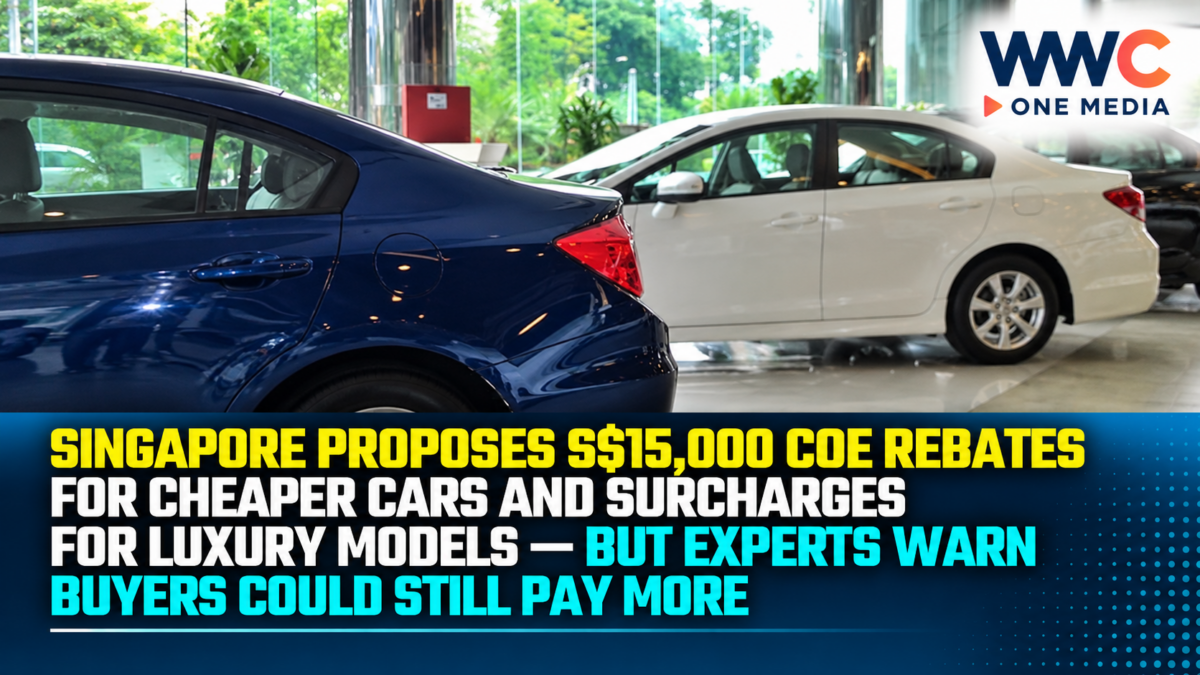
SINGAPORE — Singapore is considering one of the biggest changes to its car ownership system in years, with a proposal to merge two major Certificate of Entitlement (COE) categories and give buyers of lower-value cars rebates of up to S$15,000 while imposing equivalent surcharges on expensive models. The plan could create a S$30,000 difference in COE costs between mass-market and luxury vehicles. But as motorists delay purchases and car dealers question whether wealthy buyers will even notice the surcharge, experts warn that the overhaul could fail to deliver its most anticipated benefit: genuinely more affordable cars for ordinary Singaporean families.
Singapore’s proposed reform of its vehicle ownership system has triggered uncertainty throughout the automotive market.
On October 8, the Land Transport Authority (LTA) launched a public consultation on merging Categories A and B into one passenger-car COE category.
The proposal would replace the current distinction based largely on engine specifications with a fee-and-rebate mechanism linked to a vehicle’s Open Market Value (OMV).
Buyers of lower-value vehicles could receive a rebate, while purchasers of higher-value cars would pay a surcharge.
But the announcement has prompted an important question among motorists and dealers: will the changes actually make family cars cheaper, or merely rearrange how Singapore’s already-expensive COE costs are distributed?
By October 9, some car showrooms in Ubi were experiencing subdued customer interest, with potential buyers choosing to delay purchases until the government’s plans become clearer.
For the automotive industry, the coming months could bring both commercial uncertainty and significant changes in consumer behavior.
Singapore Plans Major Merger of COE Categories A and B
The existing COE system separates passenger cars into two principal categories based on technical characteristics.
Category A generally covers smaller, lower-powered cars meeting specified engine and power limits.
Category B covers cars outside those limits.
The classification was designed to distinguish typical mass-market vehicles from larger or more powerful models.
However, advances in automotive technology have weakened that distinction.
Modern electric vehicles can have very different specifications from traditional petrol cars.
Manufacturers have also introduced lower-powered versions of premium models that qualify for Category A.
As a result, comparatively expensive vehicles can compete for the same COEs as more affordable family cars.
LTA believes the existing categories no longer consistently reflect the value of the vehicles being purchased.
The proposed merger aims to resolve that problem.
How the Proposed S$15,000 Rebate and Surcharge Would Work
Under the proposed fee-and-rebate system, sometimes called a feebate, vehicles would be assigned to different value bands.
The framework being considered would broadly operate as follows:
- Buyers of lower-value cars could receive rebates of up to S$15,000.
- Buyers of middle-range vehicles could face no adjustment.
- Buyers of higher-value cars could pay surcharges of up to S$15,000.
The difference between the maximum rebate and maximum surcharge would therefore be S$30,000.
However, the government is consulting on whether to use three or five value bands, among other design details.
The precise eligibility thresholds have not been finalized.
The S$15,000 figures are part of the consultation proposal, not a new entitlement already available to car buyers.
Why Open Market Value Could Replace Engine Power as a Key Distinction
A central feature of the proposed framework is the use of Open Market Value.
OMV broadly reflects the value of a vehicle when imported into Singapore, before certain local taxes and charges are applied.
Under LTA’s proposal, car models would be placed into fee-and-rebate bands based on their median OMV.
This could reduce the incentive for manufacturers to modify engine power simply to qualify a more expensive vehicle for the lower COE category.
Raymond Tang, first vice-president of the Singapore Vehicle Traders Association, told CNA that the present distinction between Categories A and B had become increasingly ineffective.
However, the reform could encourage manufacturers and dealerships to pay closer attention to vehicles’ assessed OMVs.
It may also influence which models importers decide to offer in Singapore.
The Straits Times reported concerns about how value bands would be established and whether importers could find ways to influence classification.
These concerns are among the issues that the consultation process must address.
Luxury Car Buyers May Barely Notice the S$15,000 Surcharge
One of the sharpest criticisms comes from dealers selling premium vehicles.
Anson Lee, managing director of Euro Performance Asia, told CNA that an additional S$15,000 charge may have little effect on consumers buying cars worth S$400,000 or more.
For those customers, the surcharge represents only a relatively small share of the total purchase price.
Lee suggested that a surcharge closer to S$25,000 might be more effective in creating a meaningful difference between mass-market and premium vehicles.
Raymond Tang similarly questioned whether the proposed surcharge would substantially influence buyers’ decisions.
The underlying concern is straightforward.
If wealthy motorists remain willing to pay high COE premiums, their bidding could continue to affect the market even after a new surcharge is introduced.
That would limit the reform’s ability to improve affordability for buyers of cheaper cars.
Economists Warn COE Premiums Could Rise
The Business Times reported that economists and automotive industry observers see risks in merging the COE categories.
Walter Theseira, associate professor of economics at the Singapore University of Social Sciences, said the proposed rebate-and-surcharge mechanism could create a clearer cost difference between mass-market and luxury vehicles.
But other experts warned that combining the categories could intensify competition during COE bidding.
Automotive consultant Say Kwee Neng suggested that a merger might push overall premiums higher.
The concern involves supply and demand.
If buyers from the current Categories A and B compete within the same pool, the additional willingness to pay among luxury-car purchasers could influence the clearing premium.
The rebate might lower the final amount paid by an eligible buyer, but an increase in the underlying COE premium could absorb some or all of that benefit.
This means the policy could make cheaper cars relatively less expensive than luxury vehicles without making them substantially cheaper than they are today.
The Biggest Issue: Singapore Is Not Increasing COE Supply
LTA has emphasized that its review focuses on the classification of COEs.
It does not propose increasing the supply of certificates.
This is one of the most important facts for motorists.
Singapore limits the vehicle population through its COE quota system.
As long as demand remains strong relative to available certificates, competitive bidding can keep premiums elevated.
The proposed changes redistribute costs according to vehicle value but do not eliminate scarcity.
Some buyers may benefit.
Others may pay more.
The average price level will still depend heavily on market conditions.
That is why experts caution against describing the proposal as a guaranteed solution to expensive car ownership.
Singapore’s COE Prices Remain Extremely High
The debate is unfolding while COE premiums remain elevated.
In the October 7 bidding exercise, Category A closed at S$130,001.
Category B premiums also remained above S$130,000.
Even before factoring in a vehicle’s purchase price, taxes, insurance and financing costs, securing the right to register and use a car represents a substantial expense.
For families who need a private vehicle to transport children, elderly relatives or people with mobility limitations, affordability can be especially important.
The current proposal seeks to better distinguish the amount paid by owners of high-end cars and mass-market vehicles.
But it does not introduce a separate COE category specifically for families or caregivers.
Those suggestions are among the broader policy questions considered during the consultation.
Buyers Adopt Wait-and-See Approach
At Ubi car showrooms on October 9, some prospective buyers said the announcement had made them reconsider the timing of a purchase.
Retiree Steven Chen, who was considering an electric car, told CNA that the final price offered by a dealer would remain more important than the technical structure of the COE.
Other motorists were concerned that prices might change once the government confirmed the new rules.
However, not every buyer decided to postpone.
Finance manager Ng Yong Hua went ahead with a vehicle purchase after considering the possibility of higher financing costs.
His experience illustrates an important point.
Consumers do not make decisions based solely on COE premiums.
Interest rates, dealer discounts, financing packages and changing vehicle incentives also affect the total cost.
A rebate that looks attractive on paper may not be the deciding factor if borrowing costs rise or other incentives are reduced.
Could Demand for Cheaper Cars and Used Luxury Vehicles Increase?
Some dealers believe the proposed system could change buying preferences.
Benjamin Loo, chief operating officer of CarTimes Group, told CNA that lower-value models might become more attractive if they receive rebates.
At the same time, buyers seeking premium cars could turn toward the used-car market rather than paying additional charges on new luxury models.
The market for imported mass-market vehicles could also benefit.
Dealers may consider bringing in models with lower OMVs to qualify for more favorable treatment.
However, these are industry forecasts.
There is no guarantee that every mass-market model will fall in price or that used luxury vehicles will experience a significant increase in demand.
Final outcomes will depend on the scheme’s design and how car dealers and consumers respond.
Electric Vehicles Could Face a Different Competitive Landscape
Electric vehicles are one reason Singapore is reconsidering COE classifications.
Under the current framework, manufacturers can offer versions of premium EVs with specifications adjusted to qualify for Category A.
A value-based system could reduce the advantage of such arrangements.
High-value EVs might face additional charges even if their motor power is within the current Category A threshold.
Meanwhile, lower-value EVs could potentially benefit from rebates.
This could encourage buyers to compare vehicles on overall cost rather than COE category alone.
But the effects on electric vehicle adoption remain uncertain.
Singapore’s separate EV incentives and vehicle emissions policies are also changing.
As The Straits Times reported, future changes to rebates and emissions-related charges could affect car prices independently of the COE merger.
The proposed COE mechanism should therefore not be mistaken for a new dedicated EV subsidy.
What About Private-Hire Cars and Multiple-Car Owners?
The consultation has also revived discussion about whether Singapore’s COE system should treat different types of users differently.
Suggestions raised during earlier engagements include separate treatment for private-hire cars, additional charges for multiple-car ownership and measures for people with particular family needs.
However, LTA’s principal proposal remains the merger of the two passenger-car categories and the introduction of value-based fees and rebates.
Other suggestions are being discussed as part of the broader review.
They have not all been adopted.
Industry observers have warned that private-hire vehicle operators could also compete for COEs under the merged arrangement, potentially influencing premiums.
The government will need to consider how such demand interacts with affordability for households.
Why Some Motorists Believe the Reform Is Not Enough
For some Singaporeans, the proposal is less important than the fundamental shortage of affordable COEs.
An IT professional interviewed by CNA questioned whether restructuring the system would meaningfully change prices while demand remains high.
His concern reflects a broader issue.
The reform could produce a more logical distinction between different types of vehicles.
But it might not address why COE premiums are so expensive in the first place.
That creates two separate policy objectives:
Making the system fairer between buyers of mass-market and luxury cars.
Making car ownership more affordable overall.
The proposed fee-and-rebate framework is primarily designed around the first objective.
Whether it helps deliver the second remains uncertain.
Singapore Opens Public Consultation Until November 2
LTA launched the consultation on October 8, 2026.
The public can submit views until 11:59 p.m. on November 2.
The authority is seeking feedback on whether Categories A and B should be merged, how many vehicle-value bands should be used, the level of surcharges and rebates, and whether the mechanism should apply to COE renewals.
Officials previously consulted more than 200 individuals, academics and industry representatives through focus groups and other engagement exercises.
The latest consultation provides an opportunity for motorists and businesses to respond before a final policy decision.
LTA expects to complete its review by the end of 2026 and release findings and recommendations in the first half of 2027.
There is currently no confirmed implementation date for the proposed merger.
Should Singapore Car Buyers Purchase Now or Wait?
The answer depends on each buyer’s circumstances.
Motorists planning to replace a vehicle immediately may need to consider current financing terms, available discounts and the remaining validity of their existing COE.
Those who can postpone a purchase may prefer to see how the consultation develops.
But waiting involves its own risks.
COE premiums could rise or fall before any new policy takes effect.
Dealer promotions may change.
Vehicle taxes and incentives could also alter the final price.
Most importantly, the proposed rebate has not been approved.
It would be risky to assume that postponing a purchase will automatically save S$15,000.
Consumers should compare the total on-the-road cost under actual dealer quotations rather than rely only on the proposed COE adjustment.
The Bigger Picture: A Fairer COE System Does Not Automatically Mean Cheaper Cars
Singapore’s latest COE proposal could transform how buyers of different vehicle types compete for registration certificates.
Merging Categories A and B would address a longstanding problem in which vehicle power no longer consistently reflects whether a car belongs in the mass-market or luxury segment.
Introducing rebates for cheaper cars and surcharges for expensive ones could produce a clearer distinction.
But the change also introduces uncertainties.
Wealthy buyers may be willing to absorb the additional charge.
Competition within a merged bidding pool could push up premiums.
And because the supply of COEs is not increasing, the underlying scarcity that drives high prices will remain.
Singapore is proposing to make its COE system more responsive to vehicle value, but it has not promised that the average family will pay less for a car.
The bigger test is whether the government can prevent competition from wealthy buyers and strong market demand from swallowing the savings intended for mass-market motorists.
For Singaporeans waiting to buy their next car, the question is simple: will the proposed S$15,000 rebate finally make ownership more affordable — or will higher COE premiums erase the benefit before it reaches consumers?