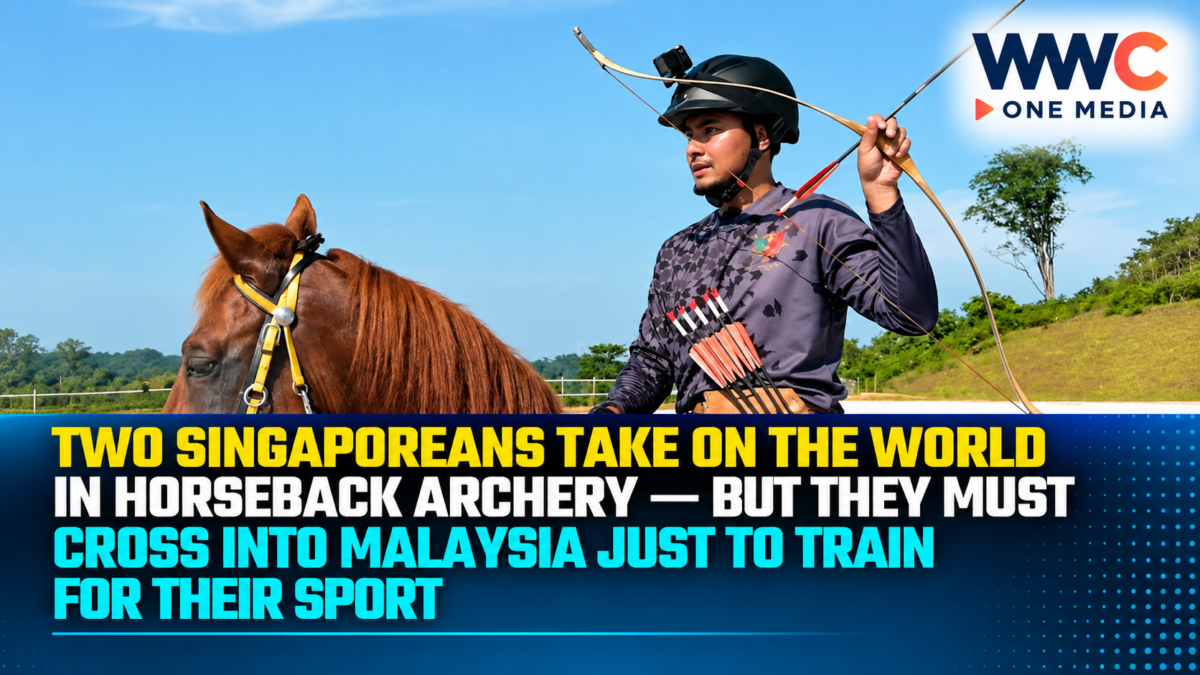
SINGAPORE — Imagine galloping across an open field, releasing your grip on the reins, drawing a bow and firing an arrow toward a target — all while keeping your balance on a moving horse. For two Singaporean athletes, this extraordinary combination of speed, precision and courage has become a passion that has taken them onto the international stage. But despite competing at the World Nomad Games against practitioners of traditional sports from around the globe, Shalihin Ahmaddullah and Syed Idrus face an unusual challenge at home: Singapore has no dedicated facility where they can properly train in horseback archery, forcing them to cross into Malaysia to pursue their sporting ambitions.
For many athletes, training means visiting a nearby gym, running track or sports complex.
For Singaporean horseback archers, preparation can involve an international journey.
The discipline combines two demanding skills: riding a horse and shooting a bow accurately while moving.
It requires coordination between rider and animal, control over the bow and the confidence to release both hands from the reins when shooting.
In a CNA Insider photo feature published on October 10, journalist Raydza Rahman and photographer Fadza Ishak documented the experiences of two Singaporean riders who have dedicated years to the sport.
Their story reveals not only the excitement of mounted archery but also the obstacles facing participants in niche sports.
Meet Shalihin Ahmaddullah, the Singaporean Who Discovered Horseback Archery in Malaysia
Shalihin Ahmaddullah, 33, is a systems analyst whose fascination with horseback archery began 11 years ago.
At the time, he was working as a stable hand in Johor Bahru.
His exposure to horses eventually introduced him to the discipline of shooting arrows while riding.
What began as an interest developed into a long-term passion.
Unlike conventional target archery, in which athletes usually stand on the ground and concentrate on a fixed target, mounted archery requires riders to coordinate their movements with those of a horse.
Shalihin describes a particular feeling of concentration when he is riding at speed and preparing to release an arrow.
For him, the experience is about more than competing.
It is about achieving a state of focus in which the rider, horse and target become the center of attention.
That level of concentration is one reason the sport continues to attract him after more than a decade.
Syed Idrus Finds His Passion in the Adrenaline
Fellow Singaporean Syed Idrus, 32, is another practitioner of horseback archery.
He shares Shalihin’s enthusiasm for the discipline but identifies its excitement as a major part of the attraction.
The combination of riding and shooting produces a demanding experience that few conventional sports can replicate.
A rider must remain alert to the horse’s movement, the location of the target and the timing of each shot.
Unlike stationary archery, mounted archery takes place within a constantly changing environment.
Idrus says that sense of adrenaline keeps him returning.
Their shared passion has led the two men beyond recreational participation.
Both have competed at the World Nomad Games, an international event featuring sports rooted in the traditions of nomadic cultures.
The experience has allowed them to participate alongside athletes from countries with much longer established horseback archery communities.
Why Horseback Archery Is So Difficult
The discipline demands more than knowing how to ride a horse or use a bow.
The rider has to bring those skills together.
During a typical mounted archery run, the horse travels along a designated course while the archer attempts to hit targets.
Depending on the competition format, targets may be positioned at different angles, requiring the rider to shoot forward, sideways or backward.
Competitors must act quickly because the horse continues moving.
They cannot pause in front of a target to improve their aim.
Riders also need sufficient balance and confidence to shoot without continuously holding the reins.
The horse’s training is equally important.
It must remain responsive and predictable while the archer carries a bow and releases arrows.
Different competitions use different courses, distances, scoring systems and traditional styles.
Success depends on both the accuracy of the archer and the performance of the horse-and-rider partnership.
The Biggest Challenge: Singapore Has No Dedicated Training Facility
For Shalihin and Idrus, enthusiasm is not enough.
CNA reports that while horse riding and archery can be practiced separately in Singapore, there is no dedicated facility combining the two disciplines.
This creates a practical obstacle.
The riders cannot simply visit a local archery range to practice firing from a galloping horse.
Nor can they assume that a conventional riding facility permits archery activities.
Training requires appropriate space, equipment, supervision, suitable horses and safety measures.
As a result, the two athletes travel to Johor Bahru to develop their combined skills.
Their experience highlights a wider challenge for participants in less widely practiced sports.
A country may have established facilities for the individual components of a discipline without having the infrastructure to bring them together.
For Singapore’s horseback archers, access to a suitable training environment remains an important limitation.
Training Across the Singapore–Malaysia Border
Johor Bahru has become central to the two riders’ preparation.
The Malaysian city offers access to the training environment they need for their sport.
But crossing the border adds practical demands.
Athletes must account for travel time, transport arrangements and the availability of suitable facilities.
Those commitments are particularly challenging when combined with ordinary employment and personal responsibilities.
Shalihin’s professional work as a systems analyst makes his dedication especially notable.
Training cannot always be organized around the convenience of a nearby sports center.
Instead, preparation requires additional planning.
The arrangement also illustrates the value of cross-border sporting connections.
For Singaporean participants in specialized disciplines, access to facilities in neighboring countries can provide opportunities unavailable at home.
How Two Singaporeans Reached the World Nomad Games
Shalihin and Idrus have taken their skills to the World Nomad Games.
The international competition celebrates sports associated with nomadic societies.
It brings together athletes from countries with distinct traditions of horse riding, archery, wrestling and other cultural disciplines.
For Singaporean horseback archers, participation offers opportunities to test their skills in an international environment.
It also allows them to encounter different approaches to horsemanship and competition.
The 2026 World Nomad Games were held in Kyrgyzstan from August 31 to September 6.
The sixth edition featured a wide range of traditional sporting events in and around Bishkek and the Issyk-Kul region.
Horseback archery was among the featured disciplines.
CNA confirms that the Singaporean riders have competed at the Games.
However, it does not report that either athlete won a medal at the latest edition.
Their participation should therefore not be described as a championship victory without independently verified results.
World Nomad Games 2026 Show How International the Sport Has Become
The latest World Nomad Games offered a strong illustration of horseback archery’s global reach.
According to Kyrgyz news agency Kabar, the Kyrgyz-style horseback archery competition took place in the Kyrchyn gorge on September 2 and 3.
The event attracted 72 male competitors representing 33 countries and 45 female competitors representing 32 countries.
That is 117 competitors across the two reported fields.
The men’s event was won by Kazakhstan’s Abzal Tulybekov.
Saudi Arabia’s Bader Altamimi finished second, while Kyrgyzstan’s Mergen Mirlanov placed third.
The women’s competition was won by Mongolia’s Gunbileg Ganbaatar.
Poland’s Anna Sokulska finished second, and Russia’s Yulia Lozhnikova took third.
These results demonstrate the range of countries represented in traditional mounted archery.
They also show that the sport is attracting competitive participation beyond the regions where many of its historical traditions developed.
For Singaporean athletes, that international environment offers a valuable opportunity to gain experience.
Horseback Archery Is More Than a Modern Extreme Sport
Although its combination of movement and precision can resemble a modern adventure sport, mounted archery has deep historical roots.
Horse-mounted archers were important in the military and hunting traditions of several societies across Eurasia.
Their ability to shoot while riding made them effective in circumstances where mobility was essential.
Over time, different cultures developed their own equipment, techniques and riding traditions.
Modern horseback archery preserves elements of those practices within organized sporting competitions.
The World Nomad Games help showcase the cultural importance of such disciplines.
Its programme includes sporting events alongside cultural activities celebrating traditional knowledge, crafts and other aspects of nomadic heritage.
Participants therefore contribute to more than an athletic contest.
They also help sustain interest in historical skills that might otherwise receive limited public attention.
Safety and Horse Welfare Matter
The excitement of horseback archery comes with risks that require careful management.
Riding at speed and handling archery equipment involve potential dangers to the athlete, horse and anyone nearby.
Training should take place only in suitable facilities with qualified supervision.
Horses must be properly prepared for the activity.
The shooting course also requires controlled access, suitable target placement and appropriate safety arrangements.
It would be unsafe to combine ordinary recreational riding with bow shooting without specialized training and permission.
Equine welfare is just as important as rider safety.
The horse is a partner in the sport, not simply a means of transport.
Its training, fitness, handling and recovery should be taken seriously.
The sport’s appeal should not obscure the need for responsible practice.
Why Singapore’s Niche Sports Deserve Attention
Singapore is internationally recognized for its investment in several mainstream and elite sporting disciplines.
But horseback archery illustrates the variety of interests pursued by individuals outside the most familiar sports.
Participants in niche disciplines may have fewer local training options, smaller communities and limited public recognition.
They may also need to invest considerable time and personal resources to pursue their passion.
The achievements of such athletes should not be measured only by medals.
Qualifying for international competition, continuing to train over many years and helping introduce unfamiliar disciplines to a wider audience can be meaningful accomplishments.
That does not automatically establish that public funding or new facilities should be allocated to any particular sport.
Such decisions would require evidence about participation, demand, feasibility and costs.
Nevertheless, the experiences of Shalihin and Idrus show why smaller sporting communities are worth documenting.
A Sporting Connection Between Singapore and Malaysia
The riders’ cross-border training also illustrates the importance of regional cooperation.
Singapore and Johor Bahru are closely connected through travel, commerce and personal relationships.
For niche sports, the relationship can extend to training facilities and sporting expertise.
Access to a suitable venue across the border may allow an athlete to pursue opportunities that would otherwise be difficult.
This could be relevant to other Southeast Asian athletes who need specialized environments for particular activities.
However, CNA’s report does not establish the existence of a formal government-backed cross-border mounted archery programme.
The training arrangement should be understood as the riders’ practical response to the facilities available to them.
Could Horseback Archery Grow in Singapore?
The CNA feature raises an interesting question about the sport’s future.
Exposure through international competitions and media coverage may attract curiosity among new participants.
Some people may be drawn to its traditional cultural roots.
Others may find the combination of equestrian skill and archery appealing.
But the availability of suitable facilities remains a major consideration.
Growing the sport would require more than encouraging people to try it.
Training locations, qualified instructors, horse welfare standards, insurance and other safety requirements would need careful consideration.
No confirmed announcement has been made about building a dedicated horseback archery centre in Singapore.
Nor has an official national expansion programme been established by the reporting reviewed.
For now, practitioners such as Shalihin and Idrus continue working within the opportunities available to them.
The Bigger Picture: Passion Without Borders
Shalihin Ahmaddullah and Syed Idrus are pursuing a sport that demands concentration, courage and a strong relationship between horse and rider.
Their experiences have taken them from Singapore and Johor Bahru to international competitions celebrating centuries-old sporting traditions.
Along the way, they have faced a challenge that is unusual for athletes competing on the world stage.
The most suitable environment for practicing their discipline is not in their home country.
Yet the absence of a dedicated Singapore training facility has not ended their involvement.
Instead, they continue traveling to Malaysia to practice and improve.
Their story is a reminder that sporting ambition is not limited to familiar stadiums, major leagues or Olympic events.
Some of the most determined athletes pursue disciplines that receive relatively little attention.
For Singapore’s horseback archers, the thrill lies in the extraordinary moment when balance, timing, trust and precision come together on a moving horse.
But the bigger challenge begins long before an arrow reaches its target: finding the space, facilities and opportunities needed to keep competing internationally.
As their sport attracts attention through the World Nomad Games, Shalihin and Idrus are showing that a passion rooted in ancient traditions can still inspire modern athletes — even when pursuing it requires crossing a national border.