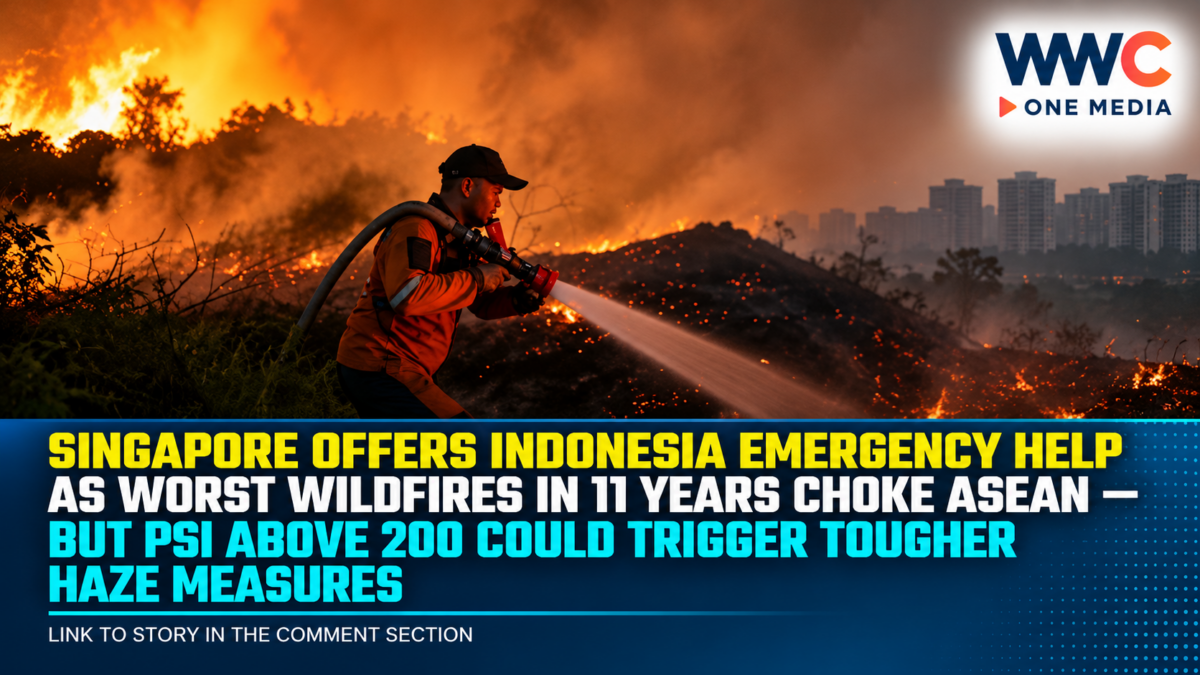
SINGAPORE — Singapore has offered to help Indonesia fight devastating forest and peatland fires as smoke pushes air pollution across Southeast Asia to unhealthy levels. Minister for Sustainability and the Environment Grace Fu confirmed that she had contacted her Indonesian counterpart, Mohammad Jumhur Hidayat, to express support and offer assistance. But as Singapore’s air quality approaches the “very unhealthy” threshold and Indonesia battles its worst fire season in 11 years, the bigger question is whether emergency firefighting and regional cooperation can prevent another prolonged haze crisis.
Singapore is stepping up its response to the regional haze emergency as forest and land fires across Indonesia continue to release thick smoke into neighboring countries.
Speaking at Our Tampines Hub on Saturday, October 10, Grace Fu said Singapore was ready to support Indonesia’s firefighting efforts where assistance would be useful.
Fu explained that unusually dry conditions associated with a powerful El Niño event have made the fires more difficult to control.
She also confirmed that she had been in direct contact with Indonesia’s environment minister, Mohammad Jumhur Hidayat.
The Singapore minister acknowledged Indonesia’s efforts to contain the fires and expressed support for wider regional discussions on the haze crisis.
Her comments came as Singapore’s 24-hour Pollutant Standards Index, or PSI, remained in the unhealthy range.
The problem has become increasingly urgent for Southeast Asia, with Malaysia closing schools in affected areas, Singapore preparing additional public-health measures and communities in Indonesia facing severe smoke exposure.
Grace Fu Contacts Indonesian Minister as Haze Worsens
Singapore’s latest diplomatic offer reflects its concern about the rapidly deteriorating air quality.
Fu said she had spoken with Indonesian Environment Minister Mohammad Jumhur Hidayat and expressed appreciation for the work being undertaken to control the fires.
The discussions also included the possibility of Singapore providing support.
The exact form of any future assistance was not announced.
Singapore has not confirmed a specific deployment of firefighting personnel, helicopters or equipment under the October 10 offer.
The minister also supported broader regional cooperation to address transboundary haze.
The distinction is important because firefighting assistance requires agreement on what resources are needed, how they will be deployed and whether local operating conditions allow them to be effective.
Indonesia has welcomed offers of help from neighboring countries, but the arrangements remain subject to coordination.
Singapore’s PSI Reaches 192, Approaching Very Unhealthy Level
The deterioration in Singapore’s air quality has heightened public concern.
On October 9, the 24-hour PSI reached 192 in central Singapore, the highest reported level of the 2026 haze season at that point.
The reading placed the city close to the threshold for very unhealthy air quality.
Under Singapore’s PSI system, readings between 101 and 200 are classified as unhealthy.
The very unhealthy category begins at 201.
By 9 a.m. on October 10, conditions had improved slightly, but all five monitoring regions remained unhealthy.
The readings reported by CNA were:
- Central Singapore: 174
- Western Singapore: 160
- Eastern Singapore: 156
- Southern Singapore: 135
- Northern Singapore: 124
These readings are historical measurements from October 10, not live air-quality figures for October 11.
Conditions can change with rainfall, wind direction and the volume of smoke transported from Indonesia.
Residents should consult official National Environment Agency advisories for updated information.
Singapore Prepares Stronger Measures if PSI Exceeds 200
Singapore’s government has activated its Haze Task Force, a coordinating body involving 28 agencies.
The task force is preparing stronger protective measures in case pollution reaches the very unhealthy range.
According to Singapore’s Ministry of Sustainability and the Environment, the government has sufficient N95 mask stocks and is ready to activate distribution arrangements when the 24-hour PSI exceeds 200.
Eligible Singaporeans would be able to obtain masks through designated vending machines or community centres.
The government is also preparing air-conditioned haze shelters.
These would include spaces in community centres and selected residents’ committee and residents’ network centres.
The shelters would be particularly helpful for people without effective cooling or air filtration at home.
However, preparation does not mean that every planned shelter has already opened or that masks have already been distributed islandwide.
The measures are tied to specified pollution thresholds and official activation decisions.
Schools Could Close if Pollution Becomes Hazardous
Education authorities are also monitoring the haze.
Singapore’s Ministry of Education has said it will consider closing schools if the forecast for the following day indicates hazardous air quality.
The relevant threshold is a 24-hour PSI above 300.
The decision would depend on official forecasts and circumstances.
That means a PSI reading above 200 does not automatically trigger nationwide school closures.
Schools and parents should follow announcements from the education ministry and individual institutions.
The government has also issued guidance to workplaces, preschools and organizers of outdoor activities.
Workers exposed to polluted outdoor air may require adjustments to tasks and schedules.
People with existing respiratory or cardiovascular conditions may need additional precautions.
Healthcare Facilities Strengthen Haze Preparedness
Singapore’s hospitals, polyclinics and nursing homes have already taken steps to limit haze exposure.
Measures include the use of air purifiers, closing windows where appropriate and deploying portable cooling equipment.
The goal is to protect patients while ensuring that healthcare facilities remain capable of responding to increased respiratory complaints.
Fine particles in haze can irritate the eyes and respiratory system.
People with asthma, chronic lung disease or heart conditions may be especially vulnerable during periods of elevated pollution.
Children, older adults and pregnant women are also groups for whom the government recommends added caution.
Anyone experiencing severe breathing difficulties or other emergency symptoms should seek immediate medical assistance.
For routine exposure precautions, residents should reduce unnecessary prolonged or strenuous outdoor activity according to official health advisories.
Formula 1 Singapore Grand Prix Faces Haze Concerns
The haze has also affected preparations for Singapore’s Formula 1 Grand Prix weekend, scheduled for October 9 to 11.
The event attracts large crowds and international visitors.
On October 9, Fu said there were no immediate plans to change outdoor entertainment activities.
However, authorities and event organizers were monitoring conditions.
Contingency plans included making air-quality updates available to participants and providing access to medical assistance and N95 masks where required.
Reuters separately reported that Formula 1-related entertainment could be adjusted if haze conditions deteriorated.
The race itself was expected to proceed under the arrangements reported at that time.
It would be inaccurate to state that Singapore had already cancelled the Grand Prix because of the haze.
The episode illustrates how regional air pollution can affect major sporting events, tourism operations and public safety planning.
Indonesia Welcomes Offers From Singapore and Malaysia
The Straits Times reported on October 10 that Indonesia welcomed offers of assistance from both Singapore and Malaysia.
Indonesian officials also emphasized that the type of support matters.
Low visibility can complicate aerial firefighting.
One disaster management official suggested that firefighters working on the ground might be more useful than additional helicopters in some affected areas.
Indonesia has maintained dozens of aircraft on standby to assist with firefighting operations.
According to The Straits Times, 61 aircraft were available for operations.
Indonesia was also hoping for heavier rainfall toward late October or early November.
However, forecasts of rain do not guarantee the immediate extinguishing of fires.
Peatland fires can continue burning below the surface, making them especially challenging to detect and control.
The discussions demonstrate that international cooperation must be adapted to conditions on the ground.
Malaysia Offers Aircraft, Helicopters and Personnel
Malaysia has also expressed concern about deteriorating air quality linked to Indonesian fires.
Prime Minister Anwar Ibrahim discussed the situation with Indonesian President Prabowo Subianto.
Malaysia offered assistance that could include aircraft, helicopters and firefighting personnel.
At the time of the October 10 reporting, Malaysian officials were still discussing the arrangements through diplomatic channels.
The country has already experienced substantial haze disruption.
Reuters reported that schools were closed in multiple Malaysian states and territories on October 9 because of poor air quality.
The response highlights the regional impact of smoke generated by forest and land fires.
Haze does not stop at national borders.
Its consequences can include respiratory illness, changes to school operations, reduced outdoor activity and disruption to business and transportation.
Indonesia Battles Its Worst Fire Season in 11 Years
Indonesia is facing a particularly severe wildfire season.
CNA reported that approximately 202,000 hectares had burned between January and July 2026 according to official figures.
Satellite-based estimates suggested that the area affected had increased to almost 896,000 hectares by the end of August.
These figures come from different monitoring methods and time periods.
They should not be combined or treated as directly equivalent measurements.
The scale of the fires nevertheless indicates the seriousness of the crisis.
Prolonged dry weather has contributed to more widespread burning across vulnerable landscapes.
Sumatra and Kalimantan have been among the major areas affected.
Smoke from fires in these regions has been transported toward neighboring countries under unfavorable wind conditions.
Indonesia has experienced severe fire episodes before, particularly during El Niño years.
But the 2026 crisis is reported to be its most serious in more than a decade.
Why Peatland Fires Are So Difficult to Extinguish
A major part of Indonesia’s fire problem involves peatland.
Peat is made up of partially decomposed organic material that can store large quantities of carbon.
When peatlands remain wet, they are less likely to burn.
But drainage, land degradation and prolonged drought can make them extremely vulnerable.
Once ignited, peat can smolder underground for long periods.
Surface flames may disappear while burning continues below the ground.
This makes peat fires difficult to detect and fully extinguish.
Smoke from peatland combustion also contains fine particles that can travel significant distances.
Environmental groups argue that longer-term solutions require restoring peatland water levels, preventing damaging land use and improving fire enforcement.
Emergency firefighting is necessary during a crisis.
But without addressing underlying environmental conditions, similar fires can recur.
Environmental Groups Warn That Falling Hotspot Counts May Be Misleading
Reuters reported on October 5 that Indonesia had recorded a substantial reduction in detected fire hotspots.
But environmental organizations warned that the decline did not necessarily mean the fire emergency was ending.
Peat fires may continue burning beneath the surface.
Changes in satellite observations and weather conditions can also affect the number of hotspots detected.
Pantau Gambut, an Indonesian environmental organization, has raised concerns about the degradation of peatland ecosystems.
The group estimates that a large proportion of the country’s peatlands have become more vulnerable because of drainage and environmental damage.
Greenpeace has also called for stronger accountability for companies associated with fires.
These concerns illustrate why the problem requires more than extinguishing visible flames.
Preventing future haze emergencies may involve sustained environmental restoration, stronger land-management practices and clearer enforcement.
Indonesia Suspends 57 Companies After Fire Inspections
Indonesian authorities have also intensified enforcement.
According to figures reported by CNA, the government suspended 57 companies following inspections that identified more than 34,000 hectares of burned land within their areas.
The enforcement measures reflect growing pressure on businesses whose land holdings are affected by fires.
However, the presence of burned land within a company’s area does not automatically establish criminal responsibility for deliberately starting a fire.
That depends on the applicable investigations, evidence and legal proceedings.
Authorities are seeking to determine whether land-management requirements were violated.
Environmental groups are also pressing for more transparent accountability.
The effectiveness of enforcement will depend on whether sanctions produce lasting improvements in fire prevention.
Indonesia Creates New Agency for Peatland and Mangrove Management
President Prabowo Subianto has ordered the creation of a national agency focused on peatland and mangrove management, restoration and conservation.
The institution is also intended to strengthen prevention of recurring forest and land fires.
Its establishment reflects the need for longer-term solutions.
Healthy peatlands and mangrove ecosystems can provide important environmental benefits.
Restoring degraded peatlands may also reduce fire vulnerability when water levels are properly maintained.
However, establishing an agency is only the beginning.
Effective results will depend on funding, technical capacity, coordination with provincial authorities and enforcement of environmental regulations.
It would be premature to claim that the creation of the agency has already solved Indonesia’s fire problem.
Singapore and Indonesia Already Have an Environmental Cooperation Agreement
The latest offer of assistance builds on existing bilateral cooperation.
On June 29, 2026, Singapore and Indonesia signed a memorandum of understanding on environmental cooperation.
The agreement was signed by Grace Fu and Mohammad Jumhur Hidayat.
It covers several areas, including air and water quality, transboundary pollution, climate change, waste management and environmental capacity building.
The agreement also provides a framework for technical exchanges, joint studies and cooperation between officials.
This is important because the October haze crisis does not require the two countries to begin diplomatic cooperation from scratch.
They already have a formal arrangement intended to support practical engagement on shared environmental challenges.
However, the memorandum does not establish that a specific Singapore firefighting mission has been approved or deployed.
Any operational assistance would still require appropriate coordination.
Haze Crisis Triggers Legal Action in Indonesia
The fire emergency is also generating legal pressure within Indonesia.
Associated Press reported that residents of West Kalimantan had brought a lawsuit against government officials and agencies over the handling of prolonged fires and smoke pollution.
The plaintiffs allege failures in prevention, firefighting and environmental oversight.
They are seeking greater accountability and remedies for affected communities.
The Guardian has also reported on legal challenges brought by civil society and Indigenous groups.
The allegations have not been established through a final court judgment.
The lawsuit nevertheless highlights the domestic consequences of the fire crisis.
Residents living closest to the burning areas may experience far more severe exposure than people in neighboring countries.
For those communities, the emergency is not only about regional diplomatic tensions.
It involves health, livelihoods, schooling and access to clean air.
Why the Crisis Matters Across Southeast Asia
The haze is a regional problem with consequences for multiple ASEAN countries.
Singapore and Malaysia have already introduced protective measures.
Indonesia faces direct environmental and public-health impacts from the fires.
Other parts of Southeast Asia may experience deteriorating air quality depending on winds and weather conditions.
The 2026 crisis underscores the limits of relying on national responses alone.
Fire prevention requires cooperation on environmental management.
Emergency responses require coordination between authorities.
Public-health agencies must communicate reliable air-quality information.
Governments also need to balance economic activity with protections for vulnerable populations.
For the Philippines, the situation reinforces the importance of regional cooperation and emergency planning when pollution crosses borders.
But the exact effects in any country depend on local monitoring data and weather conditions.
A severe haze event in Singapore should not automatically be presented as evidence of equally severe pollution throughout the Philippines.
The Bigger Picture: ASEAN’s Haze Challenge Is Far From Over
Singapore’s latest offer to Indonesia represents an important diplomatic response to worsening regional air pollution.
Grace Fu has been in contact with her Indonesian counterpart, and Indonesia has welcomed assistance offers from its neighbors.
Singapore is also preparing stronger domestic protections as its air-quality readings approach the very unhealthy range.
Malaysia has experienced school closures, while Indonesia continues fighting extensive forest and peatland fires.
But the greatest challenge lies beyond the immediate emergency.
Dry weather, degraded peatlands, enforcement gaps and recurring land fires have made transboundary haze a persistent regional problem.
Emergency firefighting can reduce the immediate danger.
Lasting improvement will depend on whether governments can prevent the same conditions from producing another crisis.
Singapore has offered to help Indonesia fight the fires while preparing masks, haze shelters and stronger health precautions at home.
But the bigger question is whether ASEAN can move beyond emergency responses and establish effective long-term solutions to the forest and peatland fires that repeatedly threaten millions of residents.
As the region enters another difficult haze period, the true test will be whether cooperation today can prevent the next crisis rather than merely contain the current one.