VIENTIANE, LAOS — China has established a new military foothold in mainland Southeast Asia, opening a joint aviation training and support facility in Laos as satellite images reveal eight military aircraft and more than two dozen support vehicles at the site. Beijing insists the project is designed to strengthen military training and regional cooperation. But analysts warn that the new facility could give China a lasting strategic advantage, increase its influence over Laos and unsettle Vietnam, which now faces a growing Chinese security presence on its western flank.
China’s expanding military cooperation with Laos has entered a new phase.
On September 29, Beijing and Vientiane officially opened the China-Laos Joint Support and Training Center and the China-Laos Friendship Aviation Academy at Ban Keun Airport in Vientiane Province.
The facility is approximately 50 kilometres north of the Lao capital.
According to China’s Ministry of National Defense, the project will help train Lao air force pilots and support joint military activities.
However, the announcement has attracted international attention because of its possible implications for the regional balance of power.
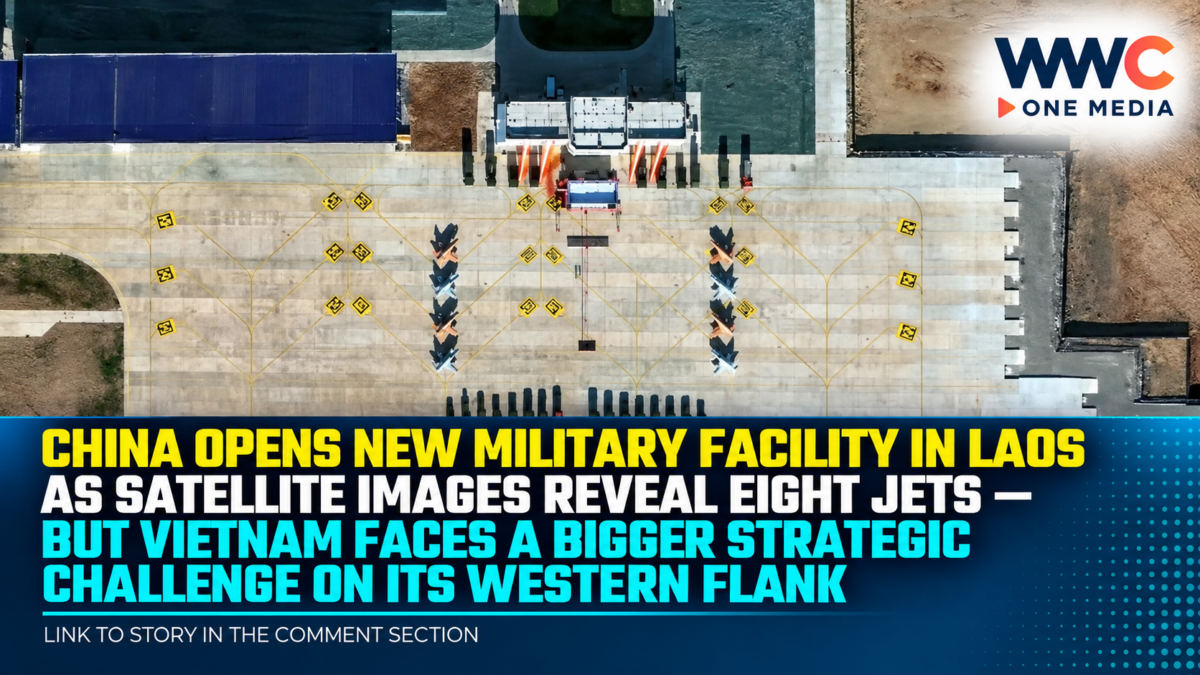
A Reuters investigation published on October 6 revealed satellite images showing eight aircraft believed to be K-8 light attack and training jets, alongside more than two dozen military support vehicles.
The images also showed ongoing construction around the airfield.
For regional security analysts, the facility represents something more consequential than a routine training agreement.
It could become China’s first dedicated overseas air force foothold in Southeast Asia, complementing its existing military facilities and partnerships elsewhere.
China and Laos Officially Open New Military Training Center
The Ban Keun facility opened on September 29 after an extensive construction and refurbishment programme.
According to China’s Ministry of National Defense, the centre and aviation academy will be jointly maintained and operated by Chinese and Lao personnel.
Lao Deputy Prime Minister and Minister of National Defense Khamlieng attended the inauguration ceremony, alongside representatives of China’s People’s Liberation Army.
Beijing says the project will improve military training and strengthen defence cooperation.
The aviation academy will focus on developing the capabilities of Lao military pilots.
The support centre is also expected to help facilitate broader bilateral defence activities.
China has emphasized that the project respects international law and does not target other countries.
But the scale and location of the development have prompted questions about whether its eventual functions could extend beyond training.
Satellite Images Reveal Eight Military Aircraft
The first major indication of the facility’s possible operational significance came from commercial satellite imagery.
Reuters examined images captured by Vantor on September 30, one day after the facility’s official opening.
The images showed eight aircraft that security analysts identified as likely Hongdu JL-8 jets, also known as K-8 aircraft.
The K-8 is used for flight training and can perform light attack missions.
It was jointly developed by China and Pakistan and has been exported to several countries.
The images also showed more than two dozen military support vehicles and continuing runway construction.
Analysts cited by Reuters said the aircraft appeared consistent with K-8 models operated by China and Laos.
However, the imagery alone does not conclusively establish which country owns every aircraft or whether all are permanently stationed at the facility.
That distinction matters because the presence of training aircraft does not automatically establish that Ban Keun is operating as an offensive combat base.
The more important question is how the installation will develop.
Could Ban Keun Become China’s First Major Overseas Air Force Base in ASEAN?
Security specialists are divided over how to characterize the facility.
Some believe it could eventually become China’s first full-scale overseas military base in Southeast Asia.
Others caution that its current infrastructure and stated functions are more limited.
In a CNA commentary published October 10, Ian Storey, a principal fellow at the ISEAS–Yusof Ishak Institute, described the development as an important diplomatic gain for Beijing.
He identified Ban Keun as a potentially significant overseas foothold for China’s air force.
Reuters separately quoted analysts who suggested that the facility could eventually accommodate aircraft with greater capabilities.
But neither the Chinese government nor the Lao government has officially described the project as a permanent Chinese combat airbase.
The official designation remains a jointly operated support and training centre.
Its eventual strategic role will depend on whether the installation acquires additional infrastructure, personnel and operational functions.
Why Analysts Are Watching the Runway
The physical development of the Ban Keun airfield is attracting close attention.
Reuters reported that satellite images showed substantial construction activity and runway expansion.
Security experts are monitoring whether the installation develops additional fuel storage, ammunition facilities, air defences or surveillance capabilities.
Such infrastructure could help determine whether the facility is evolving beyond pilot training.
A longer runway could allow larger aircraft to operate.
Additional communications and surveillance systems could support wider intelligence activities.
However, these developments have not all been confirmed.
The possibility of future intelligence-gathering operations is an analytical concern, not proof that the site is currently being used to monitor neighboring countries.
China maintains that its activities are peaceful and focused on legitimate military cooperation.
Vietnam Faces a Strategic Dilemma
Among Southeast Asian countries, Vietnam may have the strongest reasons to monitor the development.
Laos and Cambodia occupy an important position along Vietnam’s western side.
Hanoi has historically maintained close diplomatic, political and defence relationships with both countries.
At the same time, Vietnam has territorial and maritime disputes with China in the South China Sea.
That creates a sensitive strategic environment.
China already maintains a close defence relationship with Cambodia, including access to facilities at Ream Naval Base.
The new Ban Keun installation creates another potential point of Chinese military access in mainland Southeast Asia.
In his CNA analysis, Storey argues that this strengthens Beijing’s influence in an area that Vietnam has traditionally considered important to its security.
However, Vietnam had not issued a formal public objection to the Ban Keun opening as of the reporting reviewed.
The concern is therefore primarily an assessment by regional security analysts, not an announced Vietnamese diplomatic confrontation.
China’s Cambodia Partnership Adds to Regional Concerns
Ban Keun is not an isolated development.
China has established a military logistics base in Djibouti and deepened its security cooperation with Cambodia.
In 2025, China and Cambodia inaugurated a joint support and training facility at Ream Naval Base.
The Cambodian arrangement gives Beijing an additional means of sustaining military engagement in Southeast Asia.
Taken together, the facilities point toward a broader Chinese effort to develop overseas defence relationships and supporting infrastructure.
Their functions, however, are not identical.
Ream is a maritime installation with access to the Gulf of Thailand.
Ban Keun is an inland aviation facility in a landlocked country.
It would be misleading to describe them as interchangeable military bases or assume that both provide the same strategic capabilities.
The common factor is China’s growing access and institutional presence.
Russia Could Lose Influence Over Laos’ Armed Forces
Another potentially important consequence involves Russia.
Laos has historically relied heavily on Russian military equipment.
According to Storey’s analysis, more than half of the Lao air force’s 37 aircraft are Russian-made.
The country has also conducted military exercises with both Russia and China.
Since 2017, the Lao People’s Armed Forces have reportedly participated in eight exercises with China and six with Russia.
However, Russia’s war in Ukraine and Western sanctions have complicated its defence production and overseas commitments.
Laos ordered ten Yak-130 training aircraft from Russia in 2018.
Storey reports that only four were delivered, with one subsequently lost in a 2024 crash.
A proposed Russian-supported pilot training facility at Xieng Khouang has also made uncertain progress.
China’s new aviation academy could therefore make Beijing a more attractive defence partner.
But a confirmed decision by Laos to replace its Russian aircraft with Chinese fighters has not been announced.
Any future aircraft purchases remain speculative.
Could China Sell More Military Aircraft to Laos?
The training centre creates an opportunity for closer cooperation between the Chinese and Lao air forces.
It could also position Chinese defence manufacturers to compete for future equipment orders.
Training arrangements often help military personnel become familiar with particular aircraft systems, maintenance practices and operating procedures.
This can influence future procurement decisions.
Storey raises the possibility that Laos could eventually consider Chinese-made training aircraft or more advanced fighters.
However, there is no verified announcement that Laos has purchased Hongdu JL-10 aircraft or Chengdu J-10 fighters as part of the Ban Keun project.
Future procurement will depend on Laos’ military requirements, finances and political priorities.
The confirmed development is the opening of the joint facility, not a new fighter-jet acquisition contract.
Laos’ Economic Dependence on China Raises Questions
The military project also has an economic dimension.
China has become one of Laos’ most important investors, creditors and infrastructure partners.
Major Chinese-backed projects include the railway connecting Vientiane to the Chinese border.
The railway has improved physical connectivity between the two countries and created opportunities for trade and investment.
However, Laos also faces significant debt pressures.
Some analysts are concerned that economic dependence could increase Beijing’s political influence.
The new military facility adds another dimension to that relationship.
It raises a question about how Laos can benefit from Chinese investment and defence cooperation while preserving flexibility in its foreign policy.
But it would be inaccurate to claim that China obtained Ban Keun through a confirmed debt-for-base arrangement.
No evidence reviewed establishes such a transaction.
Economic leverage is one possible analytical explanation for deepening cooperation, not a proven contractual mechanism behind the facility.
A Former Secret US Airfield Becomes a China–Laos Military Facility
Ban Keun also carries historical significance.
During the Vietnam War era, the United States used the area for covert aviation operations in Laos.
Reuters reported that the airfield was known as Lima Site 44.
It was associated with Air America, an airline covertly owned by the Central Intelligence Agency.
The facility supported operations connected to US-backed forces during the conflict.
More than five decades later, China is developing a new military presence at the same location.
The historical reversal has attracted attention from security scholars.
An airfield once associated with America’s covert operations is now part of Beijing’s expanding regional military partnerships.
The symbolism is striking.
However, historical symbolism does not establish that the new facility has the same intelligence or combat functions as the Cold War-era installation.
Thailand Says Laos Has the Right to Choose Defence Partners
Thailand is another country watching the development.
According to Reuters, a Thai military official acknowledged Laos’ sovereign right to cooperate militarily with other states.
The official also said Thailand was monitoring the situation.
Bangkok maintains substantial economic and security relationships with both China and the United States.
Unlike Vietnam, Thailand does not have a comparable territorial dispute with China in the South China Sea.
This may reduce the immediate political sensitivity of the Ban Keun project from Thailand’s perspective.
Nevertheless, the expansion of military infrastructure near regional transportation networks is relevant to security planners.
Analysts have also raised the possibility that a more developed Chinese facility could support intelligence-gathering activities.
That possibility should not be reported as an established Chinese operation against Thailand or US–Thai military exercises.
Why the United States Is Likely Watching Closely
The United States has long maintained security partnerships across Southeast Asia.
These relationships include treaty allies and other countries that cooperate through military exercises, training and defence dialogue.
China’s growing military access in Laos could influence Washington’s assessment of regional security developments.
A facility that evolves into a larger air operations or surveillance hub would be more consequential than one restricted to basic pilot training.
That is why security experts are monitoring construction progress.
But the immediate military advantage may be limited.
China already operates major airbases inside its own territory, including in southern China.
The Ban Keun installation does not automatically provide capabilities superior to those existing facilities.
Its greater value could lie in diplomacy, logistical access and a sustained military relationship with Laos.
This is the central distinction between expanding political influence and immediately changing military power in the region.
What the Development Means for the Philippines and ASEAN
The opening of Ban Keun adds another issue to ASEAN’s evolving security environment.
Southeast Asian governments maintain different relationships with China, ranging from close economic and military cooperation to serious maritime disputes.
For the Philippines, the development may attract attention because Manila is involved in ongoing South China Sea disputes with Beijing.
China’s additional military access in mainland Southeast Asia could contribute to wider discussions about regional influence and defence partnerships.
However, Ban Keun is located in Laos, not near Philippine territory.
Its opening does not automatically create a new direct military threat to the Philippines or establish an immediate change in the operational balance in the West Philippine Sea.
The implications are primarily regional and strategic.
ASEAN governments will have to assess whether additional foreign military facilities contribute to training and stability or intensify concerns over great-power competition.
Why This Is a Diplomatic Win for China — But Not Necessarily a Strategic Win for Everyone
From Beijing’s perspective, the opening of the Ban Keun facility delivers several advantages.
It deepens military cooperation with Laos, creates opportunities to train pilots and establishes a more permanent physical presence for bilateral defence activities.
It also demonstrates that China can develop military partnerships beyond its own borders.
For Laos, the project could improve pilot training and access to aviation infrastructure.
But the relationship also raises difficult questions.
A closer dependence on Chinese military assistance could limit Vientiane’s ability to diversify its defence partnerships.
Vietnam may become more concerned about Chinese access along its western side.
Russia could lose some influence if Laos increasingly turns to China for equipment and training.
The United States may also intensify its monitoring of Chinese military infrastructure in the region.
None of these outcomes is inevitable.
They are plausible strategic implications that depend on the facility’s future role and the choices made by regional governments.
The Bigger Picture: China’s Military Reach Is Expanding Across Southeast Asia
China’s new facility in Laos marks a significant development in its defence diplomacy.
The China-Laos Joint Support and Training Center and accompanying aviation academy opened on September 29.
Satellite imagery reviewed by Reuters has since revealed military aircraft, support vehicles and continuing construction.
Beijing describes the project as a legitimate training initiative that does not target third countries.
Security analysts see an installation that could evolve into a more significant overseas military presence.
The implications extend beyond China and Laos.
Vietnam must consider the growth of Chinese military access near its western flank.
Russia faces another potential challenge to its traditional role as a military supplier.
The United States and Thailand will monitor whether the facility develops additional capabilities.
China has secured an important new military partnership in the heart of mainland Southeast Asia.
But the larger question is whether Ban Keun remains primarily a training centre or evolves into a more powerful military and intelligence foothold.
For Beijing, the opening is already a diplomatic gain. For Laos and its neighbors, the full strategic consequences are only beginning to emerge.