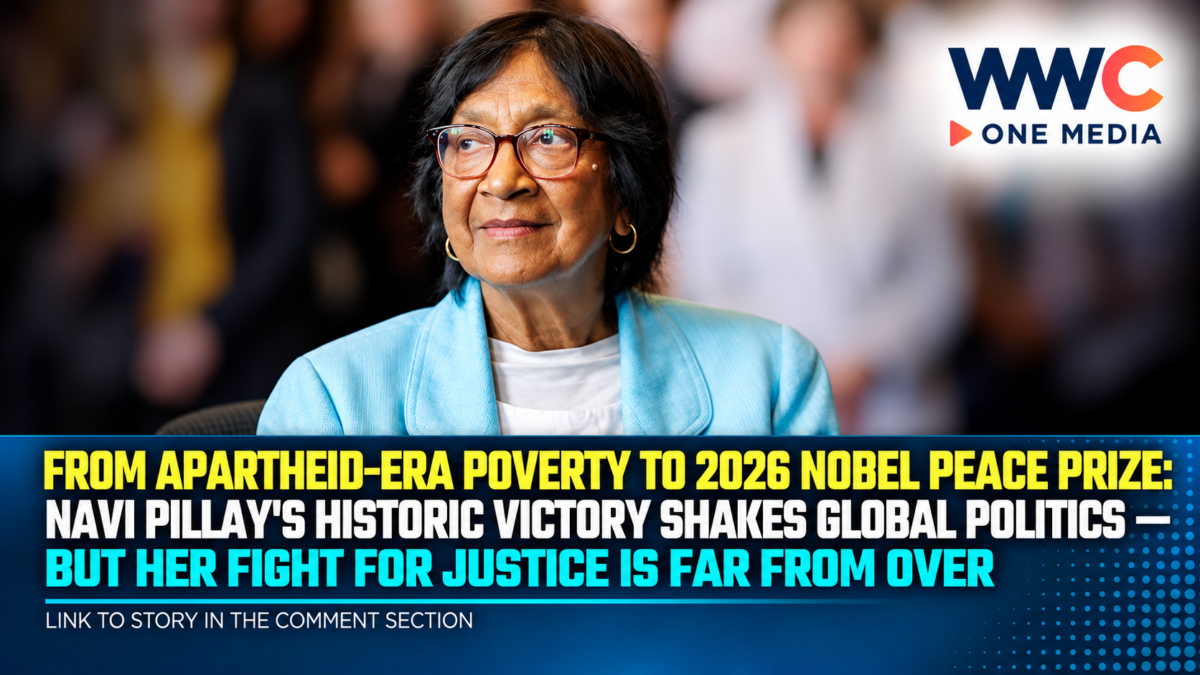
JOHANNESBURG — From growing up in a poor Indian-origin family under South Africa’s apartheid system to becoming one of the world’s most influential human rights judges, Navanethem “Navi” Pillay has spent decades challenging discrimination, war crimes and abuses of power. On October 9, 2026, the 85-year-old jurist received one of the world’s highest honors: the Nobel Peace Prize. But her victory comes at an extraordinary moment, as international courts face mounting political pressure, the United States moves against the International Criminal Court and unresolved genocide cases continue to test whether powerful leaders can be held accountable.
The Norwegian Nobel Committee has awarded the 2026 Nobel Peace Prize to South African lawyer and international judge Navi Pillay for her lifelong commitment to peace and international law.
The decision recognizes a career spanning apartheid-era legal battles, the prosecution of atrocities in Rwanda, landmark international criminal proceedings and leadership of the United Nations’ human rights system.
Pillay has also played prominent roles in investigations involving Gaza and Myanmar.
Her selection comes as international legal institutions face increasingly intense political criticism.
On the same day the Nobel Committee announced its decision, the Trump administration imposed sweeping sanctions on the International Criminal Court, where Pillay previously served as a judge.
The simultaneous developments have turned the award into a significant moment in the global debate over justice, national sovereignty and accountability.
For Pillay, however, the recognition is the culmination of decades spent defending people who faced discrimination and violence.
Who Is Navi Pillay, the 2026 Nobel Peace Prize Winner?
Navanethem Pillay was born in 1941 in Durban, South Africa, into a family of Indian Tamil descent.
Her father worked as a bus driver.
She grew up in a poor neighborhood during apartheid, when the country’s racial segregation laws restricted opportunities for non-white South Africans.
Those experiences shaped her understanding of inequality and the law.
Pillay studied at the University of Natal before continuing her education at Harvard University in the United States.
She earned advanced law degrees, eventually receiving a Doctor of Juridical Science in 1988.
Her education was especially significant given the obstacles faced by women and non-white professionals in apartheid-era South Africa.
Rather than pursuing only a conventional legal career, Pillay became an advocate for people targeted by discriminatory laws and political repression.
Her early work established the principles that would later define her international career.
From Apartheid Oppression to South Africa’s Legal History
In 1967, Pillay established her own law practice in Durban.
She became the first non-white woman to open a law firm in the city.
At a time when apartheid laws severely restricted the rights of Black, Indian and other non-white South Africans, her practice represented both a professional achievement and an act of resistance.
Pillay defended political activists and individuals affected by discriminatory government policies.
Her legal work brought her into contact with members of the anti-apartheid movement, including people imprisoned by the white-minority government.
One of her significant victories came in 1973.
She successfully fought for political prisoners held on Robben Island to have access to legal representation.
Among the prisoners at the island prison was Nelson Mandela.
The ruling reinforced the principle that imprisonment should not eliminate access to legal assistance.
For Pillay, the struggle was not merely about one prison or one group of detainees.
It concerned whether the law could protect people whom the state had sought to silence.
Nelson Mandela’s Role in Navi Pillay’s International Career
South Africa’s democratic transition opened a new chapter in Pillay’s career.
In 1994, Nelson Mandela became the country’s first Black president following its first fully democratic national election.
The following year, Pillay was appointed to South Africa’s High Court.
She became the first woman of color to serve in that role.
Her appointment was another milestone in a legal system that had previously excluded people on racial and gender grounds.
Mandela subsequently recommended Pillay for service on an international tribunal established to prosecute those responsible for atrocities in Rwanda.
That recommendation helped move her career from South African constitutional and human rights law into international criminal justice.
It would become one of the defining transitions of her professional life.
The Rwanda Genocide Tribunal and a Landmark Legal Breakthrough
Pillay’s work at the International Criminal Tribunal for Rwanda helped establish an important precedent in international law.
The tribunal was created following the 1994 genocide in Rwanda, during which extremist forces killed hundreds of thousands of people, predominantly Tutsis.
International prosecutors sought to hold individuals responsible for genocide and other serious crimes.
Pillay served as a judge and later became president of the tribunal.
She participated in the landmark Akayesu case, which helped establish that sexual violence could constitute an act of genocide when committed with the necessary intent to destroy a protected group.
The 1998 judgment was a major development in international criminal law.
It demonstrated that rape and sexual violence could be central instruments of mass atrocities, rather than merely incidental consequences of conflict.
The ruling influenced later prosecutions and strengthened recognition of crimes committed against women during war and genocide.
This achievement is one of the principal reasons Pillay is regarded as a pioneering international jurist.
Navi Pillay’s Role at the International Criminal Court
Pillay subsequently joined the International Criminal Court, established under the Rome Statute.
The ICC began operating in 2002 to prosecute individuals accused of genocide, crimes against humanity, war crimes and, under defined conditions, the crime of aggression.
Pillay served as a judge from 2003 to 2008.
Her work placed her at the center of a developing international judicial institution.
The court’s purpose is to provide accountability for the gravest crimes when relevant national systems are unwilling or unable genuinely to conduct proceedings, subject to jurisdictional requirements.
Pillay helped advance the idea that international law should apply beyond national borders.
However, the ICC’s authority remains contested by some governments.
Countries including the United States, Israel, China and Russia are not parties to the Rome Statute.
The court’s jurisdiction, decisions and political independence have therefore remained sources of international debate.
Pillay’s Nobel recognition comes at a moment when those disagreements are particularly visible.
Leading the United Nations’ Human Rights System
In 2008, Pillay became the United Nations High Commissioner for Human Rights.
She held the position until 2014.
As the UN’s leading human rights official, she publicly challenged abuses committed by governments and armed groups.
Her tenure covered major international developments, including political unrest and conflicts during the Arab Spring.
Pillay spoke out against repression and violence in countries including Libya and Syria.
Her willingness to criticize governments regardless of their political alignment helped shape her reputation as an outspoken defender of universal human rights.
She also faced criticism from governments that disputed her findings or objected to international scrutiny.
Her approach emphasized that human rights protections should not depend on a country’s political influence or diplomatic relationships.
That principle remained central to her work after leaving the UN position.
Why Navi Pillay’s Gaza Investigation Remains Controversial
One of the most politically sensitive parts of Pillay’s recent career involves the Israeli-Palestinian conflict.
From 2021 to 2025, she chaired an independent commission established by the UN Human Rights Council to investigate the underlying causes of the conflict and alleged violations of international law.
The commission concluded that Israel was responsible for genocide in Gaza.
Pillay defended the commission’s findings, arguing that international humanitarian and human rights law must apply consistently.
Israel has strongly rejected the genocide accusation and criticized the commission’s work as biased.
The United States has also challenged aspects of the UN investigative process.
It is important to distinguish the commission’s conclusion from a final judgment by the International Court of Justice.
The UN commission is an investigative body.
It does not deliver binding judicial verdicts on state responsibility.
Its conclusions are therefore significant findings, but they are not equivalent to a completed ICJ ruling declaring Israel legally responsible for genocide.
This distinction is essential when accurately reporting on Pillay’s work.
Navi Pillay Is Also Involved in the Myanmar Genocide Case
Pillay continues to play a role in international justice.
She serves as a judge ad hoc at the International Court of Justice in proceedings involving Myanmar and the Rohingya minority.
The case examines allegations that Myanmar violated the 1948 Genocide Convention.
It arises from the military’s treatment of Rohingya Muslims, particularly during the 2017 campaign that forced hundreds of thousands of people to flee to Bangladesh.
Myanmar has disputed the genocide allegations.
The proceedings are legally separate from Pillay’s earlier work at the ICC and the Rwanda tribunal.
The ICJ primarily resolves disputes between states, while the ICC prosecutes individuals.
Pillay’s involvement in multiple international institutions illustrates the breadth of her legal career.
It also reinforces why the Nobel Committee selected her as a symbol of international law and accountability.
As of October 11, a final judgment in the Myanmar case remained pending.
Norwegian Nobel Committee Recognizes Decades of Courage
The Norwegian Nobel Committee announced Pillay’s selection on October 9.
Its official statement highlighted her commitment to international law and the pursuit of accountability for serious crimes.
The committee described a career connecting the struggle against apartheid with the development of international judicial institutions.
The award is not solely recognition of one case, one tribunal or one investigation.
It honors Pillay’s broader role in strengthening legal mechanisms intended to address war crimes, crimes against humanity and genocide.
The Nobel Peace Prize includes a medal, diploma and prize money of 12 million Swedish kronor, approximately US$1.2 million at the time of reporting.
The formal ceremony will take place in Oslo on December 10, 2026.
Pillay is among a distinguished group of South Africans recognized with the Nobel Peace Prize, alongside figures such as Nelson Mandela and Desmond Tutu.
Her victory also highlights the contributions of women to international legal institutions historically dominated by men.
Pillay Dedicates Nobel Recognition to Victims of Atrocities
Pillay received news of the award while attending an event in Nuremberg, Germany.
The city has historic importance to international criminal law because of the post-Second World War trials of Nazi leaders.
The location added symbolism to the announcement.
According to Reuters, Pillay dedicated the recognition to survivors of international crimes and people who continue working for justice.
Her response reflected the central theme of her career.
The development of international criminal law has been driven not only by legal institutions but also by victims, witnesses, investigators and advocates who insist that atrocities should not be ignored.
The Nobel Prize recognizes Pillay individually.
But the work it honors involves generations of people seeking accountability for abuses committed during war, repression and mass violence.
Trump Criticizes the Nobel Committee’s Decision
The Nobel announcement quickly became a political flashpoint in Washington.
President Donald Trump publicly criticized the decision to award the prize to Pillay.
He questioned her selection and again argued that his diplomatic efforts deserved recognition.
Trump has repeatedly expressed interest in receiving the Nobel Peace Prize.
His latest reaction drew attention because of the administration’s opposition to international institutions with which Pillay has been closely associated.
The Norwegian Nobel Committee, however, is independent of the Norwegian government.
Its decision was presented as recognition of Pillay’s record in international law, not as an official response to American domestic politics.
The Nobel Prize should not be described as a competition directly decided by world leaders or governments.
Its selection follows the committee’s own assessment of Alfred Nobel’s stated criteria.
US Sanctions Against the ICC Add a New Dimension
Hours after Pillay’s Nobel Prize was announced on October 9, the Trump administration revealed expanded sanctions targeting the International Criminal Court.
Secretary of State Marco Rubio defended the move as a measure to protect American sovereignty.
The administration argues that the ICC has attempted to exercise unacceptable authority over Americans and officials of US allies.
The court and its supporters reject that characterization.
They argue that sanctions risk interfering with independent judicial proceedings and weakening accountability for serious international crimes.
The proximity of the two announcements created a powerful political contrast.
On the same day that a former ICC judge was honored for advancing international justice, Washington imposed restrictions on the institution where she previously worked.
However, the timing does not prove that Pillay’s award caused the sanctions.
The US–ICC dispute predates the 2026 Nobel announcement.
It involves longstanding disagreements over jurisdiction, investigations and international legal authority.
Why the Nobel Prize Matters for the Future of International Law
Pillay’s award comes at a difficult moment for international institutions.
Conflicts in Ukraine, Gaza, Sudan and other regions have renewed debate about how the world investigates alleged war crimes.
International courts depend on cooperation from governments.
They do not possess independent police forces capable of arresting every suspect or enforcing every decision.
Their authority relies partly on legal commitments made by participating states.
When powerful countries reject court decisions, refuse cooperation or impose sanctions, international accountability mechanisms can face serious operational obstacles.
Supporters argue that institutions such as the ICC and ICJ remain necessary because grave crimes should not go unexamined.
Critics question whether those institutions apply the law consistently or exceed legitimate legal authority.
Pillay’s Nobel recognition brings those competing arguments into sharper focus.
The award represents support for international law as a mechanism for peace, but it does not settle the political and legal disputes surrounding individual institutions.
What Navi Pillay’s Story Means for Asia and the Philippines
Pillay’s work has direct relevance beyond South Africa and Europe.
Her involvement in the Myanmar genocide case concerns alleged atrocities against the Rohingya, one of Asia’s most significant human rights issues.
Her record at the ICC also resonates in the Philippines, where the court has pursued proceedings related to the country’s former anti-drug campaign.
These situations involve different facts, legal jurisdictions and individuals.
They should not be treated as equivalent cases.
Nevertheless, they share a broader concern about the ability of international institutions to investigate alleged serious crimes and provide fair judicial processes.
For Asian audiences, Pillay’s career illustrates how international legal principles can affect countries far removed from the original European and African institutions in which they developed.
It also reinforces the importance of due process.
Allegations must be assessed through appropriate proceedings, and people accused of crimes remain entitled to the presumption of innocence.
A Lifetime of Defending People Without Power
The remarkable feature of Pillay’s career is its consistency.
As a young lawyer, she represented people suffering under South Africa’s apartheid system.
As a judge, she helped establish legal principles protecting victims of sexual violence during genocide.
As a United Nations official, she challenged repression and human rights abuses.
As an international judge and investigator, she continued examining allegations involving powerful governments and military authorities.
Throughout her career, Pillay has argued that the law should protect people regardless of their race, nationality, religion or political influence.
Her achievements have attracted admiration.
They have also generated substantial opposition, especially when her investigations challenged governments or state policies.
That tension is part of the significance of the award.
The Nobel Committee has recognized a jurist whose work repeatedly placed her in disputes involving powerful political interests.
The Bigger Picture: Her Nobel Victory Is Not the End of the Battle
Navi Pillay’s journey is an extraordinary story of persistence.
Born into poverty and racial discrimination in apartheid-era South Africa, she went on to become a pioneering lawyer, a High Court judge, an international war crimes jurist and the United Nations’ top human rights official.
Her contributions helped establish important legal protections for victims of genocide and sexual violence.
Her work has also shaped global debates about the responsibility of governments and military leaders.
On October 9, the Norwegian Nobel Committee honored those decades of service with the 2026 Nobel Peace Prize.
But the global institutions Pillay helped strengthen continue to face serious challenges.
Political disputes, contested investigations and sanctions against international courts are testing whether legal accountability can function when powerful states oppose it.
Navi Pillay has received the world’s most prestigious peace award for a lifetime devoted to international justice.
But the larger question is whether the international legal system she helped build can withstand the political pressures now threatening its independence and effectiveness.
For Pillay, the Nobel Prize is a historic recognition. For the world, her work raises an unfinished challenge: ensuring that justice remains meaningful even when the people and governments facing scrutiny are powerful.