RIYADH, SAUDI ARABIA — Yemen’s escalating war has reached Saudi Arabia’s busiest international aviation hub, with successive Houthi attacks on Riyadh’s King Khalid International Airport killing civilians, damaging aircraft and disrupting passenger flights. Saudi authorities initially reported three deaths, including a Saudia airline pilot, following strikes on October 8. But a separate attack on October 10 killed at least 12 more people and wounded 309, dramatically intensifying fears of a wider Middle East conflict. With President Donald Trump considering US participation in Saudi strikes, fighting continuing around the strategic Bab el-Mandeb Strait and international airlines facing growing security risks, the crisis now threatens far more than Saudi Arabia’s airports.
Saudi Arabia is confronting a rapidly intensifying security crisis as missile attacks linked to Yemen’s Houthi movement increasingly target civilian infrastructure.
The latest escalation follows the collapse of a fragile period of reduced fighting in Yemen and a renewed offensive by Saudi-backed Yemeni government forces.
Airports, oil installations and commercial shipping routes have become central to the confrontation.
The Houthis, an Iran-aligned armed movement that controls Yemen’s capital, Sanaa, have warned commercial aircraft against operating in Saudi airspace.
Saudi Arabia has vowed to respond to attacks on civilians and strategic infrastructure.
Meanwhile, the United States is considering whether to become more directly involved in strikes against the group.
The renewed violence creates serious risks for passengers, energy companies, international shipping and millions of civilians already affected by Yemen’s prolonged war.
Riyadh Airport Attacks Kill Three, Including Saudia Pilot
Saudi Arabia’s General Authority of Civil Aviation confirmed on Friday, October 9, that three Saudi citizens had died in two attacks on King Khalid International Airport the previous day.
Among those killed was Saudia Airlines Captain Hamoud Ali Alkalthami.
The national airline publicly confirmed the pilot’s death and expressed condolences.
Other people were wounded, and a Saudia aircraft sustained damage.
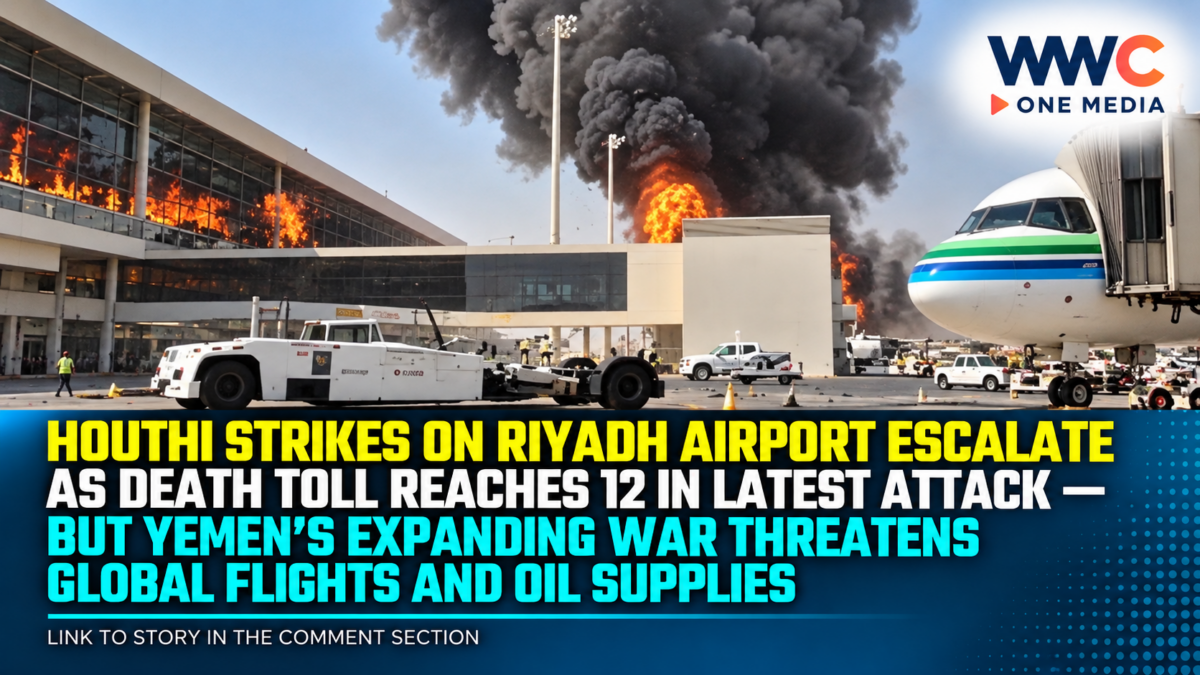
Smoke was seen rising from the airport, while flights were cancelled, delayed or diverted.
The attacks also caused anxiety throughout Riyadh.
Diplomatic personnel received instructions to shelter in place, while international schools adopted additional precautions.
Saudi authorities reported that falling missile interception debris had damaged a kindergarten and a medical complex elsewhere in the capital.
These developments illustrated the danger created when missiles and interceptor debris fall near populated civilian areas.
The three deaths were confirmed in reporting published October 9.
However, they were not the final fatalities associated with the week’s attacks.
A New October 10 Attack Kills 12 and Injures 309
The security situation deteriorated sharply the following day.
On Saturday, October 10, King Khalid International Airport was struck again.
Saudi authorities reported that at least 12 people were killed and 309 wounded.
The victims included four Saudi nationals, two Bangladeshis and one citizen each from the United States, Egypt, Jordan, Palestine, Syria and Sudan.
Emergency services transported injured passengers and airport users to hospitals.
Eyewitnesses described explosions, injuries and damaged areas inside the terminal.
Airport operations were temporarily suspended, and aircraft were diverted to other destinations.
The October 10 strike was a separate incident from the October 8 attacks described in the original CNA report.
Editorial clarification: The 12 reported fatalities from October 10 should not be confused with the three deaths announced October 9. Reuters subsequently reported that the earlier attacks during the week had caused four deaths in total.
These figures describe different reporting periods and must be presented accurately.
Why the Houthis Are Attacking Saudi Arabia Again
The renewed missile campaign is closely connected to developments inside Yemen.
The Houthis, also known as Ansar Allah, seized control of Sanaa in 2014.
Saudi Arabia intervened militarily in 2015 as part of a coalition supporting Yemen’s internationally recognized government.
Years of fighting devastated the country and created one of the world’s most severe humanitarian crises.
A UN-brokered truce in 2022 reduced large-scale hostilities, although it did not produce a permanent political settlement.
Fighting intensified again during 2026 amid the wider regional conflict involving Iran, the United States and Israel.
The Houthis recently advanced along Yemen’s Red Sea coast, increasing pressure on forces aligned with the Saudi-backed government.
Those advances helped trigger a new counteroffensive.
The Houthis have responded by intensifying attacks against Saudi targets, including airports and energy infrastructure.
They have portrayed their campaign as retaliation for Saudi military action against Yemen.
Saudi Arabia rejects attacks on civilian facilities and maintains that its operations support Yemen’s recognized government.
Houthis Threaten Commercial Aviation Across Saudi Airspace
The Houthi movement has issued increasingly aggressive warnings to airlines.
Its military spokesperson, Yahya Saree, suggested that certain flights would require authorization from a Houthi body in Sanaa.
The group has warned aircraft against operating in Saudi airspace, with exceptions it described for areas above Mecca and Medina.
These statements represent Houthi threats, not internationally recognized authority over Saudi aviation.
Nevertheless, the warnings have practical consequences.
Airlines must assess whether missile threats create unacceptable risks for passengers, crew members and aircraft.
Carriers may suspend flights, alter routes or avoid certain airspace altogether.
Even temporary restrictions can disrupt connecting journeys and increase operational costs.
The attacks are particularly concerning because King Khalid International Airport is a major hub serving Riyadh and connecting Saudi Arabia to international destinations.
Airlines Face Cancellations, Diversions and Growing Safety Concerns
The airport strikes have prompted significant changes to airline operations.
Following the October 8 attacks, flights began resuming as Saudi authorities restored operations.
But the October 10 strike forced another shutdown and renewed diversions.
The European Union Aviation Safety Agency expanded its warning concerning operations over Saudi airspace.
Aviation risk-monitoring organizations also advised carriers to avoid affected areas.
The US Embassy urged American citizens to stay away from Riyadh’s airport and nearby locations following the latest attack.
For travelers, these developments create uncertainty over departures, arrivals and connecting flights.
For airlines, the problem goes beyond scheduling.
Missile attacks require carriers to reassess airspace risk, crew safety, insurance exposure and the possibility of further disruption.
No airline can guarantee normal schedules while attacks remain a credible threat.
Travelers should follow official airline notices and airport announcements rather than relying on previously published flight information.
Saudi Coalition Responds With Strikes on Houthi Positions
Saudi Arabia has intensified military operations in response to the Houthi offensive.
The Saudi-led coalition said it destroyed three missile-launch platforms used by the group.
Coalition officials warned that attacks against civilians and civilian infrastructure would be met with a firm response.
Saudi aircraft have also struck Houthi positions in Yemen, including areas around Sanaa.
Houthi-affiliated media have reported strikes on locations under the movement’s control.
Both sides have made claims about military successes, damage and casualties.
Those claims cannot always be independently verified because journalists face limited access to active conflict areas.
The distinction is important.
A coalition announcement that a missile launcher has been destroyed is an official military claim unless independently confirmed.
Likewise, Houthi casualty claims require verification.
The wider pattern is clear: the conflict is becoming more intense, with both sides conducting operations that carry serious risks for civilians.
Battle for Bab el-Mandeb Could Affect Global Trade
One of the most strategically important fronts is the Bab el-Mandeb Strait.
The narrow waterway connects the Red Sea with the Gulf of Aden.
It is part of the maritime route linking the Indian Ocean to the Suez Canal and Mediterranean Sea.
Commercial ships using this passage include container vessels, oil tankers and carriers transporting other commodities.
The Houthis recently gained control of territory along the coastline near the strait.
Saudi-backed Yemeni government forces subsequently launched a campaign to retake strategic positions.
Some Saudi and Yemeni officials claimed significant territorial gains.
However, battlefield accounts remained contradictory.
Other military sources reported continuing resistance and only limited advances.
It would therefore be premature to state that Saudi-backed forces have conclusively secured every contested part of the strait.
The importance of Bab el-Mandeb lies in its role in international shipping.
Further fighting or attacks against commercial vessels could increase shipping costs and disrupt supply chains.
Yemen’s Taiz Region Becomes Another Major Front
The fighting is not confined to the coast.
The strategic city of Taiz has also become a focal point.
Houthi fighters have advanced around the city and disrupted an important road connecting government-held positions.
Taiz has long suffered from the wider civil war, including fighting and restrictions on movement.
Renewed hostilities could further limit civilian access to food, medical care and essential supplies.
The city also illustrates why military developments in Yemen cannot be measured solely by control of ports and shipping lanes.
The conflict affects densely populated communities.
Even when one side claims tactical gains, the humanitarian costs may continue rising.
More Than 200,000 Displaced Since July
The human consequences of renewed war are severe.
According to UN figures cited by CNA, more than 200,000 people have been displaced in Yemen since July 2026.
Families have fled fighting, insecurity and damage to their communities.
Many already lived with the consequences of years of conflict, weak public services and economic hardship.
Displacement creates additional pressure on humanitarian organizations.
People forced from their homes may struggle to find safe accommodation, clean water, food and medical treatment.
Children face interruptions to education.
Older people and individuals with medical conditions can be especially vulnerable.
The renewed escalation threatens to reverse progress made during periods of reduced fighting.
For Yemen’s civilian population, the war’s expansion is not primarily a question of military influence.
It is a direct threat to everyday survival.
Could Pakistan and Turkey Become More Involved?
Saudi Arabia has sought additional security support from regional partners.
Reuters reported that Riyadh was looking to Pakistan and Turkey for assistance under defence cooperation arrangements.
Pakistan has indicated that its military personnel and resources are supporting the defence of Saudi territory.
Pakistani officials distinguished such defensive support from launching attacks across the border into Yemen.
That distinction is important.
The presence of foreign military personnel in Saudi Arabia does not automatically mean those forces have joined offensive operations against the Houthis.
The risk of wider involvement remains a serious concern.
Additional countries could be drawn into security arrangements, air defence operations or other forms of military assistance if attacks continue.
But specific deployments and combat roles must be confirmed rather than assumed.
Trump Considers Direct US Involvement
The October 10 attack has increased pressure on Washington.
President Donald Trump told reporters that the United States was evaluating whether it should join Saudi strikes against the Houthis.
He did not announce a final decision authorizing new American combat operations in response to that attack.
US Secretary of State Marco Rubio separately condemned the missile strikes and emphasized the danger to innocent civilians.
Washington has strong security ties with Saudi Arabia and maintains a significant military presence in the wider Middle East.
It also has longstanding concerns about Houthi attacks on international shipping.
A direct US role could significantly alter the military balance.
But it could also expand the conflict and increase the risks of retaliation.
As of the reporting reviewed on October 11, Trump’s remarks indicated that intervention was under consideration, not that a new joint US-Saudi campaign had already been ordered.
Saudi Arabia’s Oil Industry Faces Renewed Threats
The Houthis have also warned workers at Saudi oil facilities to evacuate.
Saudi Arabia is one of the world’s largest oil exporters, making threats to its energy infrastructure internationally significant.
Attacks against refineries, pipelines or export terminals can affect expectations about future supply.
The latest escalation is occurring alongside broader disruptions linked to the conflict involving Iran and the Strait of Hormuz.
Together, risks affecting Hormuz and Bab el-Mandeb create a difficult environment for energy transportation.
However, threatened attacks do not necessarily mean oil production has been halted.
Nor does every missile strike result in an immediate measurable loss of exports.
The economic impact depends on physical damage, shipping restrictions, insurance costs and the duration of any disruption.
Energy markets will be watching whether attacks spread further into Saudi Arabia’s refining and export infrastructure.
Riyadh’s Major Investment and Energy Conferences Face Security Questions
The timing of the airport attacks is particularly sensitive for Saudi Arabia.
Riyadh is preparing to host major international business and energy events, including the World Petroleum Council Energy Congress and the Future Investment Initiative.
These gatherings attract executives, government officials and investors.
The security situation has complicated travel decisions for participants.
Some international representatives have reconsidered attending in person.
Organizers have indicated that events are expected to continue with security precautions.
The disruption matters because Saudi Arabia is seeking to diversify its economy through investment, tourism and international business activities.
Repeated attacks on airports could weaken confidence in the reliability of travel arrangements.
However, the reported security concerns do not establish that Saudi Arabia’s broader economic development programme has collapsed.
They demonstrate how an expanding regional war can complicate the kingdom’s commercial ambitions.
What the Escalation Means for Asian Travelers and Businesses
The Saudi aviation situation also matters to Southeast Asian countries.
Saudi Arabia is a destination for workers, business travelers, tourists and religious pilgrims from across Asia.
Flight disruptions in Riyadh can affect passengers travelling to Saudi Arabia or connecting through the region.
For Filipino workers and other Asian nationals based in the kingdom, reliable official security guidance is especially important.
Businesses may also face higher logistics and insurance costs if attacks disrupt regional aviation and shipping.
The Philippines, Singapore, Malaysia, Indonesia and other Asian economies are exposed to changes in international energy prices.
The extent of those effects will depend on the duration of the conflict and actual disruptions to trade.
There is no basis to claim that all flights between Asia and Saudi Arabia have been permanently suspended.
Affected passengers should check their specific airline and flight status.
The Bigger Picture: Yemen’s War Is Becoming a Regional Security Crisis
Yemen’s renewed fighting is no longer contained within its borders.
The Houthis have escalated missile attacks on Saudi airports and threatened aviation and energy facilities.
Saudi-backed Yemeni government forces are fighting to retake strategic territory near Bab el-Mandeb.
Saudi Arabia has increased military operations and sought assistance from regional partners.
Meanwhile, Washington is considering a more direct role.
The latest attack at King Khalid International Airport demonstrates the risks facing civilians.
At least 12 people were killed and 309 wounded in the October 10 incident, following earlier attacks that also caused fatalities.
The conflict is simultaneously placing pressure on commercial aviation, international shipping and Saudi Arabia’s economic plans.
For Yemen, the humanitarian consequences are growing, with more than 200,000 displaced since July.
The Houthi campaign against Saudi Arabia has expanded from a cross-border security threat into a serious danger for passengers, civilian infrastructure and regional commerce.
But the bigger risk lies in what happens next: further escalation involving Saudi Arabia, the United States or other regional powers could deepen an already devastating war and increase threats to global energy and shipping routes.
The question is whether diplomacy can halt the latest escalation before Yemen’s renewed conflict becomes an even wider Middle East crisis.