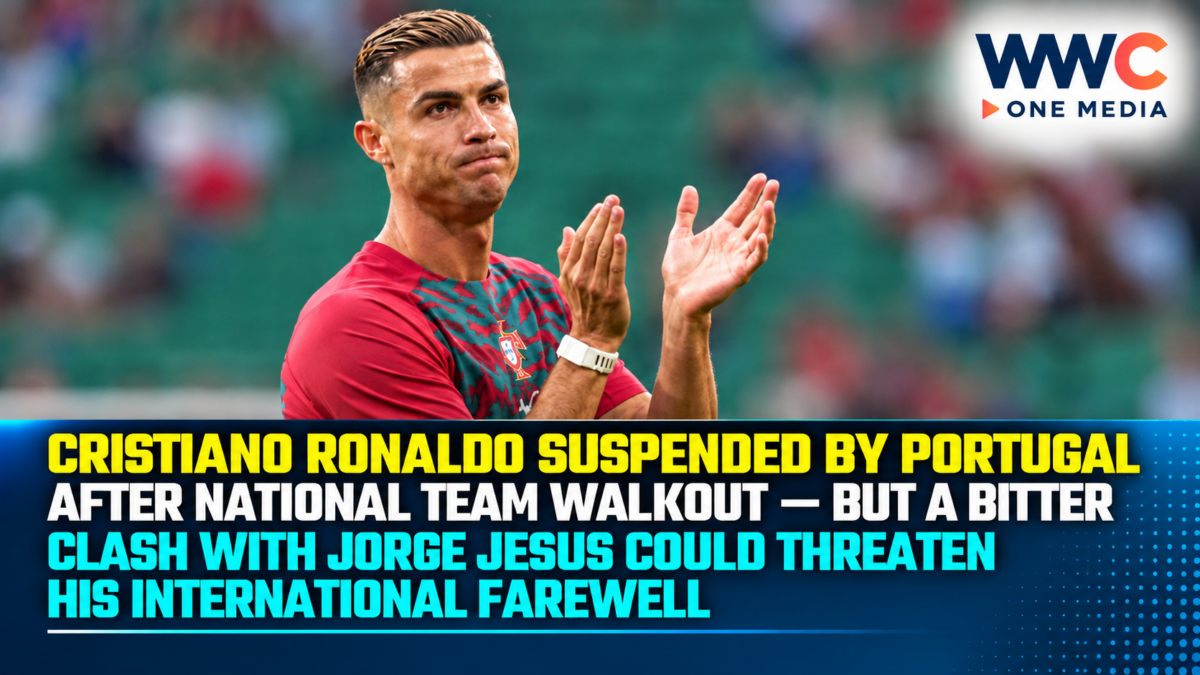
LISBON, PORTUGAL — Cristiano Ronaldo’s international career has entered another dramatic chapter after the Portuguese Football Federation provisionally suspended the 41-year-old superstar for walking out of the national team camp following a dispute with head coach Jorge Jesus. The fallout began when Ronaldo was left on the bench during Portugal’s victory over Norway, despite what he claims was a promise of playing time. But while Ronaldo has apologized and accepted that his actions deserve punishment, the unresolved disciplinary case could threaten his participation in upcoming Nations League matches — and complicate what may be the final chapter of his extraordinary career with Portugal.
One of football’s most celebrated international players is facing disciplinary action from his own national federation.
On Saturday, October 10, Portuguese media reported that the Portuguese Football Federation (FPF) had formally opened proceedings against Cristiano Ronaldo following his departure from the squad’s training camp in Copenhagen.
The five-time Ballon d’Or winner had left Portugal’s preparations before a Nations League match against Denmark following a disagreement with coach Jorge Jesus.
The federation imposed a provisional suspension while its disciplinary authorities review the incident.
Ronaldo has acknowledged that leaving the squad was inappropriate, even as he maintains that his coach failed to honor their private agreements.
The controversy has generated international attention because the Portuguese captain, now 41, is approaching the end of his playing career.
Despite the dispute, both the federation and the coach have indicated that they would welcome his return.
The question is no longer simply why Ronaldo walked out.
It is whether Portugal can repair the relationship before a disciplinary decision affects his remaining international appearances.
Portugal Provisionally Suspends Cristiano Ronaldo
The Portuguese Football Federation confirmed through statements reported by A Bola, Reuters and other international outlets that disciplinary proceedings had been opened against Ronaldo.
The case follows his decision to leave the national team camp during the September–October international window.
The federation’s disciplinary section formally initiated proceedings on October 9, with the development publicly reported the following day.
Ronaldo was placed under a preventive suspension while the case was being considered.
The proceedings have been given urgent status.
Importantly, the provisional measure is not the same as a final disciplinary ruling.
The federation has not announced a definitive suspension length.
Ronaldo has not been permanently expelled from Portugal’s national team.
The final decision will be made through the federation’s disciplinary process rather than by the coach alone.
What Happened Between Ronaldo and Jorge Jesus?
The dispute emerged during Portugal’s Nations League fixture against Norway on September 27.
Ronaldo was named among the substitutes.
According to the player’s account, he and Jesus had previously discussed managing his workload.
At 41, Ronaldo believes careful scheduling is essential to maintaining his fitness and extending his playing career.
He said there had been an agreement that he would not be required to play in the matches against Norway and Denmark.
However, Ronaldo claims the manager later told him he would receive approximately 30 minutes of playing time against Norway.
The striker warmed up on the touchline but was never introduced.
Portugal won the match 2-1.
Ronaldo subsequently expressed frustration about what he considered an unfulfilled promise.
The disagreement intensified after the player and coach discussed how the situation would be explained publicly.
Ronaldo alleges that Jesus failed to honor another agreement about that explanation.
Jesus has disputed Ronaldo’s characterization of their discussions.
These competing accounts remain central to the controversy.
Ronaldo Leaves Portugal’s Camp Before Denmark Match
The situation escalated in Copenhagen.
Ronaldo departed Portugal’s training camp before the Nations League match against Denmark.
He had already been the subject of questions about his absence from training.
Portuguese media reported that he left following comments made by Jesus at a press conference.
Ronaldo later confirmed that he had spoken with federation president Pedro Proença before leaving.
He also stated that he intended to explain the circumstances to supporters.
The decision triggered concerns about the authority of the coaching staff and the responsibilities of the national team captain.
Whatever disagreements may have occurred behind the scenes, leaving an international training camp carries disciplinary implications.
The federation therefore moved to examine whether Ronaldo’s conduct breached its regulations.
Ronaldo Apologizes to Fans and Teammates
On October 6, Ronaldo published a lengthy explanation of his departure.
He criticized what he described as broken promises by Jesus but also accepted personal responsibility.
Ronaldo apologized for leaving his teammates and for failing to acknowledge supporters after the Norway match.
He recognized that, as captain and one of the country’s most experienced players, his actions carried additional significance.
The striker indicated that he understood disciplinary consequences could follow.
He also made clear that he had not decided to retire immediately from international football.
Instead, Ronaldo said he remained willing to represent Portugal if he continued performing well and maintaining the required fitness.
His response was an attempt to distinguish his disagreement with the manager from his commitment to the national team.
However, the apology does not automatically end the disciplinary proceedings.
Jorge Jesus Denies Breaking Promises
Portugal coach Jorge Jesus has rejected Ronaldo’s account of an agreed playing-time arrangement.
The manager said no such binding agreement had been made.
He has emphasized the authority of the national team coach to make selection decisions based on tactical requirements and the needs of the squad.
Jesus also indicated that he remains open to Ronaldo returning.
The dispute presents a difficult challenge because of the player’s exceptional status.
Ronaldo is not merely an experienced squad member.
He is Portugal’s record international goalscorer and most-capped player.
However, national team management requires consistent expectations about discipline and selection.
Allowing any player to determine their own playing time could undermine the coaching staff.
At the same time, managing a 41-year-old star’s fitness is a legitimate sporting consideration.
The unresolved issue is whether the coach and player can restore their working relationship.
Portuguese Federation Wants Ronaldo Back
FPF president Pedro Proença has attempted to reduce tensions.
According to comments reported by CNA and A Bola, Proença said the federation, coaching staff and players wanted Ronaldo to return.
He emphasized that the disciplinary proceedings must be handled independently.
This distinction matters.
The federation can express support for Ronaldo’s future international involvement without interfering with the body’s responsibility to assess his conduct.
Proença’s comments also suggest that the controversy has not resulted in a complete breakdown between the player and Portugal’s football authorities.
The immediate priority is to conclude the disciplinary process.
A broader challenge will be ensuring that Ronaldo and Jesus can work together under an agreed professional framework.
How Long Could Ronaldo Be Suspended?
Portuguese media have reported that the disciplinary rules could allow a suspension lasting between one and six months for abandoning national team duties without an accepted justification.
However, other reports have discussed possible match-based sanctions.
These reported ranges should not be treated as an official final punishment.
The disciplinary body must determine which rule applies, review the circumstances and issue its decision.
Factors could include whether Ronaldo provided notice, the justification for his departure and his acknowledgment of responsibility.
His previous contributions to the national team do not automatically exempt him from the rules.
Equally, the maximum penalty should not be assumed to be the outcome.
As of October 11, Portugal had confirmed a provisional suspension, not a definitive six-month ban.
That remains the essential fact for publication.
November Nations League Matches Could Be Affected
Portugal’s next scheduled Nations League fixtures are against Denmark and Wales in November.
Ronaldo’s eligibility will depend on the outcome and duration of the disciplinary measures.
If the final sanction extends into the November international window, he could miss those matches.
However, there has been no confirmed announcement that he will be absent from both games.
The federation’s decision may determine whether he returns immediately or must wait longer.
The uncertainty is especially significant because Ronaldo has relatively few international windows remaining as a 41-year-old player.
Each missed opportunity could reduce the number of appearances he makes before eventually retiring from national team football.
Portugal Continue Winning Without Ronaldo
One of the most interesting aspects of the controversy is Portugal’s performance in Ronaldo’s absence.
The team continued producing positive Nations League results despite the disruption.
Portugal secured its place in the competition’s quarter-finals.
Striker Gonçalo Ramos also made a strong contribution after being given opportunities in attack.
The Guardian reported that Ramos scored three times during the sequence of matches in which Ronaldo was unused or absent.
This success strengthens the argument that Portugal have alternative attacking options.
It does not mean Ronaldo has become irrelevant.
His international goalscoring record, experience and leadership remain substantial assets.
But it does demonstrate that the national team can compete effectively without relying entirely on him.
That reality may influence future selection decisions.
Gonçalo Ramos Emerges as an Alternative
Ramos’s performances have attracted attention because of the uncertainty surrounding Ronaldo.
The younger striker offers different attacking characteristics, including movement, pressing and opportunities to build combinations with teammates.
His goals provide evidence that Portugal’s attack can function with another centre-forward.
For Jesus, this creates both an opportunity and a selection challenge.
A strong national team benefits from competition for places.
However, replacing a player with Ronaldo’s record is a major decision that carries public and media attention.
The coach must weigh current form, tactical suitability, fitness and experience.
Any decision to select Ramos ahead of Ronaldo should be assessed on sporting grounds rather than automatically interpreted as punishment or a personal dispute.
Ronaldo Returns to Al Nassr and Scores
Despite the turmoil surrounding Portugal, Ronaldo has continued playing club football in Saudi Arabia.
He returned to Al Nassr and scored in a 3-0 victory over Diriyah on October 9.
The performance demonstrates that the provisional Portugal suspension has not automatically prevented him from representing his club.
This is another important distinction.
The disciplinary matter concerns Ronaldo’s departure from the Portuguese national team camp.
There has been no confirmed announcement that he is globally banned from all football activity.
His continued appearances for Al Nassr also provide opportunities to demonstrate his form before Portugal’s next international fixtures.
Strong club performances could support his case for selection once any disciplinary restrictions are resolved.
Ronaldo’s Extraordinary Portugal Career
Ronaldo made his senior Portugal debut in 2003.
Over more than two decades, he has become one of the most successful players in international football history.
According to Reuters’ October reporting, he has accumulated 234 international appearances and scored 146 goals.
He helped Portugal win the 2016 European Championship and the inaugural UEFA Nations League in 2019.
The country also won the Nations League again in 2025.
Ronaldo’s international achievements have made him a central figure in Portuguese sporting history.
His career has extended across multiple generations of players and managers.
That longevity adds significance to the current controversy.
Any disciplinary punishment will be viewed against an extraordinary record of service.
But sporting achievements do not eliminate the expectation that national team members observe established rules.
Is Cristiano Ronaldo Retiring From International Football?
The suspension has inevitably generated speculation about retirement.
Ronaldo has previously indicated that the 2026 FIFA World Cup would be his final appearance at the tournament.
After Portugal’s exit, questions emerged about whether he would immediately end his international career.
He has not announced an immediate retirement following the latest disciplinary action.
On the contrary, he has expressed a desire to make further appearances for Portugal.
The Guardian reported that he still hopes to participate in future farewell matches.
Those comments suggest Ronaldo wants to conclude his national team career on the field rather than through an unresolved disagreement with his coach.
However, no specific farewell fixture has been formally confirmed as a result of his statement.
The timing and circumstances of his eventual retirement remain uncertain.
What This Means for Portugal’s Next Generation
The controversy also reflects a broader transition in Portuguese football.
Portugal possess established stars and talented younger players capable of taking on greater responsibilities.
Ronaldo’s influence has been enormous, but the team must eventually develop beyond his playing career.
Coaches increasingly face the challenge of integrating experienced veterans with younger players who may provide different tactical options.
The success of Ramos during Ronaldo’s absence highlights that transition.
For the federation, the preferred outcome may be to preserve Ronaldo’s contribution while giving the coaching staff the flexibility to prepare for the future.
Achieving that balance requires clear communication.
It also requires acceptance that no player, regardless of reputation, is guaranteed a particular role.
The Bigger Picture: Ronaldo’s Legacy Faces a Difficult Final Test
Cristiano Ronaldo’s provisional suspension has created an unexpected challenge near the end of his international career.
The player believes he was misled about his role during Portugal’s Nations League matches.
The coach disputes his account.
Ronaldo responded by leaving the national team camp, a decision he has since acknowledged was wrong.
The Portuguese Football Federation has opened disciplinary proceedings and imposed a preventive suspension.
At the same time, senior officials have expressed their desire to welcome him back.
The immediate question is how long Ronaldo will be suspended and whether he can return for Portugal’s November matches.
The larger issue is whether one of football’s greatest international players can repair his relationship with the national team and conclude his extraordinary career on his own terms.
For Ronaldo, who has spent more than two decades representing Portugal, the final chapter may now depend as much on discipline, communication and reconciliation as on goals.
He remains Portugal’s record goalscorer — but the biggest challenge of his international farewell may be finding a way back into the team he has represented since 2003.