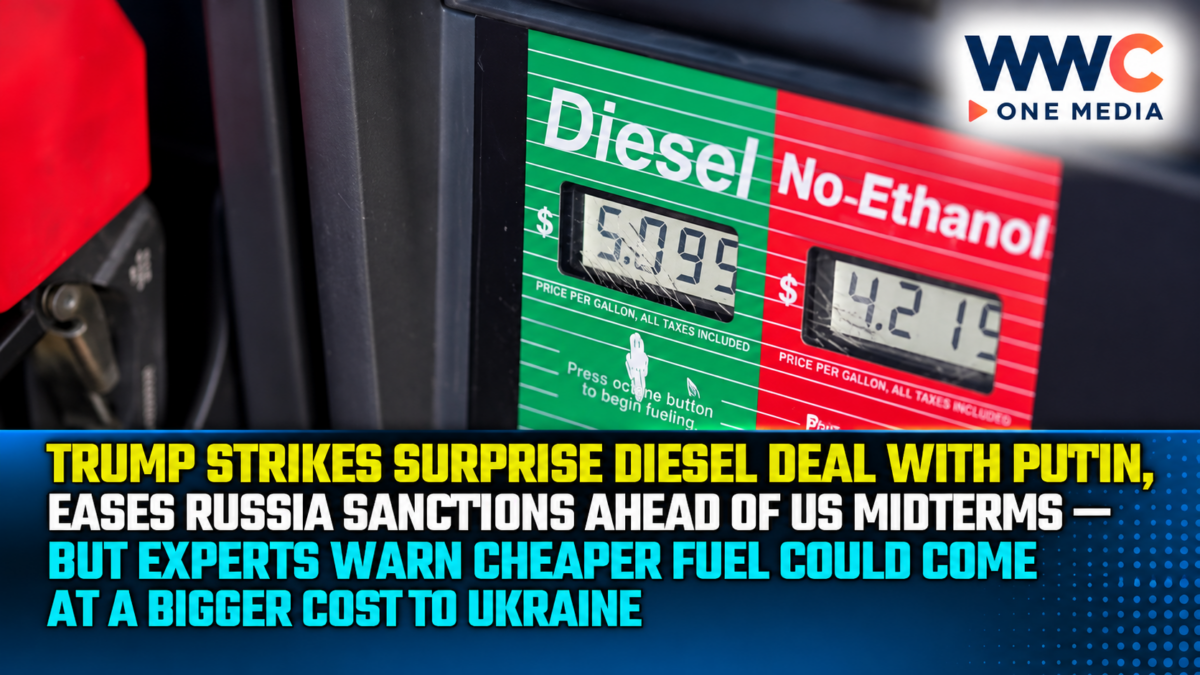
WASHINGTON — US President Donald Trump has reached a controversial agreement with Russian President Vladimir Putin to release more than 4.8 million metric tonnes of Russian diesel into American and global markets, temporarily easing sanctions on Moscow as fuel prices soar ahead of the November 3 US midterm elections. But while Trump promises relief for farmers, truckers and households, energy analysts warn the additional supplies may do little to lower prices — and could provide Russia with fresh revenue as its war against Ukraine continues.
A major shift in American energy and foreign policy is unfolding after the Trump administration moved to reopen access to Russian diesel.
On Friday, October 9, Trump announced that Putin had agreed to release large quantities of the fuel following direct discussions between the two leaders.
The administration simultaneously authorized certain transactions involving Russian-origin diesel, reversing part of the economic pressure Washington had imposed on Moscow over its invasion of Ukraine.
Trump says the arrangement will increase global fuel supplies and reduce the financial burden on American businesses and consumers.
However, the announcement immediately drew criticism from Ukraine, European allies and lawmakers in Washington.
The controversy exposes a difficult policy dilemma: whether short-term relief from high energy prices justifies relaxing restrictions intended to limit the revenue available to Russia’s war economy.
Trump Announces More Than 4.8 Million Tonnes of Russian Diesel
Trump unveiled a phased supply arrangement following discussions with Putin.
According to his October 9 announcement, Russia agreed to provide:
- More than 300,000 metric tonnes immediately.
- Another 500,000 tonnes during November 2026.
- An additional 1 million tonnes afterward.
- A further 3 million tonnes within a short period, depending on the condition of Russian refineries.
Together, the announced quantities exceed 4.8 million metric tonnes.
The initial shipment of more than 300,000 tonnes is equivalent to approximately 2.25 million barrels of diesel.
Trump described the arrangement as an important step toward relieving pressure on international fuel markets.
However, the quantities are announced commitments, not evidence that every shipment has already arrived.
The timing and feasibility of subsequent deliveries remain important unresolved questions.
US Treasury Temporarily Eases Russian Diesel Sanctions
The agreement was accompanied by an official policy change.
On October 9, the US Treasury’s Office of Foreign Assets Control issued Russia-related General License 135.
The license authorizes specified transactions connected with the sale, delivery, unloading and importation of Russian-origin diesel.
The authorization is temporary, extending into April 2027.
This is a significant development because Washington previously imposed restrictions on Russian energy transactions as part of its response to the war in Ukraine.
The new authorization does not mean that every American sanction against Russia has been abolished.
It applies to particular activities involving diesel fuel under the conditions of the license.
Other sanctions and restrictions remain relevant.
The distinction matters for businesses, banks, traders and shipping companies evaluating transactions involving Russian energy.
Why Trump Is Turning to Putin for Diesel
The decision comes amid severe pressure on fuel prices.
According to the original Channel NewsAsia report, US gasoline prices had climbed more than 46% since late February 2026.
Diesel prices had risen approximately 67% over the same period.
As of October 9, regular gasoline averaged about US$4.37 per gallon, while diesel averaged approximately US$6.28.
The price increases followed major disruptions to global energy supplies, including the conflict involving the United States, Israel and Iran.
The Strait of Hormuz, a critical shipping route for oil and petroleum products, has experienced severe disruption.
Additional risks involving tankers, refining capacity and regional infrastructure have intensified market concerns.
Trump’s administration is therefore searching for ways to increase available fuel supplies.
Russian diesel has emerged as a politically controversial option.
Diesel Prices Affect Far More Than Motorists
Diesel is essential to many sectors of the global economy.
Heavy trucks use it to transport goods.
Farmers depend on it for agricultural machinery.
Construction companies, shipping operators and industrial businesses also rely on diesel and related fuels.
When diesel prices rise, transportation and production become more expensive.
Those additional costs can eventually affect food prices, retail goods and construction projects.
This is why the Trump administration is emphasizing benefits for farmers, ranchers and truckers.
Lower diesel prices could help reduce pressure on business operating expenses.
However, the benefits depend on whether the agreement meaningfully increases fuel availability and whether wholesale price reductions reach consumers.
A political announcement alone does not guarantee lower prices at the pump.
Energy Experts Question Whether the Deal Can Deliver
One of the biggest uncertainties is whether Russia can meet the announced supply commitments.
Russian refineries have experienced disruptions associated with Ukrainian attacks and wider wartime pressures.
These disruptions may restrict the amount of diesel that can be produced and exported.
Energy analysts also question whether redirecting Russian diesel toward the United States would create genuinely additional global supply.
If the same fuel would otherwise have been sold to another customer, the arrangement could largely redistribute existing shipments rather than resolve an underlying shortage.
Associated Press reported that energy specialists expect only limited price benefits from the agreement.
Some analysts also believe the announced volumes are too small relative to global diesel consumption to create a sustained decline in prices.
The commercial details, delivery timetable and actual capacity available from Russia will therefore determine whether the policy works.
Diesel Markets React, but Long-Term Relief Remains Uncertain
Financial markets reacted quickly to Trump’s announcement.
S&P Global reported that the margin between US ultra-low-sulfur diesel futures and crude oil prices fell substantially on October 9.
This suggested traders were reassessing expectations for diesel supply.
But a decline in a wholesale market indicator is not the same as a sustained reduction in the retail price paid by drivers.
Fuel prices also depend on refining costs, inventories, transport expenses, local taxes and market conditions.
The initial reaction shows that the announcement influenced expectations.
It does not prove the proposed shipments will be sufficient to reverse the broader energy crisis.
Investors and consumers will need to watch actual deliveries and future price data.
Ukraine Condemns Trump’s Agreement With Putin
Ukrainian President Volodymyr Zelenskyy strongly criticized the arrangement.
Kyiv argues that allowing Russia to sell more fuel could generate revenue that supports Moscow’s continued military operations.
Ukraine has spent years urging international partners to restrict Russian energy income as part of efforts to pressure the Kremlin to end the war.
The diesel arrangement therefore raises concerns about consistency in American sanctions policy.
From Ukraine’s perspective, buying Russian fuel while seeking to weaken Moscow’s ability to finance the war sends conflicting signals.
The Trump administration argues that immediate energy affordability is a major priority.
The disagreement illustrates the tension between economic needs and geopolitical objectives.
There is no verified evidence that the diesel agreement itself constitutes a negotiated settlement of the war.
Fighting continues, and the territorial disputes remain unresolved.
Germany Refuses to Follow Washington’s Sanctions Reversal
The reaction has extended beyond Ukraine.
On October 10, Germany reaffirmed its commitment to maintaining restrictions against Russia.
The German government said its position on sanctions and support for Ukraine had not changed.
European governments have spent years trying to reduce dependence on Russian energy.
For them, resuming purchases could weaken a central component of their response to Moscow’s invasion.
The American decision may therefore produce different approaches among Western allies.
Washington is temporarily relaxing certain restrictions to address fuel costs.
Berlin and other European governments remain focused on limiting Russian energy revenue.
However, the disagreement does not establish that NATO or the European Union has formally abandoned cooperation with the United States.
It highlights a significant policy divergence.
Australia Rejects the Idea of Buying Russian Fuel
Australia has also distanced itself from the American arrangement.
Energy Minister Chris Bowen said the country neither needs nor wants Russian fuel.
Canberra has maintained sanctions associated with Moscow’s invasion of Ukraine.
Australian officials are instead focusing on alternative sources of fuel supply and energy security arrangements.
This response illustrates that additional Russian diesel may not attract buyers in every market.
Some countries may regard the economic benefits as insufficient to outweigh the political and strategic consequences.
Others may be more willing to consider purchases if domestic fuel shortages become severe.
The actual international market for the proposed Russian shipments is therefore still uncertain.
Putin Gains a Potential Economic and Diplomatic Opening
For Russia, the agreement could offer two advantages.
First, renewed fuel sales may generate additional export revenue.
Second, the arrangement may signal an opening for further economic engagement with Washington.
Russia has faced extensive Western sanctions since its full-scale invasion of Ukraine in February 2022.
Energy exports have remained central to its economy.
Any easing of restrictions can therefore carry financial significance.
However, the size of the benefit will depend on actual shipment volumes, prices and commercial terms.
The Kremlin’s willingness to provide diesel should not be interpreted as evidence that Russia has agreed to withdraw from Ukraine or accept a comprehensive peace settlement.
The energy arrangement and the peace negotiations remain separate issues.
Trump Faces Pressure Ahead of November 3 Midterm Elections
The timing of the decision is politically important.
Americans are scheduled to vote in congressional midterm elections on November 3, 2026.
High fuel prices are a sensitive issue because they affect commuting, transportation, agriculture and household costs.
The Republican Party faces pressure to demonstrate that the administration can ease the cost of living.
Trump has made fuel affordability a major part of his public messaging.
The Russian diesel deal gives him a concrete policy announcement to present to voters.
But it also creates political risks.
Critics can argue that relaxing restrictions rewards Putin while the war continues.
Even if the arrangement produces some price relief, its political impact will depend on whether voters believe the economic benefits justify the foreign-policy consequences.
The Deal Could Complicate Ukraine Peace Negotiations
The agreement emerged as American, Ukrainian and European officials were involved in renewed diplomatic discussions aimed at ending the war.
The talks have struggled with fundamental disagreements about territory, security guarantees and the conditions for a ceasefire.
Russia continues to occupy significant areas of Ukraine.
Kyiv rejects surrendering its sovereignty over occupied territory.
The diesel announcement has added another source of tension.
Ukrainian officials worry that sanctions relief could reduce pressure on Moscow before a peace agreement has been reached.
Washington may argue that energy cooperation can occur alongside diplomatic efforts.
But there is no established evidence that Russia made meaningful concessions on the war in exchange for the diesel arrangement.
That remains one of the most important unanswered questions.
Ukraine’s Attacks on Russian Refineries Add Another Complication
Ukrainian strikes on Russian oil infrastructure have become a significant part of the conflict.
Kyiv argues that attacks on facilities supporting Russia’s economy and military operations weaken Moscow’s ability to sustain its war effort.
These strikes have also reduced or disrupted some refining operations.
That creates a practical contradiction for the diesel deal.
Trump is seeking additional Russian fuel supplies at the same time that Russia’s refining infrastructure faces wartime disruption.
The Financial Times reported that the United States had warned Ukraine against refinery attacks because of their impact on global energy supplies.
This has added to tensions between Washington and Kyiv.
The situation raises difficult questions about how energy-market stability can be balanced with Ukraine’s efforts to defend itself.
Could Russian Diesel Lower Prices in Asia?
The agreement could also influence Asian energy markets.
Countries including the Philippines, Singapore, India and other regional economies are sensitive to global oil and refined-product prices.
Transport costs, electricity generation, manufacturing and consumer prices can all be affected by changes in energy markets.
If more diesel enters global trade and wholesale prices fall, some Asian importers could benefit.
But that outcome is not guaranteed.
The impact will depend on regional supply arrangements, shipping costs, exchange rates and domestic pricing systems.
For the Philippines, a sustained decline in global diesel prices could eventually help reduce transport and logistics costs.
However, there is no verified basis to claim that Philippine pump prices have already fallen because of the Trump–Putin announcement.
The deal is a potential market influence, not a confirmed domestic price reduction.
The Bigger Question: Is the World Becoming More Dependent on Russian Energy Again?
The diesel arrangement highlights a wider challenge facing global energy policy.
Governments want affordable fuel.
They also want stable supply chains and reliable security partnerships.
Those goals do not always align.
Sanctions can restrict access to energy supplies from major exporting countries.
But removing restrictions can weaken the economic pressure used to achieve foreign-policy objectives.
The current market crisis has intensified that trade-off.
For Washington, lower fuel prices could provide economic and political relief.
For Ukraine, Russian energy revenue could strengthen Moscow’s ability to continue fighting.
For Europe, the decision raises questions about whether Western sanctions policies will remain coordinated.
For Asia, the issue is whether the global market will receive enough genuinely additional diesel to reduce prices.
The Bigger Picture: Trump’s Fuel Relief Gamble Could Become a Geopolitical Test
Trump’s October 9 announcement represents a substantial change in American policy toward Russian energy.
The administration has authorized specified diesel transactions after announcing a deal involving more than 4.8 million tonnes of potential supplies.
The goal is to lower fuel costs as the United States approaches its midterm elections.
But the economic benefits are far from certain.
Energy experts warn that Russia’s damaged refining capacity, limited export availability and global market conditions could reduce the impact.
Meanwhile, Ukraine and several US allies fear that easing sanctions will provide Moscow with additional revenue and weaken pressure to end the war.
Trump has turned to Putin for help easing America’s fuel-price crisis.
But the bigger question is whether the Russian diesel deal will actually make energy cheaper — or deliver more economic and diplomatic benefits to Moscow than to consumers.
As Washington approaches the November 3 elections, the real test will be measured not in promised fuel shipments but in actual deliveries, pump prices and the consequences for the war in Ukraine.