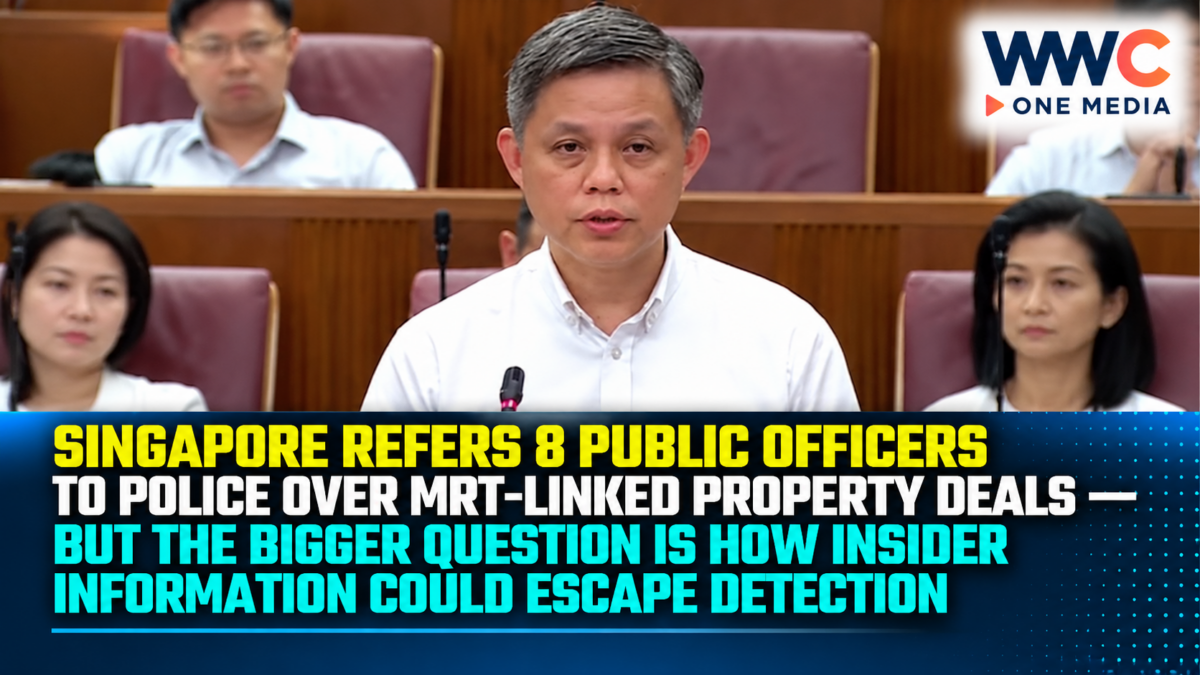
SINGAPORE — Singapore’s reputation for clean government is facing a new test after eight public officers were referred to police for further examination of property purchases near future MRT stations. A government review examined transactions involving 191 officers following an American academic study that identified unusual buying patterns before station locations became public. No wrongdoing has been established, but the controversy has exposed a bigger question: Are Singapore’s existing rules strong enough to detect the possible misuse of confidential information before public trust is damaged?
Singapore has long emphasized integrity as a defining feature of its public service.
Public officers handle sensitive information about transport infrastructure, land-use planning, housing policies and regulatory decisions.
Some of that information can influence the value of private assets long before government plans are formally announced.
That makes strict safeguards essential.
A study released by the US-based National Bureau of Economic Research (NBER) has now triggered closer scrutiny of whether privileged knowledge could have influenced private property purchases.
In Parliament on October 6, Coordinating Minister for Public Services Chan Chun Sing disclosed that eight officers had been referred to police following a review involving 191 officers.
The referrals do not establish guilt.
But the revelation has intensified debate about government transparency, property declarations, oversight and the effectiveness of existing anti-corruption safeguards.
Writing in a CNA commentary published October 10, veteran newspaper editor Han Fook Kwang argued that Singapore should tighten its controls—not merely to protect the public, but also to protect officers from situations that could expose them to temptation or suspicion.
The principle underlying his argument is straightforward: trust in public servants must be supported by meaningful verification.
How Eight Singapore Public Officers Came Under Police Scrutiny
The controversy began with an academic working paper examining property purchases near planned but unannounced MRT stations.
Researchers sought to determine whether people they identified as public officials appeared more likely than comparable buyers to purchase homes in areas that would later benefit from railway expansion.
Their analysis indicated unusual activity, particularly before public announcements of certain stations.
The findings prompted Singapore’s Public Service Division (PSD) to examine available government records.
The researchers had focused on the 2007–2011 period.
PSD expanded its review through 2014 to cover additional years in which MRT station locations were announced.
Officials examined transactions involving 191 public officers.
Eight cases were subsequently referred to police because the information available warranted further examination.
Some transactions had circumstances that raised questions.
In other cases, available records were insufficient to exclude the need for additional scrutiny.
The eight referrals do not mean eight officers were found to have bought properties using secret MRT information.
That determination remains for investigators to assess.
What Did the American Researchers Discover?
The NBER working paper was titled Do Social Norms Substitute for Enforcement? Evidence from Public Officials’ Home Purchases in Singapore.
Its authors were Tomasz Piskorski, Amit Seru, Jian Zhang and Chun Zhao.
The researchers examined property transactions alongside records intended to identify people working in the public service.
They compared buying patterns near future MRT stations with those of other purchasers.
Their study reported that individuals identified as civil servants appeared disproportionately likely to purchase properties near planned stations before their locations were publicly announced.
The pattern was strongest approximately one to two years before announcements.
It was also concentrated among individuals classified as mid-level officials and those associated with agencies connected to rail planning.
The study raised the possibility that some purchasers possessed an information advantage unavailable to ordinary market participants.
But the researchers’ statistical findings did not independently prove that particular individuals accessed confidential information or breached the law.
Why Buying Property Near Future MRT Stations Raises Concerns
The location of an MRT station can influence property demand.
Convenient access to rail transport may make an apartment more attractive to residents and investors.
That can affect prices, rental prospects and future development.
Suppose a government employee knows that a station is being considered near a particular residential development.
If that information is confidential and materially affects the officer’s purchasing decision, the transaction could raise questions under public-service rules.
But location-based investment is not inherently improper.
Ordinary buyers may use publicly available planning documents, neighborhood development trends and other information to predict where rail infrastructure might eventually appear.
The challenge is determining whether a purchase reflects legitimate market research or the improper use of information obtained through official duties.
That distinction requires evidence about what the individual knew, when they knew it and how it affected the transaction.
A suspicious-looking date alone cannot answer those questions.
Why the Government Says the Study Is Not Proof of Corruption
Singapore authorities have emphasized the difference between statistical association and individual misconduct.
In its September 25 response, PSD acknowledged that the research findings merited attention.
However, it warned that buying patterns cannot by themselves establish whether a particular officer had access to confidential planning information.
The government also identified questions about the research methodology.
These included the underlying proprietary data, how individuals were matched across different records and how accurately the researchers identified public officers.
Another complication is that future infrastructure projects may already have been discussed publicly before precise station locations were announced.
Property buyers could have made informed predictions without accessing secret records.
The government’s review therefore examined individual circumstances rather than simply treating the study’s statistical conclusions as proof of misconduct.
This is an important protection against unfairly accusing officers who may have acted lawfully.
NUS Academics Also Question the Research
The study attracted scrutiny from Singapore-based academics.
CNA reported in September that National University of Singapore professors Ivan Png and Jessica Pan had asked for their names to be removed from the paper’s acknowledgements.
They said they were not familiar with the research in the manner the acknowledgements might suggest.
University of Chicago economist Chang-Tai Hsieh also questioned aspects of the study’s conclusions.
One concern was whether the potential price gains from advance knowledge of MRT station locations had been correctly interpreted.
A separate Business Times commentary similarly argued that an unannounced station location is not necessarily an unpredictable one.
These criticisms do not establish that the study is wrong.
They do, however, demonstrate why its findings require independent verification.
The researchers identified a pattern worth investigating.
The government must determine whether that pattern can be connected to actual improper conduct.
Chan Chun Sing Explains Why Eight Cases Were Referred
Speaking in Parliament on October 6, Chan Chun Sing explained how the review was conducted.
PSD identified officers who worked in agencies involved in rail planning and purchased properties near subsequently announced MRT stations during the review period.
For each case, officials considered the officer’s role, the timing of the purchase and whether the individual may have had access to relevant non-public information.
They also examined other available transaction records.
The review identified eight cases requiring further examination.
Chan emphasized that the referrals should not be interpreted as findings of guilt.
Police will examine the cases independently.
Additional administrative checks are continuing.
The government’s responsibility is to investigate credible concerns while protecting officers against unsupported allegations.
That balance is central to maintaining confidence in the eventual findings.
Singapore Already Requires Public Officers to Declare Property Purchases
One of the central questions raised by the controversy is why existing safeguards may not have detected potentially questionable transactions earlier.
Singapore’s public-service rules already include property declaration requirements.
Since the 1990s, officers have been required to declare private-property purchases.
They must also make annual declarations concerning non-owner-occupied properties.
Officers who possess non-public information relevant to a proposed transaction must seek approval from their Head of Agency before proceeding.
The rules extend beyond property purchases to other transactions involving potentially relevant confidential information.
They also cover specified transactions involving spouses and financially dependent children.
Officers are prohibited from disclosing confidential information to relatives, friends or other people for private gain.
Depending on the circumstances, improper disclosure or use could breach public-service rules or applicable laws, including the Official Secrets Act.
The safeguards are therefore not absent.
The key question is whether they are sufficiently effective in practice.
Are Property Declarations Actually Checked?
This is the issue at the center of Han Fook Kwang’s CNA commentary.
A declaration system can help identify conflicts of interest only when information is reviewed and potential warning signs are investigated.
If employees submit declarations that receive little meaningful scrutiny, a requirement may provide less protection than intended.
Han questioned whether officials sufficiently examine property declarations for transactions that deserve attention.
For example, should a declared purchase be compared with the employee’s access to confidential infrastructure plans?
Should unusually timed transactions receive additional examination?
Could existing records be used to identify patterns without treating every legitimate purchase as suspicious?
These are questions about the design and enforcement of internal controls.
They are not evidence that Singapore’s current declaration records are routinely ignored.
The effectiveness of those procedures is precisely what authorities may need to examine as their review progresses.
The Grey Area Between Public Knowledge and Confidential Information
The hardest cases may involve information that is not clearly public but is also not a final government decision.
Consider a public officer who knows that planners are discussing rail expansion in a particular district.
The officer may not know the exact station location.
But that professional familiarity could help them make an educated prediction about future property demand.
Would buying property in that district be improper?
The answer may depend on the actual information available, how it was acquired and the relevant rules.
Another situation involves an officer already planning to buy a home.
Shortly before paying a deposit, the officer learns through work that a station is likely to be built nearby.
Did the new information materially affect the decision?
These examples show why allegations cannot be resolved simply by looking at transaction dates.
They also support the argument for clearer guidance on when an officer should disclose a possible conflict and seek approval.
The goal should be to prevent misuse without unfairly restricting ordinary financial decisions.
Why Stricter Rules Could Also Protect Civil Servants
Han’s argument goes beyond catching misconduct after it occurs.
He believes stronger safeguards may help prevent wrongdoing in the first place.
Where an employee knows transactions will be reviewed, the incentive to misuse official information may be reduced.
Clearer rules can also protect honest officers.
An officer who obtains approval before a potentially sensitive purchase may have a stronger record demonstrating that the transaction was properly disclosed.
A transparent review process can reduce uncertainty.
It can also help agencies distinguish harmless coincidences from cases requiring investigation.
Han illustrates this principle through a past experience as a newspaper editor, when weak controls over promotional vouchers contributed to an employee’s misuse of them.
His lesson was that inadequate oversight can create unnecessary opportunities for wrongdoing.
For public institutions, prevention may be more effective than waiting for a scandal before reviewing procedures.
Could Artificial Intelligence Help Detect Unusual Property Purchases?
The controversy raises broader questions about modern oversight.
Government agencies hold information about officers’ roles, property declarations and access to sensitive projects.
In principle, appropriately governed analytical systems could help identify transactions deserving additional examination.
For example, a risk-based review could compare a declared purchase with the officer’s work responsibilities and the timing of relevant planning decisions.
However, such analysis would require strong safeguards.
It should not rely on automated assumptions that purchasing property near a future station proves wrongdoing.
False matches and incomplete data could unfairly damage reputations.
Privacy protections, independent human review and clear accountability would be essential.
Singapore has not announced a comprehensive new automated monitoring programme as part of the October 6 statement.
Using more systematic cross-checks is a possible reform worth evaluating, not a policy already confirmed.
What About Spouses, Relatives and Friends?
Misuse of confidential information may not always involve an officer purchasing property personally.
A related person could potentially benefit from information passed on by someone with government access.
Singapore’s rules already address specified transactions involving spouses and financially dependent children.
They also prohibit officers from passing non-public information to others for private gain.
Members of Parliament have questioned whether declaration requirements should extend more broadly to other relatives or people living in the same household.
The government has said it will consider potential gaps.
But any broader framework would have to balance enforcement with legitimate privacy concerns.
Not every transaction by an officer’s relative should automatically be treated as suspicious.
The challenge is to detect actual information misuse without creating unreasonable obligations for people who do not work in public service.
Why the Issue Matters Beyond the MRT Property Market
Transport planning is not the only area where confidential government information might have financial value.
Decisions involving land use, development approvals, property taxes or vehicle regulations could influence market behavior.
For example, advance knowledge of a significant change in COE supply could affect expectations about vehicle costs.
Confidential information concerning property-related taxes could also affect decisions about buying or selling real estate.
Han raises these examples to illustrate why information protection matters across government.
They are hypothetical scenarios, not established findings of misconduct in those policy areas.
As Singapore’s economy becomes increasingly data-driven, safeguarding sensitive government information will remain important.
Public institutions must protect commercially valuable information while continuing to make legitimate policy announcements transparently.
The Role of Police and CPIB
Singapore has established processes for investigating suspected public-sector misconduct.
PSD’s present role is administrative fact-finding.
It does not determine criminal responsibility.
Where information suggests potential offences, cases may be referred to the police or the Corrupt Practices Investigation Bureau, depending on the circumstances.
Police are now examining the eight referred cases.
Investigators will need to determine whether the available facts support further action.
Possible outcomes could include a finding that there is insufficient evidence of wrongdoing.
Where misconduct is established, disciplinary or legal consequences may follow according to the applicable rules.
No such outcome should be assumed before the investigations conclude.
The credibility of the process depends on evidence, independence and due process.
Singapore’s International Reputation Raises the Stakes
Singapore’s public service is widely associated with strong governance standards and administrative discipline.
That reputation is an important part of the country’s international standing.
Investors and residents depend on confidence that government decisions are made for legitimate public purposes.
Allegations involving advance access to infrastructure plans therefore attract attention even before misconduct has been proven.
The potential concern is not simply whether an individual officer made an improper profit.
It is whether members of the public believe officials operate under rules that apply consistently and can be effectively enforced.
A credible investigation can help protect public confidence.
So can a willingness to strengthen safeguards when evidence reveals weaknesses.
But premature accusations against civil servants could also undermine trust unfairly.
Accountability requires both vigilance and restraint.
What Happens Next?
Several questions remain unresolved as of October 11.
Police must examine the eight referred cases and determine whether there is evidence of misconduct.
PSD is continuing its own checks.
Authorities will also need to consider what the review reveals about the practical effectiveness of current safeguards.
Parliamentary questions have raised the possibility of broader cross-checks, stronger declaration requirements and more systematic monitoring of sensitive transactions.
The government has not announced that all these proposals will be adopted.
Chan has said any additional measures should be proportionate to the risks, practical to implement and compatible with legitimate personal transactions.
Those considerations matter.
An effective integrity system must discourage abuse without treating every public officer’s ordinary investments as evidence of wrongdoing.
The Bigger Picture: Singapore’s Real Test Is Prevention, Not Just Punishment
The controversy surrounding MRT-linked property purchases has become an important test of Singapore’s public-sector safeguards.
An academic study raised questions about buying patterns near future MRT stations.
A government review examined transactions involving 191 officers.
Eight cases were referred for police investigation.
No wrongdoing has yet been established.
The immediate task is to determine what happened in those individual cases.
But the wider policy challenge is larger than the eight officers under scrutiny.
It concerns whether property declarations, information-access controls and internal oversight can detect potential conflicts before they become public controversies.
Clearer rules could protect public resources and prevent improper financial advantage.
They could also protect civil servants by helping them identify conflicts before making personal transactions.
Singapore already has rules preventing public officers from exploiting confidential information.
But the crucial question is whether those rules are verified and enforced strongly enough to maintain public confidence.
As investigators examine the eight cases, the broader challenge is ensuring that confidential government decisions never become an unfair advantage in private markets—and that honest officers are protected by an accountable system.