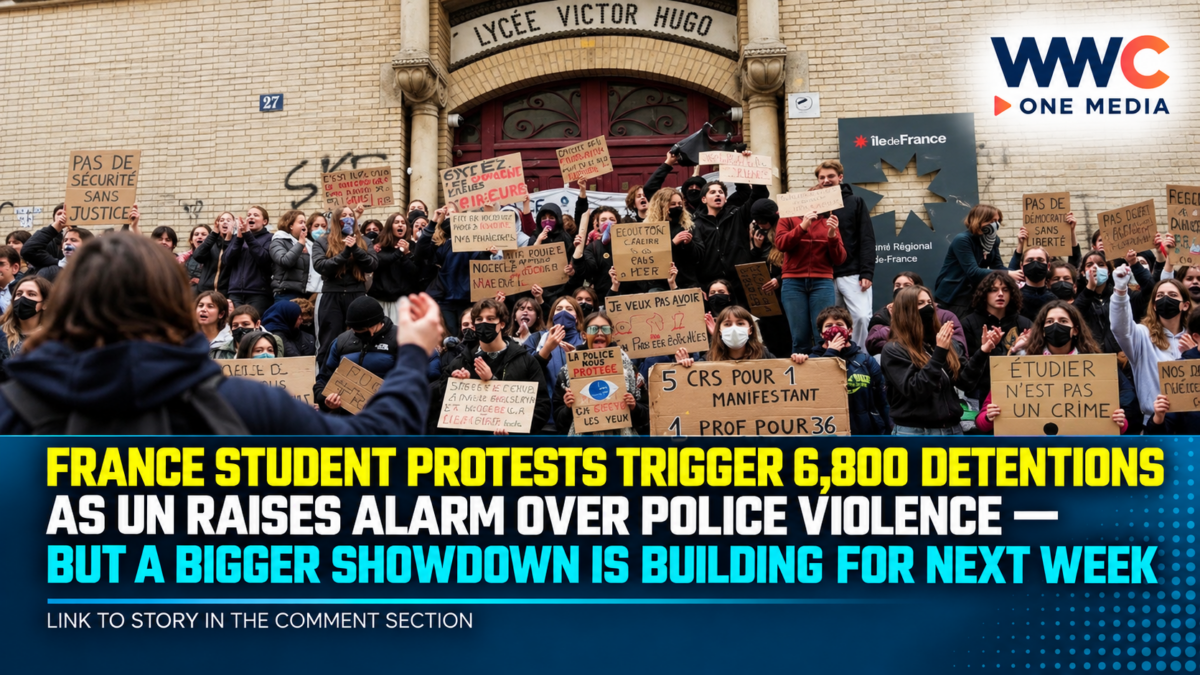
PARIS — France is facing one of its most serious student protest movements in years as thousands of teenagers demand better schools, more teachers and an end to deteriorating classroom conditions. More than 6,800 people have been detained since the demonstrations began, with minors accounting for 86% of those detained, according to the French Justice Ministry. The United Nations has expressed concern over violent confrontations between protesters and police, while authorities estimate at least €30 million in damage. But despite government promises to deploy 3,000 substitute teachers, student organizers are preparing another wave of demonstrations — raising the prospect of a deeper confrontation ahead of France’s 2027 presidential election.
A nationwide wave of student-led demonstrations is putting pressure on President Emmanuel Macron’s government to address longstanding problems within the French education system.
What began in late September with high school blockades in the Paris region has expanded into a broader movement involving teenagers, teachers, parents and labor organizations.
Students have complained about overcrowded classrooms, teacher absences, inadequate facilities and school buildings that become dangerously uncomfortable during periods of extreme heat.
The protests have also exposed wider concerns about inequality between schools in wealthier communities and those serving disadvantaged neighborhoods.
Although many demonstrations have remained peaceful, others have involved vandalism, fires and violent confrontations with police.
Authorities have responded with riot officers, arrests and crowd-control weapons.
The growing number of injuries and detentions has attracted attention from international human rights organizations.
Now, as the government attempts to reduce tensions through new education commitments, student groups say the measures are insufficient.
More Than 6,800 Detained as Protests Spread Across France
France’s Justice Ministry reported on Friday, October 9, that more than 6,800 people had been detained since the demonstrations began.
Approximately 86% were minors.
That proportion is especially significant because many protesters are high school students aged between 15 and 18.
The detention figure describes people taken into custody during the unrest.
It does not mean that all were charged with crimes or convicted of wrongdoing.
The scale of the detentions has intensified scrutiny of French policing practices.
Students and rights advocates argue that police responses have sometimes been excessive.
Authorities maintain that officers have been responding to public disorder, violence and threats to safety.
The competing claims underline the challenge facing the government: ensuring students can demonstrate peacefully while protecting teachers, residents and public infrastructure.
Why Are French Students Protesting?
The movement is rooted in dissatisfaction with the condition of France’s public schools.
Students have identified several major concerns:
- Overcrowded classrooms and difficult timetables
- Teacher shortages and frequent cancelled lessons
- Aging buildings, damaged facilities and inadequate equipment
- Poor ventilation and classrooms that become excessively hot
- Unequal educational opportunities between communities
These grievances have become particularly visible in lower-income areas around Paris.
The Guardian reported that students in Sevran, a suburb of Paris, described schools without enough desks or chairs, deteriorating toilets and lengthy teacher absences.
For many demonstrators, the issue is not simply academic performance.
They believe inadequate school conditions undermine their opportunities and reflect wider inequality.
The protests therefore combine demands for practical improvements with a broader call for fair treatment.
UN Raises Alarm Over Violent Clashes
The United Nations human rights office publicly expressed concern on October 9.
Spokesperson Shabia Mantoo said the organization was following reports of violence connected to high school demonstrations and blockades.
The UN urged all parties to act peacefully.
The statement followed reports of injuries involving protesters and police officers.
Human rights advocates have accused some officers of using disproportionate force during confrontations.
The French government has defended the need for law enforcement when demonstrations turn violent.
Both aspects of the situation must be considered.
Peaceful assembly is an important democratic right.
At the same time, arson, assaults and destruction of property can create serious risks that authorities have a responsibility to address.
The key legal and public-policy question is whether individual uses of force were necessary and proportionate.
Teenager Loses Hand After Stun Grenade Incident
One of the most serious incidents involved a 15-year-old student who lost a hand following the use of a police stun grenade.
The injury prompted widespread criticism of riot-control tactics.
According to CNA and AFP, the French government subsequently suspended the use of the weapon involved.
The decision came amid growing concern about injuries associated with so-called less-lethal crowd-control equipment.
These weapons are designed to reduce reliance on firearms, but they can still cause severe injury.
Their use requires careful assessment of circumstances, distance, risk to bystanders and applicable operating rules.
The incident has intensified calls for clearer safeguards when police respond to demonstrations involving children.
The suspension of the weapon is a confirmed government response.
It should not be interpreted as a final finding of criminal liability against a specific officer.
Police Misconduct Investigations Increase
As of the October 9 CNA report, police had opened 18 internal investigations into allegations of misconduct.
Subsequent Reuters reporting on October 10 described 24 cases under examination by France’s internal police oversight body, the IGPN.
The newer figure reflects a later reporting point and should not be confused with the earlier total.
Reuters highlighted the case of a 14-year-old identified as Eden, who suffered serious facial injuries after reportedly being struck by a tear-gas canister.
His family filed a complaint, and the incident is under investigation.
Rights organizations have called for closer scrutiny of how police use tear gas, grenades, batons and other crowd-control weapons.
Police representatives argue that officers must have effective tools to respond when they face violent attacks.
The existence of an investigation does not automatically establish wrongdoing.
Its purpose is to determine what happened and whether the conduct was lawful.
Government Reports Hundreds of Police Injuries
The violence has also affected law enforcement officers.
Reuters reported French government figures indicating approximately 700 police officers had been injured during the unrest.
Authorities have condemned attacks on officers, school employees and public property.
There have been incidents involving vandalism, arson and damage to schools or public infrastructure.
The government estimates that damage linked to the demonstrations has reached at least €30 million, equivalent to approximately US$33.6 million in the reporting period.
That figure is a preliminary estimate rather than an independently audited final total.
Students and organizers have argued that violent incidents should not overshadow the broader movement’s demands.
Most demonstrations have been peaceful, according to reporting from international news agencies.
Distinguishing peaceful participants from those involved in criminal conduct is essential to fair coverage of the unrest.
More Than 260,000 Rally in One Day
The demonstrations have reached a significant scale.
According to Associated Press, more than 266,000 people took part in protests across France on October 6.
Approximately 56,000 participated in Paris.
The demonstrations involved students, educators, labor organizations and other supporters.
Participants called for greater education funding and action on teacher shortages.
Police deployed tear gas during some confrontations.
Nearly 500 people were detained that day, according to AP’s reporting.
The turnout demonstrated that the movement had extended beyond individual school blockades.
It also highlighted the potential for a sustained campaign involving multiple groups concerned about public services and government spending.
However, turnout at one protest should not be treated as proof of nationwide agreement on every demand or tactic.
Hundreds of Schools Disrupted
School operations have been significantly affected.
Earlier in October, several hundred schools were closed or partially closed amid demonstrations and security concerns.
On October 9, the Education Ministry reported that 141 of France’s approximately 3,700 high schools remained closed.
A week earlier, around 800 had been affected.
The decline suggested a temporary easing of disruption.
Government officials described the movement as slowing.
Student organizers offered a different interpretation.
They said demonstrators were regrouping and preparing for further nationwide action.
The distinction matters because reopening schools does not necessarily mean the grievances behind the protests have been resolved.
Students may return to classes temporarily while continuing to plan demonstrations.
Students Plan New Protests for October 13
Organizers have called for another wave of demonstrations on Tuesday, October 13.
Students interviewed by AFP said they were conserving their energy for the next round.
Student union representatives described the government’s initial proposals as inadequate.
The new mobilization could test whether the authorities’ commitments are enough to reduce public anger.
It may also test the movement’s ability to sustain participation after several weeks of disruption.
As of October 11, the planned demonstrations had not yet occurred.
Their turnout, policing arrangements and consequences remain uncertain.
It would be premature to claim that another round of violent clashes is inevitable.
France Promises 3,000 Substitute Teachers
Education Minister Édouard Geffray has announced that approximately 3,000 substitute teachers will be deployed to address staffing shortages.
The immediate priority is 114 high schools identified as facing particularly serious disruption.
The government also intends to review school timetables and address other problems raised by students.
These steps acknowledge that teaching shortages and disrupted lessons require action.
However, substitute teachers may provide only partial relief if the underlying problems involve permanent staff vacancies, inadequate facilities or unequal funding.
Student representatives argue that the measures do not adequately address the structural problems affecting schools.
The dispute now centers on whether emergency interventions will be followed by lasting education reforms.
Prime Minister Promises Wider Plan by Late October
Prime Minister Sébastien Lecornu has promised a more comprehensive response by the end of October.
The government is expected to address demands involving school resources and conditions.
Economy Minister Roland Lescure has also indicated that adjustments may be possible within the proposed 2027 budget.
But France is facing significant fiscal constraints.
According to CNA’s reporting, the draft budget provides for a 1.4% increase in education funding, bringing the total to approximately €90.9 billion.
Critics argue that the increase is insufficient to resolve longstanding problems.
The government must weigh education investment against demands involving defence, debt servicing and other public services.
Those competing financial priorities help explain why the dispute has become politically difficult.
France’s Debt Burden Complicates Education Reform
Reuters has highlighted the growing pressure on France’s public finances.
The government faces high borrowing costs and a substantial debt burden.
This limits how easily it can respond to demands for greater spending.
Public frustration is increasing as families and teachers see worsening conditions in some schools while the government emphasizes fiscal discipline.
The question is not simply whether France should invest more in education.
It is how much additional funding can be provided, where it should be directed and how the government can ensure it produces meaningful results.
Opposition parties have offered differing approaches.
Some advocate higher taxes or changes to spending priorities.
Others emphasize tighter public spending and greater security.
These disagreements are likely to become more prominent as the 2027 presidential election approaches.
Macron Faces Political Pressure Ahead of 2027 Election
The protests have arrived during a sensitive period for President Emmanuel Macron’s administration.
France is scheduled to hold a presidential election in 2027.
Macron cannot seek another consecutive term under the country’s constitutional term-limit rules.
The unrest could influence how voters assess his government’s record on education, public spending and policing.
Political figures from across the ideological spectrum have responded differently.
Far-left leader Jean-Luc Mélenchon has voiced support for the protesters and criticized police tactics.
Far-right leader Marine Le Pen has condemned the violence associated with some demonstrations.
Their competing positions reflect a broader divide over public services, security and the right to protest.
However, the student movement should not automatically be portrayed as controlled by a particular political party.
Its origins and demands are rooted in school conditions, even as political organizations attempt to shape the public debate.
Student Anger Goes Beyond Classroom Conditions
The Guardian’s reporting from Sevran highlights a deeper sense of exclusion among young people.
Students described feeling neglected by the state and disadvantaged by the conditions in which they are expected to study.
The movement has also brought attention to unequal access to mental health support and extracurricular resources.
In disadvantaged areas, poor infrastructure and teacher shortages may reinforce existing social inequalities.
Students argue that educational opportunity should not depend on the neighborhood in which a family lives.
These concerns help explain why some demonstrators have continued despite government promises.
For them, the dispute involves dignity and fairness as well as school budgets.
Their demands will require more than temporary reopening measures if the underlying inequalities remain unchanged.
Why the Protests Matter Beyond France
The unrest has attracted international attention because of its scale and the age of many participants.
It raises questions relevant to other countries facing pressure on education systems.
Governments must address staffing shortages, aging infrastructure and rising expectations while working within budget limits.
They must also respond to demonstrations in ways that respect peaceful assembly and protect public safety.
For countries in Asia, including the Philippines, the developments offer an example of how education concerns can develop into a broader political movement.
However, the French situation has its own legal, economic and historical context.
It would be inaccurate to assume that identical conditions or solutions apply in other countries.
The broader issue is how governments maintain confidence among young people when public services appear unable to meet their needs.
The Bigger Picture: France’s Student Protests Have Become a Test of Government Credibility
France’s student demonstrations began as a campaign for better education.
They have evolved into a national dispute involving public spending, policing and political accountability.
More than 6,800 people have been detained.
The UN has expressed concern about violent confrontations.
Investigations are underway into allegations of police misconduct.
Authorities have also reported significant injuries among officers and damage to public property.
The government has responded with promises of thousands of substitute teachers and a broader plan by late October.
But student organizers have not declared the movement over.
France’s government is trying to restore normal classroom operations while responding to legitimate concerns about education quality and public safety.
The bigger challenge is whether temporary measures can address deeper inequalities — and whether authorities can maintain order without undermining confidence in the right to peaceful protest.
With another round of demonstrations planned for October 13, the next few days could determine whether the crisis begins to ease or develops into a more sustained confrontation ahead of France’s 2027 presidential election.