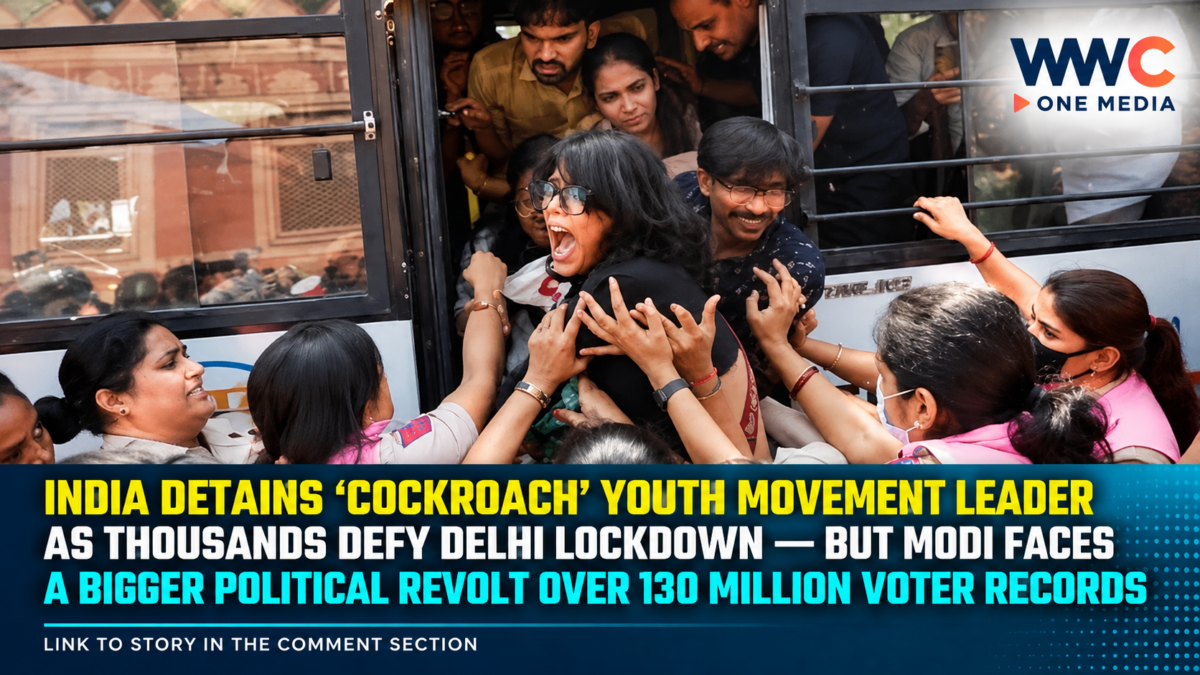
NEW DELHI, INDIA — Indian police have detained Abhijeet Dipke, the founder of the fast-growing Cockroach Janta Party youth movement, as thousands of demonstrators attempted to challenge a massive security lockdown in the nation’s capital. The October 10 crackdown involved suspended mobile internet services, closed metro stations and the detention of more than 2,000 people, according to Reuters. But behind the confrontation lies an even bigger political dispute: the removal of approximately 130 million entries from India’s electoral rolls and allegations that the changes could favor Prime Minister Narendra Modi’s ruling Bharatiya Janata Party.
India’s latest wave of political unrest has entered a decisive phase after authorities detained the leader of a youth movement that has transformed online anger into demonstrations against the country’s election administration.
Abhijeet Dipke, a 31-year-old political strategist and activist, was intercepted by police after arriving in New Delhi from Mumbai on Saturday, October 10, ahead of a planned protest.
The demonstration was organized by the Cockroach Janta Party, or CJP, a movement demanding the resignation of Chief Election Commissioner Gyanesh Kumar.
The group alleges that India’s controversial electoral-roll revision has unfairly removed legitimate voters and compromised trust in the country’s election process.
The Election Commission and Modi’s ruling BJP deny allegations of wrongdoing.
According to Reuters, security personnel shut down access to parts of central Delhi, restricted transportation and prevented demonstrators from reaching the planned rally site at Jantar Mantar.
But the measures did not eliminate the protests.
Activists instead staged smaller demonstrations across several locations, while related rallies and detentions were reported in other Indian cities.
The confrontation has become a significant test for India’s political leadership as questions over election transparency intersect with youth frustration over employment, education and government accountability.
Police Detain Abhijeet Dipke at Delhi Airport
The day’s most prominent detention involved CJP founder Abhijeet Dipke.
According to Reuters, officers approached him aboard an aircraft after it arrived in Delhi from Mumbai.
Television footage showed Dipke confronting police and declaring that he was not afraid of being arrested.
The activist had travelled to the capital to participate in a planned demonstration against Chief Election Commissioner Gyanesh Kumar.
Authorities had already prohibited the gathering.
Police told organizers that the protest could not proceed because permission had not been granted.
CJP representatives confirmed that Dipke and fellow movement leaders Saurav Das and Ashutosh Ranka were detained.
Their detention attracted particular attention because the movement has rapidly developed from an online protest campaign into a nationally recognized source of political opposition.
For Dipke’s supporters, the incident reinforced their concerns about restrictions on political dissent.
For authorities, it formed part of a wider operation intended to prevent a prohibited demonstration and maintain public order.
The legality and proportionality of individual police actions remain subjects of debate.
Delhi Lockdown Shuts Transport and Mobile Internet
Security forces imposed extensive restrictions ahead of the protest.
Thousands of police and paramilitary personnel were deployed across New Delhi.
Officers established checkpoints, inspected vehicles and attempted to prevent demonstrators from accessing Jantar Mantar.
Dozens of metro stations were affected by closures and restrictions.
Mobile internet services were also suspended in parts of central Delhi.
Markets were shut in affected areas, and public transportation faced significant disruption.
According to Reuters, police stopped buses and checked vehicles at points of entry into the capital.
The measures disrupted daily life for residents who were not necessarily participating in the demonstrations.
The operation was widely described as a lockdown.
However, it was a security crackdown concentrated on Delhi and protest-related locations, not a nationwide shutdown of Indian transportation or internet services.
More Than 2,000 People Detained in Delhi
Reuters reported that more than 2,000 protesters were detained in Delhi on October 10, citing a Home Ministry official.
Other organizations reported higher estimates of detentions during the wider security operation.
The figures vary because they come from different sources and may include different locations and periods.
A single nationwide detention total has not been independently established.
Nevertheless, the scale of police action was substantial.
The demonstrations involved students, political activists, civil society organizations and supporters of the Cockroach movement.
Several prominent opposition figures and public personalities were also reported to have been detained during related demonstrations.
The crackdown drew attention to the government’s use of preventive detention and restrictions on public gatherings.
Critics argued that peaceful political opposition should not be met with such sweeping measures.
Authorities maintained that the restrictions were necessary to preserve public order.
Protesters Turn to Flash Demonstrations Across Delhi
Despite the heavy security presence, protesters continued to organize.
The Indian Express reported that activists shifted toward spontaneous demonstrations at multiple locations after police prevented access to the main rally site.
These included Connaught Place, Dilli Haat, Rajghat and the Safdarjung flyover.
The approach allowed smaller groups to gather away from the heavily fortified protest area.
Officers subsequently moved to disperse demonstrations and detain participants.
The development demonstrated the challenge authorities face when protest movements use decentralized organizing methods.
Instead of relying on a single large gathering, activists can attempt to organize multiple smaller actions.
However, the existence of flash protests does not establish that the movement has achieved nationwide majority support.
It shows that demonstrators continued mobilizing despite substantial security restrictions.
Hundreds Detained at Related Mumbai Protest
The demonstrations were not confined to New Delhi.
The Indian Express reported that more than 600 people were detained during a related gathering in Mumbai.
Protesters had attempted to reach August Kranti Maidan, a site closely associated with India’s independence movement.
Among those reportedly detained were Tushar Gandhi, a descendant of Mahatma Gandhi, and actor Imran Khan.
Police deployed barricades and personnel to prevent the demonstration from proceeding.
The involvement of public figures contributed to the wider visibility of the movement.
It also demonstrated how the electoral controversy had spread beyond the capital.
However, Mumbai’s reported detention count should not be added to Delhi estimates without clearly identifying the different locations and sources.
How the ‘Cockroach’ Movement Became a National Force
The Cockroach Janta Party has an unusual political identity.
Its name emerged from a public controversy in which unemployed young people were compared to cockroaches.
Dipke responded by suggesting that those dismissed in such terms could become powerful if they united.
His online response attracted attention and helped create a rallying point for frustrated young Indians.
According to Reuters, Dipke comes from a Dalit background and has experience in political strategy.
His movement has drawn support from people concerned about unemployment, educational opportunities and political accountability.
The CJP is better understood as a youth-led pressure movement than as an established national electoral party.
Its supporters have organized demonstrations focusing on public examinations, employment and, more recently, electoral transparency.
That evolution has turned Dipke into a prominent political figure despite his relatively recent rise to national attention.
Earlier Education Protests Helped Build Momentum
Before confronting India’s election authorities, the movement campaigned on education-related issues.
Concerns about examination irregularities and opportunities for young people had become major sources of public dissatisfaction.
Reuters reported that earlier protest activity contributed to political pressure preceding the resignation of India’s education minister in July 2026.
That history helps explain why the movement attracted attention from established political organizations.
It had already demonstrated an ability to organize supporters around issues with direct consequences for young people.
The dispute over electoral rolls provided a new focus.
Unlike examination policies, voter registration affects the functioning of India’s democratic system more broadly.
By linking youth grievances to electoral accountability, the CJP has entered a far more politically sensitive debate.
Why 130 Million Removed Voter Records Are at the Center of the Crisis
The central controversy involves India’s Special Intensive Revision of electoral rolls.
Election authorities say the exercise is intended to update registration records and remove entries that should no longer appear on voter lists.
Such entries can include records associated with deceased individuals, duplicate registrations, people who have moved and other cases requiring verification.
Reports indicate that approximately 130 million voter-list entries were removed during the exercise.
Opposition parties and activists claim that the process may have disproportionately affected minority and economically vulnerable communities.
They also allege that the changes could benefit Modi’s BJP.
The Election Commission rejects allegations that the revision was designed to manipulate elections.
The crucial distinction is between the number of deleted entries and the number of eligible voters who may have been wrongfully removed.
The first is a reported administrative figure.
The second is a disputed legal and factual question.
It is not accurate to state that 130 million legitimate voters have been conclusively stripped of their rights.
Chief Election Commissioner Gyanesh Kumar Faces Growing Pressure
Gyanesh Kumar has become the central target of the demonstrations.
CJP leaders are demanding his resignation and greater scrutiny of the electoral-roll revision.
They argue that the Election Commission must demonstrate independence and ensure that eligible citizens can register and vote.
The broader opposition has questioned the transparency of the process and called for stronger safeguards.
Election authorities maintain that the revision is a legitimate administrative exercise.
The disagreement has created a difficult challenge for the institution responsible for managing India’s elections.
Public confidence depends not only on maintaining accurate voter records but also on ensuring that registration procedures are understandable, transparent and accessible.
As of October 11, there had been no established final judicial determination proving that Kumar deliberately manipulated electoral rolls to benefit the BJP.
The allegations should therefore remain attributed to the protesters and opposition.
Modi’s Government Faces Competing Political Pressures
For Prime Minister Narendra Modi, the protests represent a politically sensitive challenge.
His government and party face accusations of suppressing dissent while benefiting from disputed electoral decisions.
The BJP denies improper manipulation of the voter lists.
Supporters of the government argue that maintaining accurate records is essential to electoral integrity.
They also emphasize that authorities have powers to restrict unauthorized gatherings when public order is at risk.
Critics counter that large-scale detentions, internet restrictions and transport shutdowns can discourage lawful political participation.
The confrontation has therefore developed into two overlapping disputes.
The first concerns the accuracy and fairness of electoral registration.
The second concerns whether the state’s response to protesters is consistent with democratic rights.
Even a transparent resolution of the voter-list controversy would not automatically settle questions about the policing of demonstrations.
Opposition Parties Join the Dispute
The protests have attracted attention from established opposition leaders.
Congress leader Rahul Gandhi and other critics of the BJP have raised concerns about voter registration procedures.
Some opposition politicians joined or supported protests surrounding the October 10 crackdown.
Their involvement has amplified the political significance of the movement.
At the same time, the Indian Express reported differing reactions among parties associated with the ruling National Democratic Alliance.
Some leaders encouraged dialogue with protesting young people, while others defended the government’s security response.
This suggests that the handling of the demonstrations has generated discussion beyond a straightforward division between the BJP and its parliamentary opponents.
The longer-term political effect remains uncertain.
Why the Arrest Could Strengthen the Movement
The detention of a protest leader can have different political consequences.
It may disrupt planning, weaken coordination and discourage some supporters from attending demonstrations.
But it can also draw additional attention to the movement’s demands.
Dipke’s confrontation with police aboard an arriving aircraft was widely circulated in news coverage and on social media.
The images placed the CJP leader at the center of a national political story.
This may strengthen his visibility among people already concerned about electoral transparency and youth unemployment.
However, visibility does not guarantee lasting public support.
The movement’s future will depend on its organizational capacity, ability to sustain demonstrations and effectiveness in communicating specific demands.
The government’s response will also influence how the controversy develops.
What the Crackdown Means for India’s Democratic Institutions
India’s political system depends on several important democratic safeguards.
These include independent election administration, access to the ballot, judicial oversight and rights of political participation.
The electoral-roll dispute raises questions about how the country balances the need to remove inaccurate records against the danger of excluding eligible citizens.
The protest crackdown raises a separate question about when restrictions on assemblies are necessary and proportionate.
A government may have legitimate public-order concerns without every proposed restriction automatically being justified.
Similarly, the existence of a large protest does not independently establish that all allegations against election officials are true.
Both issues require evidence, transparent procedures and legal scrutiny.
That is why the dispute has significance beyond the immediate fate of the Cockroach Janta Party.
Why the Crisis Matters Ahead of Future Elections
India faces further state elections in 2027.
The controversy over voter registration could remain politically significant as those contests approach.
Accurate rolls are necessary to prevent registration errors and protect electoral integrity.
But eligible voters also need accessible ways to check their records, correct mistakes and challenge wrongful exclusions.
For the government, demonstrating that those safeguards work will be important to restoring confidence.
For opposition parties, the issue offers a way to challenge the administration on electoral accountability.
For the CJP, it provides a cause extending beyond the education and employment issues that initially helped the movement grow.
No particular election result can be predicted from the October protests alone.
The political consequences will depend on developments in the months ahead.
The Bigger Picture: India’s Youth Movement Challenges More Than One Election Official
The October 10 events in Delhi have transformed a planned demonstration into a wider political confrontation.
Abhijeet Dipke and other Cockroach Janta Party leaders were detained.
More than 2,000 people were detained in Delhi, according to Reuters.
Transport and mobile internet restrictions disrupted parts of the capital.
Protesters nevertheless continued organizing, including through smaller gatherings and demonstrations in other cities.
At the center remains a dispute over roughly 130 million removed voter-list entries.
Election officials say the changes are part of an effort to maintain accurate records.
Opponents argue that the revision has endangered the voting rights of legitimate citizens.
Those competing claims require careful examination.
India’s security crackdown has disrupted the Cockroach Janta Party’s planned protest, but it has not resolved the controversy over electoral transparency.
And while Dipke’s detention has placed the movement under intense pressure, it may also increase attention to the grievances that helped it grow.
The bigger question is whether India’s leaders and election institutions can address public concerns through credible, transparent processes — or whether the confrontation will deepen as the country approaches another cycle of elections.