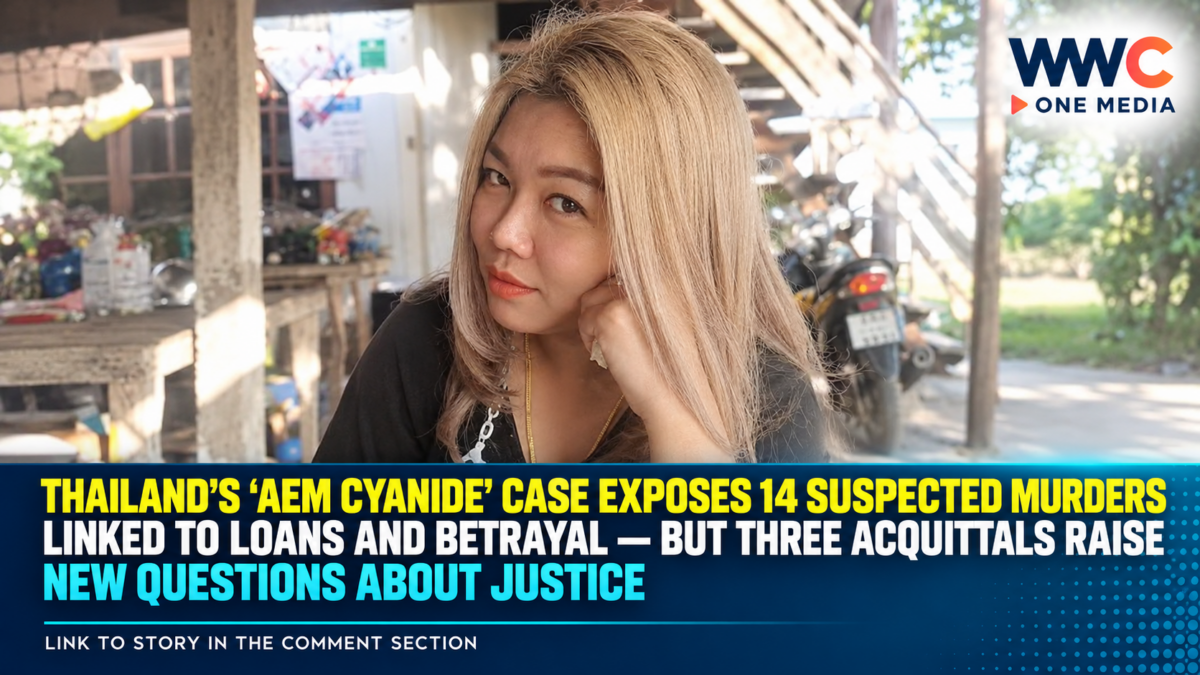
BANGKOK, THAILAND — A series of mysterious deaths across Thailand, initially blamed on natural causes, has become one of the country’s most disturbing criminal investigations. At the centre is Sararat Rangsiwuthaporn, widely known as “Aem Cyanide,” a woman accused of poisoning friends and acquaintances amid financial disputes involving loans, savings groups and gambling debts. Police linked 14 deaths and one alleged attempted murder to her. But the case has taken a complicated turn: while Thai courts have handed down multiple murder convictions and severe sentences, three acquittals reveal the challenges of proving every suspected killing — leaving grieving families facing another long wait for answers.
The case of Thailand’s so-called cyanide murders is back in the spotlight following a two-part investigative documentary that examines how families, police officers and an independent investigator uncovered possible connections between deaths that initially appeared unrelated.
Channel NewsAsia’s Death Loans: Thailand’s Cyanide Murders explores the experiences of families who lost loved ones, a woman who survived an alleged poisoning attempt and the financial relationships that investigators believe connected the cases.
The investigation concerns events dating back to 2015, with the decisive breakthrough occurring in April 2023.
Sararat, now 39, was arrested that month after authorities investigated the death of 32-year-old Siriporn “Koy” Khanwong.
Her arrest led police to revisit other sudden deaths involving people who had known her.
Many had financial connections to Sararat through personal loans or rotating savings groups.
But the criminal proceedings have not produced convictions in every case.
The distinction between police suspicions and court-proven murders remains central to understanding one of Thailand’s highest-profile criminal prosecutions.
A Woman Survives — And Begins to Suspect Her Trusted Friend
One of the most compelling accounts comes from Kantima “Pla” Paesaard.
Pla had known Sararat for approximately a decade.
Their families had close connections, and their husbands or former husbands had attended the same police academy class.
In 2022, Sararat gave Pla herbal medicine after she complained of a cough.
According to Pla’s account in the CNA documentary, she became seriously ill shortly after taking the medicine.
She experienced difficulty breathing and physical weakness before losing consciousness.
She was taken to hospital, where doctors treated her emergency condition.
Pla later learned that her heart had temporarily stopped.
At first, she believed she had suffered an allergic reaction.
She did not immediately suspect that someone might have deliberately harmed her.
Months later, however, news emerged that Sararat was under investigation over a suspected cyanide poisoning.
Pla began reconsidering her experience.
She recognized similarities between her symptoms and those associated with cyanide exposure.
Police subsequently treated her experience as an alleged attempted murder.
However, the trial concerning Pla’s case remains pending, and her account must be distinguished from a final court finding.
A Second Encounter Raises Disturbing Questions
Pla also recalled another interaction with Sararat in November 2022.
During a gathering, her mother noticed that Sararat had lost weight.
Sararat attributed the change to weight-loss pills.
Pla’s mother asked whether she could bring some for her daughter.
Sararat subsequently brought pills to Pla’s home.
But Pla decided not to take them.
After the cyanide investigation became public, she began questioning whether that encounter might also have placed her in danger.
The circumstances contributed to her concerns about Sararat.
Nevertheless, suspicions about the pills are not proof that they contained poison.
The documentary presents the encounter as part of Pla’s account and the wider investigation.
The legal determination of what happened to her remains unresolved.
Her attempted-murder trial is scheduled for November 25, 2026.
The Death of a Young Mother Leaves a Family Searching for Answers
Another case featured in CNA’s investigation involves Sawitree “Nim” Budsrirak, a mother from Mukdahan province.
In November 2020, Nim was caring for her children while her husband, Nitipon Nuchit, worked in Bangkok.
The couple had recently welcomed a baby daughter.
One day, Nitipon tried to contact his wife through a video call.
When she did not answer, he called their young son.
The child directed the phone’s camera toward his mother, who appeared to be lying motionless.
Initially, Nitipon thought she was sleeping.
When a later call showed her in the same position, he became concerned and asked a neighbour to check on her.
Nim was found dead.
Her sudden death devastated the family.
At the time, there was no established link to Sararat.
Only after other suspicious deaths came under investigation did her family’s financial connections and unanswered questions receive renewed attention.
The prosecution concerning Nim’s death had not reached trial as of CNA’s October 2026 report.
That means her case must not be described as a separately proven murder committed by Sararat.
Childhood Friend Dies After Lending Money
The investigation also examined the death of Surat “Bee” Toraphap.
Bee, 35, had known Sararat since childhood.
According to his family, he was generally healthy and did not have habits that would have led them to expect a sudden death.
In January 2021, he was found dead in a bathroom at his home in Kanchanaburi province.
His brother became suspicious after discovering financial conversations involving Sararat.
Bee had reportedly lent her 50,000 baht, followed by another 10,000 baht.
The total amount was approximately 60,000 baht.
At the time, authorities classified his death as natural.
His brother continued to question the circumstances.
Following the wider cyanide investigation, the case became one of those examined for possible connections to Sararat.
As with Nim’s death, the allegation had not been resolved through a completed trial by October 2026.
For Bee’s family, the uncertainty has prolonged the grief surrounding his death.
The April 2023 Death That Changed Everything
The investigation’s turning point was the death of Siriporn “Koy” Khanwong.
On April 14, 2023, Koy travelled to the Mae Klong River in Ratchaburi province.
She had planned to release fish into the river as part of a Buddhist merit-making activity.
Her mother expected her to return later that day.
But Koy never came home.
She was found dead near the river.
Her family was immediately troubled by the circumstances.
Koy was only 32, and relatives believed she had been healthy.
They were also concerned that some of her personal belongings appeared to be missing.
Initial information pointed toward a possible heart-related death.
But the family continued seeking answers.
That determination changed after an independent investigator helped bring the case to the attention of senior police officials.
Independent Investigator Helps Police Find a Breakthrough
Rapee Chamnanrua was a friend of Koy’s family.
He became involved because he believed that the circumstances surrounding her death deserved closer examination.
Rapee raised concerns about her missing belongings, her health and inconsistencies in the initial understanding of the incident.
His inquiries eventually reached senior police official Surachate Hakparn, widely known in Thailand as “Big Joke.”
Surachate served as deputy national police chief from 2022 to 2024.
After reviewing the concerns, he supported further investigation.
Authorities examined surveillance footage and obtained additional forensic evidence.
The CCTV footage showed that Koy had not been alone during the river visit.
Sararat had accompanied her.
A more detailed toxicology examination also detected cyanide poisoning.
The findings transformed the investigation.
Koy’s death was no longer being treated simply as an unexplained medical emergency.
Investigators now had evidence supporting a homicide inquiry.
The breakthrough ultimately led to Sararat’s arrest on April 25, 2023.
CCTV and Forensic Evidence Become Central to the Case
The recovered surveillance footage played an important role.
According to CNA, the cameras near the river had recently been repaired after being out of operation.
The recordings placed Sararat with Koy during the relevant period.
But CCTV evidence alone was not sufficient to prove that poison had been administered.
Investigators therefore considered other evidence, including toxicology findings, financial records and witness accounts.
The court later convicted Sararat of Koy’s murder.
On November 20, 2024, a Bangkok court sentenced her to death for the killing.
The judgment became the first major murder conviction in the wider series of cases.
International news outlets, including Reuters-syndicated reports and Australian broadcaster ABC, independently reported the decision.
However, establishing guilt in Koy’s murder did not automatically prove the allegations involving every other death under investigation.
Each prosecution requires evidence sufficient to satisfy the court.
How Money-Sharing Circles Became Part of the Investigation
A striking feature of the case is the role of financial relationships.
Several victims had reportedly participated in rotating savings groups or had lent money to Sararat.
These informal financial arrangements are sometimes known as sharing circles.
Participants regularly contribute money to a pooled fund.
Members may then receive or borrow funds under agreed conditions.
Such arrangements are common in some communities and can provide access to money outside conventional banking.
They often depend heavily on personal trust.
According to economics professor Piriya Pholphirul, quoted by CNA, large numbers of Thai people participate in these arrangements, with substantial sums circulating through the system.
The financial structure itself is not evidence of criminal conduct.
But investigators alleged that Sararat used relationships formed through lending and savings arrangements to obtain money.
When debts became difficult to repay, prosecutors alleged, financial disputes provided a motive for some of the poisonings.
The case demonstrates how ordinary financial relationships can become relevant evidence during a criminal investigation.
Gambling Debts Under Scrutiny
Investigators also examined Sararat’s alleged gambling activity.
According to CNA, police traced financial transactions to gambling websites and gambling venues.
Surachate claimed that Sararat had lost large sums of money while gambling, including an alleged incident involving 10 million baht.
Investigators argued that financial losses and pressure from creditors helped explain the pattern they believed existed across several deaths.
However, motive evidence must be distinguished from proof of an individual murder.
A gambling problem, an unpaid debt or a financial dispute does not independently establish that someone committed homicide.
Courts must assess whether the prosecution has connected the accused to the particular criminal act through admissible evidence.
The financial allegations provide context for the investigators’ theory.
They do not eliminate the need to prove each separate charge.
A Cyanide Delivery Becomes a Key Investigative Lead
Another important line of inquiry involved how Sararat allegedly obtained cyanide.
Investigators examined purchasing and delivery records.
According to CNA, a delivery photograph became especially significant.
The photograph reportedly showed a vehicle associated with Sararat and a distinctive pink bag inside.
Police subsequently recovered evidence they considered connected to the cyanide supply.
Investigators also examined transaction details linking deliveries to contact information.
The evidence helped prosecutors build their wider case.
However, cyanide has legitimate industrial and commercial applications, including metal processing.
The fact that someone has access to or possesses the substance does not automatically establish murder.
Investigators must connect physical and documentary evidence to the circumstances of each alleged poisoning.
That evidentiary burden has proved important throughout the ongoing legal proceedings.
Thailand’s Courts Deliver Multiple Death and Life Sentences
Sararat’s legal position has changed significantly since the first conviction in November 2024.
According to The Nation Thailand, by September 22, 2026, courts had delivered eight judgments in cases connected to the wider prosecution.
The outcomes included:
- Three death sentences
- Two life sentences
- Three acquittals
The September 22 ruling resulted in a third death sentence.
In that case, the court found Sararat guilty of poisoning a creditor in connection with an unpaid debt.
The decision was based on the evidence examined during that particular trial.
The defence announced plans to appeal.
These sentencing outcomes are significant, but they do not mean that every accusation has been upheld.
They also do not mean that the death sentences have already been carried out.
Sararat remains incarcerated, and further legal proceedings are pending.
Three Acquittals Complicate the Serial-Murder Narrative
One of the most important developments in 2026 has been the acquittal of Sararat in three cases.
In March, the Criminal Court acquitted her in a prosecution involving the alleged poisoning of a female engineer in 2020.
The court found insufficient evidence connecting her to the alleged act during the relevant period.
In July, she was acquitted in a separate case involving a vegetable vendor whose death had been linked by prosecutors to an unpaid debt.
The court found that the evidence did not adequately establish her involvement.
These decisions demonstrate that the courts have not accepted every allegation advanced by prosecutors.
An acquittal should not be described as merely a technicality or ignored because of convictions in other cases.
It represents a court decision that the particular charge was not proven to the required legal standard.
For journalists, this distinction is essential.
The phrase “14 suspected murders” accurately describes the wider investigation.
It would be inaccurate to write that Sararat has been convicted of murdering all 14 people.
Sararat Denies the Allegations
Sararat and her defence have disputed the wider accusations.
Her legal representatives have challenged the strength of evidence in several cases.
They have argued that the presence of cyanide in a victim’s body does not automatically establish that Sararat administered it.
They have also questioned whether police connected unrelated deaths to her because of public attention surrounding the investigation.
Those arguments have succeeded in some proceedings and failed in others.
The mixed outcomes highlight why each case must be considered separately.
The convictions are serious judicial findings.
The acquittals are also legally significant.
Other allegations remain unresolved until the relevant proceedings conclude.
The eventual appeals process may produce further developments.
Why Forensic Examinations Matter in Suspicious Deaths
A broader concern emerging from the investigation is how sudden deaths are classified and reviewed.
Several cases initially appeared to involve natural causes.
Families later questioned whether additional examinations should have been conducted.
Cyanide poisoning can involve rapid medical deterioration, and symptoms may overlap with other serious conditions.
Reliable forensic investigation requires appropriate sample collection, testing and interpretation.
It also depends on cooperation among medical professionals, police investigators and forensic laboratories.
In Koy’s case, further examination produced evidence that changed the direction of the investigation.
The discovery emphasizes the importance of investigating suspicious circumstances rather than relying solely on an initial assumption.
However, it does not establish that every earlier medical classification was deliberately falsified.
Determining whether a death was mishandled requires examination of the available evidence, medical procedures and decisions made at the time.
Families Still Wait for Answers Years Later
The legal proceedings are only one part of the story.
For the families of those who died, the investigation has prolonged an already devastating experience.
Nim’s husband continues to remember the life they built and the children they were raising.
Bee’s brother still struggles with the loss of someone he believed had been healthy.
Koy’s mother and sister remember a woman who was central to their family.
The investigation has also placed their personal losses under national and international scrutiny.
Some families have received court decisions.
Others are still waiting for trials.
For those affected, legal resolution matters, but it cannot undo years of grief.
The documentary highlights the personal consequences of an investigation that is frequently discussed through the number of suspected victims or the severity of possible punishment.
Behind those figures are families whose lives changed permanently.
CNA Documentary Reveals the Human Story Behind the Case
CNA Insider’s two-part series Death Loans: Thailand’s Cyanide Murders premiered in September 2026.
The documentary reconstructs the investigation through interviews, archival material and accounts from people close to the events.
Its first episode focuses on the death that prompted the breakthrough.
The second examines the wider pattern of suspected deaths and the experience of the surviving complainant.
The series also includes investigators, medical experts and legal perspectives.
Its most important contribution is showing how financial trust, family grief and forensic evidence intersected.
The documentary should not be confused with a new court judgment.
It is a journalistic examination of an ongoing criminal case, published while additional proceedings and appeals remain possible.
What Happens Next in the Aem Cyanide Case?
A further hearing is scheduled for November 25, 2026, concerning the alleged attempted murder of Pla.
Other proceedings involving deaths investigated by police have yet to reach a final resolution.
The defence has also signalled plans to challenge at least some convictions.
That means the judicial process is not over.
Future developments could include additional convictions, acquittals or appeal rulings.
The total number of proven offences may therefore change as the courts complete the outstanding cases.
The current record should be reported precisely.
By September 22, courts had imposed three death sentences and two life sentences across the proceedings covered by The Nation Thailand and CNA.
Three cases had resulted in acquittals.
There is no verified basis for reporting that Sararat has been convicted of all 14 suspected murders or that she has already been executed.
The Bigger Picture: Trust, Money and the Search for Justice
Thailand’s cyanide murder investigation has become one of the country’s most closely watched criminal cases.
It began with individual deaths that families struggled to understand.
The breakthrough in Koy’s case opened an investigation stretching across provinces and years.
Police examined financial relationships, surveillance footage, forensic evidence and possible connections involving 14 deaths and one alleged attempted murder.
Several courts have since convicted Sararat of serious offences and imposed severe sentences.
Yet other courts have acquitted her when the evidence was insufficient.
The mixed outcomes underline a fundamental principle of criminal justice: even in an exceptionally disturbing case, every allegation must be proven.
For the families, the story is about loved ones who never came home.
For investigators, it is about assembling evidence across separate incidents and years.
For Thailand’s justice system, it is about delivering accountability without allowing the notoriety of one case to replace careful legal scrutiny.
The investigation into Aem Cyanide has exposed a disturbing series of deaths involving friendships, loans and alleged financial motives.
But the biggest unresolved question is how many of the suspected killings can ultimately be proven in court — and whether the remaining families will receive the answers they have sought for years.
As the next trial approaches in November, Thailand’s search for justice in the cyanide case remains far from finished.