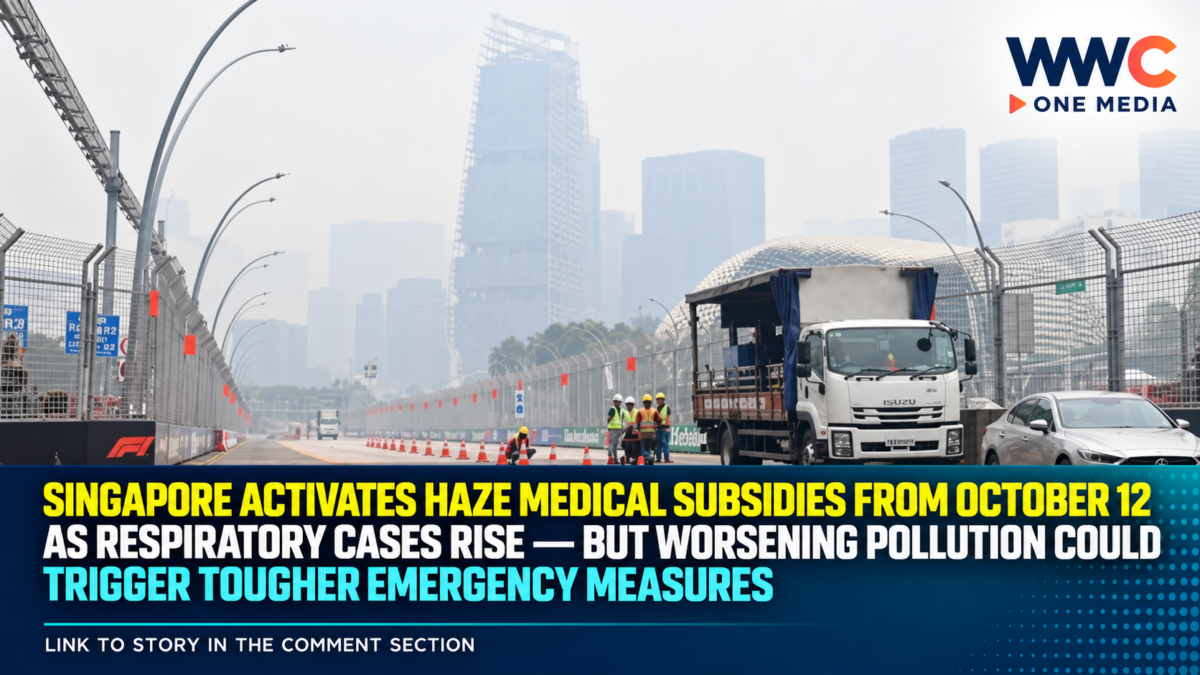
SINGAPORE — The Singapore government is activating emergency medical subsidies for haze-related illnesses from Monday, October 12, allowing eligible residents to receive treatment for as little as S$0 to S$10. The decision comes as unhealthy air pollution grips the island and hospitals report increasing respiratory-related visits. But with smoke from Indonesian forest and land fires continuing to threaten air quality, officials are preparing additional measures that could include free N95 masks, temporary haze shelters and possible school closures if pollution reaches dangerous levels.
Singapore is strengthening its public-health response to the regional haze emergency by reactivating a medical subsidy programme that was last used during the severe pollution crisis of 2015.
Health Minister Ong Ye Kung announced on Sunday, October 11, that the Ministry of Health (MOH) would activate the Haze Subsidy Scheme and the Public Health Preparedness Clinic (PHPC) Scheme from October 12.
The measures are intended to make medical treatment more affordable while helping hospitals manage an increase in patients experiencing breathing difficulties and other haze-related conditions.
According to Channel NewsAsia, the subsidies will be available at all polyclinics for Singapore citizens and at participating PHPC general practitioner clinics for specified eligible groups.
The announcement comes as Singapore’s 24-hour Pollutant Standards Index, or PSI, remains in the unhealthy range.
Although occasional rainfall has provided some relief, smoke from forest and land fires in Indonesia continues to threaten the region.
Officials are now trying to prevent worsening air pollution from overwhelming healthcare services while protecting children, older residents and people with existing medical conditions.
1. Singapore Activates Haze Subsidies Starting October 12
The government’s Haze Subsidy Scheme will take effect on Monday, October 12, 2026.
The programme reduces medical costs for qualifying outpatient treatment linked to haze exposure.
It will operate through two types of healthcare facilities: public polyclinics and participating private GP clinics under the PHPC network.
The scheme is not a general offer of free medical treatment to every patient.
Eligibility and the amount payable depend on citizenship, patient category and where treatment is obtained.
At polyclinics, all Singapore citizens qualify for the scheme.
At participating PHPC clinics, eligibility is restricted to designated groups, including children, seniors and certain government healthcare-assistance cardholders.
The distinction is important for residents planning to visit private doctors.
Not every GP clinic participates in the programme, and not every patient will qualify for a subsidised consultation at a private clinic.
2. Who Pays S$0, S$5 or S$10 for Treatment?
The government has established three main patient-payment tiers for qualifying haze-related treatment.
S$0 — Fully subsidised care
Singapore citizens receiving Public Assistance will have their covered treatment fully subsidised.
Up to S$5 — Pioneer and Merdeka Generation
Eligible seniors under the Pioneer Generation and Merdeka Generation schemes will pay no more than S$5.
Up to S$10 — Other eligible Singapore citizens
This category includes qualifying children, older adults and designated healthcare-assistance cardholders.
The S$10 charge is a maximum for covered treatment, not a flat fee automatically charged to every eligible patient.
These rates apply to conditions included in the programme and at participating facilities.
Patients seeking treatment for unrelated medical problems should not assume the same capped charges will apply.
3. Which Singaporeans Can Use the Scheme at Private GP Clinics?
Participating PHPC clinics will provide subsidised care to Singapore citizens belonging to designated categories.
These include:
- Children aged 18 and below
- Seniors aged 65 and above
- Public Assistance beneficiaries
- Pioneer Generation members
- Merdeka Generation members
- CHAS Blue and Orange cardholders
- Medical Fee Exemption Card holders
Eligible residents should check that their chosen GP is participating before visiting.
A PHPC decal or Haze Subsidy Scheme poster at a clinic can help identify participating providers.
MOH also directs residents to its website for current clinic information.
At public polyclinics, the eligibility rule is broader because all Singapore citizens can access subsidised treatment for covered haze-related illnesses.
Foreign residents and visitors should not assume they qualify for this Singapore-citizen-specific scheme.
4. Asthma, Bronchitis and Eye Irritation Among Covered Conditions
The Haze Subsidy Scheme covers several respiratory and eye conditions that can be aggravated by air pollution.
The specified conditions include allergic rhinitis, asthma, bronchitis, conjunctivitis, chronic obstructive pulmonary disease, upper respiratory tract infections and certain complications.
These illnesses can be especially troublesome during haze episodes because fine airborne particles may irritate the eyes and respiratory system.
People with asthma or chronic lung disease may experience worsening symptoms.
Others may develop coughing, nasal irritation or breathing discomfort.
However, not every cough or respiratory infection is necessarily caused by haze.
A healthcare professional must assess the patient’s condition and determine appropriate treatment.
Patients should also avoid assuming that the subsidy covers every medicine, investigation or unrelated medical service without checking the scheme’s rules.
5. Ong Ye Kung Warns of Rising Respiratory Cases
Speaking to reporters at Bukit Canberra on October 11, Health Minister Ong Ye Kung acknowledged that more patients were seeking treatment for respiratory problems.
He said emergency departments had experienced a week-on-week increase in such cases.
Polyclinics were also reporting higher attendance involving respiratory symptoms.
The increase has prompted concerns about additional pressure on the healthcare system if air quality deteriorates further.
Ong encouraged people with conditions manageable through primary care to consult GPs and polyclinics rather than immediately visiting hospital emergency departments.
The approach is intended to preserve emergency resources for patients with life-threatening conditions.
For residents, the message is straightforward: seek medical attention when necessary, but choose the appropriate level of care.
People experiencing severe breathing difficulties, serious chest pain or other emergency symptoms should still seek emergency medical assistance.
6. Private Clinics Report More Patients During the Haze
Additional reporting by Lianhe Zaobao indicates that haze-related illnesses were already increasing before the formal subsidy announcement.
Some GP clinics reported approximately 10% to 20% more patients presenting with respiratory or allergy-related problems.
These included people experiencing asthma flare-ups, nasal irritation, coughs and eye discomfort.
The reported increases reflect experiences at particular clinics and should not be interpreted as a nationwide official percentage increase in all medical visits.
Nevertheless, they provide additional evidence of how the haze is affecting everyday healthcare demand.
For clinics, the rise can mean more appointments and greater demand for common respiratory treatments.
For patients, the cost of repeated visits may create additional financial pressure.
By reactivating the subsidy scheme, the government is attempting to reduce that burden while expanding access to primary healthcare.
7. Singapore Brings Back a Programme Last Used in 2015
The Haze Subsidy Scheme was first introduced in 2013.
It was subsequently activated during the major haze episode in 2015, when Singapore experienced some of its worst recorded air pollution.
During that crisis, the 24-hour PSI reached 341 on September 25, entering the hazardous category.
The medical subsidy programme operated from September 16 to November 22, 2015.
According to Lianhe Zaobao, the government spent more than S$3.3 million on the scheme, benefiting more than 77,000 patients.
Its return in October 2026 reflects the seriousness of the current pollution episode.
However, reactivation does not mean the 2026 haze has already reached the same severity as the worst conditions recorded in 2015.
The current response is partly precautionary, aimed at making treatment accessible before medical demand rises further.
8. Singapore’s Air Pollution Remains in the Unhealthy Range
The National Environment Agency (NEA) has reported unhealthy air quality across Singapore as smoke continues to drift from Indonesia.
At 9 a.m. on October 11, The Straits Times reported the following 24-hour PSI readings:
- North: 118
- South: 115
- East: 138
- West: 152
- Central: 151
A PSI between 101 and 200 is classified as unhealthy.
The readings represented some improvement compared with earlier periods, but they remained high enough to warrant precautions.
On October 9, the central region registered a 24-hour PSI of 192 at 5 p.m., one of the highest readings of the current haze episode.
Pollution measurements can change throughout the day.
Residents should consult live NEA updates rather than relying on older figures when making decisions about outdoor activity.
9. Smoke From Sumatra and Kalimantan Threatens Singapore
The regional haze has been associated with increased hotspots in parts of Indonesia, particularly Sumatra and Kalimantan.
According to NEA’s October 9 statement, unfavorable wind conditions have transported smoke toward Singapore.
The agency warned that continued dry conditions and prevailing winds could allow more haze to reach the island.
Periods of rainfall may temporarily improve air quality.
However, persistent smoke emissions elsewhere in the region could cause pollution to return.
The situation illustrates the transboundary nature of Southeast Asia’s haze problem.
Pollution generated beyond Singapore’s borders can still affect residents, businesses, schools and hospitals.
Because of this, local emergency measures provide protection against exposure but do not eliminate the underlying source of smoke.
Long-term improvements also require regional cooperation on fire prevention and land management.
10. Government Prepares Free N95 Masks and Haze Shelters
Singapore’s 28-agency Haze Task Force has been placed on heightened readiness.
The government is preparing additional responses if air pollution rises into the very unhealthy range.
These could include distributing N95 masks to eligible Singaporeans and opening air-conditioned haze shelters.
Potential shelter locations include community clubs and selected residents’ committee or residents’ network centres.
Officials have said these measures can be introduced if conditions require them.
A key planning threshold is a 24-hour PSI exceeding 200.
However, preparations are not the same as a confirmed islandwide distribution or the immediate opening of every possible shelter.
Residents should follow official announcements for the actual availability, locations and eligibility rules of additional support.
11. Schools Could Close if PSI Exceeds 300
The haze crisis has also raised concerns about education and student safety.
Singapore’s Ministry of Education (MOE) has stated that it will consider school closures if the next day’s forecast indicates hazardous air quality.
The relevant planning threshold is a 24-hour PSI exceeding 300.
Education Minister Desmond Lee said decisions would be communicated by approximately 8 p.m. the preceding day through schools and official MOE channels.
This means parents should not interpret the haze subsidy announcement as a directive closing Singapore’s schools.
As of the October 11 reporting, no general school closure under this threshold had been announced for the entire country.
The education authorities are monitoring the situation and will make decisions according to updated forecasts.
Parents should rely on communications from their schools and MOE rather than unverified social media claims.
12. Hospitals and Nursing Homes Strengthen Protection
Singapore’s healthcare institutions are also implementing haze preparedness measures.
Public hospitals, polyclinics and nursing homes have been taking steps to limit exposure to polluted outdoor air.
These measures include using air purifiers, closing windows in suitable areas and using portable cooling equipment where appropriate.
MOH has previously confirmed that healthcare institutions maintain plans to handle potential increases in respiratory-related visits.
These include activating additional clinical resources and hospital surge capacity when necessary.
The objective is to ensure that healthcare facilities can continue operating safely during periods of prolonged pollution.
The measures are particularly important for patients with chronic illnesses, older adults and people already receiving hospital care.
However, a preparedness plan does not mean that all hospitals are currently overwhelmed.
MOH’s public statements describe steps designed to help facilities respond if demand increases.
13. Why Seniors, Children and Pregnant Women Face Greater Risks
Haze can affect people differently depending on age, health status and level of exposure.
Children may be more vulnerable because their respiratory systems are still developing.
Older adults and people with chronic heart or lung conditions may be more susceptible to worsening symptoms.
Pregnant women are also among the groups for whom the authorities recommend additional caution.
MOH advises vulnerable populations to avoid or minimize prolonged or strenuous outdoor physical activity when the 24-hour PSI is unhealthy.
People who experience persistent or worsening symptoms should seek medical advice.
For immediate activity planning, NEA recommends checking the one-hour PM2.5 readings as well as the 24-hour PSI forecast.
The two measurements serve different purposes and should not be treated as identical.
A short-term improvement in visible conditions does not necessarily mean that the air is safe for prolonged exertion.
14. What Residents Should Do During Unhealthy Haze
Residents can reduce exposure by limiting unnecessary strenuous outdoor activity when pollution levels are elevated.
People with existing respiratory conditions should follow their prescribed treatment plans and monitor symptoms.
Where practical, indoor spaces can be protected by closing windows during periods of heavy smoke and using appropriate air filtration.
A properly fitted N95 respirator can help reduce exposure to airborne particles when outdoor activity is necessary.
However, respirator use should follow applicable health guidance, particularly for people with medical conditions that make breathing through a respirator difficult.
Residents should also monitor official air-quality updates and avoid circulating unverified forecasts.
Anyone experiencing severe symptoms should seek prompt medical care.
The medical subsidy scheme can help with outpatient treatment costs, but it is not a substitute for environmental precautions or appropriate emergency treatment.
15. Why the Haze Response Matters for Southeast Asia
Singapore’s decision to reactivate haze subsidies demonstrates the public-health consequences of regional air pollution.
The impact extends beyond reduced visibility.
Haze can increase demand for medical treatment, disrupt outdoor activities and require government agencies to activate emergency arrangements.
Malaysia has also experienced serious haze conditions, including school closures in affected areas.
These responses illustrate the regional nature of the problem.
Governments can issue health advisories, strengthen healthcare capacity and support affected residents.
But preventing recurring haze episodes also depends on addressing fire risks, improving environmental enforcement and maintaining cross-border cooperation.
For the Philippines and other ASEAN countries, Singapore’s response provides an example of how healthcare financing and emergency preparedness can be coordinated during severe air pollution.
However, Singapore’s medical subsidy scheme applies under Singapore’s own eligibility rules and does not automatically extend to residents of other countries.
The Bigger Picture: Medical Subsidies Are Only the First Line of Defence
Singapore’s decision to reactivate haze medical subsidies provides immediate support to residents facing respiratory and eye-related illnesses.
From October 12, qualifying citizens can receive treatment for covered conditions at participating clinics and polyclinics with capped patient charges.
The measure should help improve access to primary care while reducing unnecessary pressure on hospital emergency departments.
But authorities are preparing for the possibility that air quality could worsen.
Additional measures may include mask distribution, haze shelters and school closures if specific pollution thresholds are reached.
The wider challenge lies in the regional sources of haze and the changing weather conditions that can transport smoke across national borders.
Singapore is making haze-related medical treatment more affordable from October 12, with eligible citizens paying no more than S$10 and some groups receiving even greater assistance.
But the bigger concern is whether continued pollution from Indonesia could push Singapore’s PSI above 200, forcing authorities to introduce stronger protective measures.
For residents, the immediate priority is protecting their health and obtaining timely treatment. For governments across Southeast Asia, the harder task is preventing the region’s recurring haze emergencies from becoming an even greater public-health burden.