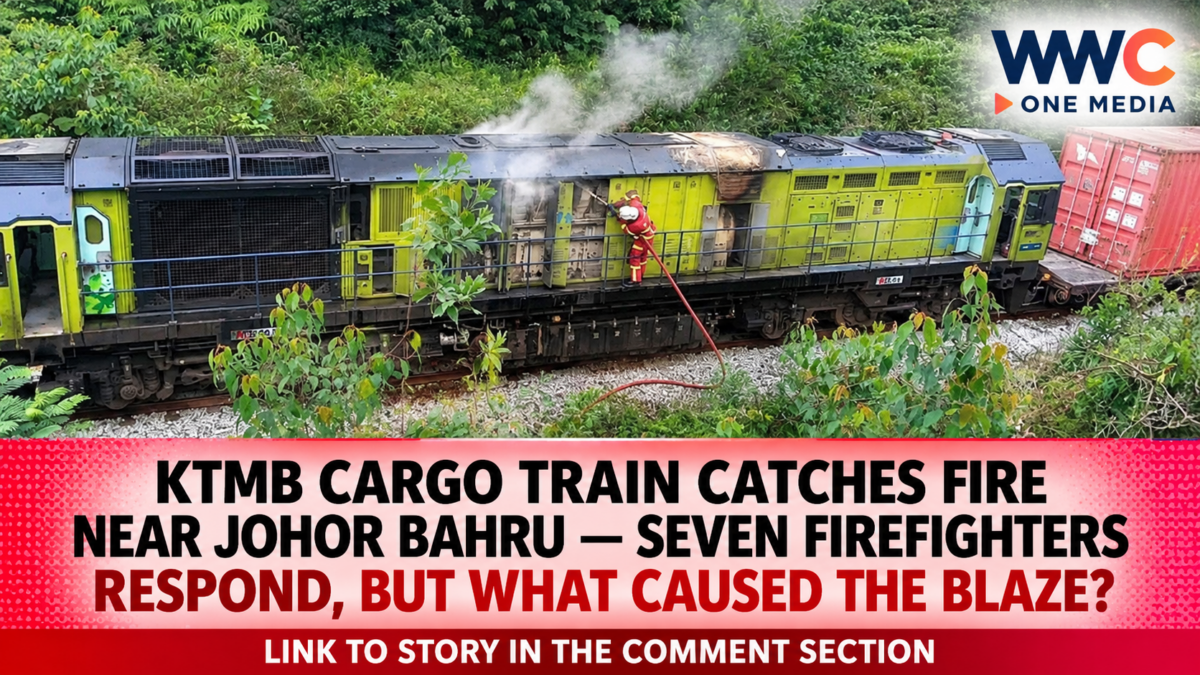
JOHOR BAHRU, Malaysia — A cargo train operated by Keretapi Tanah Melayu Berhad (KTMB) caught fire near Taman Daya in Johor Bahru on Monday, November 2, prompting an emergency response from firefighters and an investigation into what caused the blaze.
No injuries were reported.
The fire involved locomotive M1004, which was hauling cargo train No. 193 from the Port of Tanjung Pelepas to Pasir Gudang when the incident occurred at approximately 1.10pm along the railway line between Kempas Baru and Pasir Gudang.
KTMB said the driver immediately stopped the train after noticing the fire, taking precautionary action to protect railway operations and those in the surrounding area.
The Fire and Rescue Department of Malaysia (JBPM) extinguished the blaze at approximately 2.50pm.
Although the incident caused concern after photographs and videos circulated online, authorities confirmed that the damage was limited to the locomotive, with preliminary estimates putting the affected portion at around 5 per cent.
The locomotive has since been moved to the Kempas Baru Depot for technical inspection and damage assessment. Its exact cause of fire remains under investigation.
What happened to the KTMB cargo train?
According to KTMB’s statement, the incident occurred at Kilometer 4.75 along the Kempas Baru-Pasir Gudang railway route.
The locomotive was transporting cargo from the Port of Tanjung Pelepas towards Pasir Gudang when the driver detected the fire.
The driver immediately brought the train to a stop as a safety precaution.
The Johor Fire and Rescue Department dispatched a Fire Rescue Tender carrying seven personnel from the Tebrau Fire and Rescue Station after receiving an emergency call.
Firefighters worked to contain the blaze, which was completely extinguished at 2.50pm.
The fire department estimated that approximately 5 per cent of the locomotive was damaged.
No injuries were reported, and KTMB said safety measures were implemented at the affected location before train movements were allowed to resume.
Why did the locomotive catch fire?
This remains the biggest unanswered question.
KTMB has not announced a confirmed cause and has cautioned the public against speculation while investigations continue.
The affected locomotive, M1004, was transferred to the Kempas Baru Depot for technical examination and damage assessment.
Further inspections will be conducted with Berapit Mobility and the Railway Assets Corporation (RAC).
Investigators will need to establish what caused the fire and whether any technical or operational issues contributed to the incident.
Until those checks are completed, it would be premature to attribute the blaze to an electrical fault, engine malfunction, maintenance problem or any other specific cause.
The findings will help KTMB determine whether additional preventive or maintenance measures are necessary.
Seven firefighters responded as emergency teams contained the blaze
The Tebrau Fire and Rescue Station deployed seven personnel and a Fire Rescue Tender to the scene after receiving the emergency call.
The response was particularly important because the fire involved a locomotive operating along an active railway route.
KTMB said safety precautions were taken at the affected location before train movements resumed.
The incident did not result in reported injuries, and the locomotive was subsequently moved to the depot for further examination.
The fire department’s estimate of 5 per cent damage also provides an important clarification: the reported figure refers to the locomotive, not the entire cargo train or its wagons.
Was passenger train service affected?
The incident involved a cargo train rather than a passenger service.
KTMB said safety measures were put in place before train movements were allowed to resume along the affected area.
The available reports do not establish that passenger services were cancelled or that commuters were stranded because of the fire.
It is therefore important not to describe the incident as a major passenger railway disruption without further confirmation from KTMB.
The affected freight locomotive remains subject to technical inspection.
The locomotive is part of KTMB’s wider freight strategy
The locomotive involved in the incident is part of KTMB’s Rolling Stock Strategy (RSS), a programme intended to strengthen the country’s freight railway operations.
According to KTMB, the initiative involves 44 locomotives and 246 cargo wagons under a sale-and-leaseback arrangement.
The programme includes arrangements for the provision, refurbishment and maintenance of railway assets.
The involvement of a locomotive under this programme makes the technical investigation important beyond the immediate incident.
The inspection findings could help determine whether any additional maintenance or preventive measures are required for the affected equipment.
However, there is currently no evidence that the fire was caused by the locomotive’s participation in the RSS programme.
Why freight railways matter to Malaysia’s supply chain
Cargo trains play an important role in moving goods between ports, industrial areas and distribution centres.
The Port of Tanjung Pelepas is a major logistics gateway in southern Malaysia, while Pasir Gudang is an important industrial and port area in Johor.
Rail freight can support the movement of goods while reducing the need for some long-distance road transport.
An incident involving a freight locomotive therefore raises questions about equipment reliability and railway safety, even when no injuries or major service disruption are reported.
For related coverage, read WWC ONE MEDIA’s report on smoke detected beneath an MRT train at Bukit Gombak, prompting passenger evacuation.
The incident involved a different railway system and country, but it also illustrates why suspected equipment problems require prompt investigation and appropriate safety precautions.
A separate Johor fire highlights the importance of emergency response
The cargo train fire comes after another widely reported fire incident in Johor Bahru involving the basement carpark at JB City Square.
That October incident prompted evacuations and left several people reporting breathing difficulties.
The Fire and Rescue Department investigated the blaze, while preliminary findings pointed to a four-wheel-drive vehicle rather than the electric vehicle speculation circulating online.
Read WWC ONE MEDIA’s report: Singaporean Woman Among Four With Breathing Difficulties After JB City Square Carpark Fire.
Although the two incidents are unrelated, both demonstrate the importance of relying on confirmed information from emergency responders rather than unverified social-media claims.
For additional context on fire-response readiness, see WWC ONE MEDIA’s coverage of the Philippines’ plan to procure 1,500 new fire trucks amid concerns about emergency-response capacity.
What happens next?
KTMB has confirmed that the affected locomotive will undergo technical inspection and damage assessment.
The investigation, involving Berapit Mobility and the Railway Assets Corporation, is expected to help establish the cause and identify any necessary improvements.
For now, the confirmed facts are straightforward: a KTMB cargo locomotive caught fire near Taman Daya, firefighters extinguished the blaze, no injuries were reported, and the affected locomotive was moved to the Kempas Baru Depot.
The public should avoid assuming that a particular mechanical or electrical fault caused the incident until the investigation is complete.
The immediate emergency is over, but one important question remains: what caused a KTMB locomotive to catch fire while transporting cargo through Johor — and will the investigation uncover any maintenance or safety issues that need to be addressed?