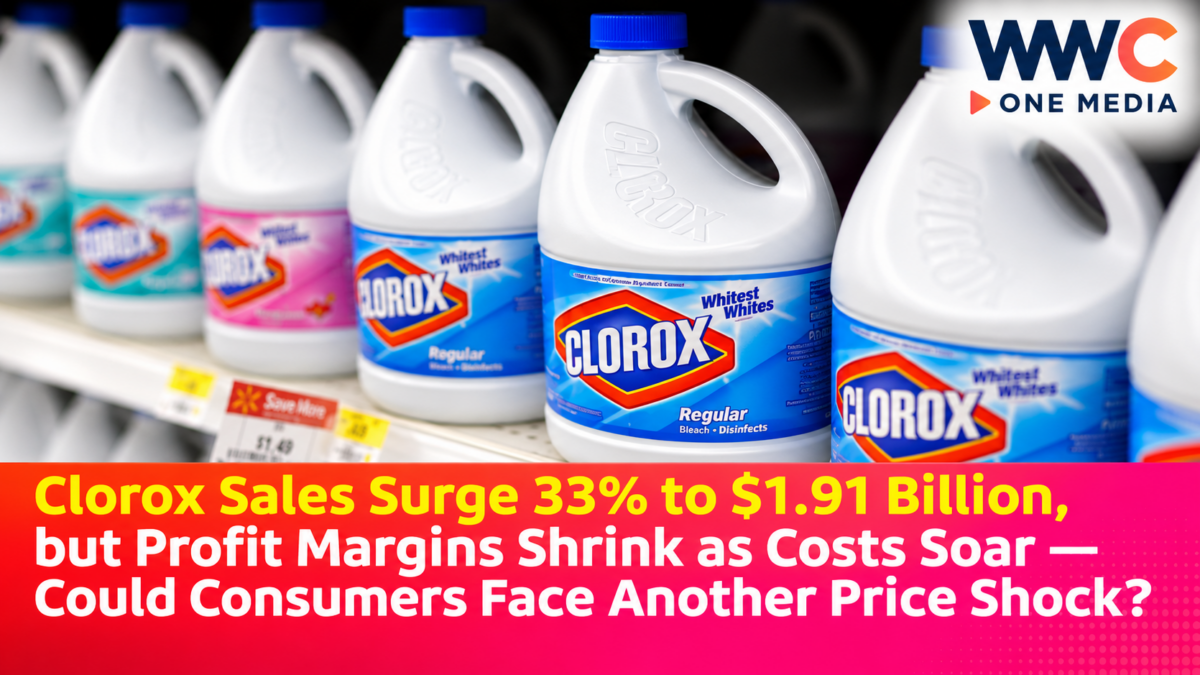
OAKLAND, California / MANILA — November 3, 2026. American household-products giant Clorox is warning that rising commodity, manufacturing and transportation costs are putting fresh pressure on profitability, even after the company reported a stronger-than-expected quarterly earnings performance.
The maker of Clorox bleach, Pine-Sol, Glad, Burt’s Bees and Hidden Valley Ranch reported $1.91 billion in net sales for the first quarter of fiscal 2027, a 33% increase from the previous year.
But behind the headline growth, the financial results revealed a more troubling development.
Clorox’s gross profit margin fell to 40.4%, compared with 41.7% a year earlier, as higher production and logistics expenses offset some of the benefits from increased sales and cost-saving initiatives.
The company also revised its full-year gross-margin forecast to approximately 41.5%, citing stronger inflationary pressures and an unfavorable mix of products sold.
According to the company’s November 2 financial disclosure, adjusted earnings per share increased 82% to $1.55, exceeding Wall Street expectations.
However, management now expects fiscal 2027 adjusted earnings to finish closer to the bottom of its previously announced $5.70-to-$6.00-per-share range.
The results underscore a growing challenge for consumer-staples companies: maintaining profitability when production costs are rising and households are becoming increasingly selective about their purchases.
The critical question is whether Clorox can protect its earnings without raising prices further — or whether a new wave of household-product inflation could put additional pressure on consumers already struggling with living costs.
Clorox Posts $1.91 Billion in Quarterly Sales
Clorox reported net sales of approximately $1.905 billion for the three months ended September 30, 2026, compared with $1.429 billion a year earlier.
The 33% increase was supported by several factors.
Its acquisition of GOJO Industries, the company behind Purell hand sanitizers, contributed approximately 15 percentage points to growth.
Organic sales increased 18%.
However, much of that organic increase reflected an unusual comparison with the previous year, when Clorox’s enterprise resource planning system transition affected retailer orders.
During the earlier transition, retailers had reduced inventory and shipments.
As normal ordering patterns resumed, the latest quarter benefited from comparison with a depressed prior-year base.
Clorox estimated that this effect contributed approximately 18 percentage points to organic sales growth.
That means the reported 18% organic growth should not be interpreted as an equivalent increase in underlying consumer demand.
The distinction is crucial for investors evaluating whether the company can sustain sales growth once those comparison effects disappear.
Gross Margin Drops as Production Costs Rise
While revenue improved, Clorox’s gross margin declined by 130 basis points.
A basis point equals one-hundredth of a percentage point.
The decline from 41.7% to 40.4% means that a smaller proportion of revenue remained after accounting for the cost of products sold.
Clorox attributed the pressure primarily to higher commodity prices, manufacturing expenses and logistics costs.
The GOJO acquisition also contributed approximately 50 basis points of unfavorable margin impact through acquisition-related inventory accounting.
Increased sales volumes and cost-saving measures helped offset some of these pressures.
But they were insufficient to prevent the overall margin decline.
The result highlights a difficult financial environment for manufacturers of household essentials.
Even companies with widely recognized brands can struggle to maintain profitability when the cost of raw materials, energy, packaging and transportation rises faster than they can offset it.
Clorox Cuts Full-Year Margin Outlook to 41.5%
The most significant warning in the company’s latest report concerned its expectations for the rest of fiscal 2027.
Clorox now anticipates a full-year gross margin of approximately 41.5%.
Management said higher-than-normal inflation and unfavorable product mix are expected to outweigh the benefits of cost reductions and pricing initiatives.
The company maintained its full-year sales growth guidance of 13% to 14%.
It also retained its adjusted earnings-per-share forecast of $5.70 to $6.00.
However, management now expects adjusted earnings to finish closer to the lower end of that range.
This is an important distinction.
Clorox did not reduce its formal full-year adjusted EPS range. It lowered its gross-margin expectation and shifted its profit outlook toward the bottom of the existing range.
For investors, that signals reduced financial flexibility even though the company remains profitable.
Wall Street Estimates Beaten — But Investors Still Have Questions
Clorox reported adjusted earnings of $1.55 per share, compared with approximately $1.07 expected by analysts cited by financial news services.
Revenue of $1.91 billion also exceeded the approximately $1.88-billion market estimate.
Net income increased to approximately $170 million, or $1.39 per diluted share, compared with approximately $80 million, or $0.65 per share, in the comparable period.
The company also generated $143 million in operating cash flow, up from $93 million a year earlier.
These figures demonstrate stronger reported earnings and cash generation.
However, the improvement was partly influenced by unusual year-earlier comparisons, cost savings and a lower tax rate.
The question for investors is whether those benefits will translate into sustainable profitability when commodity costs remain elevated and comparison effects normalize.
Purell Acquisition Expands Clorox’s Healthcare Business
Clorox completed its acquisition of GOJO Industries in April 2026.
The transaction expanded the company’s health and hygiene portfolio by adding Purell products and related professional cleaning solutions.
Clorox subsequently introduced Clorox Purell ProCare, combining parts of the CloroxPro and GOJO businesses.
The company believes the integration can strengthen its relationships with healthcare institutions, offices and other professional customers.
In the latest quarter, its Health and Wellness division recorded a 62% increase in sales.
The GOJO acquisition contributed substantially to that growth.
But acquisitions also carry financial and operational challenges.
Clorox expects acquisition-related costs during fiscal 2027, including integration expenses and accounting adjustments.
The company must demonstrate that combining the businesses will eventually generate enough additional profit to justify those costs.
Why Higher Energy Prices Matter to Household-Product Manufacturers
One major source of pressure is energy.
Manufacturers depend on fuel, electricity and other energy inputs to operate production facilities and transport finished products.
Packaging materials and chemical feedstocks can also be influenced by commodity-market conditions.
In August, Supply Chain Dive reported that Clorox expected more than $200 million in inflation-related cost pressure during the year, with energy, commodities, suppliers and transportation among the major contributors.
Earlier Reuters reporting also documented how the conflict involving Iran was increasing costs for consumer-goods manufacturers.
WWC ONE MEDIA explored the broader energy-market risk in Oil Prices Hit Six-Week High as Middle East Conflict Deepens Supply Shock Fears.
The report explained how disruptions affecting oil shipments could increase costs for transportation, manufacturing and international trade.
For companies such as Clorox, the impact can extend throughout the supply chain.
However, the price of crude oil does not determine every manufacturing expense.
Contract terms, inventories, supplier arrangements and production efficiency also influence final costs.
Consumers Are Becoming More Price-Sensitive
Clorox’s margin warning comes amid a challenging period for American consumers.
Higher gasoline prices and other living expenses have reduced the flexibility of many household budgets.
In April, Reuters reported that the company was experiencing softer demand and rising costs as consumers became more selective about branded household purchases.
Its competitive environment includes private-label products and lower-priced alternatives.
When consumers become more price-sensitive, manufacturers must make difficult choices.
They can increase retail prices to offset higher costs.
They can absorb additional expenses through lower profit margins.
Or they can invest in productivity improvements to reduce their costs.
Each approach has risks.
Higher prices may encourage shoppers to switch brands.
Lower margins can weaken earnings.
Cost reductions may take time and require upfront investment.
WWC ONE MEDIA previously examined the inflation backdrop in US Inflation Set to Surge as Gasoline Prices Climb — But a Bigger Fed Interest Rate Shock Could Be Coming.
That report discussed how energy costs could affect consumer spending and Federal Reserve policy.
Clorox’s latest results provide a company-level example of how those pressures can reach the consumer-staples industry.
Supplier Price Increases Are Affecting Other Consumer Businesses
The financial pressure is not unique to Clorox.
Other businesses have warned that increases in supplier costs can become difficult to absorb without changing prices.
WWC ONE MEDIA examined one such development in Canadian Grocery Empire Warns Food Inflation Could Return as Supplier Costs Surge 120% — But Are Families Facing Another Price Shock?.
The Canadian grocery-market story concerns a different industry and does not establish Clorox’s own supplier inflation rate.
Nevertheless, both developments illustrate a broader challenge.
Manufacturers and retailers are operating in an environment where changes in raw-material, shipping and supplier expenses can influence consumer prices.
The impact varies by product category, pricing agreements and competitive conditions.
For household-product manufacturers, maintaining consumer loyalty while managing input-cost inflation is becoming increasingly important.
Could More Price Increases Be Coming?
Clorox has already identified pricing actions as one way to offset higher costs.
But the November 2 financial report does not announce a universal price increase across all its products.
Whether shoppers ultimately pay more will depend on future company decisions, retailer pricing and competition.
Manufacturers may respond by changing promotional activity, adjusting product mixes or improving production efficiency.
Some products may become more expensive while others remain unchanged.
For that reason, it would be misleading to claim that bleach, disinfectants or every Purell product will immediately rise in price.
The verified development is that Clorox expects higher cost pressure to reduce its gross margin unless offset by other measures.
Future retail-price decisions remain uncertain.
New Leadership Adds Another Turning Point
Clorox is also preparing for a leadership transition.
The company has announced that Unilever executive Fabian Garcia will become chief executive on January 5, 2027.
He is expected to succeed Linda Rendle, who is stepping down for health reasons.
The transition comes at a difficult time.
Clorox is integrating a major acquisition, managing cost inflation and attempting to rebuild underlying growth after its technology-system transition affected shipment patterns.
Investors will be watching whether the incoming leadership can strengthen margins while preserving market share.
The challenge is especially important because consumers may resist further price increases.
A successful strategy will likely require sustained productivity gains, improved product demand and effective integration of the Purell business.
What the Clorox Warning Means for the Philippines
Clorox’s results primarily reflect its global business and US consumer-market conditions.
They do not establish that Philippine retail prices for Clorox or Purell products will increase immediately.
However, the underlying forces are relevant to Philippine manufacturers and consumers.
Higher energy, logistics and imported-material costs can also influence business expenses in Southeast Asia.
WWC ONE MEDIA explored this issue in Philippines Faces Broader, Stickier Inflation Wave as Food, Fuel and Labor Costs Rise.
The report described how fuel prices, wages, transportation and other operating expenses can reinforce inflationary pressures.
For Filipino businesses distributing imported consumer goods, exchange rates and transportation costs can also influence final retail prices.
Nevertheless, changes in US corporate margins cannot be directly converted into Philippine inflation forecasts.
Local pricing will depend on separate supply, demand and currency conditions.
Why Investors Should Look Beyond the 33% Revenue Jump
Clorox’s financial report presents a complicated picture.
Revenue increased sharply.
Adjusted earnings exceeded expectations.
Cash flow improved.
Yet gross margins weakened, and management became more cautious about full-year profitability.
The company’s reported 33% sales growth was influenced by an acquisition and unusual inventory comparisons.
Those factors may not repeat in future quarters.
Investors therefore need to monitor whether Clorox can produce more consistent underlying organic growth.
The company forecasts fiscal 2027 organic sales growth of 3.5% to 4.5%.
However, that figure includes more than 3.5 percentage points of benefit from comparison with the prior year’s inventory drawdown.
This means underlying momentum could be considerably less dramatic than the headline growth numbers initially suggest.
For investors, profitability and sustainable demand may matter more than one unusually strong quarterly comparison.
The Bigger Question: Can Clorox Beat Inflation Without Losing Customers?
Clorox’s latest earnings report illustrates the dilemma facing some of the world’s best-known consumer brands.
The company is generating higher reported revenue and expanding its health and hygiene business.
But inflation continues to pressure manufacturing costs, transportation expenses and gross margins.
Clorox has responded through cost reductions, pricing actions and strategic investment.
The company is also integrating GOJO and preparing for a new chief executive.
Yet consumers remain highly sensitive to household expenses.
For the business, the next challenge is protecting profitability without weakening demand or surrendering market share to cheaper alternatives.
For investors, the question is whether the latest earnings beat marks the beginning of a sustainable recovery or merely reflects temporary benefits from unusual comparisons.
As Clorox reports $1.91 billion in quarterly sales but cuts its full-year margin expectations, can the household-products giant absorb rising costs and protect its customers — or could persistent inflation force another round of difficult decisions across America’s consumer-staples industry?