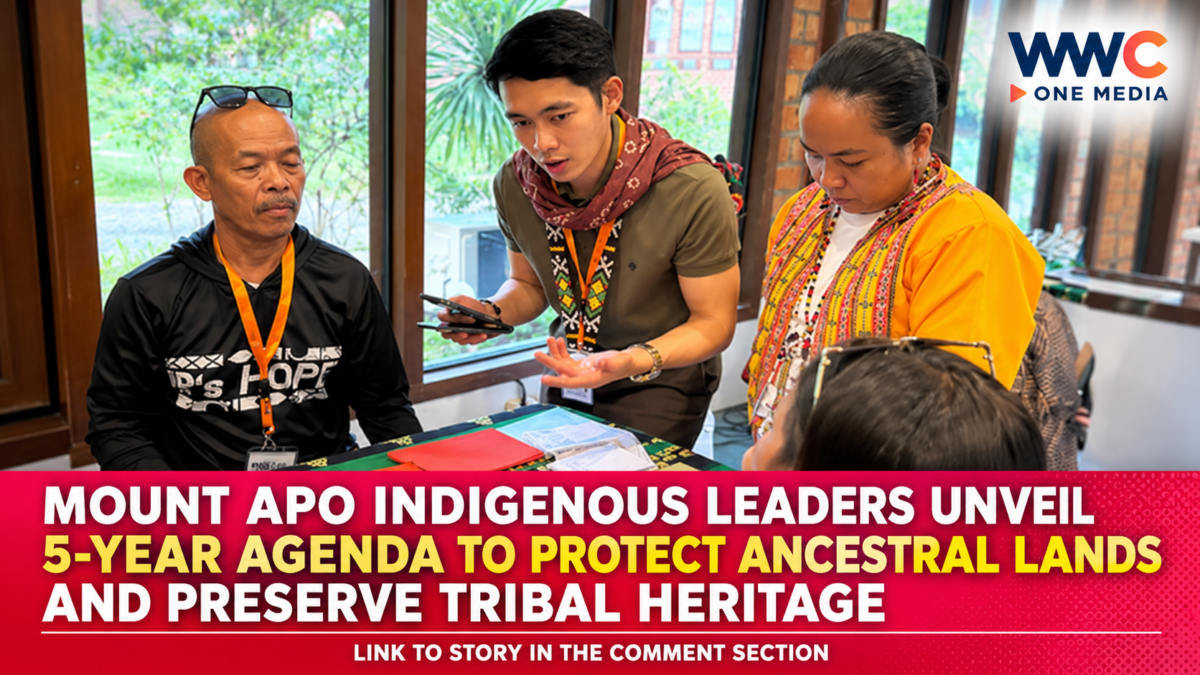
DAVAO CITY, Philippines — Indigenous leaders from communities surrounding Mount Apo have presented a five-year action agenda aimed at protecting ancestral lands, strengthening traditional governance, conserving forests and biodiversity, and ensuring that women and young people have a greater role in decisions affecting their communities.
The recommendations were developed during the Mount Apo Indigenous Peoples Conference 2026, held at Malagos Garden Resort in Davao City on October 28 and 29. Participants represented the Bagobo Klata, Bagobo Tagabawa, and Obu-Manuvu communities.
The proposed Mount Apo Indigenous Peoples Action Agenda 2026–2030 identifies five priority areas: ancestral domain protection and land management, Indigenous governance, biodiversity conservation and climate change, sustainable livelihoods, and the participation of women and youth.
Organizers intend for the recommendations to become part of the Mount Apo Indigenous Peoples Declaration 2026 and serve as a common framework for coordinated action across the Mount Apo landscape.
Protecting ancestral lands while supporting livelihoods
One of the major concerns raised during the conference was the growing pressure on Indigenous communities to sell portions of their ancestral lands.
Joshua Donato, project coordinator and lead proponent of LifeBank Foundation Inc.-Sicao, said an earlier case study by organizers found instances in which Indigenous landowners sold their properties because they lacked the resources needed to cultivate and maintain them.
The concern highlights the connection between land protection and economic opportunity. Without sustainable sources of income and adequate support, some families may struggle to retain and develop their ancestral territories.
Organizers have pointed to community-based tourism and other sustainable livelihood initiatives as possible ways to help Indigenous families generate income while protecting natural resources.
Donato cited the Sicao community project area in Barangay Tamayong, where Mount Talomo and its 14 waterfalls have potential for hiking and ecotourism development.
However, any tourism initiative would need to consider environmental protection, land-use rules, and the rights and participation of the communities concerned.
Women and young people seek a stronger voice
The conference also highlighted the need to ensure that Indigenous women and younger generations participate meaningfully in community decisions.
Jeciry Antic, chairperson of the Tibolo Integrated Farm Workers Association, raised concerns about the future of farming as more Indigenous children pursue formal education and professional careers.
While she welcomed the growing number of Indigenous learners, she questioned how communities could encourage the next generation to remain connected to agriculture and traditional livelihoods.
Her concern points to a broader challenge: education and professional opportunities should not come at the expense of traditional knowledge, farming skills, and cultural continuity.
Jaspher Ortiz Lanzo of the Mindanao Indigenous People Youth Organization also emphasized the importance of examining whether Indigenous students are learning their languages, customs, and cultural practices alongside their formal education.
He said Indigenous Peoples Education could be strengthened, with improvements requiring support and action from the Department of Education.
The discussions underscored the importance of creating opportunities for young people to succeed in modern professions while remaining connected to their cultural identities.
Preserving cultural identity across generations
Obu-Manuvu tribal chieftain Bae Nilda Landim also discussed efforts to maintain cultural identity among Indigenous residents in Barangay Carmen, Baguio District.
She described how community activities and traditional clothing help children recognize and express their tribal heritage, even when they attend schools or live in different parts of Davao.
The issue is particularly significant as Indigenous communities seek to preserve their languages, traditions, and customary practices while adapting to changing social and economic conditions.
According to the Second Congressional Commission on Education, Davao Region had 255,385 Indigenous Peoples learners, the highest number among the country’s regions. These learners accounted for 22 percent of public school enrollment in the region, based on figures reported on October 26.
Recommendations to be brought to communities and government
Following the conference, organizers said the policy recommendations would be consolidated and presented to the tribal offices of participating communities for validation.
The outputs are also expected to be shared with the policy and advocacy office of the Mindanao Development Authority. Donato said three congressmen could help bring proposed measures to Congress.
He added that existing policies concerning Mount Apo need stronger implementation and further support.
The conference was organized by LifeBank Foundation Inc.-Sicao, the National Commission on Indigenous Peoples Region 11-Davao City Provincial Office, and the Mount Apo Natural Park Protected Area Management Office.
Turning a five-year agenda into lasting action
The proposed 2026–2030 agenda brings together concerns that extend beyond environmental conservation. It also addresses land ownership, livelihood security, Indigenous governance, education, and the preservation of cultural identity.
For communities around Mount Apo, the challenge will be turning the recommendations into coordinated programs and concrete protections that can be sustained over the next five years.
The agenda’s long-term value will depend on how participating communities, government agencies, and partner organizations validate, support, and carry out the proposed measures.
Protecting Mount Apo, the Indigenous leaders’ discussions suggest, also means protecting the people, traditions, and ancestral relationships that have shaped the mountain’s identity for generations.