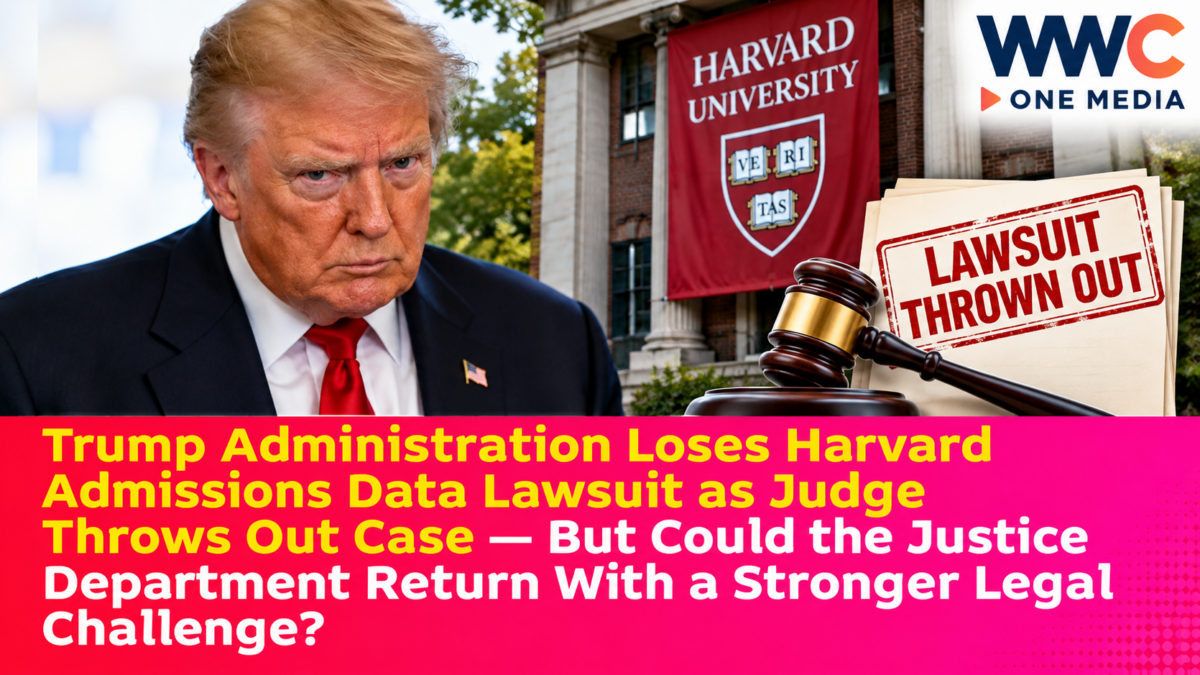
BOSTON, MASSACHUSETTS / MANILA — November 3, 2026. Harvard University has secured another significant courtroom victory against President Donald Trump’s administration after a federal judge dismissed a US government lawsuit demanding detailed student admissions records, including information about applicants’ race, ethnicity, academic performance and admission decisions.
The November 2 ruling represents a setback for the Justice Department’s attempt to investigate whether the Ivy League university continues using race in admissions decisions despite the US Supreme Court’s landmark 2023 ruling against its previous race-conscious admissions system.
US District Judge Myong J. Joun ruled that federal officials had not demonstrated compliance with the legal procedures required before asking a court to compel Harvard to provide the disputed records.
But the victory comes with a significant limitation.
The judge dismissed the case without prejudice, meaning federal authorities may be able to file another lawsuit after correcting the procedural deficiencies.
The ruling also did not determine whether Harvard’s current admissions policies discriminate against applicants.
For Harvard, the decision temporarily blocks the government’s attempt to obtain a court order compelling disclosure.
For the Trump administration, it leaves open the possibility of renewing its legal challenge.
As Harvard celebrates another courtroom victory, could the Justice Department return with a stronger case — and eventually force the university to disclose years of sensitive applicant information?
Federal Judge Dismisses Justice Department Lawsuit Against Harvard
The case was filed in February 2026 in the US District Court for the District of Massachusetts.
Federal authorities alleged that Harvard had failed to provide sufficient information for an investigation into compliance with federal civil rights law.
The Justice Department wanted detailed admissions records covering Harvard College, Harvard Medical School and Harvard Law School.
Officials maintained that the information was necessary to determine whether race remained an unlawful factor in the selection of students.
Harvard challenged the government’s demands.
The university argued that it had already provided relevant policies, guidance and other information, while the requested applicant-level records contained extensive sensitive personal information.
On November 2, Judge Joun sided with Harvard on a specific procedural question.
He found that the government had not adequately established that it completed the required steps to secure voluntary compliance before seeking judicial enforcement.
The ruling halted the current lawsuit without resolving the broader dispute.
Why the Government Lost the Case
The central legal issue was not whether Harvard had violated admissions law.
Instead, the court examined whether federal agencies followed the proper process before filing their lawsuit.
Under the applicable federal civil rights enforcement framework, agencies generally must provide appropriate notice of alleged noncompliance and undertake required efforts to obtain voluntary compliance before seeking certain forms of judicial enforcement.
Judge Joun concluded that the government had not sufficiently demonstrated that it fulfilled those prerequisites.
The Department of Education also failed to establish compliance with the procedures applicable to its involvement in the dispute.
The ruling illustrates an important principle of administrative law.
Government agencies may possess legitimate investigative authority, but their use of that authority must comply with applicable statutes and regulations.
A court can reject an enforcement request because of procedural errors without deciding whether the underlying investigation is justified.
That is precisely the distinction in Harvard’s latest legal victory.
The Lawsuit Was Not a Judicial Finding of Racial Discrimination
One of the most important aspects of the case is what it did not establish.
The Justice Department’s original February 13 announcement explained that the lawsuit sought to compel Harvard to provide documents.
The government did not use that particular lawsuit to request a judgment finding that Harvard’s current admissions system was discriminatory.
Instead, federal officials sought records that they believed would allow them to investigate whether Harvard had complied with the Supreme Court’s 2023 decision.
The November dismissal therefore cannot accurately be characterized as a ruling that Harvard is free of discrimination.
Nor does it establish that federal investigators’ concerns are correct.
The court decided that the government had not shown it was entitled to the requested judicial enforcement at that stage.
Any broader conclusion would go beyond the ruling.
What Student Records Did the Government Want?
Federal investigators sought five years of admissions information across several Harvard schools.
The requested records included applicants’ grades, standardized test scores, race and ethnicity, application essays, extracurricular activities and admission outcomes.
Officials also sought internal admissions assessments and materials relating to university policies.
The Justice Department argued that aggregated demographic figures were insufficient to determine whether individual admissions decisions were influenced by race.
According to the government’s position, applicant-level information could allow investigators to compare academic qualifications, application characteristics and admissions outcomes.
Harvard countered that the requests were exceptionally broad.
The university raised concerns about exposing confidential information concerning large numbers of applicants, including individuals who were never admitted.
These competing positions raise a significant question about how civil rights investigations should balance government oversight against student privacy.
The November ruling did not provide a definitive answer to that question.
The Supreme Court’s 2023 Affirmative Action Decision Remains in Force
The dispute traces directly to the US Supreme Court’s June 2023 ruling in Students for Fair Admissions v. Harvard and the related case involving the University of North Carolina.
The court held that the race-conscious admissions programs at issue violated applicable constitutional and statutory protections.
The decision substantially restricted the use of race in American university admissions.
However, the ruling did not forbid applicants from discussing how their personal experiences, including experiences involving race, shaped their lives.
Universities may consider relevant individual experiences within the limits established by the decision.
They cannot simply recreate prohibited racial preferences through another label.
Since the ruling, universities have revised admissions guidance, applicant evaluation procedures and diversity-related policies.
The federal government has sought to determine whether those changes are sufficient.
Harvard maintains that it has taken steps to comply.
The Justice Department argues that additional information is necessary to verify compliance.
Harvard’s Admissions Data Shows a Changing Student Population
The university’s latest published admissions statistics provide important context.
For the undergraduate Class of 2030, Harvard reported 55,104 applicants and 2,037 admitted students.
The published data also showed that Black students accounted for 9.3% of enrolled students who reported their race or ethnicity, compared with 11.5% in the previous class.
Asian American students represented 43.2%, up from 41%.
Hispanic or Latino students accounted for approximately 11.4%.
The Harvard Crimson reported that Black enrollment had declined for three consecutive entering classes after the Supreme Court’s 2023 decision.
However, these aggregate demographic figures do not establish whether unlawful discrimination occurred in any individual admissions decision.
Changes in enrollment can reflect application patterns, admission decisions, students’ choices among universities and reporting methods.
Harvard has also changed aspects of its racial-demographic reporting, complicating historical comparisons.
For investigators, aggregate data can identify trends.
But a trend alone is not necessarily proof of a legal violation.
Harvard Says It Has Already Changed Its Admissions Procedures
In its court filings, Harvard described steps taken following the Supreme Court ruling.
These included providing updated guidance to admissions personnel and restricting how information about applicants’ race could be used during evaluation.
Harvard’s legal team also argued that the university had supplied substantial materials in response to government inquiries.
The Justice Department disputed whether those submissions were sufficient.
The government maintained that without individual applicant records, investigators could not meaningfully examine whether the university was continuing to consider race unlawfully.
Both positions reflect legitimate questions for a compliance investigation.
Universities are obligated to follow applicable civil rights law.
At the same time, federal agencies must use lawful procedures when obtaining sensitive records.
The judge’s November decision focused on the second issue.
Trump Administration Signals That the Fight May Continue
The dismissal does not end the federal investigation.
Because the lawsuit was dismissed without prejudice, the government may attempt to satisfy the required procedural conditions and bring a new case.
United Press International reported that a Justice Department spokesperson indicated the government intended to pursue the matter again.
The Department of Education also publicly criticized the decision.
Its spokesperson argued that students should be evaluated according to merit and achievement rather than race.
The administration maintains that rigorous enforcement of the Supreme Court’s 2023 ruling is necessary to protect equal treatment.
Harvard, meanwhile, has argued that the government’s actions are part of a broader attempt to pressure the university over its governance and academic independence.
The court did not resolve those competing political characterizations in this particular decision.
Harvard’s Legal Confrontation With Washington Is Far From Over
The admissions-data dispute is one of several legal battles between Harvard and the Trump administration.
Since 2025, federal officials have challenged the university over issues including research grants, student admissions, campus antisemitism, international enrollment and academic governance.
Harvard has obtained favorable judicial rulings in multiple disputes.
Courts have blocked or rejected some government efforts involving federal funding and restrictions on international students.
The administration has continued to defend its oversight measures and, in some cases, pursue appeals.
Reuters reported that earlier funding disputes involved more than $2 billion in federal research grants.
Those proceedings are legally separate from the admissions-records case.
A victory in one lawsuit does not automatically resolve another.
Each dispute depends on its own legal authority, factual record and procedural history.
Could Harvard’s Fight Benefit Universities in Asia?
The confrontation has also attracted international attention.
Students considering American universities must evaluate not only academic quality and tuition costs but also visa policies, research funding and institutional stability.
WWC ONE MEDIA previously examined these issues in Trump’s Harvard Battle Could Give Hong Kong a Rare Opportunity in Global Education.
The report explored whether political uncertainty affecting Harvard could strengthen Hong Kong’s position as an international education destination.
Universities in Hong Kong, Singapore, Australia and other markets are competing to attract international students.
However, Harvard’s legal disputes do not establish that students are abandoning the institution.
The university continues to attract a substantial international applicant population and retains significant academic prestige.
The more realistic concern is whether prolonged political and regulatory uncertainty could influence decisions made by some students and researchers.
International Students Face Separate Regulatory Pressures
The legal dispute over admissions records does not directly concern student visas.
But it is unfolding alongside broader changes affecting international education in the United States.
WWC ONE MEDIA previously reported on U.S. Universities Tighten Internship Rules for International Student.
That article discussed stricter scrutiny of Curricular Practical Training, a program that allows eligible international students to undertake qualifying employment related to their studies.
Those rules are separate from Harvard’s admissions litigation.
However, the developments illustrate how multiple regulatory decisions can affect the experience of international students.
For Filipino families considering American education, the important distinction is between confirmed changes in immigration or education rules and unresolved political proposals.
The Harvard admissions ruling does not cancel the Supreme Court’s 2023 decision or change general US student-visa requirements.
Why Procedural Requirements Matter in Government Investigations
Harvard’s victory highlights a broader legal principle: courts may reject government action when agencies fail to demonstrate compliance with required procedures.
WWC ONE MEDIA examined a separate example involving election law in Trump Loses California Ballot Battle as Court Rejects Bid to Block 20,000 Suspected Voters — But Could the Fight Reach the Supreme Court?.
That article concerned election administration rather than university admissions.
The two disputes involve different legal standards and factual questions.
Nevertheless, both demonstrate why the precise scope of a court ruling matters.
When a judge rejects a government request, it does not necessarily mean every underlying allegation has been disproven.
Similarly, allowing an investigation to proceed does not establish that the investigated party violated the law.
Accurate reporting must distinguish legal procedure from findings on the merits.
What the Dispute Means for Higher Education Policy
The Harvard case is part of a wider debate over university admissions, fairness, privacy and government oversight.
Supporters of stronger federal enforcement argue that universities should be required to demonstrate compliance with civil rights law through meaningful documentation.
They contend that aggregate statistics alone may not reveal whether applicants are treated differently based on race.
Harvard and its supporters emphasize that investigations must follow legal procedures and respect legitimate privacy concerns.
They argue that universities should not be compelled to disclose excessively broad collections of sensitive applicant information without proper legal safeguards.
These perspectives are not necessarily mutually exclusive.
Federal authorities can pursue lawful discrimination investigations while remaining subject to procedural and privacy requirements.
The unresolved issue is how those obligations should apply to the specific records demanded from Harvard.
The Philippine Education Perspective
The broader significance extends to countries where public policy and court decisions influence university operations.
In the Philippines, higher education faces different challenges involving access, institutional funding and government oversight.
WWC ONE MEDIA examined one such issue in Nearly Half of Philippine State Universities Face 2027 Budget Cuts as Students Warn of Deeper Education Crisis.
That story concerns Philippine public-university funding, not US racial admissions policy.
Still, it illustrates the importance of government decisions for institutional resources and educational opportunities.
For universities in any country, effective public oversight must be balanced with applicable law, transparency and student protections.
The Harvard dispute offers an example of how courts can enforce limits on administrative power even when the government asserts an important public interest.
What Happens Next in the Harvard Case?
The next development will depend largely on how the Justice and Education departments respond.
Federal officials could attempt to renew their document requests using procedures that address the deficiencies identified by Judge Joun.
They could pursue negotiations over the scope of the information sought.
They may also seek further judicial review, depending on available legal options.
Harvard could continue challenging the breadth or legality of particular requests.
The court’s November 2 decision does not determine how those future disputes would be resolved.
A new complaint would need to be evaluated according to its own record and legal arguments.
In the meantime, the Supreme Court’s 2023 admissions decision remains binding.
Harvard and other covered universities must continue complying with applicable federal civil rights law regardless of the dismissal of this particular enforcement lawsuit.
The Bigger Question: Has Harvard Won the Battle but Not the War?
Harvard’s November 2 legal victory represents another setback for the Trump administration’s efforts to compel changes at the prestigious university.
The court rejected the government’s request for judicial enforcement because the necessary procedural groundwork had not been established.
But the ruling did not decide whether Harvard’s current admissions practices violate federal law.
It did not permanently prohibit the government from requesting applicant-level information.
And it did not prevent federal authorities from pursuing a properly supported enforcement action in the future.
For Harvard, the immediate result is protection against the current lawsuit.
For Washington, the challenge is determining whether it can satisfy the required procedures and justify renewed judicial intervention.
For students and prospective applicants, the deeper issue is whether universities and federal agencies can establish a transparent and lawful way to ensure fair admissions without compromising sensitive personal information.
As Harvard defeats another Trump administration lawsuit over admissions data, will federal officials accept the court’s procedural limits — or could a renewed legal offensive reopen the fight over race, merit and government control of America’s elite universities?