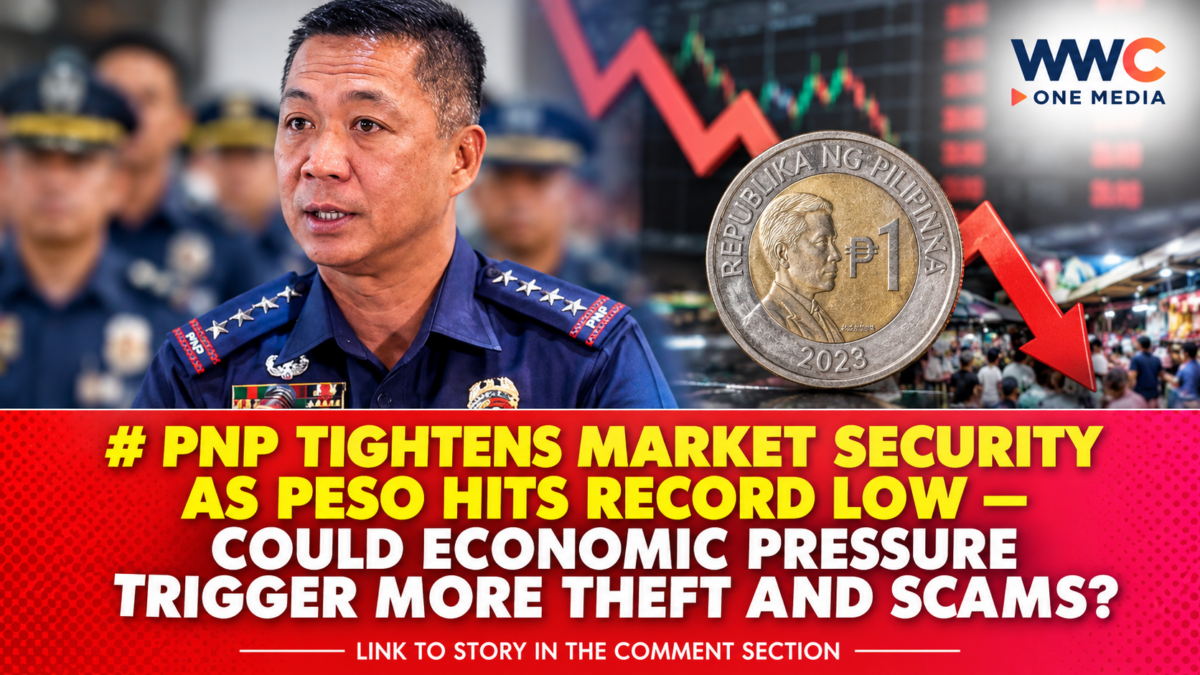
MANILA, Philippines — The Philippine National Police (PNP) has ordered intensified market surveillance, intelligence monitoring and community patrols as the peso continues to weaken against the US dollar, warning that criminals could exploit economic uncertainty to commit theft, robbery, fraud and other opportunistic offenses.
PNP chief Police General Jose Melencio Nartatez Jr. directed regional and local police units to respond promptly to verified reports of criminal activity, particularly in vulnerable communities and commercial areas where consumers, workers and small business owners may face increased financial pressure.
The directive, reported by SunStar on November 1, 2026, is intended to strengthen public safety as Filipinos contend with concerns over rising prices and the possible effects of a weaker currency on household expenses.
Nartatez said the police organization is tightening intelligence operations and community patrols to help protect consumers and businesses from crimes associated with financial strain.
“The PNP actively monitors street-level crime trends to prevent opportunistic offenses driven by financial strain,” the police chief said.
He added that the PNP would remain vigilant in protecting communities and key economic activities from criminal exploitation.
PNP focuses on theft, robbery and fraud
The police directive identifies several offenses that authorities want to prevent or address more quickly, including theft, robbery and fraud.
These crimes can affect ordinary consumers, market vendors, small business owners and other people who conduct daily transactions in commercial areas.
The PNP’s approach involves monitoring emerging peace and order concerns, strengthening intelligence gathering and maintaining police visibility in vulnerable locations.
However, the announcement did not provide specific deployment figures, identify particular markets or cities receiving additional personnel, or establish a timetable for the heightened security measures.
It also did not present statistics showing that theft, robbery or fraud had already increased because of the peso’s depreciation.
The distinction matters: the PNP is describing a preventive security response to possible economic-related crime risks, not announcing a confirmed nationwide crime surge.
Peso falls to a record low of ₱64.17 against the US dollar
The PNP’s announcement came after the Philippine peso weakened to a historic closing low of ₱64.17 against the US dollar on October 27, 2026.
The currency had breached the ₱64-per-dollar level for the first time during trading that day, according to reports citing Bankers Association of the Philippines data.
The decline raised concerns about the cost of imported products and the potential effects on businesses that rely on foreign supplies.
A weaker peso means importers generally need more pesos to purchase the same amount of goods priced in US dollars. Depending on contracts, inventory costs and market conditions, some of these additional expenses may eventually be reflected in local prices.
The effects can reach beyond imported consumer products.
The Philippines depends on imported petroleum, while many businesses also rely on foreign-sourced machinery, equipment, raw materials and production inputs. A weaker currency can therefore add pressure to transportation, manufacturing and operating costs.
In its September 29 report, Peso Slips as US-Iran Tensions, Wage Hike and Higher Fares Fuel Inflation Concerns, WWC ONE MEDIA examined how international tensions, fuel prices, wage adjustments and transport fares can combine to put pressure on the Philippine economy.
The latest currency weakness adds another dimension to those concerns.
Why a weaker peso matters to ordinary Filipinos
A declining currency does not affect every household or business in exactly the same way.
Consumers may face higher costs when imported goods become more expensive. Businesses that depend on imported supplies may also experience increased operating expenses, potentially affecting their prices and investment decisions.
Fuel is particularly important because international petroleum purchases are commonly priced in US dollars.
When the peso weakens, the local-currency cost of imported fuel can rise, depending on international oil prices and other market factors. Higher fuel expenses can then affect transportation, electricity generation, logistics and the distribution of food and other products.
The impact can be especially challenging for households whose incomes do not increase at the same pace as their expenses.
However, currency depreciation can also benefit certain sectors. Overseas Filipino workers’ families may receive more pesos when converting dollar remittances, while exporters and some businesses earning foreign currency may gain from more favorable conversions.
GMA News reported that economists consider the weaker peso a mixed development, with potential benefits for dollar earners but additional costs for import-dependent consumers and businesses. <Cite refs={[“turn403228search7″,”turn346542search1”]}/>
The broader concern is whether prolonged currency weakness will contribute to higher prices and reduce household purchasing power.
Economic pressure and the risk of financial scams
The PNP’s warning also highlights the importance of protecting the public from fraudulent schemes during periods of financial uncertainty.
When people become more concerned about their household budgets, they may encounter offers promising quick income, unusually high investment returns or easy financial assistance.
Such offers can be used to exploit people looking for ways to supplement their earnings.
The PNP’s November 2 warning against fraudulent investment offers reinforces this concern. Nartatez urged the public to verify investment opportunities rather than automatically trusting individuals because they are popular on social media or operate a legitimate-looking business.
That separate warning followed the arrest of a businesswoman accused of involvement in a ₱160-million investment scam. Police said the suspect allegedly offered investors guaranteed monthly returns of five percent. These remain allegations, and the case should not be treated as proof that economic uncertainty has caused a nationwide increase in investment fraud. <Cite refs={[“turn579922search0″,”turn579922search2”]}/>
The Bangko Sentral ng Pilipinas also identifies investment fraud, phishing, identity theft, text scams and other financial schemes among the risks consumers should recognize. Its guidance emphasizes verifying suspicious offers and reporting questionable transactions through the appropriate financial institution or authorities. <Cite refs={[“turn579922search5”]}/>
For the PNP, stronger surveillance and faster responses to verified complaints are intended to help prevent criminals from taking advantage of vulnerable members of the public.
Government faces a wider challenge beyond policing
While the PNP can strengthen public safety, it cannot directly reverse the peso’s depreciation or control inflation through police operations.
Those responsibilities fall primarily to the country’s economic and financial authorities.
President Ferdinand Marcos Jr. said on October 28 that the government would do everything possible to prevent the peso from continuing to weaken against the US dollar. Reuters reported that he cited the country’s foreign exchange reserves as part of the government’s capacity to defend the currency. <Cite refs={[“turn304661news16″,”turn346542search0”]}/>
Meanwhile, Malacañang has pointed to external pressures, including global oil prices, geopolitical tensions and US interest rates, as factors affecting the peso. It has also outlined assistance and coordination measures intended to cushion the impact of higher costs on consumers. <Cite refs={[“turn304661search13”]}/>
The economic challenge is not limited to the exchange rate. Higher imported fuel costs can influence transportation and electricity expenses, while businesses may face additional pressure from more expensive raw materials and equipment.
WWC ONE MEDIA explored these interconnected risks in Philippine Inflation Could Hit 8.1% as Fuel, Electricity and Transport Costs Surge — But Will the BSP Be Forced Into Another Rate Hike?.
Another related report, Philippines Moves to Secure Oil Reserves Abroad as Middle East Conflict Threatens Fuel Supply — But Will It Prevent Another Price Shock?, examines how international energy developments and the country’s dependence on imported petroleum can affect domestic fuel costs.
These economic issues require coordinated responses from financial regulators, energy authorities, consumer-protection agencies and law enforcement institutions.
What Filipinos should watch next
The effectiveness of the PNP’s heightened security measures will depend partly on whether police units can identify emerging crime patterns, respond quickly to credible complaints and protect communities where consumers and businesses may be vulnerable.
The public should also distinguish between legitimate economic concerns and unverified claims circulating online.
A weaker peso does not automatically mean that criminal activity will increase. Nor does every investment or business opportunity become fraudulent during periods of economic uncertainty.
Nevertheless, authorities face a responsibility to ensure that financial pressures do not create opportunities for people seeking to exploit consumers.
For now, the PNP has committed to stronger market monitoring, intelligence operations and community patrols. What remains unclear is whether the heightened measures will be accompanied by more detailed deployment information, measurable crime-prevention results and sustained protection for vulnerable communities.
The Bottom Line
The PNP’s decision to strengthen security monitoring comes as the peso faces pressure and households worry about the cost of imported goods, fuel and other necessities.
The police response is focused on preventing theft, robbery, fraud and other offenses that could exploit economic uncertainty. It does not mean authorities have confirmed a nationwide increase in crimes caused by the currency’s decline.
The bigger challenge is ensuring that public safety measures keep pace with economic pressures while financial authorities work to stabilize the currency and contain inflation.
As the peso remains under scrutiny, one question now faces both the police and economic policymakers: Can stronger security measures protect ordinary Filipinos from opportunistic criminals while the government works to ease the financial pressures affecting households and businesses?