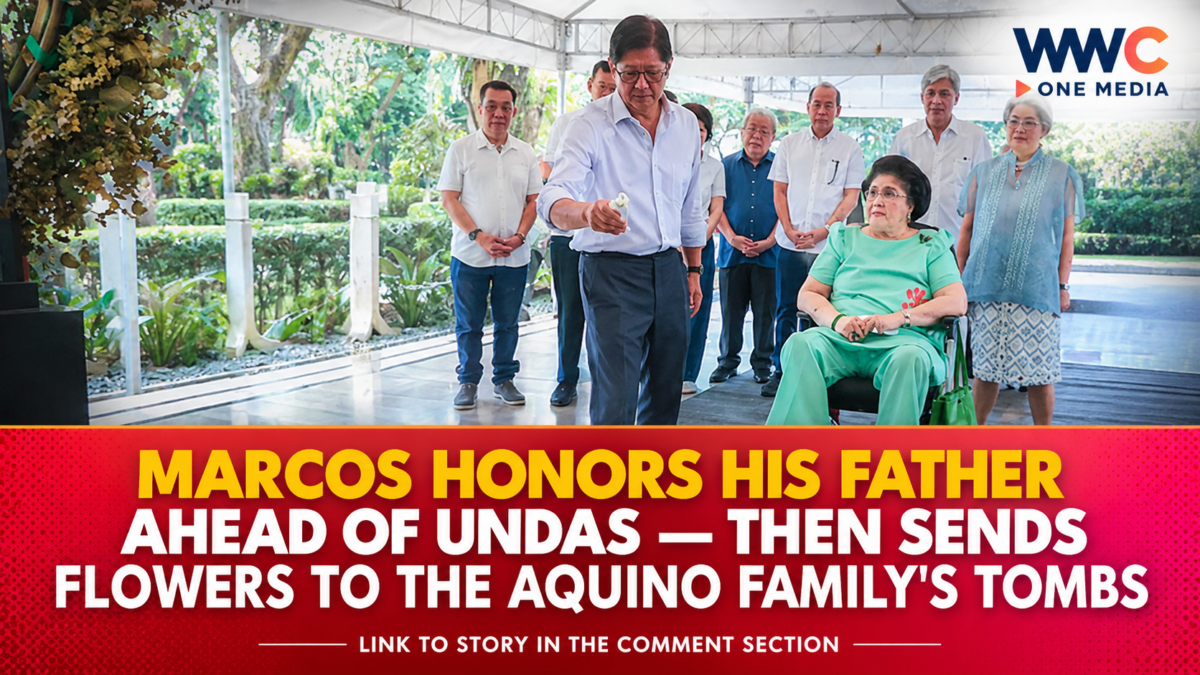
MANILA, Philippines — President Ferdinand “Bongbong” Marcos Jr. marked the 2026 Undas observance by honoring his late father, former President Ferdinand Marcos Sr., at the Libingan ng mga Bayani in Taguig City, while also reportedly sending flowers to the tombs of the Aquino family in Parañaque.
The presidential visit, accompanied by former first lady Imelda Marcos and the President’s sister Irene Marcos-Araneta, brought renewed attention to the annual tradition of remembering departed loved ones.
Marcos shared a photograph of the family at his father’s tomb on November 1, All Saints’ Day, accompanied by a message encouraging Filipinos to remember those who have passed away and extend their care to the people still around them.
However, the actual cemetery visit reportedly took place on October 30, ahead of the main Undas observance, according to the Presidential Communications Office, as reported by Philstar.
The President’s reported gesture toward the Aquino family also drew attention because of the two families’ long history as political rivals, a relationship deeply connected to some of the most significant events in modern Philippine history.
Marcos visits father’s tomb with Imelda and Irene
In the photograph shared on his official Facebook page, Marcos was seen with his mother, former first lady Imelda Marcos, and younger sister Irene Marcos-Araneta at the tomb of former President Ferdinand Marcos Sr.
The family visited the late president’s resting place at the Libingan ng mga Bayani in Taguig City.
According to Philstar’s report citing the Presidential Communications Office, the family attended a private Mass, offered prayers and paid their respects during the October 30 visit.
The photograph was subsequently shared publicly on November 1, as Filipinos observed All Saints’ Day.
In his accompanying message, Marcos reflected on the memories and values passed down by departed family members.
“Though they are no longer with us, the memories we shared and the values they taught us continue to bring our families closer together,” the President said.
He also encouraged Filipinos to remember their departed loved ones not only through prayers but through their treatment of the people who remain.
The message emphasized kindness, care and compassion during a period traditionally associated with family gatherings, cemetery visits and remembrance.
Marcos reportedly sends flowers to the Aquino family
Another development surrounding the President’s Undas observance was the reported sending of flowers to the tombs of members of the Aquino family.
According to reports cited by GMA News and Philstar, flowers were sent to the final resting places of:
- Former President Corazon “Cory” Aquino
- Former senator Benigno “Ninoy” Aquino Jr.
- Former President Benigno “Noynoy” Aquino III
The Aquino family members are buried at Manila Memorial Park in Parañaque City.
The reported gesture attracted attention because the Marcoses and Aquinos have long been associated with opposing sides of Philippine political history.
However, the reports do not establish a new political agreement or formal reconciliation between the families. The flowers were reported as part of the President’s observance of Undas.
It is important to distinguish the reported act of sending flowers from a personal visit to the Aquino burial site. The available reports describe the flowers being sent; they do not establish that Marcos personally went to the cemetery.
Why the Marcos and Aquino families remain connected to Philippine history
The historical relationship between the two families is closely linked to the country’s political transition during the 1980s.
Former President Ferdinand Marcos Sr. governed the Philippines during a period that included the declaration of Martial Law in 1972. His administration faced widespread criticism over human rights abuses, restrictions on democratic institutions and allegations of corruption.
Benigno “Ninoy” Aquino Jr. became one of the most prominent opposition figures during the Marcos administration.
Aquino was assassinated at the Manila International Airport on August 21, 1983, after returning to the Philippines from exile.
His assassination intensified public opposition to the Marcos government and contributed to the political developments that culminated in the 1986 People Power Revolution.
The revolution led to the removal of Marcos Sr. from the presidency and the installation of Corazon Aquino, Ninoy Aquino’s widow, as the country’s president.
The two families therefore occupy very different positions in the historical memory of many Filipinos.
For supporters of the Aquino family, the events surrounding Ninoy Aquino’s assassination and the People Power Revolution remain important symbols of the struggle for democracy.
The Marcos family’s political history, meanwhile, continues to be the subject of public discussion and historical debate.
These events provide context for why the President’s reported gesture toward the Aquino family attracted attention during the Undas observance.
A separate visit from Senator Imee Marcos
The President’s visit also came amid reports that his sister, Senator Imee Marcos, separately visited their father’s tomb.
The Daily Tribune reported that President Marcos visited on October 30 with Imelda and Irene, while a staff member of Senator Imee said the senator had also visited their father’s grave before traveling to Ilocos Norte.
The staff member did not disclose the exact date of her visit.
The separate visits were reported against the background of political differences between the siblings.
However, there is no established evidence that the visits were deliberately scheduled to avoid one another. The available report does not establish the reason for their separate schedules.
The development illustrates how even a family observance involving a prominent political family can attract public attention beyond the cemetery itself.
Marcos urges Filipinos to extend remembrance through kindness
Beyond the family visit, Marcos used his Undas message to encourage Filipinos to carry the values of remembrance into their everyday relationships.
In his message for All Saints’ Day and All Souls’ Day, the President said the observance should inspire people to show kindness, compassion and concern for others.
He also urged Filipinos to listen to people who are struggling and allow that concern to influence society and public service.
The message reflected a broader theme of the annual observance: remembering those who have passed away while strengthening relationships with family members and communities still living.
In a separate report, Philstar quoted Marcos as saying that the spirit of devotion shown during the holiday should also be reflected in how people care for others.
The message was delivered as millions of Filipinos traveled to cemeteries and memorial parks across the country.
Undas brings millions of Filipino families to cemeteries
The President’s visit took place during one of the country’s largest annual periods of family remembrance.
Filipinos traditionally observe All Saints’ Day on November 1 and All Souls’ Day on November 2 by visiting cemeteries, attending Masses, offering flowers and candles, and praying for departed loved ones.
The Associated Press reported that Undas combines Catholic traditions with older Filipino practices of honoring ancestors.
Families also use the occasion to reunite, share food and exchange memories about relatives who have passed away.
The nationwide scale of the observance was reflected in the Philippine National Police’s monitoring figures.
The PNP reported 40,740,246 recorded visits across 5,311 cemeteries, memorial parks and columbaria from October 30 to 6 a.m. on November 2, 2026.
The figure represents recorded visits during the reporting period and should not automatically be interpreted as a count of unique individuals.
The PNP also reported confiscating 6,499 prohibited items during its Undas security operations.
The figures highlight the logistical demands of the annual observance, as authorities managed large crowds, traffic and public safety concerns.
Cemetery restrictions and security measures shaped Undas 2026
The large number of visitors also required cemetery administrators and government agencies to prepare for the holiday rush.
Manila North Cemetery, for example, announced special visiting schedules, vehicle restrictions and rules on prohibited items before the observance.
WWC ONE MEDIA detailed these preparations in UNDAS 2026 ALERT: Manila North Cemetery Announces Strict Entry Rules, Vehicle Ban and October 27 Deadline — But Are Thousands of Visitors Ready for the Restrictions?, explaining the deadlines and entry arrangements that visitors needed to consider.
Police also strengthened security and highway assistance as families traveled to cemeteries and their home provinces. In HPG Deploys 761 Personnel and 586 Force Multipliers for Undas 2026 — What Motorists Need to Know Before Travelling, WWC ONE MEDIA reported on the Highway Patrol Group’s holiday deployment and road-safety preparations.
Traffic conditions on major expressways were another concern. SMC Prepares Five Luzon Expressways for 10% Undas Traffic Surge — But Can Its Roadwork Ban Prevent Holiday Gridlock? examined the additional staffing, emergency response teams and temporary suspension of scheduled roadworks across five Luzon expressway systems.
Meanwhile, mobile connectivity became an important part of the holiday preparations as families coordinated travel and stayed in contact. Globe Braces for Massive Undas 2026 Mobile Traffic Surge as Millions Travel — But Will Its Network Hold Up When Filipinos Need It Most? explored the telecommunications company’s preparations for increased network demand.
These developments show that Undas is not only a religious and family observance but also a major nationwide public event requiring coordination among local governments, police, cemetery administrators, transport operators and private companies.
A personal family observance with wider historical significance
Marcos’ visit to his father’s tomb was presented as a family act of remembrance during Undas.
The reported sending of flowers to the Aquino family added another dimension because of the historical relationship between the two political families.
The events should be understood within their proper context. The President’s public message focused on remembering departed loved ones, while reports about the Aquino tombs described flowers being sent during the same observance.
Neither development, on its own, establishes a change in the political positions of the families or a formal reconciliation.
For many Filipinos, Undas remains an occasion to honor relatives, reconnect with loved ones and reflect on the past.
For the Marcos family, the annual observance also brings public attention to a historical legacy that continues to shape national conversations.
As Filipinos remembered their departed loved ones in 2026, the President’s family visit—and the reported flowers sent to the Aquino tombs—offered another reminder of how personal remembrance and Philippine political history can intersect during Undas.