
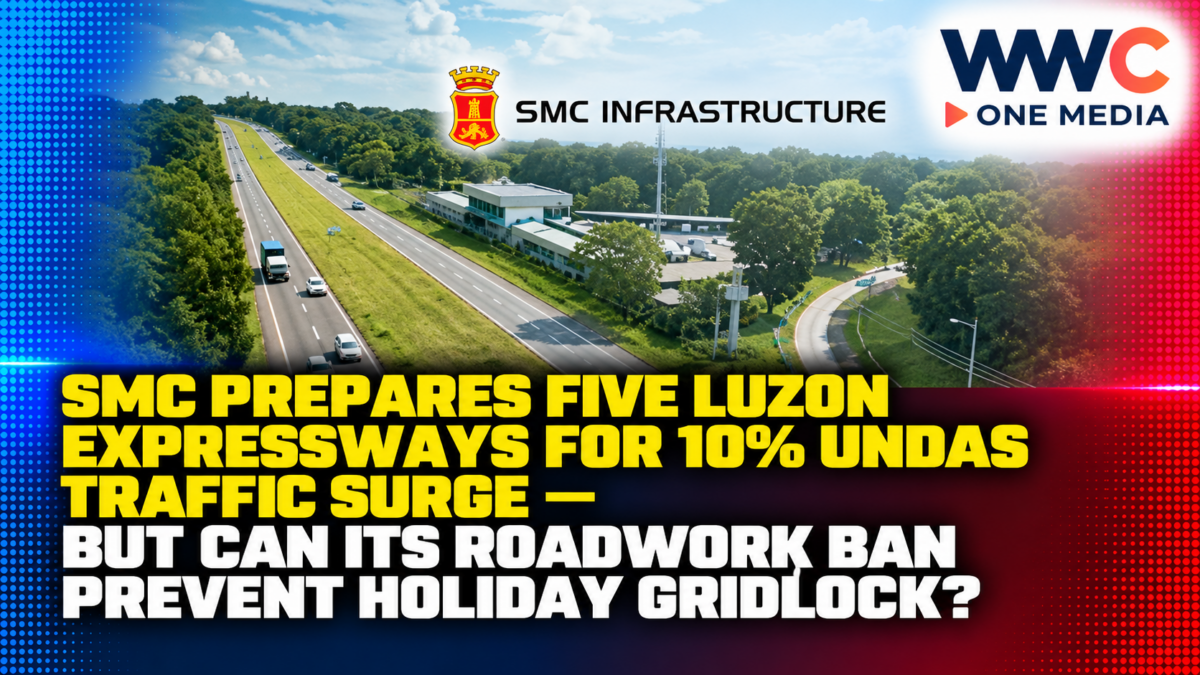
MANILA, PHILIPPINES — Thousands of Filipino families preparing to return to their hometowns and visit departed loved ones during Undas 2026 could face heavier traffic on major Luzon expressways, prompting San Miguel Corporation’s infrastructure arm to activate additional personnel, round-the-clock traffic monitoring and emergency response teams.
SMC Infrastructure is preparing for an estimated 10% increase in vehicle traffic across five major expressway systems during the All Saints’ Day and All Souls’ Day holiday period.
The preparations cover the South Luzon Expressway (SLEX), Skyway System, STAR Tollway, Ninoy Aquino International Airport Expressway (NAIAX) and Tarlac-Pangasinan-La Union Expressway (TPLEX).
Beginning October 29, SMC is placing its toll operations on full staffing while suspending scheduled roadworks from noon that day until 10 p.m. on November 3.
Ambulances, tow trucks, fire engines and quick-response teams will be positioned along the expressways to assist motorists experiencing accidents, breakdowns and other emergencies.
But despite the extensive preparations, one concern remains.
Can additional manpower and a temporary roadwork ban prevent severe holiday congestion—or will the annual Undas travel rush overwhelm even the country’s major toll expressways?
SMC EXPECTS A 10% INCREASE IN VEHICLE TRAFFIC
According to InsiderPH’s October 27 report, SMC Infrastructure expects vehicle traffic across its expressway network to increase by approximately 10% during Undas.
The projection reflects the seasonal rise in travel as families leave Metro Manila and nearby cities to visit cemeteries, reunite with relatives and spend the holiday period in their home provinces.
The increase is a company forecast.
It should not be described as a verified 10% rise that has already occurred.
Actual traffic volumes will depend on travel behavior, departure schedules, weather, road conditions and the management of congestion at expressway interchanges.
For motorists, the forecast is a warning to prepare for possible delays rather than a guarantee of traffic conditions on any particular road.
FIVE MAJOR EXPRESSWAYS COVERED
SMC’s preparations cover five expressway systems that connect Metro Manila with important destinations in Southern and Northern Luzon.
South Luzon Expressway (SLEX) serves motorists traveling between Metro Manila and southern destinations, including Laguna and routes connecting toward Batangas and Quezon.
Skyway System provides an elevated expressway connection across portions of Metro Manila and links with SLEX.
STAR Tollway supports travel through Batangas and connects with other expressway routes in Southern Luzon.
NAIA Expressway serves traffic traveling near Ninoy Aquino International Airport and surrounding road networks.
TPLEX supports travel toward areas of Central and Northern Luzon, including Pangasinan and routes leading farther north.
The five systems serve different travel patterns.
Congestion on one road does not automatically mean that all other expressways will experience the same delays.
FULL STAFFING BEGINS OCTOBER 29
Under the Department of Transportation’s Oplan Biyaheng Ayos, SMC’s full staffing arrangement takes effect at 12:01 a.m. on October 29.
The company is deploying additional toll personnel and traffic-management teams to handle the expected increase in motorists.
The preparations include coordination with the Metropolitan Manila Development Authority, Toll Regulatory Board, Land Transportation Office and local government units.
The purpose is to improve traffic flow and provide a faster response when congestion or road incidents occur.
Government coordination is particularly important where toll expressways connect with public roads.
A tollway may have several open lanes but still experience delays if the adjoining streets cannot accommodate vehicles exiting the expressway.
ROADWORKS SUSPENDED UNTIL NOVEMBER 3
One of the most important measures is the temporary suspension of scheduled road construction and maintenance activities.
SMC announced that roadworks would be suspended beginning 12 noon on October 29 until 10 p.m. on November 3.
The moratorium aims to reduce lane restrictions during the expected peak holiday travel period.
Construction activities often require partial lane closures or temporary traffic controls.
Even relatively short restrictions can create long queues when traffic volumes are high.
Suspending nonessential work can therefore help preserve road capacity.
However, the announcement does not mean that emergency repairs or urgent safety interventions can never occur.
Motorists should continue following posted advisories and instructions from traffic authorities.
EMERGENCY TEAMS WILL OPERATE ALONG THE EXPRESSWAYS
SMC will position quick-response teams, ambulances, tow trucks and fire engines at strategic locations throughout its network.
The company is preparing for incidents involving stalled vehicles, overheating engines, flat tires, traffic collisions and other roadside emergencies.
A disabled vehicle can affect several lanes when traffic is already heavy.
Prompt assistance may help reduce the time needed to clear an obstruction.
However, emergency crew deployment does not mean every incident can be resolved immediately.
Response times will depend on incident location, traffic conditions and the resources required.
Motorists should still prioritize safe driving rather than relying on roadside assistance as a substitute for vehicle preparation.
TRAFFIC MONITORING CENTERS TO OPERATE 24 HOURS
Traffic monitoring centers will operate around the clock during the holiday period.
Continuous monitoring allows operators to assess changing traffic conditions and coordinate responses to reported incidents.
The system can also help personnel identify developing bottlenecks.
However, monitoring does not automatically eliminate congestion.
If more vehicles arrive at an interchange than the surrounding road network can accommodate, traffic may still build up.
Operational coordination can help manage the situation, but physical road capacity remains a major constraint.
PETRON SERVICE STATIONS WILL PROVIDE ASSISTANCE
Emergency assistance desks will also operate 24 hours a day at participating Petron service stations along the SMC network.
These locations will complement the roadside teams deployed on the expressways.
Service areas may provide opportunities for motorists to stop, check their vehicles or obtain assistance.
However, the announcement should not be interpreted as a guarantee that all repairs, towing services or other facilities are free of charge.
Drivers should confirm the applicable terms with the operator before accepting chargeable services.
BOTTLENECKS MAY FORM OUTSIDE EXPRESSWAY EXITS
SMC identified connecting local roads as an area of particular concern.
Congestion can develop where expressways feed into smaller roads near commercial areas, provincial destinations and busy intersections.
During Undas, motorists may also encounter heavy traffic around cemeteries and public transport terminals.
This means an expressway journey can become slow even when the mainline toll road is moving relatively well.
SMC says it is working with the MMDA, LTO, TRB and local authorities to address these connecting-road issues.
The approach recognizes that holiday traffic management cannot be handled by toll operators alone.
OTHER TOLLWAY OPERATOR ALSO PREPARES FOR PEAK TRAFFIC
Independent reporting shows that SMC is not the only company implementing emergency travel measures.
Metro Pacific Tollways Corporation (MPTC) is preparing its own network for an estimated 5% increase in overall traffic, with increases reaching approximately 12% on peak travel days.
Its preparations cover NLEX, SCTEX, NLEX Connector, CAVITEX, CALAX and the Cebu-Cordova Link Expressway.
MPTC is deploying approximately 2,000 personnel across its network and suspending nonessential roadworks from October 29 through November 3.
Some of its services include free towing for eligible Class 1 vehicles to the nearest exit during a specified holiday period and basic roadside mechanical assistance at selected locations.
These services and their conditions belong to MPTC’s announced program.
They should not automatically be attributed to SMC’s tollways.
WHEN WILL UNDAS TRAFFIC BE HEAVIEST?
BusinessMirror, GMA News and TV5 reported that October 30 and 31 are expected to be important outbound travel days.
For MPTC’s northern expressways, heavy outbound movement is expected from Friday afternoon through Saturday afternoon.
Return traffic is projected to increase from the late afternoon of November 2 into the early hours of November 3.
These are travel forecasts, not guarantees that every toll road will peak at the same time.
SMC’s own 10% projection covers its network over the holiday period without establishing a precise peak hour for each expressway.
Motorists should review updated traffic advisories near their departure time.
AUTOSWEEP RFID USERS REMINDED TO LOAD THEIR ACCOUNTS
SMC is advising motorists to check their Autosweep RFID accounts before entering its tollways.
Insufficient load can cause payment delays and create additional congestion at toll plazas.
Drivers should also make sure their RFID stickers are functioning properly.
A vehicle whose tag cannot be read may require manual assistance.
During high-traffic periods, even brief payment interruptions can contribute to long queues.
The company recommends preparing toll balances in advance instead of waiting until the last moment.
ONE RFID PROGRAM REMAINS OPTIONAL
Motorists traveling across different Luzon expressway operators may also consider the One RFID, All Tollways program.
The system allows eligible users to enroll in a unified account arrangement using either the Autosweep or Easytrip provider.
It was introduced to simplify toll transactions across Luzon’s participating expressways.
However, enrollment remains optional, according to the Department of Transportation and official program information.
Drivers who prefer to retain separate Autosweep and Easytrip accounts are not automatically required to switch.
Importantly, motorists should distinguish the current unified account program from older arrangements in which one physical RFID sticker could be used while maintaining two separate load wallets.
Enrollment requirements vary according to the chosen provider and the condition of the vehicle’s existing RFID accounts.
VEHICLE CHECKS COULD PREVENT ROAD BREAKDOWNS
SMC is urging drivers to inspect their vehicles before traveling.
The recommended checks include tires, brakes, batteries, lights and cooling systems.
Tires should be inspected for wear and appropriate pressure.
Brakes and lights should be in working condition.
The battery and cooling system should also be checked, particularly before long trips.
An overheated engine or flat tire can leave a vehicle stalled on an expressway.
During heavy congestion, breakdowns can create additional risks for motorists and roadside personnel.
Preventive maintenance is therefore a practical part of holiday travel preparation.
FATIGUE IS ANOTHER IMPORTANT ROAD SAFETY RISK
Undas travel may involve long-distance driving, especially for families visiting provinces far from Metro Manila.
Drivers should plan rest stops and avoid operating a vehicle when excessively tired.
Road conditions can become more demanding during nighttime travel, heavy rain or congested periods.
Maintaining adequate following distance is also important.
Motorists should avoid sudden lane changes, unnecessary speeding and using phones while driving.
No traffic-management program can completely compensate for unsafe driving behavior.
EXPRESSWAY EMERGENCY HOTLINES
SMC Infrastructure has published the following contact numbers for roadside assistance:
SLEX: 0917-687-7539
STAR Tollway: 0917-511-7827 or (043) 756-7870
TPLEX: 0917-888-0715
Skyway: (02) 5318-8655
Drivers should save the appropriate contact details before departure.
In the event of an emergency, they should follow the instructions of traffic responders and move to a safe location when possible.
For emergencies involving immediate danger, motorists should prioritize their safety and contact appropriate emergency services.
WHAT OTHER NEWS OUTLETS CONFIRM
InsiderPH published the original story on October 27, reporting SMC’s forecast and operational preparations.
GMA News separately confirmed the estimated 10% increase and the five expressway systems covered.
Context.ph also reported the full staffing schedule, roadwork suspension and deployment of response teams.
Top Gear Philippines independently summarized both SMC and MPTC’s holiday measures, including the operator-specific assistance hotlines.
BusinessMirror provided broader context by comparing the companies’ forecasts, roadwork suspensions and motorist assistance programs.
GMA News’ earlier reporting on the Toll Regulatory Board also confirmed the government’s wider Oplan Biyaheng Ayos preparations.
Together, these sources support the announced measures.
However, many details originate from the toll operators’ own statements.
The reviewed reporting does not establish that the announced measures have already prevented congestion or reduced accidents during Undas 2026.
Those results can only be assessed after the holiday travel period.
WILL THE PREPARATIONS BE ENOUGH?
SMC Infrastructure’s strategy combines several measures intended to reduce the risk of severe holiday traffic.
Extra staff may help toll operations run more efficiently.
Emergency crews may shorten the time needed to respond to disabled vehicles.
The suspension of scheduled roadworks may preserve lanes for heavy travel.
Around-the-clock monitoring can support faster coordination.
But congestion depends on factors beyond the operator’s control.
High travel demand, collisions, bad weather and traffic on connecting local roads can still cause delays.
The most realistic goal is not necessarily to eliminate every traffic jam.
It is to improve traffic flow, respond quickly to emergencies and help motorists travel as safely as possible.
THE BIGGER QUESTION: CAN LUZON’S EXPRESSWAYS HANDLE THE UNDAS EXODUS?
The 2026 Undas holiday period will test how effectively expressway operators and government agencies coordinate one of the country’s important seasonal travel movements.
SMC has announced a 10% traffic increase forecast and implemented additional staffing, emergency preparations and a temporary suspension of scheduled roadworks.
MPTC has introduced similar measures on its own network.
Motorists, meanwhile, are being reminded to check their vehicles, prepare toll payments and allow extra travel time.
The true test of the preparations will come when outbound and return traffic reaches its peak and the road networks are under the greatest pressure.
And as thousands of Filipino families prepare to honor their departed loved ones, one question remains:
Will SMC’s roadwork ban and 24-hour emergency deployment keep traffic moving across Luzon’s major expressways—or will the Undas holiday rush trigger another round of massive highway congestion?










