
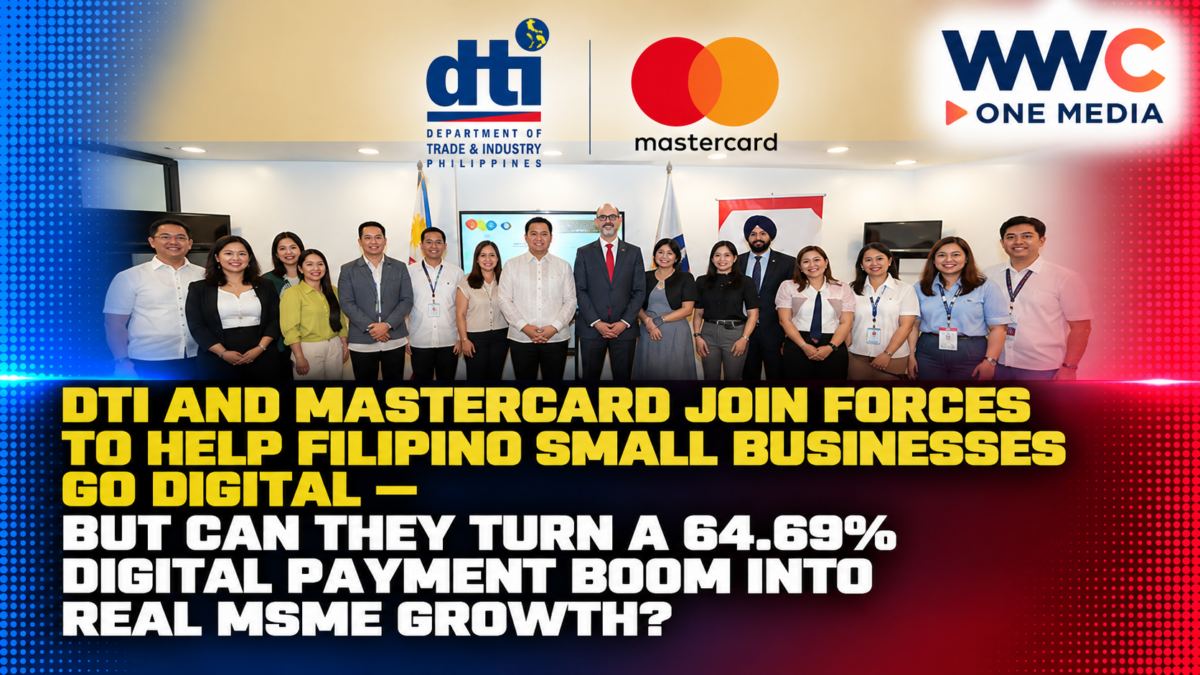
MANILA, PHILIPPINES — Filipino entrepreneurs could gain new opportunities to expand their businesses beyond traditional storefronts as the Department of Trade and Industry (DTI) and global payments company Mastercard launch a strategic partnership aimed at accelerating digital adoption among micro, small and medium enterprises (MSMEs).
The agreement, signed on October 26, 2026, brings together DTI’s E-Commerce Bureau and Mastercard to help small merchants adopt digital payment solutions, strengthen online security and improve their ability to compete in an increasingly cashless economy.
The initiative comes amid a major shift in how Filipinos pay for goods and services.
According to the Bangko Sentral ng Pilipinas (BSP), digital payments accounted for 64.69% of retail transactions by volume in 2025, compared with 57.45% the previous year.
Merchant payments represented 74.31% of digital payment transactions, highlighting the growing role of electronic payments in everyday commerce.
But while millions of consumers have become comfortable with mobile banking, e-wallets, cards and online checkout systems, smaller businesses still face obstacles involving technical skills, transaction security, payment processing costs and reliable internet access.
For the DTI and Mastercard, the challenge is no longer simply convincing entrepreneurs to establish an online presence.
It is helping them operate safely, efficiently and profitably in a rapidly changing digital marketplace.
Can this partnership help Filipino microentrepreneurs compete beyond their neighborhoods—or will the rising costs and complexity of digital commerce leave the smallest businesses struggling to catch up?
DTI AND MASTERCARD SIGN DIGITALIZATION AGREEMENT
The Department of Trade and Industry, through its E-Commerce Bureau, signed a memorandum of understanding with Mastercard on October 26.
The partnership aims to develop initiatives that make digital technologies, electronic payments and online business resources more accessible to Filipino MSMEs.
The agreement combines the DTI’s experience in enterprise development with Mastercard’s expertise in payment technologies.
Planned activities include training programs, practical learning resources and assistance intended to improve merchants’ understanding of electronic transactions.
The initiative is particularly relevant to businesses that already sell online but lack the knowledge or confidence to manage digital payments securely.
However, the memorandum of understanding does not establish that every MSME will automatically receive payment equipment, a free merchant account or direct financial assistance.
The specific programs, participation requirements and implementation schedules still need to be announced.
WHY THE PARTNERSHIP MATTERS TO FILIPINO ENTREPRENEURS
Small businesses are increasingly expected to accommodate customers who prefer electronic payments.
A customer purchasing food, clothing or household products may want to pay using a mobile wallet, bank transfer, QR code or card.
Businesses that offer only cash payments can potentially lose sales when their customers do not have physical money available.
Digital payment acceptance can also support online orders, remote transactions and deliveries.
For entrepreneurs selling beyond their immediate communities, these capabilities may be particularly useful.
However, offering electronic payments does not automatically guarantee higher sales.
Merchants also need competitive products, reliable delivery arrangements, effective customer service and appropriate business records.
The DTI–Mastercard partnership aims to address some of the knowledge and technology barriers that prevent smaller businesses from participating effectively.
DIGITAL PAYMENTS NOW ACCOUNT FOR NEARLY 65% OF RETAIL TRANSACTIONS
The BSP’s annual e-payments measurement provides the clearest evidence of the country’s growing digital payment activity.
In 2025, 64.69% of retail payment transactions by volume were conducted digitally.
That compares with 57.45% in 2024.
The increase represents 7.24 percentage points, not a 7.24% increase in transaction counts.
The figures demonstrate that electronic transactions now account for the majority of measured retail payments by volume.
However, transaction volume and transaction value are different indicators.
The 64.69% figure should not be described as the percentage of total retail spending in pesos without separately examining value-based data.
Nor does it mean that 64.69% of all Filipino businesses already accept digital payments.
The figures describe payment transactions, not merchant enrollment.
MERCHANT PAYMENTS DRIVE DIGITAL TRANSACTIONS
Merchant payments accounted for 74.31% of digital transactions in the 2025 report.
These payments involve customers purchasing goods or services from businesses.
The category includes transactions with merchants of different sizes, including some MSMEs.
Its large share illustrates the importance of everyday commerce in the expansion of digital payments.
Electronic payment adoption is no longer limited to bank transfers between individuals.
It is increasingly associated with purchases from retailers, service providers and other businesses.
However, the 74.31% figure does not mean that nearly three-quarters of small businesses have digital payment accounts.
It measures the composition of transactions within the digital payments ecosystem.
SOME BUSINESSES ARE STILL STRUGGLING TO GO DIGITAL
Despite the growth of online commerce, many smaller merchants face practical obstacles.
These can include limited digital literacy, unreliable connectivity, unfamiliarity with payment procedures and concerns about scams.
A business owner may know how to advertise products through social media but still struggle to reconcile online payments.
Others may have difficulty understanding transaction fees, payment disputes or the differences among electronic payment services.
For microenterprises with limited staff, even routine digital operations can create additional work.
The partnership therefore emphasizes practical training rather than technology access alone.
Entrepreneurs need to understand how a payment system works before they can use it effectively.
DTI SAYS ONLINE SELLERS NEED GREATER CONFIDENCE
DTI E-Commerce Bureau Director Atty. Eryl Royce R. Nagtalon emphasized that online selling has already become familiar to many Filipino entrepreneurs.
But he acknowledged that some businesses still need more confidence in accepting payments and interacting securely with customers.
The agency’s approach recognizes that signing up for a digital platform is only the beginning.
Merchants must also know how to identify genuine transactions, respond to customer questions and protect sensitive business information.
These skills can help reduce avoidable errors and security risks.
The DTI hopes that Mastercard’s experience in electronic payments will support more practical business education.
However, the effectiveness of these activities will depend on how widely the training reaches smaller enterprises.
MASTERCARD SEES OPPORTUNITY FOR SMALL BUSINESSES
Mastercard Philippines Country Manager Jason Crasto described MSMEs as central participants in the country’s economy.
He said digitalization can help entrepreneurs reach more customers, operate efficiently and compete in a connected marketplace.
Mastercard’s participation brings expertise in payment systems and merchant-related technologies.
The company intends to contribute to training and access to relevant digital payment solutions.
However, the agreement should not be interpreted as requiring all participating MSMEs to accept Mastercard-branded cards exclusively.
The public announcement does not specify an exclusive payment arrangement.
It also does not disclose a universal merchant service fee, free transaction package or subsidy for payment acceptance.
Those details should be verified when specific programs and service providers are announced.
TRAINING PROGRAMS ARE PLANNED, NOT YET FULLY ROLLED OUT
Fintech News Philippines reported on October 28 that the initiative is expected to include online learning modules for DTI-registered MSMEs.
The training would focus on electronic payment acceptance, online transaction safety and the practical use of digital commerce tools.
However, the report also noted that specific training schedules, enrollment procedures and participant targets had not been published.
This distinction matters to small business owners looking for immediate assistance.
The partnership has been signed, but detailed implementation information is still forthcoming.
It would be misleading to announce that thousands of MSMEs have already completed training under the new program.
Likewise, no verified deadline or registration link specific to this partnership has been established.
ONLINE PAYMENT SECURITY IS A MAJOR PRIORITY
Digital payment adoption creates opportunities but also exposes merchants to potential fraud.
Small businesses may encounter fake payment confirmations, fraudulent checkout links, phishing attempts and account takeover efforts.
A seller who relies on screenshots rather than verified transaction records may mistakenly release products before receiving payment.
Merchants may also be targeted through messages pretending to come from banks, payment companies or delivery providers.
Practical training should therefore include methods for verifying completed transactions and identifying suspicious activity.
Business owners should use official payment channels, protect account credentials and review their transaction records regularly.
No payment system can eliminate every fraud risk.
Security depends on both the technology and how merchants use it.
DIGITAL PAYMENTS CAN SUPPORT BETTER BUSINESS RECORDS
One potential benefit of electronic payments is the creation of digital transaction records.
These records can help business owners monitor sales and reconcile payments.
Accurate records may also support budgeting, inventory management and financial planning.
For enterprises seeking business financing, organized financial information can be useful when applying to lenders.
However, accepting digital payments does not automatically make a business eligible for a loan.
Credit decisions depend on a lender’s requirements, financial assessment and applicable rules.
The partnership announcement does not guarantee financing, credit approval or lower borrowing costs for participants.
SMALL MERCHANTS MUST UNDERSTAND PAYMENT FEES
Although electronic payments can improve convenience, they may involve costs.
Depending on the provider, merchants may pay transaction fees, equipment costs, subscription charges or other service expenses.
These charges can affect margins, particularly for businesses selling inexpensive products.
For example, a small retailer may need to compare the expected benefits of cashless acceptance with the cost of processing transactions.
The appropriate solution may differ for a sari-sari store, food stall, online shop or wholesale business.
The DTI–Mastercard partnership does not announce a universal fee waiver.
Business owners should review the specific charges and settlement arrangements before enrolling in any payment service.
QR PH AND DIGITAL WALLETS HAVE CHANGED EVERYDAY COMMERCE
The Philippine payments ecosystem has expanded through systems including QR Ph and account-to-account electronic transfers.
QR Ph is a national standard that supports interoperable QR-based payments through participating financial institutions and payment service providers.
For merchants, interoperability can potentially reduce the need to display multiple incompatible payment codes.
However, actual features depend on the merchant’s provider and the services supported.
Card payments, QR transfers and e-wallet transactions also have different operational arrangements.
A business owner should understand settlement times, payment confirmation methods and applicable fees.
The DTI–Mastercard initiative could help improve familiarity with such options, although its announcement does not identify one mandatory payment technology for all MSMEs.
BUSINESS-TO-BUSINESS PAYMENTS OFFER ANOTHER OPPORTUNITY
Fintech News Philippines highlighted a separate figure from the BSP’s 2025 e-payments data.
Only approximately 18.75% of business-initiated payments by volume were conducted digitally.
This indicates that a substantial share of transactions initiated by businesses still took place through nondigital channels.
The figure refers to a different payment category and denominator from the overall 64.69% retail digital payment share.
It should not be interpreted as meaning that only 18.75% of businesses use electronic payments.
Nevertheless, it suggests opportunities to improve how companies pay suppliers and other commercial partners.
Digital business payments can potentially improve transaction records and reduce some manual processes.
But adoption depends on the needs and capabilities of both parties to a transaction.
DTI IS BUILDING A WIDER DIGITAL SUPPORT NETWORK
The Mastercard agreement is part of a broader series of DTI initiatives supporting MSME digitalization.
In August 2026, the DTI, TikTok Shop and Converge announced a partnership focused on e-commerce skills, seller onboarding and business connectivity.
That initiative builds on the Unlad Lokal program intended to help Filipino sellers reach online markets.
The DTI has also worked with Delivery Hero Philippines, the operator of foodpanda, to provide digital marketplace training and information about online consumer protection.
These collaborations address different parts of the digital business ecosystem.
Payment acceptance is one component.
Reliable internet connectivity, online marketing, logistics, product quality and consumer trust are also important.
The growing number of partnerships reflects a strategy of working with specialized private-sector companies.
However, their actual outcomes must be measured individually.
NEGOSYO CENTER ONLINE PORTAL 2.0 PROVIDES AN EXISTING RESOURCE
A separate DTI initiative may already be useful for entrepreneurs.
On September 28, 2026, the agency launched Negosyo Center Online Portal 2.0.
The upgraded platform offers access to business registration assistance, advisory services, educational materials and mentoring.
The portal also supports online consultations with qualified business mentors.
It is an existing government resource rather than a new service created under the Mastercard agreement.
The portal may help small business owners explore available DTI services while waiting for more details about Mastercard-specific training.
However, access to the portal does not automatically enroll a business in the new Mastercard partnership.
PHILIPPINE DIGITAL ECONOMY CONTINUES GROWING
The partnership comes as the Philippine digital economy expands.
According to Philippine Statistics Authority figures cited in August reporting, the country’s digital economy generated approximately ₱2.74 trillion in gross value added during 2025.
That represented about 9.8% of gross domestic product.
E-commerce accounted for a significant share of digital activity, with approximately ₱880.46 billion in gross value added.
These figures show the economic importance of digital transactions, platforms and related services.
However, the digital economy includes much more than payments or small online retailers.
Its expansion should not be attributed to the DTI–Mastercard partnership, which was signed only in October 2026.
The new agreement is intended to help MSMEs participate more effectively in an already-growing digital economy.
REGIONAL MSMES FACE DIFFERENT DIGITAL CHALLENGES
Entrepreneurs in Metro Manila may have different technology needs from those operating in rural communities.
Some businesses have reliable connectivity and access to several payment providers.
Others face weak internet signals, limited digital skills or difficulties arranging deliveries to distant customers.
In the Cordillera region, for example, the DTI has been providing training involving online selling, digital content creation and point-of-sale systems.
The Philippine Information Agency reported in July that regional officials were also helping small businesses improve product standards and market access.
These existing efforts illustrate why digital support programs must consider local circumstances.
A one-size-fits-all approach may not work for every business.
The challenge will be ensuring that training and technology access reach entrepreneurs who need practical assistance most.
ONLINE SELLERS ALSO HAVE CONSUMER PROTECTION RESPONSIBILITIES
Small businesses entering electronic commerce must understand their responsibilities to customers.
The Internet Transactions Act of 2023, Republic Act No. 11967, establishes a framework addressing consumer and merchant rights in online transactions.
Depending on the business and the relevant rules, online sellers may have obligations involving accurate product information, consumer protection and dispute resolution.
Electronic payment acceptance does not eliminate those requirements.
Merchants should provide clear prices, explain delivery and refund conditions, and avoid misleading product claims.
Consumer trust is essential to sustainable e-commerce.
A business that accepts online payments but fails to deliver products reliably may struggle to retain customers.
Digitalization therefore involves both technical capability and responsible commercial conduct.
WHAT OTHER NEWS OUTLETS CONFIRM
InsiderPH reported the DTI–Mastercard partnership on October 27, focusing on digital payment adoption and wider market access for Filipino small businesses.
Context.ph independently covered the agreement on October 26 and highlighted the importance of training and merchant confidence.
Daily Tribune reported the memorandum of understanding and provided a photograph from the signing.
Fintech News Philippines published additional analysis on October 28, including the planned online training modules and remaining gaps in digital business payments.
Logistics News PH also documented the event and identified the DTI and Mastercard officials participating in the announcement.
For the broader payments context, the Bangko Sentral ng Pilipinas maintains the annual Report on E-Payments Measurement, including the 2025 edition.
Together, these sources confirm the agreement and its stated objectives.
However, much of the partnership coverage relies on the same official announcement.
It does not independently prove that the new program has already increased MSME revenues, created jobs or produced measurable cost savings.
WHAT FILIPINO MSMES SHOULD DO NOW
Entrepreneurs interested in digital payments can begin reviewing their existing business operations.
They can identify which customer transactions would benefit from electronic payment options.
They should also compare service fees, account requirements, payment settlement procedures and security features among providers.
Businesses selling online should establish reliable systems for checking completed payments and maintaining records.
Training in customer service, data protection and fraud prevention can also help.
For information about the new DTI–Mastercard programs, merchants should monitor official DTI announcements and verified Mastercard channels.
There is no confirmed universal enrollment deadline, guaranteed subsidy or loan offer under the partnership.
Entrepreneurs should be cautious about unsolicited messages claiming that payment of a registration fee is required to receive government-supported benefits.
THE BIGGER QUESTION: CAN DIGITAL ACCESS BECOME REAL BUSINESS GROWTH?
The DTI–Mastercard partnership arrives at an important moment for the Philippine economy.
Digital payments now account for nearly two-thirds of measured retail transactions by volume.
Consumers are increasingly familiar with cashless purchasing, while businesses face growing expectations to offer convenient electronic transactions.
For small merchants, these developments create opportunities to reach customers beyond traditional locations.
But technology access alone will not guarantee commercial success.
Entrepreneurs need the skills to operate securely, manage fees, protect customer information and deliver reliable products and services.
The government’s partnership with Mastercard could help address these challenges through practical training and payment-technology support.
However, the program’s eventual impact will depend on implementation.
The real measure of success will be how many MSMEs gain usable skills, adopt suitable payment systems and achieve sustainable improvements in their operations—not simply the signing of a partnership agreement.
And as the Philippines moves further toward a cashless economy, one question remains:
Will the DTI and Mastercard finally help smaller Filipino businesses compete in the fast-growing digital marketplace—or will high technology costs, cybersecurity threats and limited digital skills prevent many entrepreneurs from sharing in the boom?










