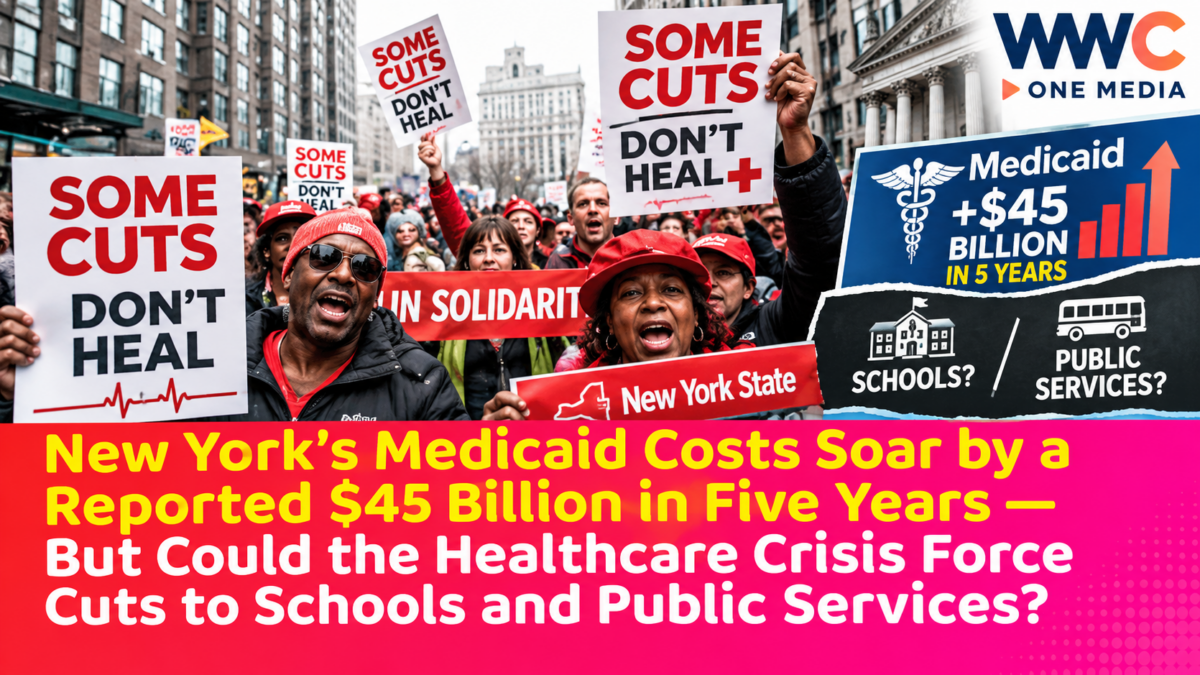
ALBANY, NEW YORK / MANILA — November 3, 2026. New York’s public healthcare system is facing mounting financial pressure after a new Bloomberg report highlighted a roughly $45-billion increase in Medicaid spending over five years, renewing concerns that America’s most expensive state healthcare programs could place an increasingly heavy burden on taxpayers and government budgets.
The November 2 report comes as state officials struggle to balance the rising cost of medical care, long-term assistance, hospital reimbursements and changes in federal healthcare funding.
According to New York State Comptroller Thomas DiNapoli, total Medicaid spending reached approximately $115.6 billion in state fiscal year 2025, including $69.2 billion in federal funding.
The program covers millions of low-income residents, older adults, children and people with disabilities.
But its costs have grown rapidly, with state-funded Medicaid spending rising faster than many other major budget categories.
New York’s fiscal projections indicate that total Medicaid spending could reach approximately $133.7 billion by state fiscal year 2029.
Meanwhile, the state’s share of Medicaid expenses is projected to grow significantly through 2030.
The figures raise a difficult political and economic question.
New York must continue providing essential healthcare to vulnerable residents while preventing medical spending from overwhelming other priorities, including public schools, transportation, housing and infrastructure.
As Medicaid costs surge and federal funding arrangements become increasingly uncertain, can New York control healthcare expenses without reducing access to care — or will taxpayers and patients ultimately face the consequences?
New York’s Medicaid Spending Surges Over Five Years
Bloomberg’s November 2 investigation describes a $45-billion expansion in New York’s Medicaid spending over a five-year period.
The report reflects a broader trend documented by the state’s own fiscal watchdogs.
Medicaid spending has increased substantially since the COVID-19 pandemic, driven by medical inflation, enrollment changes, expanded services and growing demand for long-term care.
However, several different Medicaid spending measurements are used in New York’s budget documents.
One tracks total program spending from state, federal and local sources.
Another tracks only the portion financed by New York State.
Additional reports focus on spending administered by the Department of Health or funded through the State Operating Funds budget.
These figures are not interchangeable.
The precise starting and ending values underlying Bloomberg’s $45-billion comparison were not independently established from publicly accessible comparable tables.
For that reason, the $45-billion figure should be identified as Bloomberg’s reported calculation rather than independently verified arithmetic.
What is clear from government records is that the cost of New York’s Medicaid program has risen substantially.
State Medicaid Spending Reaches $115.6 Billion
According to the Office of the New York State Comptroller, Medicaid spending totaled approximately $115.6 billion in state fiscal year 2025.
The federal government provided $69.2 billion.
The remainder came from state and local funding sources.
New York receives a standard federal Medicaid matching rate of approximately 50% for many eligible expenditures.
Certain Medicaid expansion populations qualify for a higher federal matching percentage.
The distinction is crucial because the federal government shares responsibility for funding the program.
A headline referring to total Medicaid spending does not mean the entire amount comes from New York taxpayers.
At the same time, federal funding changes can transfer additional financial pressure to the state.
That makes Medicaid both a healthcare issue and a major intergovernmental budget challenge.
Medicaid Now Costs More Than New York’s School Aid Program
One of the most significant findings in New York’s fiscal reports concerns the balance between healthcare and education spending.
The state comptroller reported approximately $39.4 billion in all-agency Medicaid spending from State Operating Funds during fiscal year 2026.
That represented 26.5% of State Operating Funds expenditures.
School aid totaled slightly more than $37 billion, accounting for approximately 24.9%.
The comparison indicates that Medicaid has overtaken school aid as the larger of the two expenditures under that measure.
Education remains a major state priority.
However, rapid Medicaid growth can reduce the budgetary flexibility available for other programs.
By fiscal year 2030, the comptroller projects Medicaid spending from State Operating Funds could reach $53.3 billion.
School aid is projected to increase to approximately $43.7 billion.
If those projections materialize, the gap between the two programs will grow further.
This does not mean school funding has already been cut to finance Medicaid.
It means that healthcare is expected to consume an increasingly large share of state resources, potentially creating harder budget choices in future years.
Why Healthcare Spending Keeps Rising
Several forces are driving New York’s Medicaid costs higher.
Medical services have become more expensive.
Hospitals and nursing homes face rising labor, supply and operating expenses.
Some providers require higher reimbursement rates to maintain financially viable services.
Demand for home-based care and long-term assistance is also growing.
Older adults and people with disabilities may need extensive services that continue over many years.
In addition, changes to federal healthcare coverage and eligibility rules can shift some costs to state-financed programs.
New York’s budget documents identify rising medical and prescription-drug costs, higher reimbursement rates, utilization changes and the needs of financially distressed hospitals as major pressures.
These forces do not necessarily result from a single policy failure.
They reflect a combination of population needs, provider costs, program design and the financing arrangements between governments.
Long-Term Home Care Becomes a Major Budget Challenge
New York’s Consumer Directed Personal Assistance Program, commonly known as CDPAP, has attracted particular scrutiny.
The program allows eligible people who need personal assistance to select and manage caregivers, including certain family members.
Its purpose is to help people receive necessary services while remaining in their homes and communities.
However, the program’s rapid expansion has raised questions about spending controls and administrative oversight.
Critics argue that weak supervision and rising utilization contributed to excessive costs.
Supporters emphasize that home care can be essential for people with disabilities and older adults who would otherwise face significant barriers to independent living.
Some also argue that reducing home-care access could shift costs elsewhere, including hospitals and nursing homes.
The financial challenge is therefore more complicated than simply eliminating services.
New York must determine how to prevent improper payments and control costs without depriving eligible residents of necessary assistance.
Medicaid Fraud Allegations Intensify Political Scrutiny
The rising costs have also attracted attention from federal officials.
In 2026, the Trump administration raised concerns about potential fraud, waste and abuse in New York’s Medicaid program.
Federal officials have questioned spending on personal-care services and sought explanations from state authorities.
Investigations and audits can play an important role in protecting public funds.
However, allegations of fraud must be distinguished from documented findings.
High spending per resident does not, by itself, prove fraudulent activity.
Differences in healthcare prices, eligibility policies, service needs and the population receiving care can influence costs.
Likewise, identifying improper payments does not establish that all spending within a program is illegitimate.
An effective review must separate verified misconduct from lawful medical services and legitimate program expenses.
New York Already Has One of America’s Most Expensive Medicaid Programs
New York has consistently ranked among the states with the highest Medicaid spending.
The Office of the State Comptroller reports that the state has one of the country’s largest Medicaid programs, with enrollment second only to California.
Approximately 6.9 million people were enrolled in February 2025.
That represented about 35% of New York’s population.
The Bronx had a particularly high Medicaid enrollment share, reflecting the importance of public coverage in communities with lower incomes and substantial healthcare needs.
USAFacts, drawing on federal Medicaid expenditure information, reported approximately $13,001 in benefit spending per New York Medicaid enrollee in federal fiscal year 2024.
That exceeded the corresponding national average of approximately $10,760.
However, this per-enrollee figure uses a different dataset and fiscal-year basis from the state budget totals.
It should not be multiplied by an enrollment figure from another period to derive a supposedly exact state expenditure total.
The Healthcare Industry Is Expanding Even as Public Budgets Face Pressure
New York’s difficulties reflect broader structural problems in the American healthcare economy.
WWC ONE MEDIA previously examined the trend in America’s Healthcare Economy Is Booming — But Patients Are Paying the Price.
The report explored how US healthcare spending has risen dramatically while patients, employers and taxpayers continue facing higher expenses.
The United States spent approximately $5.3 trillion on healthcare in 2024.
Federal projections suggest the country’s annual healthcare expenditures could approach $9 trillion by 2034.
For governments, the challenge is that healthcare costs can grow faster than the revenues needed to fund them.
More expensive care can lead to higher insurance premiums, increased public spending and pressure on household finances.
Yet reducing expenditure too aggressively may also affect hospital finances, healthcare employment and patient access.
That creates a difficult cycle in which almost every proposed solution involves financial trade-offs.
Insurance Companies Are Also Under Pressure From Medical Costs
Private insurers face many of the same healthcare inflation pressures affecting public programs.
Insurers must balance premiums, medical claims, provider reimbursement arrangements and operating expenses.
WWC ONE MEDIA recently covered those pressures in UnitedHealth Raises 2026 Profit Forecast as Earnings Jump 61% — But Is Wall Street’s Troubled Insurance Giant Finally Making a Comeback?.
The article examined rising medical costs and the changing financial outlook for a major US healthcare company.
UnitedHealth’s commercial and government-sponsored insurance businesses are not identical to New York State’s Medicaid budget.
However, the comparison illustrates how medical inflation affects different participants across the healthcare system.
When treatment costs rise, insurers and government programs may face larger bills.
Providers, meanwhile, argue that they need adequate payments to cover staffing, medicines, facilities and equipment.
Controlling costs without compromising care is therefore a challenge for both public and private health coverage.
Federal Funding Changes Could Make New York’s Problem Worse
New York faces additional uncertainty because Medicaid depends heavily on federal support.
Changes enacted through the 2025 federal budget legislation are affecting healthcare eligibility and financing arrangements.
The state’s comptroller has warned that those changes could place further pressure on healthcare coverage and New York’s finances.
The July 2026 fiscal report also discussed the potential consequences for the Essential Plan, a separate program that provides affordable healthcare coverage to eligible residents.
That distinction is important.
The Essential Plan is not simply another name for Medicaid, even though policy changes may cause some people to move between coverage categories.
State officials have sought to preserve coverage for residents affected by federal changes.
However, shifting people between programs may change which level of government pays for their healthcare.
A reduction in federal support can therefore increase state costs even when total medical-service use does not rise proportionately.
New York’s Spending Cap Has Become Harder to Maintain
New York introduced a Medicaid Global Cap in 2012 to control the growth of certain state-funded healthcare expenditures.
The cap was designed to limit spending increases according to a specified growth formula.
Over time, the state modified the calculation to reflect broader healthcare spending trends.
But the spending cap has become increasingly difficult to maintain.
The comptroller previously identified significant budgetary adjustments used to keep reported expenditures within the applicable cap.
These included shifting certain spending categories outside the calculation and using revenue from a managed-care organization tax.
Officials argue that financing adjustments can help preserve healthcare services while complying with budget requirements.
Fiscal watchdogs warn that repeated adjustments may make the program’s underlying costs more difficult to evaluate.
The important question is whether changes to accounting classifications produce genuine financial savings or merely alter where spending appears within the budget.
For taxpayers and lawmakers, transparent reporting is essential.
New York’s Future Budget Gaps Are Growing
The healthcare challenge forms part of a broader fiscal outlook.
The state comptroller’s February 2026 review projected budget gaps of approximately $6 billion in fiscal year 2028, $9 billion in 2029 and $12.5 billion in 2030 under the executive financial plan available at the time.
Those figures were projections and may change as state revenues, federal policies and budget decisions evolve.
The comptroller also reported that Medicaid and school aid together are expected to account for an increasingly large share of State Operating Funds spending.
That creates less flexibility for other programs if revenue growth fails to keep pace.
However, rising Medicaid costs are not the sole cause of New York’s projected budget gaps.
Tax revenues, economic conditions, federal funding changes and spending across multiple agencies also affect the state’s financial outlook.
Any claim that Medicaid alone caused the entire deficit would therefore be misleading.
Could Hospital Closures Become Part of the Crisis?
Hospitals are caught between competing financial pressures.
Higher staffing and operating costs can force providers to seek increased reimbursement.
But larger reimbursements may increase Medicaid spending.
At the same time, reducing payments can place financial stress on hospitals that depend heavily on public insurance.
New York’s fiscal watchdogs have warned about the need to support financially distressed healthcare institutions.
This creates a challenging policy balance.
The government needs to control expenditure.
But hospitals must also have sufficient resources to provide emergency treatment, maternity services, specialist care and other essential functions.
An effective response may involve improving payment systems, strengthening oversight and reducing avoidable medical expenses.
Simply cutting reimbursement rates may produce unintended consequences if financially vulnerable hospitals reduce services or close.
What the Medicaid Debate Means for the Philippines
New York’s Medicaid situation offers lessons for other countries trying to expand public healthcare coverage.
The Philippines faces its own debates about government health spending, public hospitals and the sustainability of PhilHealth benefits.
WWC ONE MEDIA previously examined those issues in DOH Budget Faces Massive Cut in 2027—Now Lawmakers Want Congress to Put Billions Back.
That report discussed proposed reductions in Philippine health-sector appropriations and calls for greater support for PhilHealth and public hospitals.
The Philippine and American healthcare systems differ significantly.
Medicaid is a US federal-state program, while PhilHealth operates under Philippine laws and financing arrangements.
Their spending figures cannot be directly compared without accounting for population, service coverage, costs and institutional structure.
Nevertheless, both countries face the fundamental challenge of providing affordable healthcare with finite public resources.
Expanding coverage without adequate financing can strain public budgets.
Restricting funding without addressing medical needs can leave patients facing greater personal expenses.
Hospital Investment Alone Will Not Solve the Problem
Private investment can help expand healthcare infrastructure.
But constructing more hospitals does not automatically make medical care affordable.
WWC ONE MEDIA recently examined a proposed Philippine-American hospital project in Ayala’s AC Health, US Hospital Giant Plan Pasig Medical Campus With 3,000 Potential Jobs — But Will World-Class Care Be Affordable for Filipinos?.
The proposed development could expand specialized treatment capacity and create jobs.
However, the project’s eventual affordability and insurance coverage remain questions.
The same principle applies to New York’s Medicaid debate.
Greater healthcare capacity can improve access, but governments still need sustainable ways to finance services.
Without effective cost management, additional facilities and treatments may create new spending pressures.
The objective should be to improve health outcomes while ensuring that available public funds are used effectively.
Can New York Control Medicaid Costs Without Cutting Coverage?
The central challenge for New York policymakers is identifying which expenditures can be reduced without harming medically necessary services.
Potential approaches include strengthening oversight of payments, improving eligibility administration, addressing improper billing and evaluating unusually expensive services.
Better coordination between hospitals, primary-care providers and long-term care programs may also help reduce avoidable costs.
But the success of these measures depends on implementation and evidence.
Not every spending increase represents waste.
Aging residents, people with disabilities and patients with serious medical conditions may require expensive care regardless of administrative efficiency.
Meanwhile, changes in federal financing can increase state spending even if healthcare utilization remains stable.
A credible reform strategy must therefore distinguish between preventable costs and legitimate healthcare needs.
The same distinction should guide public reporting.
The size of New York’s Medicaid program is a legitimate fiscal concern.
But large spending totals alone do not prove mismanagement or justify cutting necessary medical assistance.
What Comes Next for New York’s Healthcare Budget?
New York officials face several important decisions.
They must determine how to manage increasing state Medicaid obligations while responding to changes in federal financial support.
They must also oversee home-care services, hospital reimbursements and the financial sustainability of managed-care arrangements.
State lawmakers will need to examine whether existing spending controls are working as intended.
The comptroller is expected to continue monitoring Medicaid expenditure growth and its effect on future budget gaps.
Federal policy changes could also affect enrollment and the distribution of costs among federal, state and local governments.
For New York residents, the outcome could influence healthcare access, public budgets and future tax policy.
But no specific tax increase or statewide benefit reduction should be described as inevitable without an enacted decision.
The Bigger Question: Is New York’s Medicaid Model Becoming Unsustainable?
Bloomberg’s report of a $45-billion increase over five years puts renewed attention on one of the United States’ most expensive public healthcare programs.
New York’s official financial records independently confirm that Medicaid expenditure has grown sharply.
Total spending reached $115.6 billion in state fiscal year 2025.
State-financed costs are increasing.
And future projections indicate that healthcare will continue absorbing a substantial share of available public resources.
The spending supports essential medical services for millions of residents.
But its rapid growth raises difficult questions about affordability, oversight and the long-term balance of state priorities.
The challenge is not simply to spend less.
It is to ensure that taxpayer funding supports necessary, effective care without allowing avoidable expenses and inefficient administration to grow unchecked.
As New York’s Medicaid spending continues climbing and healthcare takes an increasingly large share of the state budget, can lawmakers restore financial discipline while protecting vulnerable patients — or will rising medical costs force a painful choice between healthcare, education and other essential public services?