
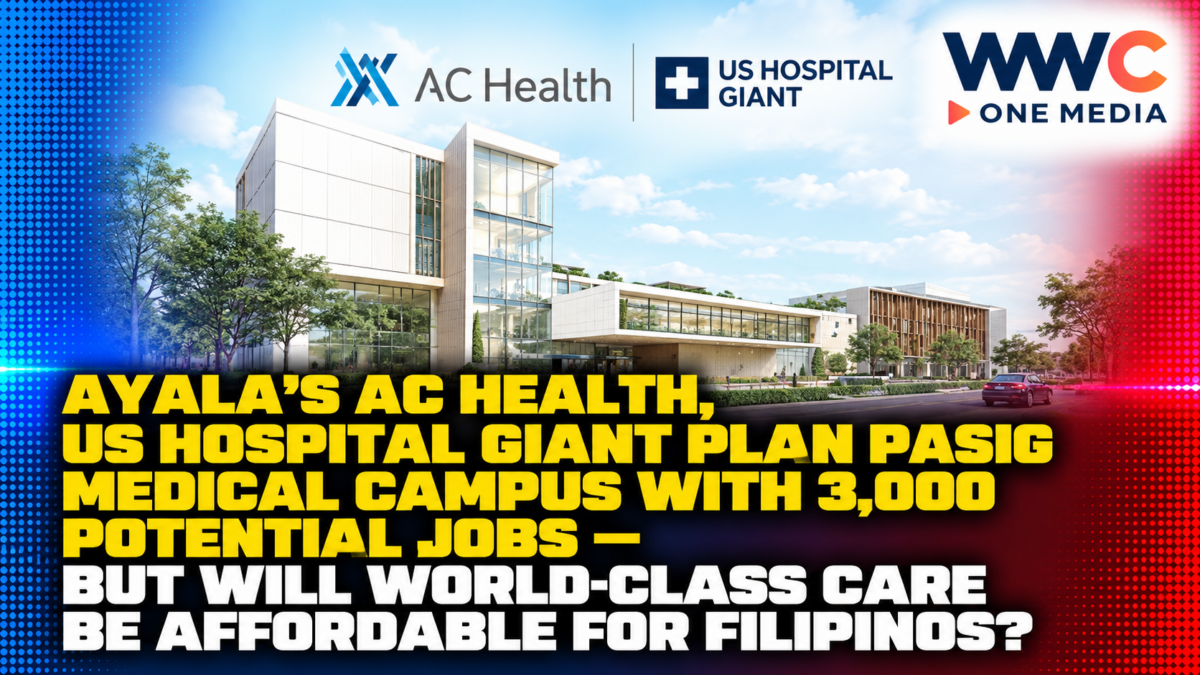
MANILA, PHILIPPINES — A major Philippine–American healthcare partnership is moving forward as US-based hospital operator Bon Secours Mercy Health (BSMH) and Ayala Corporation’s healthcare arm, AC Health, advance plans to develop a tertiary hospital campus in Pasig City that could generate approximately 3,000 jobs.
The Department of Finance (DOF) confirmed on October 27 that Finance Secretary Frederick Go had met representatives of both companies, together with officials from the Board of Investments (BOI) and Fiscal Incentives Review Board (FIRB), to discuss the proposed development.
The envisioned hospital campus aims to bring advanced medical services to Filipino patients, provide training opportunities for doctors and nurses, and expand the country’s clinical research capabilities.
Government officials also hope the investment could reduce the need for some Filipinos to travel abroad for specialized treatment while strengthening the Philippines’ position in international medical tourism.
But despite the project’s ambitions, several crucial details remain undisclosed.
The government has not announced the final investment cost, number of hospital beds, construction timetable or target opening date.
The hospital is still in the planning and investment-development stage.
And one question may ultimately matter more to ordinary Filipinos than the size of the proposed investment: Will the hospital make advanced medical care accessible to more families—or become another premium facility beyond the financial reach of many patients?
DOF BACKS MAJOR PHILIPPINE–US HOSPITAL DEVELOPMENT
Finance Secretary Frederick Go has expressed support for the proposed medical campus involving Bon Secours Mercy Health and AC Health.
The project was discussed during a meeting with executives from the American healthcare organization and Ayala’s corporate leadership.
Officials from the BOI and FIRB also participated.
The discussions reflect government efforts to encourage investment in healthcare services, professional training and high-value infrastructure.
Go said the proposal could bring advanced treatments closer to Filipino patients while creating jobs and developing healthcare professionals.
However, the DOF’s endorsement does not mean the government has approved a specific subsidy or committed to finance construction.
No public announcement establishes the project as a government-funded hospital.
The proposal is a planned private-sector development supported through investment facilitation.
WHO ARE BON SECOURS MERCY HEALTH AND AC HEALTH?
Bon Secours Mercy Health is a US-based nonprofit Catholic healthcare organization with operations in the United States and Ireland.
The group operates hospitals, outpatient services and other healthcare facilities.
It also provides supporting services through international business operations.
AC Health is Ayala Corporation’s healthcare investment and operating arm.
Its businesses include hospitals and clinics under the Healthway Medical Network, as well as pharmacy operations through Generika Drugstore and St. Joseph Drug.
The proposed partnership combines BSMH’s hospital operating experience with AC Health’s knowledge of the Philippine healthcare market.
However, the parties have not disclosed the proposed ownership percentages, operating arrangements or final corporate structure for the Pasig hospital.
It would therefore be premature to describe the project as an already finalized joint venture with disclosed equity allocations.
PROPOSED HOSPITAL COULD GENERATE 3,000 JOBS
The Department of Finance estimates that the development could create approximately 3,000 jobs once realized.
The project may offer opportunities for doctors, nurses, medical technologists and other healthcare workers.
Hospitals also require administrative, maintenance, information technology and support personnel.
Construction activity may generate additional demand for engineering and related services.
However, the government has not published a detailed breakdown of the 3,000 projected positions.
It has not established how many would be permanent hospital jobs, temporary construction positions or other employment opportunities.
The estimate should therefore be described as potential employment rather than jobs already created.
PLANS BEGAN DURING MARCOS’ JULY 2025 US VISIT
The investment proposal has been under discussion for more than a year.
In July 2025, BSMH executives met Philippine officials during President Ferdinand Marcos Jr.’s working visit to Washington, D.C.
At that time, the American healthcare operator expressed interest in developing a premium tertiary hospital in the Philippines.
The Office of the Special Assistant to the President for Investment and Economic Affairs discussed the possibility of a major investment in the healthcare sector.
Since those initial discussions, government officials have continued coordinating with BSMH and relevant agencies.
The October 2026 meeting demonstrates that the proposal remains active.
But continuing negotiations are not equivalent to a final investment decision or the start of construction.
WHAT HAPPENED TO THE EARLIER $500-MILLION INVESTMENT PLAN?
An important detail emerged from independent reporting published in July 2025.
GMA News, the Philippine Daily Inquirer, The Philippine Star and the Philippine News Agency reported that BSMH was considering an investment of approximately US$300 million to US$500 million for a premium tertiary hospital.
The figure was discussed during the company’s earlier engagement with Philippine officials.
However, the DOF’s October 27, 2026 statement does not provide a final investment cost for the Pasig project.
It also does not explicitly reconfirm that the entire earlier proposed amount will be allocated to this specific hospital campus.
For this reason, the historical US$300-million–US$500-million range should not be presented as the newly approved or finalized Pasig project budget.
The companies may eventually announce a different amount once the investment structure and development plans are completed.
WHAT IS A TERTIARY HOSPITAL?
A tertiary hospital generally offers advanced medical services and specialist care beyond the capabilities of basic healthcare facilities.
Such institutions may provide complex diagnostic services, intensive care and treatment of conditions requiring specialized expertise.
The proposed Pasig campus is intended to expand access to advanced and specialized medical services.
However, BSMH and AC Health have not released a complete list of planned hospital departments or clinical services.
No confirmed announcement establishes specific procedures, transplant programs, cancer treatments, cardiac centers or other particular specialties at the future facility.
Those details should be reported only when the operators formally disclose them.
PASIG CITY EMERGES AS A LOCATION FOR ADVANCED HEALTHCARE
Pasig City is part of Metro Manila’s major commercial and residential corridor.
The location could potentially serve patients from Metro Manila and nearby provinces.
A new tertiary hospital may provide additional choices for patients who require specialist consultations or complex medical treatment.
However, access will depend on several factors.
These include the hospital’s final location, transport connections, number of beds, medical specialties, consultation fees and insurance arrangements.
The government has not disclosed the exact site or development timetable.
Therefore, it would be misleading to announce that construction is already underway at a particular Pasig property.
CAN THE HOSPITAL REDUCE OVERSEAS MEDICAL TRAVEL?
One of the government’s stated objectives is to reduce the need for Filipinos to seek advanced medical treatment abroad.
Some patients travel internationally because they need particular procedures, specialist expertise or access to facilities not readily available locally.
Expanding domestic healthcare capabilities could allow more patients to receive treatment closer to their families.
It could also reduce certain travel-related expenses.
But achieving this outcome depends on which services the proposed hospital eventually provides.
The availability of equipment, qualified specialists and affordable treatment packages will be essential.
A premium hospital does not automatically eliminate the need for overseas care.
The actual effect would need to be evaluated once the facility becomes operational.
MEDICAL TOURISM IS PART OF THE GOVERNMENT’S VISION
The DOF also believes the proposed investment could strengthen the Philippines’ potential as a medical tourism destination.
Medical tourism involves patients traveling to another country to obtain healthcare services.
Such patients may compare medical expertise, treatment costs, hospital facilities and travel convenience.
A modern hospital with recognized clinical capabilities could potentially help attract international patients.
However, medical tourism depends on more than building new facilities.
Hospitals must maintain appropriate standards, attract qualified specialists and establish credible patient services.
Competitive pricing and international patient support may also be important.
No projected medical tourism revenue has been disclosed for the Pasig project.
FILIPINO DOCTORS AND NURSES COULD GAIN TRAINING OPPORTUNITIES
A central feature of the proposed campus is its intended role in healthcare education.
The DOF said the project could offer annual training placements for doctors and nurses.
International rotations and professional development opportunities are also being considered.
These programs could strengthen connections between local healthcare practitioners and international medical institutions.
They may provide exposure to different clinical practices, technologies and hospital management systems.
However, the announcement does not specify how many training slots would be offered each year.
It also does not identify participating medical schools or the eligibility criteria for trainees.
These details remain important for understanding the actual benefits to Filipino healthcare professionals.
RESEARCH AND DEVELOPMENT COULD EXPAND LOCAL CAPABILITIES
The proposed hospital is also expected to support medical research and development.
Research programs can help healthcare institutions study diseases, evaluate treatments and improve clinical practices.
Combining clinical services with professional training and research may create opportunities for collaboration among doctors, researchers and educational institutions.
However, the companies have not yet identified particular research fields, laboratory facilities or clinical trials to be undertaken at the campus.
Appropriate regulatory approvals, patient protections and research ethics requirements would apply to relevant activities.
It would therefore be inaccurate to suggest that the proposed hospital is already conducting research programs in Pasig.
BSMH ALREADY OPERATES A PHILIPPINE BUSINESS CENTER
The planned hospital would build on Bon Secours Mercy Health’s existing presence in the Philippines.
BSMH Chief Clinical Development Officer Dr. Michael Todd said the company is interested in contributing further to the country’s healthcare sector following the opening of its global business center in October 2025.
The center supports aspects of BSMH’s international operations.
Its presence demonstrates that the American organization has already established business activities in the Philippines.
But a global business center and a tertiary hospital are different operations.
An office supporting healthcare administration, technology or other services is not itself a hospital providing direct patient treatment.
The proposed Pasig development would represent a further expansion into healthcare delivery.
WHY THE BOARD OF INVESTMENTS IS INVOLVED
The Board of Investments promotes and facilitates investments in priority sectors of the Philippine economy.
Its participation in discussions can help investors understand relevant requirements and available investment programs.
Healthcare infrastructure is one area in which private investment may expand domestic services and employment.
However, the BOI’s presence at the meeting does not establish that the proposed hospital has already received a specific tax incentive or formal registration.
Those matters require appropriate applications, evaluations and approvals.
No incentive package or approval amount was disclosed in the DOF statement.
WHAT THE FIRB’S INVOLVEMENT MEANS
Finance Secretary Frederick Go also chairs the Fiscal Incentives Review Board.
The FIRB has responsibilities involving the oversight and administration of fiscal incentives under applicable Philippine laws.
Its participation in the meeting reflects the government’s investment-facilitation role.
However, discussions with FIRB officials should not be interpreted as an automatic grant of tax exemptions.
The October announcement does not establish that the planned Pasig hospital has been awarded tax holidays, duty exemptions or other specific benefits.
Any eventual fiscal incentives would need to comply with applicable rules.
The exact financial arrangements remain undisclosed.
AC HEALTH IS PURSUING A LARGER EXPANSION STRATEGY
The Pasig project also fits into AC Health’s wider investment plans.
In July 2026, the Presidential Communications Office reported that AC Health was pursuing a nationwide expansion supported by Singapore-based impact investor ABC Impact.
The firm, backed by the Temasek Trust ecosystem, acquired an approximately 16% minority stake in AC Health through an investment announced in 2025.
The partnership is intended to help expand healthcare services and strengthen AC Health’s operations.
However, ABC Impact’s stake is a separate investment from the proposed BSMH hospital campus.
The government has not established that ABC Impact is directly financing the Pasig development.
The funding and ownership arrangements for that specific hospital remain undisclosed.
AC HEALTH TARGETS 10 HOSPITALS, 300 CLINICS AND 1,150 PHARMACIES BY 2027
AC Health has outlined ambitious network expansion targets.
According to the Presidential Communications Office, the company aims to operate at least 10 hospitals, 300 clinics and 1,150 pharmacies nationwide by 2027.
The broader growth strategy is expected to support approximately 10,000 direct healthcare and retail jobs, depending on the final mix of new facilities and acquisitions.
These figures should be distinguished from the proposed Pasig hospital’s approximately 3,000-job estimate.
The 10,000-job target relates to AC Health’s wider network expansion.
The two employment figures should not automatically be added together because the announcements do not establish whether the Pasig project would be included within the broader development targets.
Likewise, the targets remain forward-looking and are not confirmation that all planned facilities already exist.
AC HEALTH HAS BEEN EXPANDING ITS HOSPITAL AND CLINIC NETWORK
Manila Bulletin reported in July that AC Health was planning to open additional outpatient clinics and explore hospital acquisitions.
The company has been developing its Healthway Medical Network, which operates hospitals and clinics.
Its pharmacy businesses also form part of a broader healthcare ecosystem.
The strategy seeks to connect different stages of care, including consultations, diagnostics, medicines and hospital treatment.
Such integration can potentially improve patient convenience.
However, the existence of an integrated network does not automatically establish that all services are affordable or covered by insurance.
Actual patient costs depend on individual facilities, procedures and financial arrangements.
WILL THE NEW HOSPITAL ACCEPT PHILHEALTH?
One of the most important questions for Filipino patients is whether the proposed facility will be accessible through PhilHealth and private health insurance.
The October announcement does not disclose the hospital’s future PhilHealth accreditation status.
It also does not provide treatment rates, package prices or insurance partnerships.
Since the facility has not yet opened, it would be premature to promise specific coverage.
Patients should not assume that all specialized treatments will be fully paid for by PhilHealth.
Coverage depends on applicable benefits, accreditation, eligibility and the specific medical services provided.
The affordability of the new facility will become clearer when the operators announce their actual service model.
PREMIUM HEALTHCARE AND AFFORDABILITY ARE DIFFERENT QUESTIONS
The proposed hospital has been described as a premium and state-of-the-art facility.
Such projects can introduce sophisticated equipment and specialized services.
But advanced technology may involve substantial construction, staffing and maintenance expenses.
These costs can influence treatment pricing.
For the project to meaningfully expand access, patients will need information about fees, insurance acceptance and available financial assistance.
A facility can improve the country’s overall medical capabilities without being affordable to every household.
This distinction is crucial when evaluating claims that the hospital will benefit Filipino patients.
THE PHILIPPINES FACES A WIDER HEALTHCARE ACCESS CHALLENGE
The proposed investment comes amid continuing efforts to improve the Philippine healthcare system.
Challenges include uneven availability of specialists, differences in hospital capacity across regions and the financial burden of medical care.
Investments in tertiary hospitals can expand specialized treatment capacity.
But they do not replace the need for accessible primary healthcare, community clinics and public health programs.
A hospital in Pasig may benefit certain patients in Metro Manila and surrounding provinces.
It cannot single-handedly address healthcare gaps nationwide.
Improving access requires coordination among government agencies, public hospitals, local health systems and private providers.
WHAT OTHER NEWS OUTLETS CONFIRM
InsiderPH reported the proposed Pasig hospital on October 28, citing the Department of Finance.
Context.ph published a separate October 27 report confirming the proposed partnership and its projected 3,000 jobs.
The DOF’s official announcement provides primary verification of the meeting, the participants and the development’s stated objectives.
For historical context, GMA News, the Philippine Daily Inquirer and the Philippine News Agency reported the proposed US$300-million–US$500-million investment discussed by BSMH in July 2025.
Manila Bulletin independently documented AC Health’s broader expansion ambitions in July 2026.
The Presidential Communications Office also confirmed ABC Impact’s minority investment and AC Health’s 2027 network targets.
Together, these sources establish that the hospital proposal is part of a wider investment strategy.
However, multiple recent reports rely on the same October DOF statement.
They do not independently establish that construction has begun, that the hospital’s final financing has been secured or that all planned jobs will be created.
WHAT INVESTORS SHOULD WATCH NEXT
For investors interested in Ayala Corporation and the Philippine healthcare sector, the proposed hospital raises several important questions.
The first is the final investment amount.
The second is the ownership and financing structure.
The third concerns the timeline for land development, permitting and construction.
Other considerations include the hospital’s planned bed capacity, specialty services, staffing requirements and eventual operating model.
These details will determine the scale and financial implications of the project.
The current announcement establishes government support for further development discussions.
It does not provide enough information to calculate the hospital’s expected revenue, profitability or return on investment.
THE BIGGER QUESTION: CAN THE PASIG HOSPITAL TRANSFORM PHILIPPINE SPECIALIZED CARE?
Bon Secours Mercy Health and AC Health are pursuing a major healthcare investment that could bring advanced medical services and training opportunities to the Philippines.
The planned Pasig hospital campus could create approximately 3,000 jobs and strengthen the country’s capacity for specialized treatment.
Government officials are also hopeful that the project could support medical tourism and reduce some overseas healthcare spending.
The involvement of an experienced international healthcare operator and Ayala’s expanding medical network gives the proposal strategic importance.
But several decisive questions remain unanswered.
The final investment cost is unknown.
The number of hospital beds has not been disclosed.
There is no confirmed construction timetable or opening date.
And perhaps most importantly, patients do not yet know how much the proposed services would cost or whether their insurance would cover them.
The real test of the project will be whether it progresses from investment discussions to an operating hospital that delivers safe, effective and financially accessible treatment.
And as the Philippine government works to attract international healthcare investors, one major question remains:
Will the US–Ayala hospital partnership create thousands of jobs and bring advanced medical care within reach of more Filipinos—or will the promise of world-class treatment remain beyond the means of the families who need it most?










