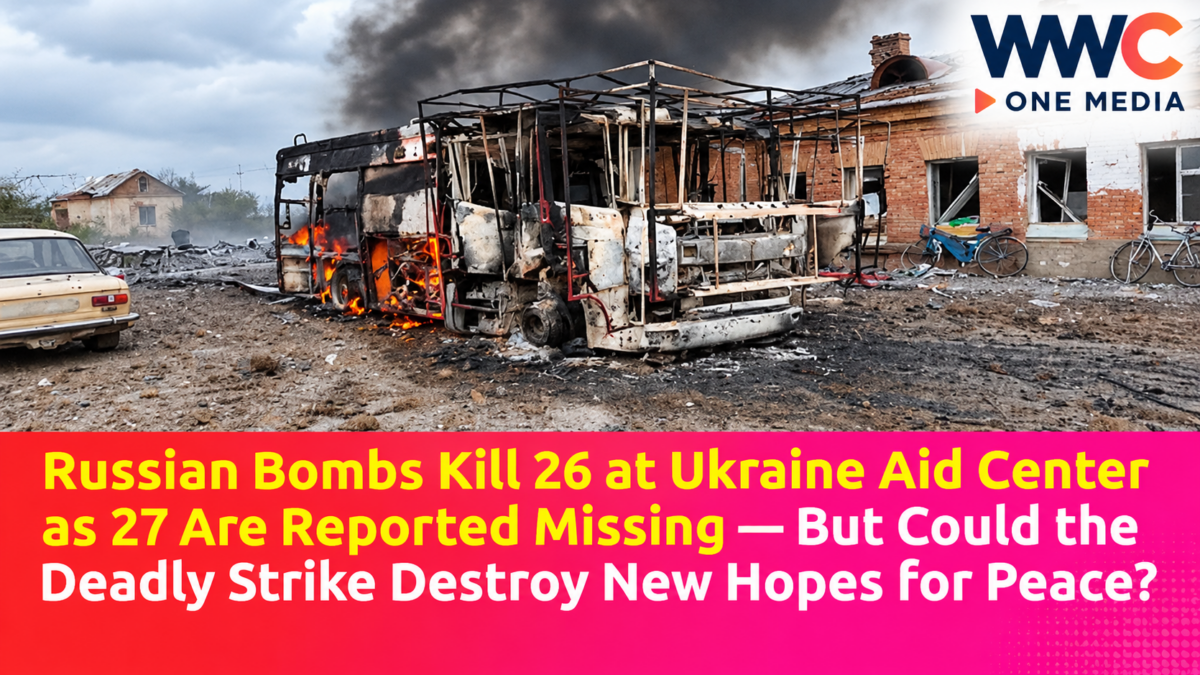
KYIV, Ukraine / MANILA — November 3, 2026. A devastating series of Russian airstrikes has killed at least 26 people at a humanitarian aid distribution center and nearby shelter in southeastern Ukraine, according to Ukrainian authorities, raising fresh fears about civilian safety and the future of diplomatic efforts to end the war.
The November 2 attack struck the village of Komyshuvakha in the Zaporizhzhia region, where a school building was being used to distribute essential supplies to residents who had remained in the dangerous frontline area.
Ukrainian President Volodymyr Zelenskyy said Russian forces first bombed the school and then launched a second wave of strikes toward a nearby shelter where people had gathered.
Initial reports placed the death toll at 18. Ukrainian emergency authorities subsequently increased the number to 24, before updated reporting from Reuters and the Associated Press put the toll at 26.
Five people were reportedly injured, while an earlier count indicated that 27 remained missing.
The situation remained dangerous for rescue teams, with Ukrainian officials reporting further drone activity that interrupted efforts to reach people buried beneath the rubble.
The attack occurred just after a rare, localized humanitarian ceasefire in neighboring Kherson region came to an end.
That pause had allowed aid deliveries and civilian evacuations in Russian-occupied Oleshky.
Now, the deadly bombing has renewed doubts about whether such limited agreements can lead to more meaningful progress toward peace.
As Washington prepares to host another round of diplomatic negotiations, the central question is whether Russia and Ukraine can establish credible protections for civilians — or whether attacks on humanitarian facilities will undermine the fragile confidence needed for a lasting ceasefire.
Russian Bombs Hit School Used to Distribute Humanitarian Aid
According to Zelenskyy, Russian aircraft carried out a series of bomb attacks on Komyshuvakha on Monday.
The first strike targeted a school building that had been repurposed as a humanitarian assistance center.
Residents in the community reportedly gathered there regularly to receive food and other essential supplies.
Zelenskyy said the subsequent strikes hit an area where people had sought shelter following the initial bombing.
The Ukrainian president described a sequence involving an initial attack followed by nine more aerial bombs.
The sequence has raised particular concern because people seeking cover from an earlier strike may have remained in danger during the later explosions.
Ukrainian officials accused Russian forces of knowingly attacking a location used by civilians.
However, determining the attackers’ knowledge and intent requires investigation.
The reported sequence is consistent with Ukrainian officials’ description of a repeated strike, but the available information does not independently establish every targeting decision made by Russian military personnel.
Death Toll Rises From 18 to 26 as Rescuers Search the Rubble
The number of reported deaths increased throughout November 2 and into November 3.
The first announcement from Zelenskyy reported 18 people killed.
Subsequent updates from Ukrainian emergency services increased the toll to 24.
By November 3, Reuters and AP were reporting 26 fatalities, citing Ukrainian officials.
The revised figures show how casualty reporting can change during large-scale rescue operations.
Emergency personnel may initially have access to only a portion of the affected area.
As damaged structures are searched and victims are identified, the number of confirmed deaths can rise.
Authorities also reported five injured.
An earlier official count listed 27 people as missing, although later reports described a smaller number as recovery operations progressed.
The missing-person figure should therefore be treated as provisional, not as an additional confirmed death toll.
It is important not to add the number of missing people to the confirmed fatalities.
Their fate had not been fully established in the reporting reviewed.
Rescue Workers and Police Officers Among the Dead
The attack also killed personnel involved in emergency and public-safety operations.
Updated Reuters reporting identified two rescue workers and four police officers among those who died.
The losses highlight the danger facing emergency responders during attacks on populated areas.
Rescue crews must work around damaged buildings, unstable structures, unexploded ordnance and the possibility of further strikes.
In Komyshuvakha, officials said renewed drone activity complicated their operations.
The Associated Press reported that teams searched collapsed buildings as darkness fell, using lights to navigate the wreckage.
Ukrainian authorities published photographs and videos showing extensive destruction.
The presence of rescue personnel among the dead underscores a wider humanitarian problem.
When emergency responders are killed or injured, communities can lose some of the very people responsible for protecting survivors and restoring essential services.
Zelenskyy Accuses Russia of Targeting Civilians
Zelenskyy condemned the bombing and argued that Russian forces were aware of the humanitarian purpose of the school.
He said residents had been receiving assistance there on a weekly basis.
The Ukrainian president characterized the repeated strikes as evidence that Moscow was not seeking meaningful de-escalation.
His accusations are politically and legally significant.
International humanitarian law requires parties to an armed conflict to distinguish between civilians and combatants, and between civilian objects and military objectives.
Intentionally directing attacks against civilians or protected civilian objects may constitute a war crime.
However, making a definitive legal determination requires evidence about the target, the information available to those carrying out the attack and the circumstances of the military operation.
The school was reportedly functioning as a humanitarian aid center rather than holding classes at the time.
That use is central to assessing its civilian character.
As of the independently reviewed reporting, Russia had not publicly provided a detailed explanation of the specific Komyshuvakha strike.
Ukraine’s allegations should be reported clearly while distinguishing them from findings by an independent investigative body or court.
A Rare Humanitarian Ceasefire Had Just Ended
The timing has intensified the political consequences of the attack.
A six-day localized ceasefire involving the southern Kherson region had begun on October 27.
The arrangement was designed to allow humanitarian deliveries and the evacuation of residents from Russian-occupied Oleshky.
The pause was facilitated with US involvement, including efforts associated with First Lady Melania Trump.
According to Reuters, the operation enabled hundreds of residents to leave and allowed humanitarian assistance to reach people facing dangerous conditions.
The ceasefire ended on November 1.
Both sides indicated that the limited humanitarian arrangement had been implemented without reported violations during its agreed period.
However, the agreement applied to a particular area and mission.
It was not a nationwide cessation of hostilities.
Fighting continued in other parts of Ukraine.
The Komyshuvakha attack occurred in Zaporizhzhia, a different region, and should not automatically be described as a violation of the Oleshky ceasefire.
The deeper issue is that the local agreement did not produce a broader reduction in violence.
Ukraine Accuses Russia of Using the Pause to Strengthen Its Forces
Following the end of the Kherson ceasefire, Ukrainian officials accused Russia of using the temporary pause to rotate personnel, reinforce positions and replenish military supplies.
Reuters reported that Ukraine’s general staff said Russian forces had strengthened defenses during the six-day arrangement.
Kremlin spokesperson Dmitry Peskov responded that military repositioning during a ceasefire was a normal activity and suggested that Ukraine could have undertaken similar actions.
The competing accounts illustrate the difficulty of implementing temporary agreements during an active war.
A humanitarian pause may allow evacuations and aid deliveries.
But unless its terms clearly regulate military movements, it may not prevent the participating forces from preparing for renewed fighting.
For future agreements, negotiators will face difficult questions about monitoring, enforcement and the scope of activities permitted during a ceasefire.
Ukraine’s Civilian Infrastructure Is Under Growing Pressure
The attack on Komyshuvakha follows a series of deadly strikes affecting Ukrainian cities and essential services.
Late October brought new reports of damage to electricity systems, transport facilities and residential areas.
WWC ONE MEDIA previously documented the escalation in Russia’s Energy Strikes Leave 350,000 Without Power as Ukraine Hits Another Oil Refinery — But Has Trump’s Ceasefire Plan Collapsed?.
The report examined attacks on Ukrainian power infrastructure and retaliatory strikes against Russian energy facilities.
Although the energy attacks and the Komyshuvakha bombing are separate incidents, they reflect the increasing pressure on civilian life.
Damage to infrastructure can limit access to electricity, water, transportation and healthcare.
For residents close to the front line, the danger is compounded by repeated aerial attacks and difficulties obtaining basic necessities.
Humanitarian distribution centers are particularly important in communities where ordinary shops and public services may no longer function reliably.
Dnipro Railway Attack Demonstrates the Danger to Civilian Transport
Another recent incident involved a reported Russian strike on a railway platform in Dnipro.
WWC ONE MEDIA covered it in 14 Killed as Russian Drone Hits Dnipro Railway Platform — Why Ukraine’s Rail Network Is Becoming a Deadly Front Line.
The railway incident occurred before the Komyshuvakha bombing and involved a different location.
Together, the reports highlight how transport and humanitarian infrastructure can become exposed to wartime violence.
Rail networks are particularly important in Ukraine because they support passenger transport, evacuations and the movement of goods.
When transport systems are damaged or considered unsafe, civilians may struggle to reach medical services or evacuate threatened communities.
The Komyshuvakha attack introduces an additional concern: whether residents can safely gather to receive humanitarian assistance.
Rescue Operations Face the Threat of Repeated Strikes
One of the most troubling aspects of the attack is the reported sequence of bombings.
Zelenskyy alleged that people had sought cover following the initial explosion before additional bombs hit the shelter.
Officials also reported renewed drone activity while rescuers were searching the wreckage.
Repeated attacks create serious operational challenges.
Emergency personnel must decide when it is safe enough to enter damaged buildings.
Delays can reduce the chances of reaching survivors.
But sending teams into an area under continuing attack can result in additional casualties.
International humanitarian law protects medical and humanitarian operations under applicable conditions and prohibits attacks directed at civilians.
The details of the reported strike sequence will be important to any future investigation.
For now, the confirmed humanitarian concern is that rescue efforts were taking place under dangerous conditions while people were still reported missing.
Ukraine Warns of More Attacks as Winter Approaches
Zelenskyy has warned that Russia could intensify its aerial campaign while Ukraine faces shortages of defensive missiles.
This concern is particularly serious as winter approaches.
Ukraine has experienced repeated attacks on power plants, electrical substations and heating infrastructure.
WWC ONE MEDIA examined the growing threat in Kyiv No Longer Feels Safe From Russia’s War — And the Latest Attacks Raise a Bigger Fear.
The article described growing pressure on civilian shelters, transport and essential infrastructure.
Ukraine has requested additional air-defense missiles and systems from Western partners.
However, air-defense coverage is not uniform across the country.
Communities near the front line can face particularly severe threats from glide bombs, drones and other weapons.
For residents of Komyshuvakha, the destruction of a humanitarian center creates immediate needs involving food, temporary shelter, medical treatment and safe access for aid workers.
European Allies Are Expanding Missile-Defense Cooperation
European governments are also working with Ukraine to develop longer-term defensive capabilities.
WWC ONE MEDIA previously reported on the initiative in Poland Joins Ukraine’s Missile Shield Coalition — But Europe’s Bigger Defense Plan Is Only Beginning.
The coalition aims to develop additional European missile-defense technology using Ukrainian battlefield experience and the expertise of participating countries.
Such programs may eventually improve defense against certain aerial threats.
But advanced missile-defense development takes time.
A prototype or planned system is not equivalent to an operational shield protecting every Ukrainian community.
Defenses against ballistic missiles, cruise missiles, drones and glide bombs can also require different capabilities.
For civilians in frontline settlements, the immediate need is protection from attacks occurring now.
Russia-Ukraine Peace Talks Planned for November 10–11
The Komyshuvakha bombing occurred as the United States prepared another diplomatic effort.
According to AP and Reuters, US special envoy Steve Witkoff announced plans for Russia-Ukraine negotiations in Abu Dhabi on November 10 and 11.
The agenda is expected to include security arrangements, de-escalation and humanitarian issues.
US officials also planned consultations with European and NATO partners concerning security guarantees and reconstruction.
The negotiations represent a potential diplomatic opportunity.
However, announcing talks does not mean the parties have agreed to a ceasefire.
Important disagreements remain over territory, military security, enforcement mechanisms and the terms of a possible settlement.
The deadly strike on Komyshuvakha could deepen mistrust.
Ukraine has argued that attacks on civilians undermine confidence in Moscow’s willingness to pursue peace.
Russia’s position on the particular bombing had not been independently established through a detailed public explanation in the reporting reviewed.
The success of the planned talks will depend on whether the parties can agree to specific, verifiable measures rather than political declarations alone.
Why the Attack Matters Beyond Ukraine
The attack has implications for the wider international humanitarian response.
Civilian aid centers are crucial in conflict-affected communities.
They may provide food, medicines, water, hygiene supplies and essential information for people who cannot safely travel elsewhere.
When such facilities are destroyed, the effects can extend beyond the immediate casualties.
Local residents may lose access to regular assistance.
Humanitarian organizations may need to relocate operations or change distribution arrangements.
Emergency teams may also require additional protection and equipment.
For countries supporting Ukraine, including European and Asia-Pacific partners, the incident highlights the continuing need for civilian protection, emergency assistance and accountability.
However, the broader consequences should not be overstated.
The available reporting does not establish that international humanitarian operations throughout Ukraine have stopped because of this single attack.
What Investigators Need to Establish
Any independent investigation should examine the precise location and nature of the targets, the sequence of explosions and the identities of the victims.
Investigators would also need to determine whether military personnel or equipment were present nearby, what information the attackers possessed and whether precautions required by international humanitarian law were taken.
Survivor testimony, physical evidence, satellite imagery and weapons analysis may help clarify those questions.
The Ukrainian authorities’ reports provide important initial information.
But allegations about deliberate targeting require careful assessment before they can be treated as legally established facts.
The distinction matters for credible war reporting.
Condemning the loss of civilian life does not require presenting every disputed military claim as independently proven.
The Bigger Question: Can Humanitarian Agreements Survive Continued Fighting?
The deaths in Komyshuvakha have cast a shadow over the limited humanitarian progress achieved in Oleshky.
For several days, the localized ceasefire demonstrated that Russia and Ukraine could cooperate on a narrowly defined civilian mission.
But the bombing in nearby Zaporizhzhia region showed how limited such progress remains when the wider war continues.
Ukraine says Russian forces targeted a location where civilians regularly received humanitarian aid.
Emergency services have reported 26 deaths, five injuries and an evolving search for missing people.
Rescue teams have faced continuing danger.
Meanwhile, the United States is preparing talks that may test whether the opposing sides can agree to more extensive humanitarian protections.
The outcome is far from certain.
As the death toll from the Komyshuvakha humanitarian-center bombing rises to 26 and families await news of those still missing, will the international community secure stronger protections for civilians — or could the latest tragedy become another obstacle to meaningful Russia-Ukraine peace negotiations?