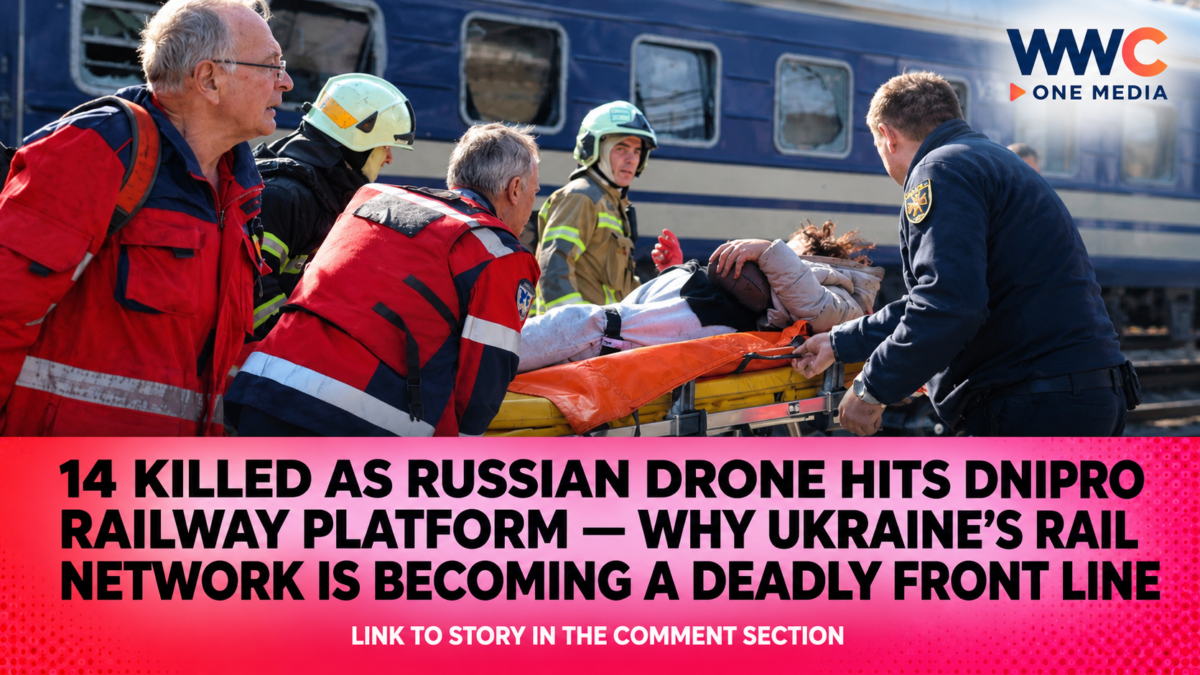
DNIPRO, Ukraine — At least 14 people were killed and another 14 injured after a Russian jet-powered drone struck a crowded railway platform in the Ukrainian city of Dnipro on Thursday, October 29, in one of several deadly attacks reported across the country that day.
The drone hit the city’s main railway station while passengers were waiting near trains, including a service preparing to depart for Zaporizhzhia, according to Ukrainian officials and the state railway operator, Ukrzaliznytsia.
The attack left bodies on the platform and damaged passenger trains. Emergency responders rushed to help the wounded as rescue operations continued at the station.
Dnipropetrovsk regional governor Oleksandr Hanzha said the death toll had risen to 14, with another 14 people injured. Six of the wounded were reported to be in serious condition. Among them was an 11-year-old boy, while one adult man reportedly suffered injuries that led to the amputation of both legs. Investing.com+2
Passenger train platform struck by jet-powered drone
Ukrzaliznytsia said the drone struck the platform where train No. 866, travelling between Dnipro and Zaporizhzhia, was located.
Ukraine’s Air Force reported that three jet-powered drones had been intercepted during the daytime attack, but a fourth evaded air defences and hit the railway station, according to AFP.
The incident highlights the danger facing Ukraine’s railway system, which remains essential for transporting passengers, workers and supplies despite repeated attacks during Russia’s full-scale invasion.
The railway network has increasingly been caught up in the wider aerial campaign. WWC ONE MEDIA previously examined how attacks on transport infrastructure are putting pressure on Ukraine’s economy in its report, Russia’s New Air Campaign Is Hitting Ukraine’s Economy Where It Hurts Most.
Other Ukrainian cities also report deadly attacks
The Dnipro strike was part of a wider wave of Russian attacks that killed and injured civilians elsewhere in Ukraine.
In Chernihiv, two 15-year-old girls were killed when a drone struck a busy central street. Another 23 people were wounded, including four children, according to local authorities.
In the central city of Kremenchuk, strikes hit residential buildings, killing three people and injuring 32, regional officials said.
Russian drones also struck buses in the southeastern city of Zaporizhzhia, injuring six people.
Taken together, the attacks reported on Thursday killed at least 20 people in Dnipro, Chernihiv and Kremenchuk, according to Reuters. Investing.com+2
The latest casualties come amid a broader pattern of attacks on Ukrainian cities and essential infrastructure. In an earlier report, WWC ONE MEDIA covered Russia’s Intensifying Missile and Jet-Powered Drone Attacks, which have placed increasing pressure on Ukraine’s air-defence capabilities.
Zelenskyy condemns attack as international pressure grows
Ukrainian President Volodymyr Zelenskyy described the Dnipro strike as horrific and called for continued international pressure on Moscow.
He also argued that sanctions against Russia and its war machine should not be eased while the invasion continues.
Prime Minister Sergiy Koretskyi accused Russia of deliberately attacking civilians on trains, at railway stations and in residential buildings.
Russia has repeatedly denied deliberately targeting civilians, maintaining that its military strikes are directed at military or strategic targets. The competing claims underline the importance of independent investigations into individual attacks. AsiaOne+2
The strike also raises renewed concerns about the vulnerability of railway infrastructure. WWC ONE MEDIA previously reported on another incident involving a Russian drone striking a train in western Ukraine shortly after senior Western figures had passed through a railway station, in Senior Western Figures Were at Ukraine Station Before Russian Train Strike.
A fragile local truce continues in southern Ukraine
The attacks occurred as a limited humanitarian ceasefire in the Kherson region entered its third day.
The six-day arrangement, brokered with US assistance, was intended to allow humanitarian aid to reach Oleshky, a Russian-occupied town where residents have faced severe shortages of food, water and medicine.
The local truce does not amount to a nationwide ceasefire. Fighting and aerial attacks have continued in other parts of Ukraine.
A humanitarian mission was preparing to deliver assistance and facilitate the possible evacuation of residents from Oleshky. The limited agreement has offered a small opening for cooperation, even as the wider conflict remains unresolved. AP News+2
The contrast between the local humanitarian pause and the deadly attacks elsewhere demonstrates how difficult it remains to secure even limited reductions in violence.
Ukraine’s railway network faces mounting pressure
Railways are among Ukraine’s most important civilian and economic lifelines. They connect major cities, keep people moving and support the transport of goods during a war that has disrupted roads, ports and other infrastructure.
Repeated strikes can therefore have consequences beyond the immediate destruction. They can disrupt passenger services, damage equipment, endanger railway workers and make essential transport less reliable.
The attacks also add to the strain on Ukraine’s already pressured economy. WWC ONE MEDIA has previously examined the financial consequences in Russia Is Now Targeting Ukraine’s Economy — And the Damage Could Cost Kyiv Billions.
For civilians, however, the consequences are immediate: a journey to work, a family visit or a routine train departure can become life-threatening when a station is struck.
With Russia continuing its aerial campaign and diplomatic efforts still struggling to produce a broader agreement, the latest attack raises a difficult question: how can Ukraine protect ordinary people and essential transport routes while the war continues?
For the families of those killed in Dnipro, the consequences are already irreversible.