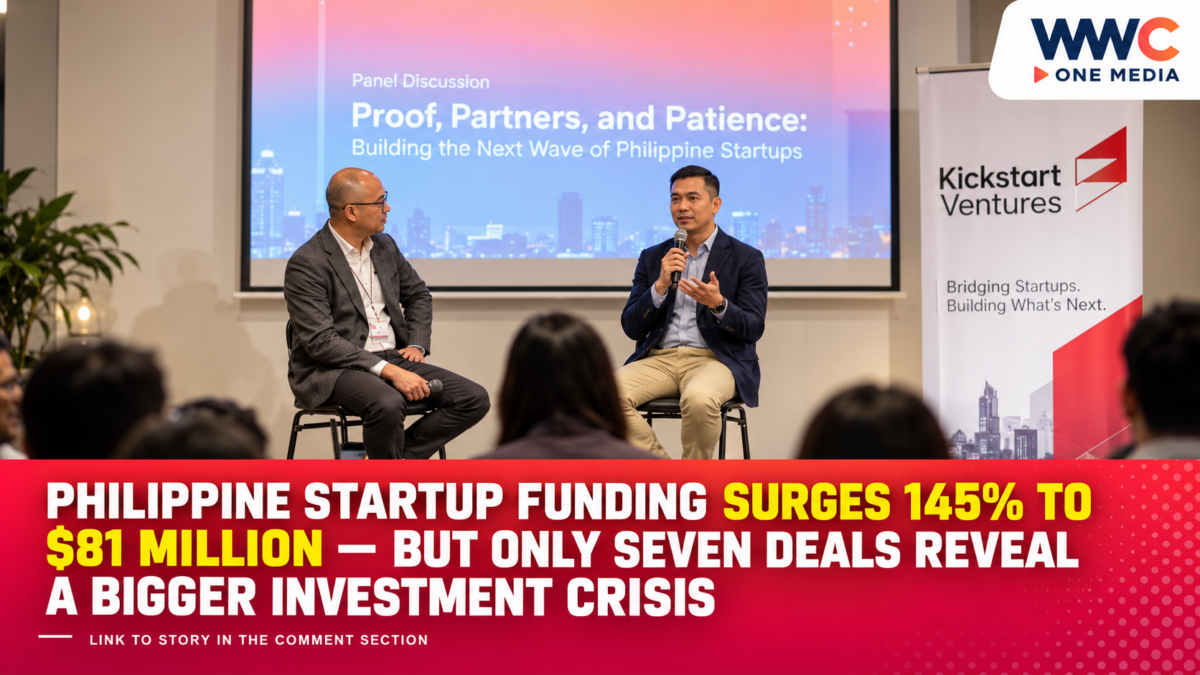
MANILA, Philippines — Philippine startups attracted $81 million in investment during the first six months of 2026, representing a sharp 145% increase from the previous semester as larger investors and corporate-backed venture capital firms played an increasingly important role in the country’s technology financing market.
But beneath the impressive growth figure is a troubling reality.
Only seven fundraising transactions were recorded during the period, down from nine in the second half of 2025 and 14 in the first half of last year.
The seven deals represent the lowest Philippine transaction count in the funding report’s historical series dating back to 2019.
The findings come from the H1 2026 Southeast Asia Startup Funding Report prepared by Kickstart Ventures and DealStreetAsia.
For Filipino founders, the numbers suggest a market in which capital remains available but is reaching fewer companies.
And as funding becomes concentrated among a small group of startups, the bigger question is whether promising Filipino entrepreneurs can secure the customers, corporate partnerships and follow-on financing needed to survive.
Philippine Startup Funding More Than Doubles From Previous Semester
Philippine startups raised $81 million between January and June 2026.
That was up from $33 million in the second half of 2025, representing an increase of approximately 145%.
The growth indicates that investors committed significantly more capital than during the preceding six months.
However, the comparison requires careful interpretation.
Funding in the first half of 2025 stood at approximately $86 million.
This means the latest $81-million total remained about 5.8% below the level recorded during the same six-month period a year earlier.
In other words, Philippine startup funding surged compared with late 2025 but did not register annual growth.
This distinction matters for businesses and investors evaluating whether the technology financing market is experiencing a sustained recovery.
One stronger semester is not enough to establish a broad turnaround.
Only Seven Deals Completed — the Lowest Since 2019
While the total value of investments increased, the number of Philippine fundraising transactions continued to decline.
The report counted seven deals in the first half of 2026.
That compares with nine in the second half of 2025 and 14 during the first half of 2025.
The latest count is the lowest in the available Philippine series dating back to 2019.
The divergence between rising capital and falling transaction numbers suggests that investors are becoming more selective.
Rather than distributing smaller investments across many early-stage businesses, capital is being concentrated in fewer transactions.
This may benefit startups that already have strong operations, established customers or demonstrated growth.
But it also raises concerns for founders seeking their first institutional investment.
A startup with a promising idea but limited commercial traction may find fundraising increasingly difficult.
Salmon’s $50-Million Round Dominates the Market
One of the most revealing findings is the concentration of funding in a few major deals.
Digital financial services company Salmon secured approximately $50 million during the reporting period.
That single transaction represented nearly 62% of the $81 million raised by Philippine startups.
Another major financing involved human resources technology company Sprout.
Together, Salmon and Sprout accounted for approximately $70 million, equivalent to about 86% of the country’s total startup funding.
This left only around $11 million spread across the remaining five reported transactions.
These figures highlight how a small number of large investments can dramatically influence the headline funding total.
A national funding rebound can therefore occur even when relatively few entrepreneurs are raising capital.
For startup founders, the concentration raises an important question about the depth of the domestic venture capital market.
If a handful of transactions are removed, the amount of financing available to the broader ecosystem becomes considerably smaller.
Fintech Captures Three-Quarters of Philippine Startup Investment
Financial technology remained the dominant sector.
Fintech startups attracted approximately $61 million, representing about 75% of all reported Philippine startup funding in the first half.
The figure includes Salmon’s $50-million financing.
It does not represent an additional amount that should be added to Salmon’s investment.
The concentration of capital in fintech reflects investor interest in digital financial services and businesses addressing gaps in access, payments, credit and other financial activities.
But investors’ interest in one sector does not necessarily mean that all fintech startups are profitable or that their services are appropriate for every consumer.
Financial technology companies must still comply with applicable licensing, consumer protection, data privacy and lending requirements.
For investors, business sustainability depends on more than attracting users.
It also requires responsible financial practices, sound risk management and a viable revenue model.
Healthcare Records First Late-Stage Deal Since 2024
Another noteworthy development was the return of late-stage startup investment in the Philippine healthcare sector.
The report identified a private equity transaction as the country’s first late-stage funding deal since the second half of 2024.
Late-stage funding typically supports companies that have moved beyond initial product development and are seeking capital for further expansion.
Its return is relevant because Philippine startups have often faced difficulties securing financing beyond their earliest stages.
But one late-stage transaction does not establish that growth capital has become widely available.
Investors still evaluate whether companies have demonstrated commercial demand, capable management and sustainable operations.
For founders, the challenge is progressing from early experimentation to a business model that can attract larger funding rounds.
Kickstart Ventures Says Corporate Partnerships Matter as Much as Capital
Kickstart Ventures believes strategic relationships with established corporations could help Philippine startups overcome funding obstacles.
The venture capital firm is associated with Globe Telecom and the wider Ayala business ecosystem.
Kickstart partner Jecky Pelaez has argued that startups often struggle because they lack access to customers capable of validating their products.
Corporate partners may help address that problem.
A startup developing enterprise software, for example, may benefit from working with an established telecommunications company or large corporate customer.
Such a relationship could provide an opportunity to test a product under real operating conditions.
It may also help the startup refine its technology, demonstrate demand and build credibility with future investors.
The value of this arrangement goes beyond the initial investment.
A corporate relationship may give founders access to industry knowledge, distribution channels, commercial networks and potential customers.
But partnerships are not guarantees of commercial success.
Startups must still deliver products that solve meaningful problems and offer sustainable value.
Kickstart Has Invested in 71 Startups Across Nine Countries
Kickstart Ventures reported managing approximately $242 million in assets.
Its investment history covers 71 startups across nine countries and more than 140 founders.
The firm primarily targets businesses at the seed-to-Series A stages, including companies developing telecommunications, business-to-business and AI-enabled technology.
It also advises the Ayala Corporation Technology Innovation, or ACTIVE, Fund.
The arrangement provides a link between emerging technology businesses and established corporations.
That connection may help startups explore commercial partnerships beyond their own limited networks.
However, the $242-million figure refers to assets managed by Kickstart.
It is not the amount the firm invested in Philippine startups during the first half of 2026.
Likewise, the 71-company portfolio spans several countries and investment periods.
It should not be presented as 71 new Philippine startup investments in 2026.
Corporate Capital Is Changing the Startup Investment Model
Traditional venture capital typically involves investors providing funds in exchange for ownership stakes, with the expectation that successful businesses will increase in value.
Corporate venture capital can share that financial objective while also seeking strategic benefits.
These may include access to emerging technologies, new customers or products that complement an established business.
For example, a telecommunications company may be interested in software that improves network operations.
A bank may consider technology that strengthens cybersecurity or automates business processes.
A retailer may evaluate logistics or artificial intelligence tools capable of improving operations.
Such partnerships may help startups demonstrate that their technology has practical applications.
However, corporate involvement can also introduce challenges.
Founders must assess exclusivity clauses, intellectual property ownership, commercial dependency and whether a partnership limits their ability to serve other customers.
The strongest arrangements allow startups to build sustainable businesses without becoming entirely dependent on one corporate partner.
Southeast Asia Raises $7.25 Billion — But One Deal Dominates
The Philippine findings form part of a wider regional report.
Southeast Asian startups raised approximately $7.25 billion across 217 equity transactions in the first half of 2026.
That was the region’s strongest headline funding total since the first half of 2022.
But the recovery was heavily concentrated.
Singapore-based data center company DayOne secured a $4.5-billion Series C financing round.
That single transaction accounted for roughly 62% of the region’s reported funding.
Excluding DayOne, regional investment totaled approximately $2.75 billion.
According to regional reporting, that adjusted figure was below the amount recorded in the preceding semester.
The broader message is similar to the Philippine experience.
Large funding rounds can push headline investment figures sharply higher even as the number of deals remains weak.
The report concluded that the regional market had moved above its lowest levels but had not yet entered a broad-based recovery.
Singapore Still Dominates Southeast Asian Startup Financing
Singapore remained Southeast Asia’s largest startup financing center.
Singapore-headquartered companies attracted approximately $6.7 billion across 145 equity transactions.
That represented roughly 92% of regional funding value.
Some companies headquartered in Singapore operate across multiple markets, meaning the geographic attribution of financing does not always correspond directly to where money is spent.
Nevertheless, the figures demonstrate the country’s strong position as a regional headquarters and fundraising center.
Vietnam attracted approximately $340 million, while Malaysia secured around $203 million.
Thailand raised about $130 million.
The Philippines accounted for roughly $81 million in the underlying domestic figures.
For the Philippines, the comparison underscores the need to deepen its own startup investment ecosystem.
But simply attracting more foreign money is not sufficient.
Startups also need access to customers, predictable regulation, capable talent and pathways to grow beyond the domestic market.
Early-Stage Startup Funding Remains a Regional Concern
One of the most significant warnings from the Southeast Asian report concerns early-stage companies.
Regional early-stage transaction volume declined by approximately 11% year on year to 195 deals.
The number was also substantially below the peak recorded in 2022.
This matters because early-stage investments finance companies before they become large, established businesses.
If fewer new startups receive initial funding, the pipeline of future growth-stage companies could eventually weaken.
A strong late-stage financing market depends partly on the existence of successful businesses that previously received seed and Series A capital.
For Philippine founders, this creates a particular challenge.
Even startups with working products may struggle to finance the transition from early development to broader commercial expansion.
Corporate partnerships could help reduce that gap by connecting promising businesses with paying customers.
But partnerships cannot fully replace a healthy market for early-stage investment.
Why Access to Paying Customers Can Be More Important Than a Funding Announcement
For many startups, a successful fundraising announcement receives more attention than the business fundamentals behind it.
But investment capital is usually temporary.
Companies must eventually develop products that customers are willing to pay for.
A startup may raise millions of dollars yet still struggle if customer demand is weak or operating costs remain too high.
Conversely, a smaller company with recurring revenue and manageable expenses may be better positioned for long-term survival.
Kickstart’s emphasis on corporate partnerships reflects this commercial reality.
Working with established businesses can allow founders to test whether their products solve real operational problems.
Successful pilot projects may lead to contracts, customer referrals or market expansion.
But they can also reveal weaknesses that startups need to address.
For founders, the goal should not merely be to secure a partnership announcement.
It should be to convert commercial relationships into measurable revenue and sustainable operations.
Artificial Intelligence Could Attract New Investment
Artificial intelligence is becoming a major focus of startup investors around the world.
The regional report identified AI-related infrastructure, computing capacity and semiconductors as important areas attracting capital.
Kickstart has also expressed interest in businesses developing AI-enabled enterprise technologies.
For the Philippines, opportunities may include software that improves business processes, customer service, financial operations and industry-specific productivity.
However, the presence of AI in a startup’s business description does not establish commercial viability.
Investors increasingly examine whether products have meaningful customers, defensible technology and realistic costs.
AI businesses may also face challenges involving data privacy, computing expenses and the reliability of automated outputs.
The potential is significant, but successful investment outcomes will depend on execution rather than technological hype alone.
What the Funding Rebound Means for Filipino Founders
The $81-million total indicates that significant capital remains available for selected Philippine startups.
But the decline to seven funding transactions highlights the difficulty of spreading investment across the broader ecosystem.
The funding environment appears more favorable to businesses with strong fundamentals, proven demand and credible routes to expansion.
Founders seeking capital may need to demonstrate clearer business performance than during earlier periods of easier financing.
That includes evidence of customer adoption, revenue growth, financial discipline and the ability to operate within applicable regulations.
At the same time, the ecosystem needs a sufficient number of investors willing to support new businesses before they become established.
If early-stage financing contracts too sharply, potentially valuable innovations may never reach commercial maturity.
This is why Kickstart’s corporate partnership model is receiving attention.
It offers one potential pathway to help founders move from experimentation to sustainable revenue.
The Bigger Challenge: Can Philippine Startups Grow Beyond Seven Deals?
The first half of 2026 presents a contradictory picture for Philippine startups.
Investment value increased sharply compared with the previous semester.
Yet transaction numbers fell to their lowest level in the available historical series.
Fintech captured most of the capital, and one large financing round accounted for nearly two-thirds of the national total.
Corporate-backed investors and strategic partners are increasingly being positioned as a way to help founders overcome commercial and financing constraints.
But the long-term health of the ecosystem will depend on broader participation.
More startups need opportunities to secure early investment, attract paying customers, expand into new markets and raise additional capital when their businesses are ready.
The next funding report will help show whether the recent improvement extends beyond a handful of large transactions.
Philippine startup funding more than doubled to $81 million compared with the previous semester. But with only seven deals and most financing concentrated in a few companies, the real question is whether corporate partnerships can unlock sustainable growth for more Filipino founders — or whether the country’s startup ecosystem will remain dependent on a small number of major investment rounds.