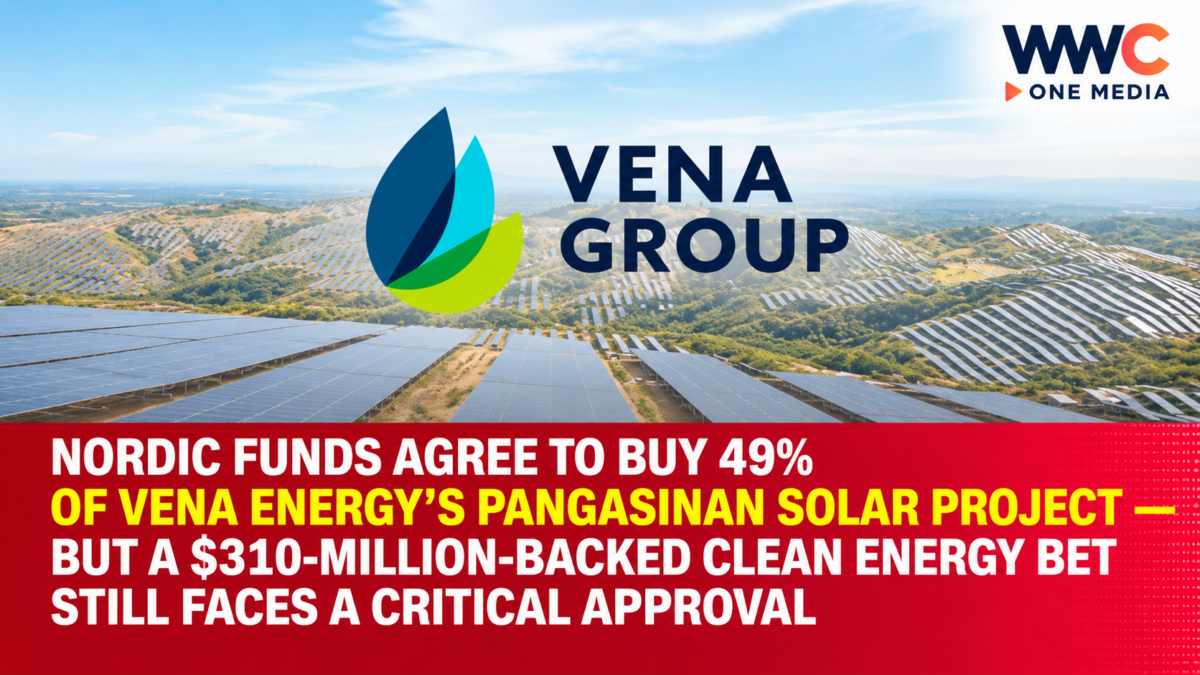
MANILA, Philippines — Two Nordic investment institutions are deepening their involvement in the Philippine renewable energy industry through an agreement to acquire nearly half of a major solar development in Pangasinan, signaling growing international interest in financing the country’s clean energy transition.
Singapore-headquartered Vena Energy announced on October 16, 2026, that Norwegian state-backed investor Norfund and Danish development finance institution Impact Fund Denmark had signed agreements to acquire a combined 49% equity interest in the 500-megawatt-peak Ixus Bugallon Solar Power Project.
Located in Bugallon, Pangasinan, the development is being constructed beside Vena Energy’s existing 550-MWp Bugallon Solar Power Project.
The new facility is expected to produce renewable electricity equivalent to the annual consumption of approximately 650,000 Philippine households once operational.
The investment comes after Vena Energy secured approximately $310 million in senior debt financing from eight international banks in July.
However, despite the scale of the agreement, the new Nordic ownership structure is not yet final.
The transaction still requires approval from the Philippine Competition Commission, making regulatory clearance the next major test for one of the country’s significant utility-scale solar investments.
Norway and Denmark Join Forces for Philippine Solar Expansion
The partnership brings together two institutions focused on financing projects with potential economic and environmental benefits.
Norfund is the Norwegian Investment Fund for Developing Countries, a government-owned institution that supports investments in developing markets.
The Philippine solar investment will be made through the Norwegian Climate Investment Fund, which Norfund manages.
Impact Fund Denmark is Denmark’s development finance institution, providing capital for investments intended to support sustainable economic development.
Under the agreement, the two institutions will acquire a combined 49% equity stake in the Ixus Bugallon project.
Vena Energy is expected to retain long-term ownership and operational involvement.
The structure allows the renewable energy developer to bring additional institutional capital into an existing project while continuing to participate in its operation.
But the announcement does not disclose the individual percentage ownership that each Nordic investor will hold.
The 49% figure represents their combined stake, not 49% for each institution.
Nordic Investors Commit $72 Million in Equity
Norfund has separately reported that the Norwegian Climate Investment Fund and Impact Fund Denmark are investing approximately $72 million in the project.
That investment corresponds to their planned combined 49% equity interest.
The amount is distinct from the $310 million in senior debt financing previously secured by Vena Energy.
The two financing arrangements have different purposes and structures.
Equity represents an ownership interest in the project, while senior debt consists of borrowing that must be repaid under the terms agreed with lenders.
The transaction illustrates how large renewable energy projects can combine different sources of capital.
Institutional investors provide equity, while commercial banks provide debt financing.
Together, these funding sources can support construction and development.
However, the $72 million should not be described as a completed cash payment until the equity transaction closes.
Likewise, the $310 million should not be incorrectly reported as the price of the 49% stake.
Vena Energy’s Ixus Bugallon Project Has 500 MWp of Planned Capacity
The Ixus Bugallon Solar Power Project is a utility-scale photovoltaic development in Bugallon, Pangasinan.
Its planned capacity is 500 MWp.
The abbreviation MWp refers to megawatt-peak, a measure of the rated output of photovoltaic panels under standardized test conditions.
It does not mean the facility will continuously generate 500 megawatts every hour of the day.
Actual electricity production will depend on sunlight, weather, equipment performance, operating conditions and the ability to deliver electricity to the grid.
The project is being developed adjacent to Vena Energy’s existing 550-MWp Bugallon solar facility.
Once the new project is completed, the two facilities will form a solar development cluster with approximately 1,050 MWp of combined capacity.
That is equivalent to about 1.05 gigawatts-peak.
The planned scale makes Pangasinan an important location for Vena Energy’s Philippine renewable energy portfolio.
Why the 650,000-Household Estimate Matters
Vena Energy said the new project is expected to generate enough electricity to match the annual consumption of approximately 650,000 Philippine households.
The estimate provides a way of communicating the potential scale of the facility’s output.
However, it does not mean the plant will directly supply electricity to exactly 650,000 separately identified homes.
Electricity from utility-scale plants typically enters the wider power system through commercial and grid arrangements.
The household figure is an annual energy-equivalence estimate based on expected generation and an assumed level of household electricity consumption.
Actual electricity production will depend on the project’s final operating performance.
As of October 20, 2026, the Ixus Bugallon project remains under development.
Its projected annual output should therefore be distinguished from electricity already generated.
Carbon Emissions Could Fall by More Than Half a Million Tonnes Annually
The planned solar facility is expected to displace electricity that might otherwise come from more carbon-intensive sources.
Vena Energy’s joint announcement estimates that Ixus Bugallon could avoid around 570,000 metric tonnes of carbon dioxide emissions each year once operating.
However, Norfund’s separate October 16 announcement gives a slightly lower estimate of 530,000 tonnes annually.
The two figures differ by approximately 40,000 tonnes.
Both refer to projected avoided emissions, not reductions already achieved.
The variation may reflect differences in modeling assumptions, although the public material reviewed does not establish the exact reason.
For accurate reporting, the company and investor estimates should remain clearly attributed.
It would be misleading to treat the 570,000-tonne figure as an independently audited environmental result from an already operating power plant.
The project’s eventual environmental contribution will depend on actual output, grid conditions and the emissions intensity of displaced generation.
The Project Already Secured $310 Million From Eight International Banks
The new ownership agreement follows an earlier financial milestone.
On July 27, Vena Energy announced that Ixus Bugallon had reached financial close for approximately $310 million in senior debt financing.
The financing involved eight international commercial banks.
Specialist publication PV Tech identified BNP Paribas and Crédit Agricole Corporate among the participating lenders.
The successful debt financing is significant because large solar developments generally require substantial upfront investment.
Funding is needed for panels, electrical equipment, construction, engineering, grid connections and related infrastructure.
By securing the banking package, Vena Energy strengthened the project’s funding structure before announcing the October Nordic equity agreement.
But July’s debt financial close and October’s pending equity transaction are separate milestones.
The former was achieved; the latter remains subject to regulatory approval and closing conditions.
Philippine Competition Commission Must Still Clear the Deal
One of the most important aspects of the October announcement is the pending review by the Philippine Competition Commission.
The PCC is responsible for enforcing the country’s competition law and reviewing transactions that meet applicable requirements.
Merger and acquisition reviews may examine whether a proposed transaction could substantially prevent, restrict or lessen competition.
The project companies have identified PCC approval as a condition before the Nordic investment can close.
This means the signed agreement has not yet resulted in an unconditional completed acquisition.
The review should not be interpreted as evidence that the investors have violated competition law.
Regulatory clearance is a standard part of many qualifying corporate transactions.
The key unresolved question is whether and when the required approval and other closing requirements will be completed.
Until then, the deal should be described as agreed, pending or proposed rather than definitively closed.
Green Energy Auction Program Provides Policy Support
The Ixus Bugallon project was awarded under the Department of Energy’s second Green Energy Auction Program, or GEA-2.
The program is part of the Philippines’ efforts to expand renewable energy generation through competitive procurement arrangements.
For developers, an auction award can provide an important commercial framework for future electricity generation.
For government, the program is intended to support additional clean energy capacity as electricity demand increases.
However, an auction award should not be confused with the plant’s completion or commercial operation.
A developer must still meet construction, grid connection, financing and other project requirements.
The Ixus Bugallon project has made important progress by securing debt financing and attracting prospective equity partners.
Its remaining milestones will determine when the planned solar capacity can begin contributing electricity.
Vena Energy Seeks to Recycle Capital Into More Projects
Vena Group chief investment officer Simone Grasso described the investment as part of an institutional partnership strategy.
Under this model, a developer can bring new investors into an infrastructure asset while retaining long-term participation in the project.
The arrangement may release capital that the developer can deploy into additional construction and development activities.
For Vena Energy, the strategy supports expansion across its regional renewable energy pipeline.
Instead of funding every project entirely with its own equity, the company can establish partnerships with institutions that seek long-term infrastructure investments.
Such arrangements can diversify sources of financing and reduce the amount of capital tied to a single project.
However, capital recycling does not guarantee that all future developments will proceed.
Each project still requires suitable commercial arrangements, financing, regulatory approvals and successful execution.
Norway Sees Its First Climate Investment Fund Project in the Philippines
Norfund described the Ixus Bugallon transaction as the Norwegian Climate Investment Fund’s first investment in the Philippines.
The development is therefore significant beyond the solar project’s capacity.
It establishes a new country exposure for a fund created to support investments that reduce greenhouse gas emissions in developing economies.
Norway’s Minister of International Development, Åsmund Aukrust, participated in the investment launch connected with the World Bank annual meetings in Bangkok.
The involvement of government-backed development finance institutions highlights the role of international capital in renewable energy investment.
Such institutions may invest alongside private companies and lenders to help mobilize funding for projects with long-term development objectives.
But their participation does not eliminate commercial risks.
The project’s eventual performance will still depend on construction, power generation, operating costs and the wider electricity market.
Denmark Emphasizes Growth Without Higher Emissions
Impact Fund Denmark’s participation reflects its focus on financing development projects through equity, loans and guarantees.
Chief executive Lars Bo Bertram emphasized the need to expand renewable energy as electricity demand rises in developing economies.
The Philippines faces the challenge of supporting economic growth while reducing dependence on carbon-intensive generation.
Manufacturing, transport, telecommunications, commercial buildings and digital infrastructure all require reliable electricity.
A larger renewable generation portfolio could help diversify the country’s electricity supply.
But solar capacity must also be integrated effectively into the power system.
The overall benefits depend on adequate transmission, system flexibility and coordination with other sources of generation.
Philippines Still Relies Heavily on Coal
The project arrives at a time when coal continues to supply a major share of Philippine electricity.
Norfund’s October announcement, citing international energy data, stated that coal accounts for approximately 62% of electricity generation in the country.
This helps explain why foreign climate-focused investors see the Philippine electricity sector as an important market.
Replacing a portion of coal generation with renewable energy could reduce operational carbon emissions.
But the transition cannot be measured only through the megawatts of new solar panels installed.
It also requires reliable transmission infrastructure, sufficient power during low-sunlight hours and an electricity system capable of balancing changing supply and demand.
Energy storage, other dispatchable resources and grid improvements may be needed as renewable penetration increases.
These considerations are important for determining how much new renewable capacity can actually contribute to a dependable electricity supply.
Pangasinan Is Emerging as a Major Solar Development Area
Vena Energy’s two Bugallon projects are expected to create a substantial solar generation cluster in Pangasinan.
The existing 550-MWp facility provides an established base alongside the 500-MWp project now under development.
Together, the projects would exceed 1 gigawatt-peak of solar capacity once completed.
This concentration of infrastructure could contribute to renewable electricity supply in Luzon.
Construction may also generate economic activity involving contractors, transport, equipment installation and supporting services.
However, the newly announced Nordic equity investment does not include a verified figure for additional permanent jobs.
Neither does the October announcement establish a guaranteed reduction in electricity bills for local households.
Those outcomes should not be inferred from the capacity and investment figures alone.
Foreign Capital Is Increasingly Important for Large Energy Projects
The Ixus Bugallon financing structure demonstrates the importance of international participation in Philippine renewable energy.
The project combines an experienced developer, global commercial banks and two Nordic development finance institutions.
Such arrangements may help support capital-intensive projects that require years of planning and implementation.
For the Philippines, attracting investors can contribute to expanding power-generation infrastructure.
But the wider investment environment also matters.
Developers need clear regulations, timely permits, suitable grid connections and viable commercial arrangements.
Without these conditions, even projects with financing commitments can encounter delays.
The challenge is therefore not limited to obtaining money.
It is also about turning financial commitments into functioning assets that generate electricity reliably.
The Bigger Test: From Signed Agreements to Clean Electricity
The proposed Nordic investment gives Ixus Bugallon another important milestone.
Norfund and Impact Fund Denmark have agreed to purchase a combined 49% stake in the 500-MWp facility, following the project’s earlier $310-million debt financing.
Vena Energy expects to retain long-term ownership and operational involvement while strengthening its capacity to pursue additional projects.
Once operating, the solar installation is projected to produce electricity equivalent to the annual requirements of approximately 650,000 households.
But several questions remain.
Will the PCC approve the proposed ownership transaction?
Will the project complete construction and grid integration on schedule?
And will actual electricity generation meet the developer’s long-term expectations?
The Nordic investment agreement reflects international confidence in the potential of Philippine renewable energy. But the bigger test begins with regulatory clearance and continues through construction, commercial operation and the delivery of measurable clean electricity to the country’s power system.