MANILA, Philippines — A single fraudulent transaction can wipe out years of savings, derail a family’s financial plans and leave victims struggling with anxiety long after the money is gone.
That is the warning from digital identity and fraud-prevention company IDfy Philippines, which is calling for stronger cooperation among banks, financial technology companies, regulators and consumers as increasingly sophisticated cybercriminals target Filipino households.
IDfy Philippines country head Raghu Chandrasekhar said the consequences of online fraud should not be measured solely through financial statistics.
A victim may lose money intended for groceries, rent, education, medical treatment or Christmas celebrations.
Some scams involve criminals spending weeks or months building relationships before persuading their targets to transfer substantial amounts of money.
Others use impersonation, deceptive links and rapidly evolving technology to create a false sense of urgency or trust.
The warning comes ahead of the holiday shopping season, when consumers may encounter more promotional messages, payment requests and unfamiliar online sellers.
But as artificial intelligence makes fraudulent messages and impersonations more convincing, the bigger question is whether Philippine financial institutions can protect customers quickly enough to prevent a devastating loss.
IDfy Says the Human Cost Goes Beyond Stolen Money
During an interview with InsiderPH published on October 19, Chandrasekhar urged the public to look beyond the headline figures commonly used to describe cybercrime.
A bank account may show the amount stolen, but it cannot fully capture the impact on the household that lost it.
Families may have to postpone necessary purchases, borrow money to pay bills or abandon savings goals.
Victims may also become distrustful of online services and other people.
For older consumers and retirees, the consequences can be particularly difficult when the money stolen represents funds accumulated over decades.
IDfy’s message is that cybersecurity is not only a technical concern for banks and technology companies.
It is also a household financial security issue.
‘Chaos in Cavite’ Shows How Criminals Exploit Trust
To communicate the risks in a more accessible way, IDfy recently launched a graphic novel titled Chaos in Cavite.
The story follows investigative journalist Cal Ilagan as he investigates a relationship-based investment scam involving a retired banker from General Trias, Cavite.
Criminals gain the victim’s confidence before stealing savings and moving the proceeds through multiple bank accounts.
The narrative also illustrates how money mule networks can be used to move suspected criminal proceeds, including through transactions eventually involving cryptocurrency.
The fictional story builds on IDfy’s earlier graphic novel, Mayhem in Makati.
The new publication was launched at The Peninsula Manila in an event attended by banking executives, fintech representatives, cybersecurity advocates and government officials.
IDfy says the graphic novel will be available digitally at no cost.
Importantly, the retired banker and investigative journalist are characters in an educational story. The narrative should not be reported as a verified criminal case involving a real named victim.
Criminals Are Building Relationships Before Attacking
One of the central warnings from IDfy concerns long-term manipulation.
Not every scam begins with an obviously suspicious text message.
Some fraudsters first establish regular communication, develop an emotional connection or pose as trusted professionals.
They may claim to be investment advisers, romantic partners, business contacts or people facing an emergency.
Once a victim trusts the relationship, the criminal introduces a request for money or access to sensitive information.
The process can make fraud difficult to recognize because the victim may believe they are helping someone familiar.
This is one reason simple warnings about suspicious links, while useful, are not sufficient on their own.
Consumers also need to recognize unusual financial demands that arise within relationships they previously considered trustworthy.
A familiar name, photograph or voice is not proof that a request is legitimate.
AI and Deepfakes Add New Fraud Risks
Chandrasekhar warned that artificial intelligence can help criminal groups produce increasingly convincing impersonations.
AI tools can generate natural-sounding messages and deceptive images, while synthetic audio and video may be used to imitate real people.
These capabilities can make some traditional fraud warning signs less obvious.
A suspicious message may no longer contain obvious spelling mistakes.
A fabricated profile may include realistic images.
And a caller may appear to sound like a person the victim knows.
However, not every digital scam involves artificial intelligence, and IDfy’s interview did not establish what proportion of Philippine scams use deepfake technology.
The concern is that these tools can increase the speed, scale and credibility of some criminal operations.
Consumers should independently verify unexpected financial requests through trusted contact information, even when the sender appears familiar.
New Survey Finds 84% of Filipino Adults Encountered Scam Attempts
The latest independent research reinforces the urgency of IDfy’s warning.
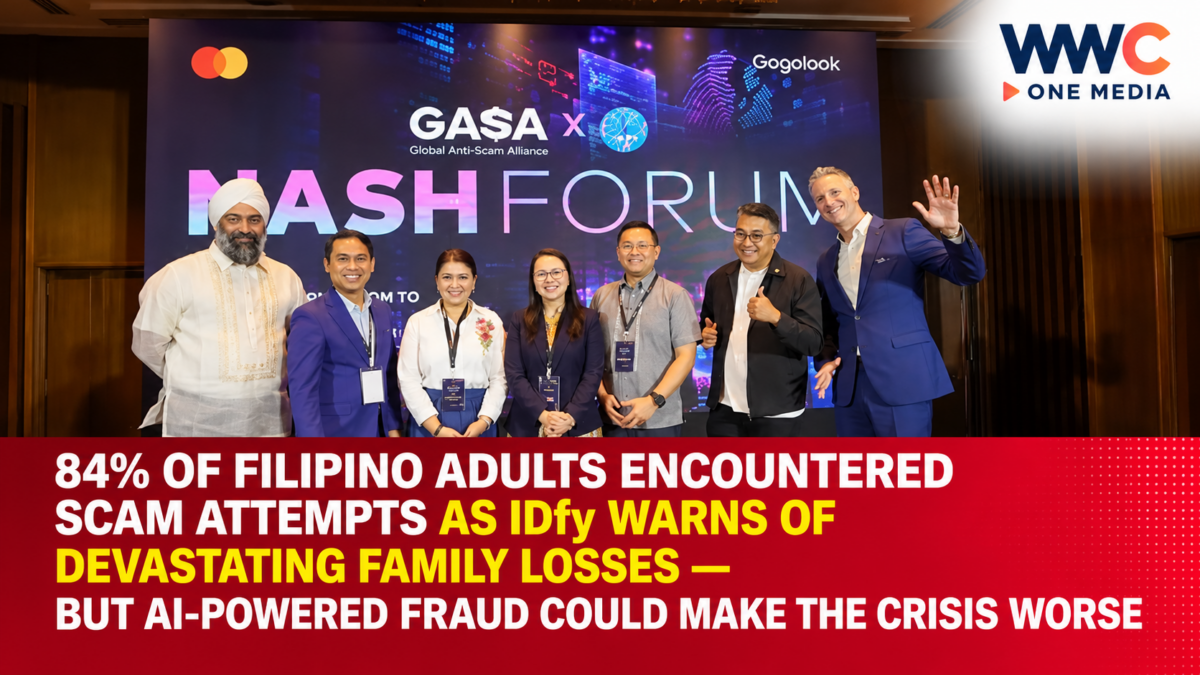
The State of Scams Philippines 2026 report, prepared by the Global Anti-Scam Alliance with Mastercard and Gogolook, found that 84% of surveyed Filipino adults had encountered a scam attempt during the previous year.
That was higher than the 77% reported in the 2025 survey.
The findings were based on responses from 1,160 Filipino adults.
The report estimated that scam losses could amount to approximately ₱121.8 billion annually.
However, that figure was calculated by extrapolating survey responses, not by adding up verified police reports, completed bank investigations or audited loss records.
The distinction is important because estimates and officially confirmed financial losses are different measurements.
The survey nevertheless provides evidence that scam exposure is widespread.
More Than Eight in Ten Victims Report Emotional Harm
The human consequences become clearer in the survey’s findings.
Among surveyed scam victims, approximately 82% said the experience negatively affected their mental well-being.
About 22% reported that the experience left them unable to pay for basic necessities.
The findings support IDfy’s argument that digital fraud can become a family crisis rather than merely an isolated financial transaction.
A lost payment can disrupt an already tight household budget.
Some victims experience fear, embarrassment, stress or reduced confidence when using financial services.
The psychological effects may continue even after a bank account has been secured.
But the 82% figure applies to surveyed victims, not to the entire Philippine adult population.
It should not be presented as proof that 82% of all Filipinos have experienced psychological harm from scams.
Messaging Apps and Social Media Are Major Attack Channels
The GASA report also provides insight into where victims encounter fraudulent approaches.
Approximately 39% of scam attempts reached respondents through instant messaging applications, while 36% involved social media posts.
The researchers found that 88% of scam approaches occurred on platforms with direct-messaging functionality.
That makes everyday digital communication an important part of the threat environment.
A consumer might receive a fraudulent message while arranging a delivery, responding to a friend or browsing online shopping offers.
The attacker may then direct the person toward a payment, link or external conversation.
The findings do not mean that every message on those platforms is suspicious.
They show why financial institutions, technology companies and consumers need effective ways to verify identity and detect unusual requests.
Many Consumers Interact With Scams Despite Recognizing the Risk
Another concerning result involves the gap between confidence and actual behavior.
The 2026 survey found that 58% of Filipino adults said they were confident in their ability to recognize scams.
Yet 60% of respondents who encountered a scam proceeded to interact with it.
This suggests that general awareness does not always prevent engagement with suspicious approaches.
Criminals may exploit urgency, fear, financial need or the apparent credibility of a contact.
For example, a person may know that fraudulent investment opportunities exist but still respond to a message that appears to come from a trusted acquaintance.
Effective prevention therefore requires more than telling consumers to be careful.
It also depends on practical verification processes, responsive fraud reporting and financial systems capable of identifying unusual activity.
TransUnion Finds Philippine Fraud Exposure Above the Global Rate
A separate report from TransUnion provides additional context.
In May 2026, the company reported that the Philippines recorded a suspected digital fraud rate of 4.1% in 2025, compared with a global figure of 3.8%.
This marked the sixth consecutive year that the Philippine rate exceeded the global level under TransUnion’s measurement.
The company also found that 72% of Filipino consumers it surveyed reported being targeted by digital fraud attempts during the August–December 2025 period.
Among consumers reporting financial losses during 2025, the median loss was approximately ₱50,000.
But TransUnion’s figures are based on a different measurement framework from GASA’s October survey.
The two studies should not be combined as though they track an identical population, period or definition of fraud.
The common message is that digital fraud exposure remains a substantial consumer risk.
Money Mule Accounts Help Move Criminal Proceeds
IDfy is also drawing attention to money mule networks.
Money mules are people whose financial accounts are used to receive or transfer money connected with criminal activity.
Some may knowingly participate in illegal transactions.
Others may be recruited through deceptive job offers, personal relationships or other forms of manipulation.
Criminals can use multiple accounts to make stolen funds harder to trace.
In September, IDfy and CIBI Information published research estimating potential Philippine annual losses of up to ₱603 billion associated with money mule activity.
That is a modeled exposure estimate, not an independently verified total of funds stolen or recovered.
It should not be added to GASA’s ₱121.8-billion survey-based loss estimate.
The two figures come from different studies and methodologies.
The bigger concern is that fraud networks can exploit gaps between financial institutions when money moves rapidly from account to account.
BSP Warns Filipinos Not to Lend Their Bank Accounts
The Bangko Sentral ng Pilipinas has repeatedly warned consumers against allowing other people to use their bank accounts or electronic wallets for unfamiliar transactions.
In a June advisory, the central bank said scammers may offer payment to people willing to receive or transfer funds through personal accounts.
Such arrangements can expose account holders to financial loss and legal consequences.
The Anti-Financial Account Scamming Act, or AFASA, provides a legal framework for addressing financial account misuse and related offenses.
Consumers should not accept offers to receive money on behalf of strangers or allow someone else to use their account credentials.
An apparently easy source of income may be part of a criminal operation.
People should also be cautious about employment offers that require using a personal account to process payments for an unknown organization.
Government and Banks Strengthen Information Sharing
Financial institutions and law enforcement agencies are also trying to improve their coordination.
In July 2026, the Department of Justice and the Bangko Sentral ng Pilipinas signed an information-sharing agreement to support investigations under AFASA.
The arrangement allows authorized exchanges of relevant account information and complaints while incorporating legal safeguards.
Similar information-sharing efforts have involved the National Bureau of Investigation, the Cybercrime Investigation and Coordinating Center and the Securities and Exchange Commission.
These measures aim to improve the identification and investigation of fraudulent financial transactions.
However, an information-sharing agreement does not guarantee that every stolen payment will be recovered.
The outcome of individual cases still depends on how quickly incidents are reported, the movement of funds, available evidence and applicable legal procedures.
Banks and Fintech Companies Must Share Responsibility
IDfy argues that fraud prevention cannot depend entirely on consumers recognizing every deceptive approach.
Banks, e-wallet providers, payment processors and other financial businesses need systems capable of identifying suspicious accounts and transaction patterns.
These may include stronger identity verification, transaction monitoring, risk intelligence and appropriate information-sharing arrangements.
At the Chaos in Cavite launch, Scam Watch Pilipinas co-founder Jocel de Guzman also emphasized that online safety should involve senior management and the broader organization.
The principle is that fraud prevention cannot be isolated within a company’s information technology department.
Customer-service teams, compliance personnel, executives and operational staff may all have roles in reducing fraud risks.
But security controls must also protect legitimate customers’ privacy and access to financial services.
The challenge is preventing criminal misuse without imposing unnecessary barriers on ordinary people and small businesses.
What Filipinos Should Do Before Transferring Money
The most effective fraud-prevention habits are often practical.
Consumers should verify sellers through independent channels rather than relying entirely on links sent through messages.
They should never disclose one-time passwords, PINs or account passwords.
Unexpected requests for money from relatives, friends or colleagues should be confirmed using a separate, trusted contact method.
Promotions offering unusually high investment returns or extreme discounts deserve additional scrutiny.
Consumers should also avoid sharing their bank accounts with strangers, even when offered payment.
A transaction should not be considered safe merely because a sender’s image, voice or profile looks familiar.
For those who suspect fraud, early reporting matters because delays may give criminals more time to move funds.
What to Do if You Have Already Been Scammed
If money has been transferred or account credentials may be compromised, the first priority is to contact the bank or e-wallet provider through its verified official support channel.
Report the transaction and request available account-protection or transaction-review measures.
Change affected passwords and secure connected accounts where appropriate.
Preserve transaction receipts, reference numbers, chat records and other potential evidence.
If the financial institution does not adequately address the complaint, the consumer may escalate the concern through the BSP’s Consumer Assistance Mechanism after first raising it with the institution.
Consumers can also report suspected cybercrime to the appropriate authorities.
But filing a report does not guarantee an immediate refund.
Reimbursement and fund recovery depend on the circumstances, applicable rules and investigation results.
The Bigger Challenge: Protecting Families, Not Just Accounts
IDfy’s warning brings attention to a difficult reality of the digital economy.
Online payments, messaging applications and digital financial services have made many transactions more convenient.
But the same interconnected systems can also be exploited by criminal organizations.
For Filipino families, the consequences can be severe.
Savings intended for education, healthcare, housing or daily necessities may disappear in a matter of minutes.
Victims may also face emotional harm that lasts much longer than the transaction itself.
The latest research suggests that public awareness, although essential, cannot solve the problem alone.
Financial institutions must strengthen their systems, technology companies must address abuse on their platforms, and regulators must support lawful coordination and effective enforcement.
Consumers need clear reporting channels and practical tools to verify suspicious requests.
IDfy is warning that digital fraud is no longer just a cybersecurity problem. It is a threat to household finances, public confidence and emotional well-being. And as AI-powered deception and organized money mule networks evolve, the biggest test will be whether the Philippines can protect people before their hard-earned savings are lost.