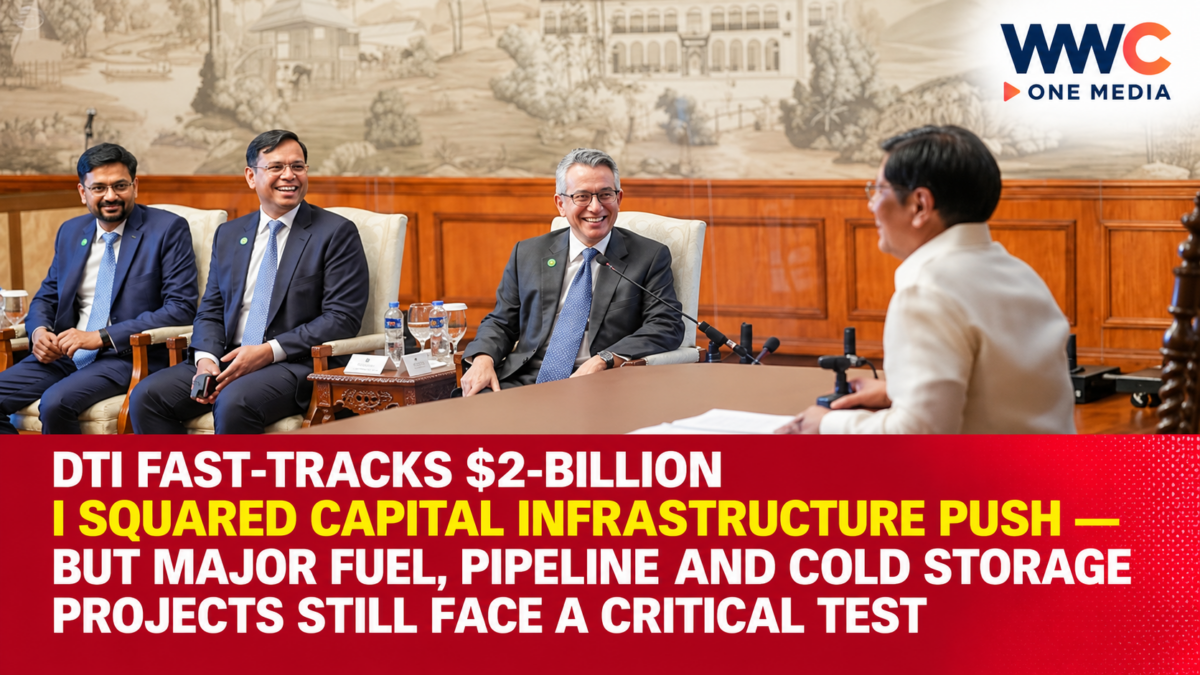
MANILA, Philippines — The Philippine government is moving to accelerate major infrastructure investments by US-based I Squared Capital as the global investment firm advances a $2-billion program covering fuel storage, pipelines, cold-chain logistics and other strategic facilities.
The Department of Trade and Industry (DTI) is coordinating with government agencies to help move qualifying projects through regulatory requirements, approvals and investment facilitation programs.
Trade Secretary Cristina Roque met I Squared Capital managing director Kunal Agarwal and operating adviser Nishant D’Souza on October 10, 2026, at Hilton Singapore Orchard, during President Ferdinand Marcos Jr.’s visit to Singapore.
The meeting reviewed progress on fuel storage projects in Batangas and Davao, proposed energy developments involving Subic and Clark, and the expansion of temperature-controlled logistics facilities beyond Luzon.
For the Marcos administration, the investment program is an opportunity to strengthen the country’s energy and food distribution systems.
But behind the multibillion-dollar headline is an important distinction.
The $2 billion is not a newly signed investment package from the October meeting. It combines more than $1 billion already invested in the Philippines with an additional $1 billion that I Squared Capital committed to deploy over two to three years beginning in October 2025.
The bigger question is whether faster government assistance can transform those commitments and proposals into completed infrastructure that Filipino businesses and consumers can actually benefit from.
Cristina Roque Pushes Faster Implementation of Infrastructure Projects
The October 10 meeting focused on how government agencies could support I Squared Capital’s existing and prospective investments.
Roque identified energy security, logistics modernization and connectivity as important economic priorities.
The DTI intends to coordinate with agencies responsible for relevant permits, regulatory requirements and investment facilitation.
The department also identified the government’s Green Lane system and CREATE MORE investment incentives as possible tools for eligible projects.
Such measures can help qualifying investments navigate government procedures more efficiently.
However, they do not automatically exempt companies from environmental regulations, competition rules or other applicable legal requirements.
Nor does a Green Lane designation guarantee that an investment will be profitable or completed on schedule.
For I Squared Capital, the immediate challenge is advancing its portfolio of projects through their respective development stages.
I Squared Capital’s $2 Billion Includes Earlier Philippine Investments
The investment program was first highlighted during the company’s discussions with President Marcos in October 2025.
At that time, I Squared Capital reported having already invested more than $1 billion in Philippine infrastructure.
It committed an additional $1 billion over the next two to three years.
Together, the existing investments and future commitment formed the $2-billion program now being reviewed by the DTI.
The clarification matters because presenting the full $2 billion as fresh capital pledged in October 2026 would overstate the announcement.
The latest development concerns acceleration and implementation, rather than the creation of an entirely new $2-billion commitment.
Government reporting has also referred to the company’s existing infrastructure assets in terms of enterprise value.
Enterprise value, committed investment and cash already spent are not interchangeable financial measurements.
The public announcements do not provide a complete project-by-project breakdown demonstrating that the entire $2 billion has already been disbursed.
Batangas and Davao Fuel Storage Facilities Move Forward
Among the projects reviewed were new petroleum storage facilities in Batangas and Davao.
These developments are being undertaken through Philippine Coastal Storage and Pipeline Corporation, an I Squared Capital portfolio business.
Fuel storage facilities are important because petroleum products must be imported, received, handled and distributed through a network of terminals and transport infrastructure.
Additional storage capacity can support inventory management and help supply businesses and communities during periods of logistical disruption.
For industrial users, transportation companies and power-sector customers, dependable fuel logistics can be operationally important.
But new storage infrastructure does not automatically eliminate the Philippines’ exposure to international oil prices.
The country remains affected by global petroleum markets, exchange-rate movements and import costs.
The benefit of additional storage is primarily in supply-chain capacity and resilience, not a guaranteed reduction in pump prices.
The DTI’s latest announcement did not provide separate capacities, final completion dates or individual investment amounts for the new Batangas and Davao facilities.
Company Already Stores More Than One Million Barrels for PNOC
Philippine Coastal Storage and Pipeline Corporation also handles more than one million barrels of strategic fuel reserves for the Philippine National Oil Company.
That existing activity illustrates the company’s role in the country’s petroleum storage infrastructure.
Fuel reserves can provide a buffer against certain disruptions when properly managed and available for use under the relevant arrangements.
But the figure should be interpreted carefully.
More than one million barrels stored for PNOC is not the same as one million barrels of newly discovered domestic oil.
It also does not establish how many days the entire Philippines could operate using those reserves.
The usable duration would depend on the products stored, contractual arrangements, inventory management and national consumption.
The confirmed figure demonstrates the scale of an existing storage service, not an independently verified measure of nationwide energy self-sufficiency.
Subic–Clark Pipeline Could Improve Fuel Transportation
One of the most significant proposed developments is a fuel pipeline connecting Subic and Clark.
I Squared Capital has signed a memorandum of understanding with the Bases Conversion and Development Authority for the project.
A pipeline could potentially move petroleum products between major logistics and industrial centers without relying entirely on road-based transportation.
Such infrastructure may help improve distribution efficiency and reduce certain handling bottlenecks.
Subic and Clark are important locations because of their roles in ports, airports, industry and regional commerce.
But the proposed pipeline has not been reported as a completed operating facility.
A memorandum of understanding normally establishes an intention to explore cooperation.
It does not necessarily amount to a binding construction contract, final investment decision or authorization to begin operations.
The project will still require appropriate technical studies, commercial arrangements and regulatory compliance.
A Subic Bay LNG-to-Power Project Is Also Under Consideration
The second memorandum of understanding with BCDA concerns a potential liquefied natural gas-to-power development in Subic Bay.
Liquefied natural gas can be transported and stored before being converted back into gas for use in certain power-generation facilities.
Gas-fired generation may support electricity systems by providing dispatchable power, depending on plant design and operating arrangements.
But the proposal remains at an exploratory stage.
The government announcements do not confirm a final plant capacity, construction budget, start date or electricity supply agreement.
It would therefore be premature to describe the Subic project as approved, under construction or scheduled to begin commercial operations on a specific date.
There are also environmental and economic considerations.
Natural gas remains a fossil fuel and produces greenhouse gas emissions when burned.
Its competitiveness depends on fuel prices, supply arrangements, infrastructure costs and the broader power market.
A proposed LNG facility should not be presented as a zero-emissions energy project.
Royale Cold Storage Expands Beyond Luzon
Energy is only one part of the investment program.
I Squared Capital is also developing its Royale Cold Storage business, which provides temperature-controlled logistics infrastructure.
The company is working on expansion opportunities in Cebu and Davao, extending its business beyond its existing Luzon operations.
Cold storage is important for agricultural products, meat, seafood and other temperature-sensitive goods.
When products are not maintained at appropriate temperatures, they may deteriorate before reaching retailers and consumers.
Modern facilities can help businesses maintain storage conditions and improve supply-chain flexibility.
The expansion may also benefit food importers, processors, wholesalers and regional distributors.
However, cold storage alone cannot solve every cause of food loss.
Farm handling, transport quality, packaging, road access and distribution practices also influence whether products reach the market in suitable condition.
Bulacan Expansion Provides an Earlier Construction Milestone
I Squared Capital’s investment program includes the expansion of Royale Cold Storage in Plaridel, Bulacan.
The company marked the groundbreaking of a 1.5-hectare expansion site in October 2025.
The Presidential Communications Office highlighted that development as part of I Squared Capital’s broader Philippine investment program.
For the company, the Bulacan facility provides an established base from which to expand its logistics capabilities.
The project also demonstrates that some portions of the investment program had already advanced beyond investment discussions.
But a groundbreaking ceremony is not equivalent to full commercial operation.
Actual facility readiness depends on completion of construction, installation of equipment, testing and compliance with applicable requirements.
The latest October 2026 reports do not provide a complete independently verified turnover date for every new cold storage development.
Cebu and Davao Could Strengthen Regional Food Supply Chains
Expanding cold storage into the Visayas and Mindanao could create new options for food businesses outside Metro Manila.
Cebu is an important regional commercial and logistics center.
Davao connects producers, distributors and consumers across parts of Mindanao.
Temperature-controlled storage can be especially relevant for businesses handling products with strict freshness requirements.
For farmers and food processors, better logistics may reduce some forms of spoilage and make distribution planning easier.
For wholesalers and retailers, it may provide additional inventory management options.
But improved storage capacity does not automatically guarantee lower retail food prices.
Final prices also depend on agricultural production, fuel costs, transport charges, market competition and other operating expenses.
The economic impact will become clearer as facilities begin operating and actual demand is established.
I Squared Capital Already Employs More Than 2,500 Workers
The company reported employing more than 2,500 people in the Philippines through its operations.
The workforce reflects the breadth of its existing activities across infrastructure and related services.
Large infrastructure investments may create opportunities for engineers, logistics personnel, technicians, construction workers and administrative employees.
Cold storage facilities can also require specialized workers who understand refrigeration equipment, food handling and inventory systems.
Fuel terminals need employees trained in industrial safety, operations and maintenance.
However, the DTI did not announce a specific new job creation figure directly attributable to the projects reviewed at the October 10 meeting.
The existing 2,500-plus employees should not be reported as 2,500 newly hired workers.
Additional employment will depend on the size, timing and completion of individual developments.
Data Centers, Telecom Towers and Hospitals Are Potential Next Steps
Beyond energy and logistics, I Squared Capital has expressed interest in exploring other Philippine sectors.
These include telecommunications towers, data centers and hospitals.
Such projects could support the country’s digital economy and healthcare infrastructure.
Telecommunications towers provide physical facilities for mobile network equipment.
Data centers support computing, storage and network services for enterprises and digital platforms.
Hospitals require substantial long-term investment in facilities, medical technology and staff.
But the October announcement did not identify finalized projects or committed financing in those additional sectors.
Interest in data centers or healthcare should not be presented as proof that construction has started.
The firm is exploring opportunities, and any projects would still need to proceed through investment assessment and applicable approvals.
CREATE MORE and Green Lanes Could Help Qualifying Investors
The DTI wants to use existing government mechanisms to help projects move forward.
The CREATE MORE law expanded and clarified investment incentives for qualifying enterprises.
The Green Lane framework is intended to improve coordination and reduce unnecessary administrative delays for eligible strategic investments.
For capital-intensive businesses, predictable processing can help with financial planning and project execution.
Delays in permits or approvals may increase costs and affect financing arrangements.
However, government facilitation must still respect legal safeguards.
Projects involving energy infrastructure, pipelines and industrial facilities can require environmental assessments, safety reviews and other approvals.
Investment speed should not come at the expense of public safety or regulatory accountability.
The challenge for government is to improve efficiency while applying the rules consistently.
Foreign Infrastructure Capital Is Not a Guarantee of Immediate Benefits
I Squared Capital is a major international investor with experience across infrastructure sectors.
Its continued activity in the Philippines may help attract financing and support development in areas with substantial capital requirements.
But foreign investment commitments are only one stage of project delivery.
A proposed facility must have a commercially viable business model.
It must secure required permits and financing.
Construction must be completed, equipment installed and operations tested.
The facility must then attract customers or serve the intended users.
Each stage involves risks involving costs, regulation, demand and implementation.
For this reason, the economic value of the $2-billion program should be evaluated through actual assets, services and employment rather than the headline amount alone.
Why Energy and Food Logistics Matter to Philippine Competitiveness
The two major sectors involved—fuel infrastructure and cold-chain logistics—can influence operating conditions for many Philippine businesses.
Reliable fuel distribution supports transportation, manufacturing and other economic activity.
Efficient cold storage can help food businesses manage products that require refrigeration or freezing.
These systems are particularly important for an archipelagic economy where goods often move between islands and regional markets.
Bottlenecks can contribute to additional costs, delayed delivery and lost merchandise.
Investment in infrastructure may help reduce some of these problems.
But the benefits will depend on how effectively new facilities connect with existing ports, roads, customers and distribution systems.
Isolated infrastructure investments may have limited value if surrounding networks remain inadequate.
The Bigger Test: Can the DTI Turn $2 Billion Into Working Infrastructure?
The latest meeting between Trade Secretary Cristina Roque and I Squared Capital signals continued cooperation between the Philippine government and a major global infrastructure investor.
The company’s existing investments provide a foundation for additional fuel storage, pipeline and cold-chain projects.
Developments in Batangas, Davao, Bulacan, Cebu, Subic and Clark could strengthen important parts of the country’s supply network.
But some projects are still proposed, others are under development, and their completion timelines differ.
The government’s role is to help qualified projects navigate regulatory requirements without weakening oversight.
The company’s responsibility is to secure the commercial, technical and financial arrangements needed to deliver its investments.
For Filipino businesses and consumers, the ultimate measure will be more reliable fuel logistics, improved temperature-controlled food distribution and real economic opportunities.
I Squared Capital’s $2-billion Philippine investment program has drawn renewed government support. But the decisive test is not another investment announcement—it is whether the promised infrastructure becomes operational and makes a measurable difference to the country’s energy security, food logistics and competitiveness.