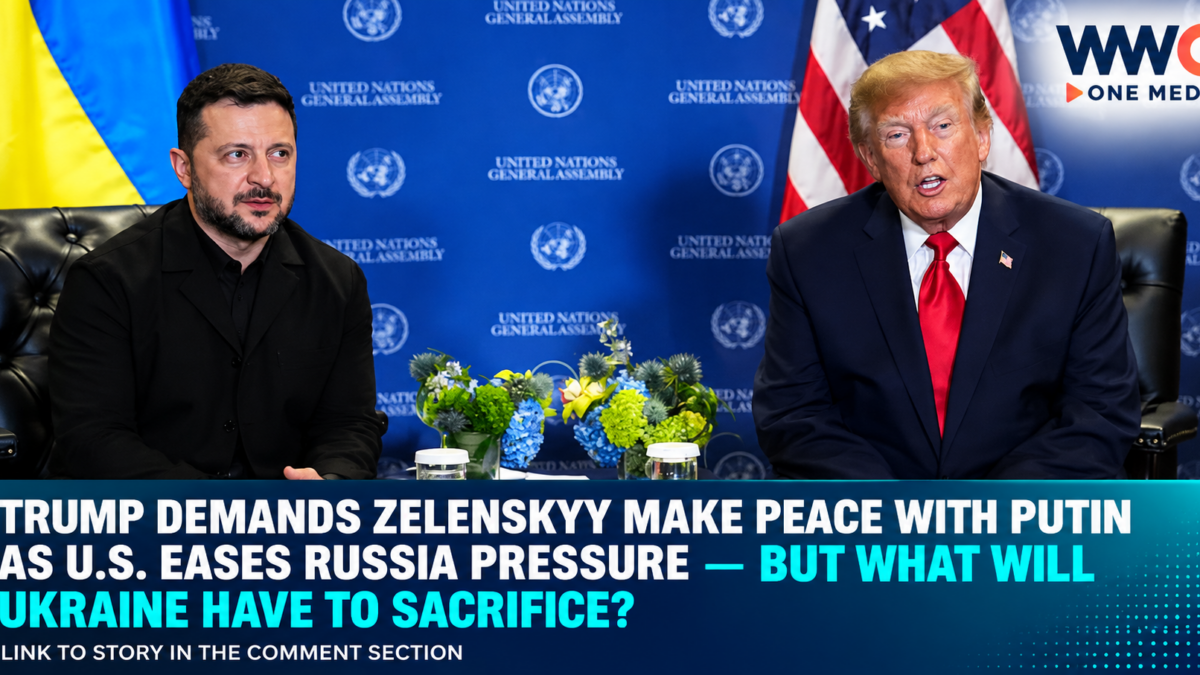
WASHINGTON, October 21, 2026 — U.S. President Donald Trump has intensified pressure on Ukrainian President Volodymyr Zelenskyy to negotiate an end to Russia’s invasion, raising fresh concerns over whether Washington’s pursuit of a peace agreement could force Kyiv into difficult compromises over its territory and national security.
Speaking to reporters at the White House on Tuesday, October 20, Trump made clear that he expects the Ukrainian president to reach an agreement with Moscow, even as Russian military operations and strikes against Ukrainian infrastructure continue.
“We want Zelenskyy to make a deal,” Trump declared, arguing that Ukraine’s leader had already missed earlier opportunities to negotiate.
His latest comments signal a renewed diplomatic push toward Moscow at a particularly sensitive moment in the war, with American officials pursuing negotiations involving both Ukraine and Russia.
Trump Turns Up Pressure on Ukraine
Trump’s remarks mark another escalation in his increasingly strained relationship with Zelenskyy, whose government has repeatedly insisted that a lasting peace cannot come at the expense of Ukraine’s sovereignty.
The U.S. president suggested that Ukrainian public support for continuing the conflict could weaken, adding that Zelenskyy would ultimately need to embrace negotiations.
The confrontation revives memories of the extraordinary February 2025 Oval Office meeting involving Trump, Vice President JD Vance and Zelenskyy, when disagreements over American support and efforts to end the war erupted publicly.
But the diplomatic stakes are now even higher.
Russia continues to occupy Ukrainian territory, while Kyiv faces the challenge of maintaining its defenses, protecting its energy infrastructure and securing dependable long-term military assistance.
For Zelenskyy, the central question is not simply whether negotiations should happen, but whether any proposed settlement would prevent Russia from launching another invasion.
U.S. Envoy Holds Peace Talks in Oslo
As Trump increased pressure on Kyiv, U.S. special envoy Steve Witkoff met Zelenskyy in Oslo, Norway, on October 20 for discussions intended to advance a possible peace framework.
According to Reuters, the meetings involved European and NATO representatives and addressed security guarantees, reconstruction and the wider security arrangements that could accompany an eventual agreement.
Zelenskyy has emphasized that Ukraine must have a direct role in negotiations determining its future.
One of Kyiv’s most important demands is for credible international security guarantees capable of deterring another Russian attack.
The talks are also taking place amid preparations for Witkoff to engage Russian President Vladimir Putin, creating a significant diplomatic test for Washington.
Whether Moscow will accept meaningful compromises remains uncertain.
Trump Eases Pressure on Russia, Raising Concerns in Kyiv
Another source of tension has been the Trump administration’s decision to ease certain restrictions affecting Russia, including measures linked to energy transactions.
Trump’s approach has drawn criticism from Ukrainian officials and some American lawmakers, who argue that reducing economic pressure on Moscow could weaken incentives for Putin to negotiate seriously.
Zelenskyy has warned that relaxing sanctions risks rewarding Russia while its military campaign continues.
The controversy has intensified following reports of delays in military supplies and restrictions affecting American-supported satellite capabilities used by Ukrainian forces.
U.S. officials have disputed suggestions that Washington has abandoned Ukraine. However, Kyiv remains concerned about the reliability of future support.
For Ukraine, the combination of diplomatic pressure, uncertainty over weapons deliveries and continued Russian attacks presents an especially difficult strategic challenge.
American Intelligence Support Resumes Amid Russian Strikes
There has been one encouraging development for Kyiv.
Zelenskyy announced that Ukraine had resumed receiving American-supported early warnings about incoming Russian missile attacks after a disruption in intelligence sharing.
The restoration is significant because advance alerts can help Ukrainian forces protect civilians, prepare air defenses and reduce damage from missile and drone strikes.
Nevertheless, Ukraine continues to face shortages of critical weapons, particularly air-defense interceptors, as Russian attacks threaten electricity supplies and other essential infrastructure ahead of winter.
The situation reinforces Kyiv’s argument that negotiations must be accompanied by security commitments strong enough to protect the country after any ceasefire.
Trump Also Seeks Release of American Detained in Russia
Trump separately revealed that he had personally raised the case of Stephen Hubbard, a 74-year-old American held in Russia, during discussions with Putin.
Hubbard, a retired teacher, was detained after Russian forces advanced into Ukrainian territory and was subsequently convicted by a Russian court on mercenary-related charges.
The United States considers him wrongfully detained.
Trump expressed optimism that progress toward securing Hubbard’s freedom could emerge, although no confirmed release agreement had been announced at the time of his remarks.
The case adds another dimension to Washington’s renewed diplomatic engagement with Moscow, alongside the more complicated negotiations over the future of Ukraine.
Could Ukraine Be Pressured Into Territorial Concessions?
Perhaps the biggest unanswered question is what Washington expects Ukraine to surrender, accept or guarantee in exchange for peace.
Russia has repeatedly sought recognition or acceptance of its control over occupied Ukrainian territories, while Kyiv maintains that its sovereignty and territorial integrity must be protected.
A ceasefire that freezes existing front lines without resolving territorial disputes could temporarily reduce fighting. However, it could also leave a dangerous confrontation unresolved.
European governments face a similarly difficult calculation: supporting diplomatic efforts to end a devastating war while ensuring any agreement does not leave Ukraine exposed to renewed Russian aggression.
Analysts and policymakers remain divided over whether Trump’s approach represents an opportunity to break the diplomatic deadlock or risks giving Moscow additional leverage.
What Happens Next?
Attention is turning to Witkoff’s discussions with Putin and whether Washington can translate the negotiations in Oslo into a proposal acceptable to both Moscow and Kyiv.
The main obstacles remain substantial: disputed territory, credible security guarantees, sanctions, military assistance and the enforcement of any future ceasefire.
For Trump, the challenge is proving that increased diplomatic engagement with Russia can produce a durable agreement.
For Zelenskyy, the stakes are existential.
And for millions of Ukrainians living under the threat of continued attacks, the difference between a temporary pause in fighting and a lasting peace could determine their country’s future.
The critical question now is whether Trump’s diplomatic pressure will finally bring Moscow and Kyiv closer to ending the war — or whether Ukraine will be asked to pay a price it considers unacceptable.