MANILA, Philippines — One of the Philippines’ most influential business leaders has delivered a challenge to the country’s corporate elite: keep competing for customers and profits, but start working together on the national problems that could determine whether the Philippines succeeds in an increasingly uncertain global economy.
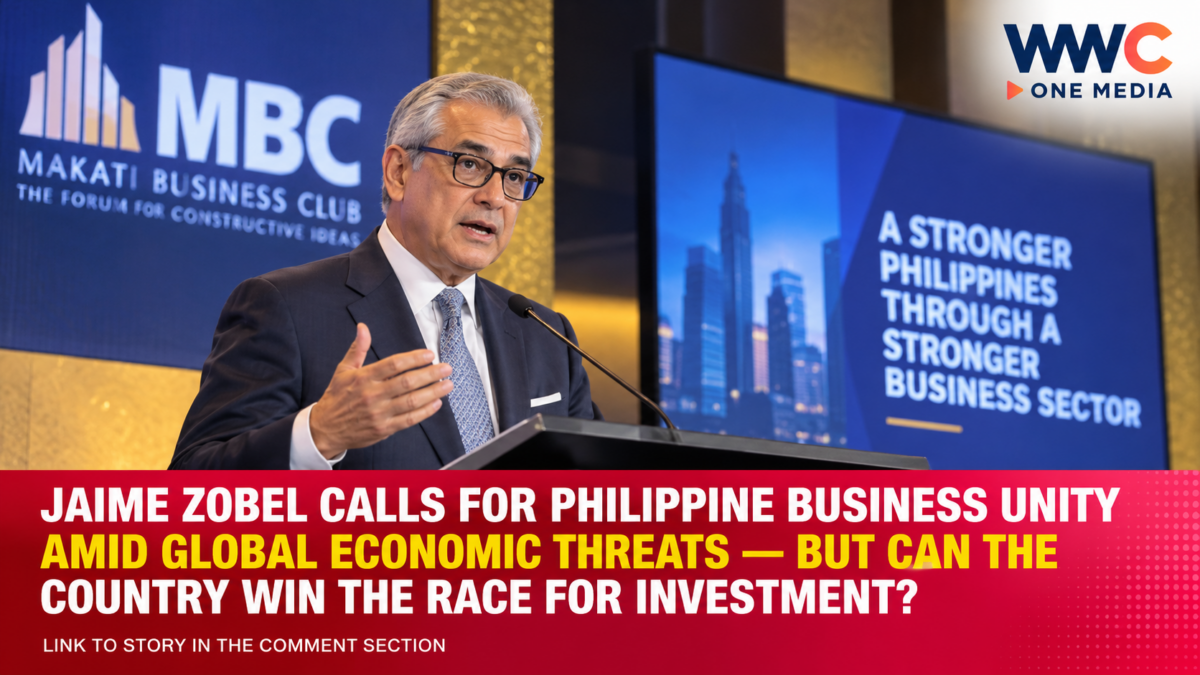
Ayala Corporation Chairman Jaime Augusto Zobel de Ayala made the appeal during the Makati Business Club’s 45th anniversary celebration at Grand Hyatt Manila on October 15, 2026.
Speaking before fellow business leaders, Zobel warned that geopolitical tensions, shifting global supply chains, artificial intelligence, climate change and persistent economic inequality are forcing countries to rethink how they compete for investment.
His central argument was that long-term corporate success depends on more than strong individual companies.
Businesses also need a country with reliable infrastructure, skilled workers, stable institutions and communities capable of participating in economic growth.
But as international companies reconsider where to invest and manufacture, Zobel raised an even bigger question: Is the Philippines preparing itself to win — or simply watching neighboring economies pull ahead?
Zobel Tells Philippine Tycoons to Compete — and Collaborate
At the anniversary celebration, Zobel emphasized that market competition remains essential.
Companies must continue innovating, attracting customers and improving their services.
But he argued that corporate rivalries should not prevent businesses from cooperating on issues that affect the entire economy.
These include improving workforce skills, strengthening healthcare, ensuring reliable energy and supporting better infrastructure.
The distinction matters.
Zobel was not calling for rival companies to stop competing, coordinate prices or divide markets.
Instead, he urged collaboration on public-interest priorities where improvements can benefit many businesses and communities at once.
Such cooperation can take the form of transparent partnerships involving industry groups, government, educational institutions and civil society.
The goal is to strengthen the environment in which legitimate competition takes place.
For the Makati Business Club, Zobel said this type of collective action reflects the organization’s purpose since its establishment in 1981.
The Philippines Faces a More Dangerous Global Economic Environment
Zobel’s warning comes at a time when the global economic outlook is being shaped by overlapping risks.
Geopolitical rivalries are affecting trade relationships and investment decisions.
Supply chains are increasingly being evaluated for national security, political exposure and resilience, not only efficiency.
Artificial intelligence is changing the skills companies require and creating uncertainty about which industries will gain or lose competitiveness.
Climate change is adding pressure on infrastructure, energy systems and vulnerable communities.
Meanwhile, inequality and uneven access to basic services remain obstacles to inclusive growth.
These developments create difficult choices for emerging economies.
International investors may be looking for new production locations, but they can also demand more reliable infrastructure, stronger workforce capabilities and predictable regulation.
For the Philippines, attracting investment will depend on whether it can offer these conditions competitively.
A Critical Question: Is the Philippines Actually Winning?
One of the most pointed parts of Zobel’s address concerned investment competition.
As global corporations diversify their supply chains, he challenged Philippine business leaders to think beyond which company or industrial estate wins an individual deal.
The greater concern is whether the country as a whole has the conditions required to attract and retain investment.
Those conditions include sufficient energy supply, modern infrastructure, qualified workers and institutional stability.
A new manufacturing plant may benefit one investor and its suppliers.
But the country’s broader gains depend on whether such investments create jobs, develop local capabilities, strengthen exports and encourage additional business activity.
If electricity remains expensive or unreliable, logistics costs remain high or workers lack needed skills, the economy may struggle to turn isolated investments into sustained national progress.
That is the competitiveness problem Zobel wants business leaders and policymakers to confront.
A Young Workforce Is an Advantage — But Not a Guarantee
Zobel highlighted the Philippines’ demographic strengths.
He cited approximately 75 million working-age Filipinos, pointing to the country’s potential labor supply.
A large working-age population can support business expansion, domestic demand and economic productivity.
But population size alone does not guarantee an economic dividend.
Workers must have access to education, training, healthcare and suitable employment opportunities.
Companies also need access to skills relevant to changing technologies and industries.
For example, advanced manufacturing may require technicians with specialized training.
Cybersecurity and cloud computing businesses need employees who understand complex digital systems.
Healthcare and engineering industries require professional qualifications and continuous learning.
If the education and training system fails to prepare enough workers, businesses may face shortages even when the population is growing.
Zobel’s point is that human capital must be developed intentionally.
Artificial Intelligence Could Reshape Philippine Competitiveness
AI was among the major forces Zobel identified as shaping the country’s future.
The technology is already influencing business operations, software development, customer service and data analysis.
It presents opportunities for companies to improve productivity.
But its rapid adoption also raises difficult questions for workers, schools and policymakers.
Some jobs may change significantly as businesses automate selected tasks.
Other roles may emerge that require different technical and analytical capabilities.
For the Philippines, the challenge is particularly important because services and technology-related activities contribute significantly to the economy.
A country that prepares workers to use AI effectively may improve its competitiveness.
But organizations that adopt technology without adequate training or safeguards could create new vulnerabilities.
Zobel suggested that the Makati Business Club can help coordinate discussions and initiatives around national AI readiness.
However, the anniversary remarks did not announce a fully funded nationwide AI program, a new government policy or a specific number of jobs to be created.
The proposal remains a call for coordinated action.
Energy Reliability Becomes a National Business Priority
Energy is another major issue identified by Zobel.
Reliable and competitively priced electricity is essential for industrial operations, offices, data centers and household productivity.
Businesses require confidence that energy will remain available as they expand.
Uncertainty about electricity supply can discourage investment or force companies to spend more on backup systems.
The energy transition also requires balancing reliability, affordability and environmental considerations.
For businesses investing in renewable energy and other generation technologies, long-term planning depends on regulation, grid readiness and financing.
Zobel’s appeal places the issue within the larger conversation about national competitiveness.
He did not announce a new power plant or a specific energy-investment commitment at the MBC anniversary.
Instead, he urged the business community to cooperate on priorities that affect the country’s overall investment environment.
Infrastructure Must Be Accompanied by Accountability
Infrastructure development is central to the competitiveness agenda.
Better roads, ports, airports, telecommunications networks and transportation systems can reduce costs and improve access to markets.
But Zobel also emphasized governance and accountability.
He argued that public resources must be managed carefully and infrastructure projects delivered properly.
That point is significant in a business environment where investor confidence depends partly on predictable rules, public-sector competence and trust in institutions.
Even a well-designed infrastructure program can underperform if projects face delays, poor execution or misuse of funds.
For businesses, transparency and accountability are not only ethical questions.
They influence project costs, financing decisions and the perceived reliability of the investment environment.
Zobel therefore identified governance and the rule of law as essential parts of national economic progress.
Ayala’s ‘Social Infrastructure’ Strategy Goes Beyond Traditional CSR
Zobel also described how Ayala is increasingly framing parts of its strategy around what it calls social infrastructure.
The concept refers to systems and services that help communities function and develop.
Examples include healthcare, education, livelihood opportunities and sustainable everyday living.
Traditional corporate social responsibility often focuses on donations, volunteering and community projects.
Social infrastructure can involve longer-term investment in services that address structural needs while operating within a sustainable business model.
For Ayala, the approach reflects its presence in sectors such as banking, property, telecommunications, energy, healthcare and education-related services.
Zobel’s wider message is that private enterprise and social progress are connected.
A business may perform better over time in a society where people can access essential services and participate productively in economic activity.
However, the concept should not be treated as proof that every corporate investment automatically creates an equitable social outcome.
Actual benefits depend on affordability, access, quality and implementation.
World Bank Forecast Highlights the Economic Challenge
Independent economic reporting provides additional context for Zobel’s warning.
In its October 2026 East Asia and Pacific update, the World Bank maintained its forecast that the Philippine economy would grow by 3.7% in 2026.
That would be slower than the 4.4% growth reported for 2025.
The institution also projected growth of 5.2% in 2027.
The World Bank identified the country’s exposure to global energy shocks as an important risk.
These forecasts underline the difficult backdrop for businesses.
Even when the economy continues growing, slower expansion can make it harder for companies to increase investment and create employment at the pace needed.
Rising operating costs and weaker demand can also influence business decisions.
The World Bank figures are separate from Zobel’s anniversary remarks, but they illustrate why national competitiveness is receiving renewed attention.
Manufacturing Shows Signs of Pressure
Recent manufacturing reports also help explain the concern.
An October BusinessMirror editorial discussing September factory conditions described weaker orders and defensive inventory management.
It highlighted the effects of softer domestic demand and international competition.
These developments matter because manufacturing contributes to exports, employment and domestic supply chains.
Philippine electronics exports remain an important area of industrial activity.
But maintaining international competitiveness requires more than attracting occasional new factories.
Businesses need dependable utilities, skilled employees, efficient logistics and access to overseas markets.
A weakened manufacturing environment can affect suppliers and other industries connected to production.
Zobel’s call for better investment readiness therefore aligns with concerns already visible in parts of the industrial economy.
Global Cooperation Is Also Becoming an Economic Priority
The concerns raised at the Makati Business Club anniversary are not unique to the Philippines.
During the October 2026 International Monetary Fund and World Bank annual meetings in Bangkok, IMF Managing Director Kristalina Georgieva also urged greater international cooperation to manage risks involving geopolitical tensions, artificial intelligence and inequality.
The IMF projected global economic growth of approximately 3.1% for 2026.
The institution warned that major disruptions could still affect the outlook.
The parallels are notable.
Both international policymakers and Philippine business leaders are confronting an environment in which technological advances create opportunities while geopolitical and financial pressures increase uncertainty.
For emerging economies, cooperation can help address challenges that individual governments or companies may struggle to solve alone.
Makati Business Club Could Move Beyond Policy Dialogue
Zobel’s message also challenged the organization hosting the event.
The Makati Business Club has long served as a venue for business leaders to discuss economic policy, governance and institutional reforms.
At its 45th anniversary, Zobel suggested a more focused approach to cooperation.
Potential areas include human capital, artificial intelligence, energy security, infrastructure and supply-chain resilience.
MBC could help bring together business executives, government representatives, academic institutions and civil-society organizations to develop practical initiatives.
The challenge would be moving from general discussions to measurable projects.
That might include supporting workforce-development programs, identifying infrastructure barriers or helping design policy recommendations.
However, the October speech did not establish that such working groups had already delivered new legislation or funded projects.
Their impact will depend on what participating organizations actually implement.
Business Unity Must Still Respect Competition and Public Interest
Collaboration among major companies can deliver benefits when it supports public-interest initiatives.
But it must also respect competition laws and legitimate market rivalry.
The objective should be to improve the country’s business environment rather than create arrangements that restrict competitors or disadvantage consumers.
Joint workforce programs, industry research and transparent policy advocacy are different from coordinating prices or dividing customers.
This distinction is important for a group whose members represent large businesses across competing industries.
Zobel’s own remarks emphasized that companies should continue competing vigorously.
The unity he called for concerns national priorities that extend beyond any single corporation.
Can Corporate Cooperation Make a Real Difference for Filipinos?
The ultimate value of Zobel’s proposal will be measured by its effect outside corporate boardrooms.
Better education could help young workers qualify for higher-value jobs.
More reliable electricity could reduce operational disruptions for businesses.
Improved infrastructure could help provincial companies connect with suppliers and customers.
Greater transparency could strengthen public confidence in institutions.
And accessible healthcare could support worker well-being and productivity.
But these outcomes require coordinated investment, effective government policy and credible implementation.
Business organizations cannot independently solve every national challenge.
Government agencies remain responsible for public policy, regulation and service delivery.
Likewise, businesses remain accountable for their own conduct and commercial decisions.
The most productive partnerships will be those with clearly defined responsibilities and measurable results.
The Bigger Test: Can the Philippines Compete Beyond Its Own Borders?
Zobel’s anniversary address was ultimately a call to reassess the country’s economic priorities.
The Philippines has important strengths, including its workforce, ASEAN position, service industries and established manufacturing sectors.
But it also faces competition from economies investing aggressively in infrastructure, industrial capacity, technology and workforce development.
The next major investment opportunity may depend on which country can offer the most reliable and competitive operating environment.
For Philippine companies, the challenge is to look beyond their own balance sheets.
For policymakers, it is to establish conditions that allow investment, employment and productivity to grow.
And for business organizations such as the Makati Business Club, it is to translate dialogue into coordinated initiatives.
Jaime Augusto Zobel de Ayala has called on Philippine business leaders to compete in the marketplace while cooperating on the foundations of national progress. But the bigger question is whether the country’s government, companies and institutions can turn that unity into stronger infrastructure, better jobs and lasting competitiveness before global economic changes leave the Philippines further behind.