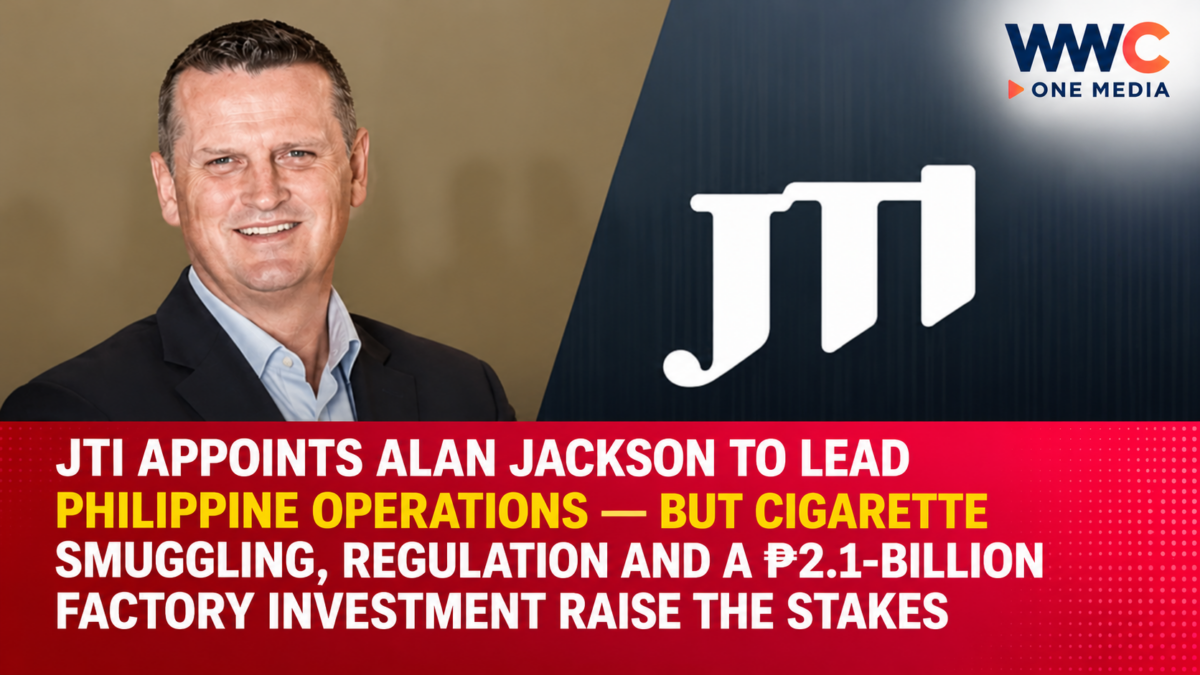
MANILA, Philippines — Japan Tobacco International (JTI) has appointed seasoned international executive Alan Jackson as general manager of its Philippine business, placing a 19-year company veteran at the center of one of the country’s most closely regulated consumer industries.
Jackson takes charge as JTI strengthens its local operations, manages an established cigarette business and develops its portfolio of newer nicotine and heated-tobacco products.
His appointment, announced October 16, 2026, also comes amid intensified government enforcement against illicit cigarette trading and significant investments in JTI’s manufacturing operations in Batangas.
For the new general manager, the challenge goes beyond delivering commercial growth.
He must navigate regulation, competition, public-health concerns, the protection of government tax revenues and the development of thousands of employees.
Can Jackson strengthen JTI’s Philippine business while confronting the illicit cigarette trade — and how will the company respond to the increasingly difficult balance between commercial expansion and public-health regulation?
JTI Brings International Leadership Experience to Manila
Jackson joined Japan Tobacco International in 2007 and has held senior roles across several geographic markets.
He previously served as general manager of JTI’s operations in Tanzania and Canada.
Before his Philippine appointment, he was vice president for marketing and sales in South Asia.
His wider professional experience spans Asia, Africa, North America, Western Europe and the Middle East.
That background gives Jackson experience operating across different regulatory environments and commercial conditions.
The Philippines presents its own challenges, including strong industry competition, excise taxes, restrictions on tobacco marketing and persistent illicit trading.
In his appointment announcement, Jackson described the Philippines as an important market for JTI and identified responsible, sustainable business development as a priority.
The company has not publicly disclosed a specific new sales, profit or market-share target associated with his appointment.
JTI Philippines Operates a Nationwide Business
JTI began Philippine operations in 2000 through JT International (Philippines) Inc.
Its local footprint has expanded substantially over the following decades.
According to The Philippine Star’s October 20 report, JTI maintains a market office and global services center in Taguig City.
Its manufacturing operations are located in Malvar, Batangas.
The company also has nearly 40 branch offices nationwide and employs approximately 5,500 people.
These operations connect local manufacturing, logistics, commercial functions and corporate support services.
The size of the workforce makes employee development and operational continuity important considerations for Jackson’s leadership.
His appointment is therefore significant beyond a routine personnel change.
He assumes responsibility for an established business with extensive manufacturing and distribution requirements.
Winston, Camel and Mighty Remain Part of the Portfolio
JTI’s Philippine business includes established international cigarette brands such as Winston, Camel, Mevius and LD.
Its portfolio also includes the local Mighty brand.
The company has been developing additional product categories, including Nordic Spirit nicotine pouches and the Ploom Aura heated-tobacco product.
These newer categories are part of the industry’s broader diversification into products that differ from conventional combustible cigarettes.
However, product diversification does not automatically mean lower public-health risk.
Heated-tobacco products still expose users to nicotine and potentially harmful substances, while nicotine pouches carry dependence and other health concerns.
The World Health Organization has cautioned against treating tobacco-industry claims about reduced harm as established proof that such products are safe.
The relevant Philippine laws, licensing requirements and marketing restrictions continue to apply.
For JTI, product expansion therefore creates both commercial opportunities and additional regulatory responsibilities.
Cigarette Smuggling Becomes a Major Leadership Challenge
One of Jackson’s clearest priorities is addressing illicit cigarette trade.
In his appointment statement, he argued that cooperation between government agencies and the legitimate industry is essential for protecting tax revenues and maintaining lawful competition.
Illicit tobacco trading can involve products imported, manufactured or distributed in violation of applicable customs, tax and other regulations.
For compliant businesses, illegal sales can create unfair competition when unlawful suppliers evade taxes and regulatory costs.
For government, smuggling can undermine excise-tax collection.
It can also complicate enforcement of tobacco-control measures.
But industry claims about the financial scale of the illicit market should be distinguished from independently verified government collections and seizure figures.
The policy challenge is not limited to protecting legitimate tobacco businesses.
Enforcement must also support public-health objectives and prevent the distribution of unlawful products.
Customs Seizures Demonstrate the Scale of Enforcement
Government records provide concrete evidence of the ongoing problem.
On June 23, 2026, the Bureau of Customs announced that an interagency operation had intercepted 23 containers of illicit cigarettes valued at approximately ₱1.7 billion.
The operation involved the Bureau of Customs, National Bureau of Investigation, Bureau of Internal Revenue and Philippine Coast Guard.
A separate Cebu operation announced on June 25 uncovered 11 containers of illicit cigarettes with an estimated value of ₱860 million.
In July, authorities reported further coordinated enforcement operations targeting illegal shipments.
These seizures show that illicit trading remains a substantial enforcement concern.
However, the value of seized cigarettes should not be confused with a confirmed amount of tax revenue lost.
Nor do seizure values establish the total size of the illegal tobacco market.
For Jackson, the importance of these developments lies in the operating environment facing the regulated industry.
Batangas Manufacturing Expansion Adds Another Responsibility
JTI’s leadership transition follows a major investment announcement involving its Batangas factory.
In September 2026, JT International Asia Manufacturing Corporation announced approximately ₱2.1 billion in advanced manufacturing investments at LIMA Estate in Malvar.
The largest component is a ₱1.9-billion Dry Ice Expanded Tobacco facility.
This is JTI’s first manufacturing installation of that type in Southeast Asia.
The technology changes how tobacco raw material is processed, with the company identifying greater consistency and manufacturing efficiency as intended benefits.
JTI also invested more than ₱177 million to expand a Controlled Atmosphere treatment facility.
That expansion became operational in July 2026 and doubled the facility’s treatment capacity.
The investments demonstrate that JTI continues to allocate significant resources to its Philippine manufacturing operations.
But the ₱2.1-billion figure is a previously announced factory investment, not a newly disclosed spending program personally initiated by Jackson.
Factory Investment Brings Employee Training Requirements
The introduction of new manufacturing technology has implications for employees.
JTI reported that workers at the Batangas facility were receiving additional technical training to operate specialized equipment.
As production systems become more advanced, employees need appropriate skills to maintain equipment, monitor processes and follow operational standards.
This can create opportunities for workforce development.
But modernized manufacturing may also change the types of skills required within a facility.
The company’s public announcements do not establish a specific number of additional jobs created by the new Dry Ice Expanded Tobacco installation.
They also do not provide a verified figure for productivity gains achieved after implementation.
Those outcomes would require further operational disclosures.
For the incoming Philippine chief, maintaining capable and adequately trained teams will be part of managing the company’s continued development.
Batangas Is an Important Part of JTI’s Regional Network
JTI describes its Malvar facility as a primary manufacturing hub serving its Asian operations.
Earlier company reporting identified exports to 22 international markets from the facility.
That role gives the Philippine operation significance beyond domestic sales.
Manufacturing for multiple markets requires coordination involving production scheduling, quality controls, logistics and compliance with destination-market requirements.
It also exposes operations to changing international demand and supply-chain conditions.
For the Philippine economy, export-oriented manufacturing contributes to industrial activity.
However, the company’s export-market count does not establish the peso value of its shipments or their contribution to national exports.
The new general manager’s role will involve supporting the wider business strategy while ensuring that Philippine operations remain competitive.
Public Health Remains Central to the Regulatory Debate
Tobacco is not an ordinary consumer product.
Cigarette smoking causes serious health harms, including cancer, cardiovascular disease and respiratory illness.
Nicotine is addictive.
The industry’s development therefore occurs within a public-health framework that seeks to reduce tobacco-related disease and protect people from exposure to harmful products.
The World Health Organization warns that heated-tobacco products and nicotine pouches should not be assumed safe merely because their use differs from conventional cigarette smoking.
This is important when assessing industry statements about innovation or next-generation products.
A new device or delivery format does not automatically amount to a proven smoking-cessation treatment.
The company’s commercial priorities must be understood alongside the obligations of regulators to protect public health.
Effective enforcement against smuggling and effective tobacco-control policies are not mutually exclusive goals.
Both can be pursued through lawful regulation, taxation and enforcement.
Employees and Communities Are Also Part of Jackson’s Agenda
Jackson has emphasized the importance of employees to JTI’s long-term business strength.
He said he intends to support workplace development and maintain the company’s community-related initiatives.
With a workforce approaching 5,500 people in the Philippines, employment practices and training are significant management responsibilities.
The company operates across corporate offices, regional branches and manufacturing facilities.
Those activities require employees with different skills, from production and logistics to compliance and administrative support.
However, the appointment announcement does not provide new verified targets for recruitment, salary increases or community spending.
Such commitments should not be inferred from general statements about employee well-being.
The appropriate measure of future progress will be the programs and outcomes the company actually discloses.
The New General Manager Faces Competing Pressures
Jackson inherits a Philippine business with an extensive footprint and substantial recent investment in manufacturing technology.
At the same time, his organization operates within a sector facing persistent illicit trading and public-health scrutiny.
These pressures can point in different directions.
The company seeks sustainable commercial performance and operational efficiency.
Government authorities seek effective tax collection, lawful competition and enforcement.
Public-health institutions seek reduced tobacco consumption, prevention of nicotine dependence and protection from harmful products.
The leadership challenge is to operate within these overlapping requirements.
Greater manufacturing investment does not eliminate regulatory obligations.
Likewise, a successful campaign against smuggling does not remove the health risks associated with tobacco use.
For the market, the key issue is how JTI manages its business in a legally compliant and transparent manner.
What Comes Next for JTI Philippines?
Jackson’s appointment creates a new leadership phase for JTI’s local operations.
The company’s priorities include managing its established portfolio, implementing recent manufacturing investments, supporting employees and engaging with authorities on illicit trading.
The results of those efforts are not yet known.
JTI has not announced an independently verifiable profit forecast or a specific timetable for achieving additional market-share gains under the new general manager.
Its next developments will need to be assessed through formal company disclosures, regulatory decisions and evidence of operational performance.
The appointment is significant because of the size and reach of JTI’s Philippine business.
But a leadership announcement alone does not establish a financial turnaround or a successful resolution of industry challenges.
JTI has brought in a globally experienced executive to lead its Philippine operations during a period of factory modernization and intensified enforcement against tobacco smuggling. The bigger test for Alan Jackson will be managing commercial performance while meeting regulatory requirements and confronting the wider public-health responsibilities of the industry.










