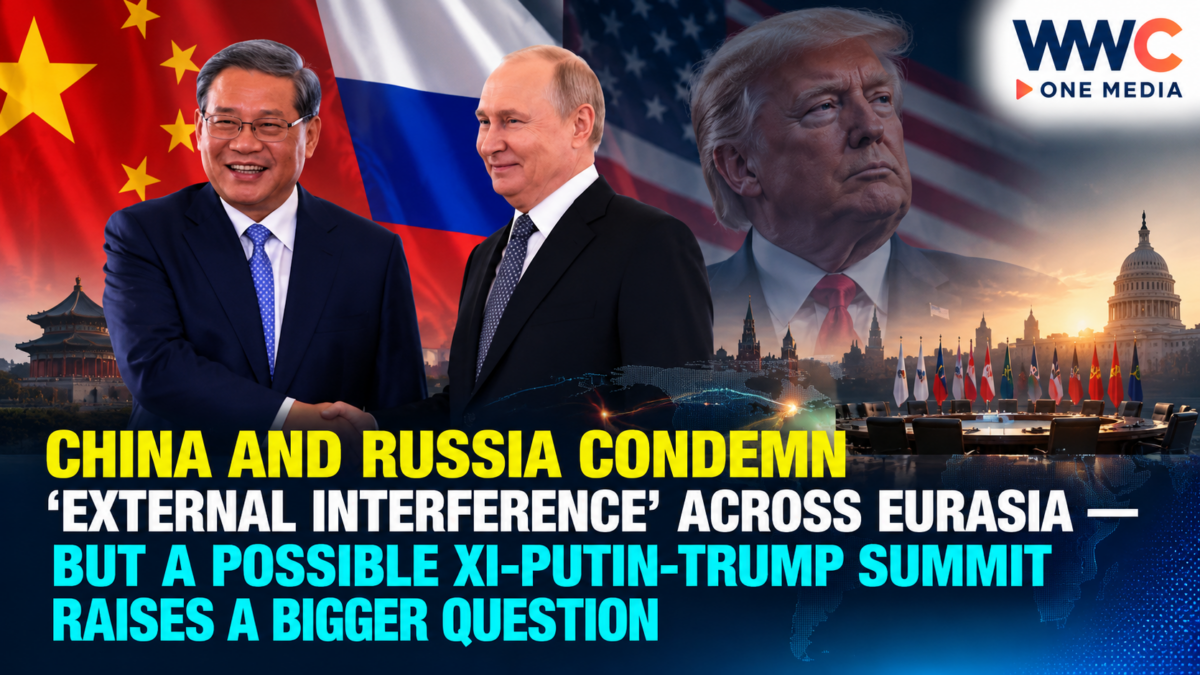
BEIJING / ST. PETERSBURG — China and Russia have delivered a joint warning against what they describe as destabilizing foreign interference in Eurasia, reinforcing their strategic relationship as negotiations over the Ukraine war and discussions about a possible three-way summit with the United States attract international attention.
In a statement released on Thursday, October 22, Beijing and Moscow argued that intervention by outside powers was undermining regional stability and cooperation.
The declaration followed Chinese Premier Li Qiang’s visit to Russia, where he met President Vladimir Putin and Prime Minister Mikhail Mishustin.
The two governments pledged to support each other on matters they consider essential to their national interests, including sovereignty, security and territorial integrity.
But another development has intensified the diplomatic significance of the statement.
The Kremlin says discussions are underway about a possible meeting involving Putin, Chinese President Xi Jinping and U.S. President Donald Trump during November’s Asia-Pacific Economic Cooperation summit in Shenzhen.
No trilateral summit has been officially confirmed, and the China–Russia declaration does not announce a new military alliance or a joint confrontation with the United States.
Beijing and Moscow Issue Joint Warning
The October 22 statement followed the 31st regular meeting between the Chinese and Russian heads of government.
Both governments said they opposed attempts by outside powers to dictate political or security arrangements in Eurasia through coercion.
Their declaration describes external involvement as a central source of instability across the continent.
It also includes a pledge of support for one another’s core interests.
China specifically reaffirmed its support for Russia’s sovereignty, security and internal stability.
The declaration reflects a longstanding theme in Chinese and Russian diplomacy: opposition to what their leaders characterize as unilateral pressure, coercive intervention and interference in domestic affairs.
However, the language should be understood as the governments’ own assessment.
The statement does not independently establish that external interference is the principal cause of instability in Eurasia.
Who Met Whom — and Why Does It Matter?
Li Qiang and Mikhail Mishustin
The Chinese and Russian premiers held their 31st regular meeting on October 21, discussing cooperation and the implementation of priorities set by their presidents.
Li Qiang and Vladimir Putin
Li also met Putin in St. Petersburg, conveying greetings from Xi Jinping and emphasizing closer strategic coordination.
According to China’s official Xinhua News Agency, Li described Beijing and Moscow as partners that had continued working together despite a turbulent international environment.
He called for deeper cooperation, stronger political trust and practical results from agreements reached by the two countries’ leaders.
These meetings were part of an established diplomatic mechanism, not an emergency summit convened in response to a newly announced conflict.
What China and Russia Are Trying to Strengthen
The two countries are pursuing cooperation across several sectors.
| Area | Cooperation discussed |
|---|---|
| Trade and investment | Strengthening commercial ties and economic coordination |
| Energy | Continuing cooperation in traditional and emerging energy industries |
| Transportation | Expanding infrastructure and cross-border connectivity |
| Technology | Developing digital-economy and industrial cooperation |
| Diplomacy | Coordinating positions in bilateral and multilateral forums |
| Security | Supporting each other’s stated core interests and preferred regional arrangements |
Ahead of the premiers’ meeting, Chinese and Russian officials specifically identified trade, agriculture, transportation, nuclear energy, aviation, aerospace and the digital economy as areas for cooperation.
The October 22 declaration reinforces that broader agenda.
It does not, however, establish that new projects have already been funded or completed.
Is China–Russia Cooperation Becoming a Military Alliance?
The growing coordination between Beijing and Moscow frequently attracts international attention because both countries possess significant military capabilities and maintain difficult relationships with Western governments.
China and Russia describe their relationship as a comprehensive strategic partnership.
Beijing has also characterized the relationship as based on non-alliance, non-confrontation and not targeting third countries.
That official description does not mean their policies never overlap or that other governments share their interpretation of regional security.
The distinction is important: a joint political statement promising mutual support is not the same as a newly signed mutual-defense treaty.
The October 22 announcement contains no confirmed creation of an alliance obligating China or Russia to enter a war on the other’s behalf.
The Ukraine War Complicates the Message
Russia’s continuing war in Ukraine remains a major source of disagreement between Moscow, Kyiv and Western governments.
While Russia argues that its national security interests must be reflected in any European security arrangement, Ukraine and its supporters emphasize Ukraine’s sovereignty, territorial integrity and right to determine its future.
Beijing has called for negotiations and a political settlement.
China’s Foreign Ministry reiterated that position on October 21 in response to questions about possible talks involving China, Russia and the United States.
Ukraine has insisted that it must participate in negotiations affecting its future.
The differing positions demonstrate why the China–Russia statement cannot be treated as a universally accepted explanation of the region’s instability.
Could Xi, Putin and Trump Meet in November?
POSSIBLE THREE-LEADER SUMMIT
Proposed participants
Xi, Putin and Trump
Potential venue
Shenzhen, China
APEC summit dates
November 18–19, 2026
Meeting status
Under discussion
Confirmed APEC dates and reported diplomatic discussions. No confirmed trilateral meeting or agreed agenda.
AA News
+1
Kremlin aide Yuri Ushakov told reporters on October 21 that a three-way meeting involving the Chinese, Russian and American presidents was being discussed.
The possibility was also raised during Putin’s talks with U.S. special envoy Steve Witkoff.
According to Ushakov, none of the three governments had ruled out the idea.
However, China’s Foreign Ministry said it had no additional information to provide regarding such a summit.
Reuters separately reported that no formal proposals or agenda had been established as of October 19.
The China–Russia joint statement released October 22 did not mention the possible trilateral meeting.
Therefore, reports that a historic summit is already scheduled or that a Ukraine peace agreement has been reached would be premature.
Why the Shanghai Cooperation Organization Matters
Li Qiang’s visit to Russia followed meetings in Central Asia, including the October 20 gathering of heads of government from the Shanghai Cooperation Organisation (SCO) in Tajikistan.
The SCO provides a platform for cooperation on regional security, economic development and political coordination.
China and Russia are prominent members, but the organization also includes other governments with their own diplomatic interests.
Li’s participation reflects Beijing’s efforts to strengthen relationships across Eurasia through multiple institutions rather than relying exclusively on bilateral agreements with Moscow.
The expanded diplomatic activity provides context for the October 22 statement, although the SCO meeting and the China–Russia declaration were separate events.
What This Means for the Philippines and ASEAN
The China–Russia declaration has no immediate, announced effect on Philippine trade or security arrangements.
Its importance lies in the broader international environment.
Closer coordination between major powers can affect diplomatic negotiations, energy trade, international sanctions and competition over regional security policies.
For ASEAN countries, including the Philippines, developments involving Beijing, Moscow and Washington are relevant because these governments influence international trade and strategic relationships.
The Philippines also has its own unresolved maritime disputes with China.
On October 19, the Philippine government summoned Chinese Ambassador Jing Quan following remarks that Manila described as threatening. Beijing disputed that characterization and said its position had been misrepresented.
That disagreement is separate from the China–Russia Eurasia statement, but it illustrates the wider complexity of regional diplomacy.
The Bigger Question: Diplomatic Cooperation or Greater Strategic Rivalry?
The October 22 declaration reinforces the close coordination between China and Russia.
Both governments are emphasizing sovereignty and opposition to what they describe as coercive external involvement.
At the same time, their governments are exploring deeper economic cooperation while potential high-level talks with the United States remain under discussion.
These developments create several possibilities, including continued diplomatic competition, more economic coordination and negotiations involving major powers.
But the statement alone does not prove that a new geopolitical bloc has been formed or that a major international confrontation is imminent.
The bottom line: China and Russia have jointly condemned what they call destructive external interference in Eurasia following Li Qiang’s visit to Russia. Their strategic cooperation continues to deepen, while a possible Xi-Putin-Trump meeting in November remains unconfirmed.