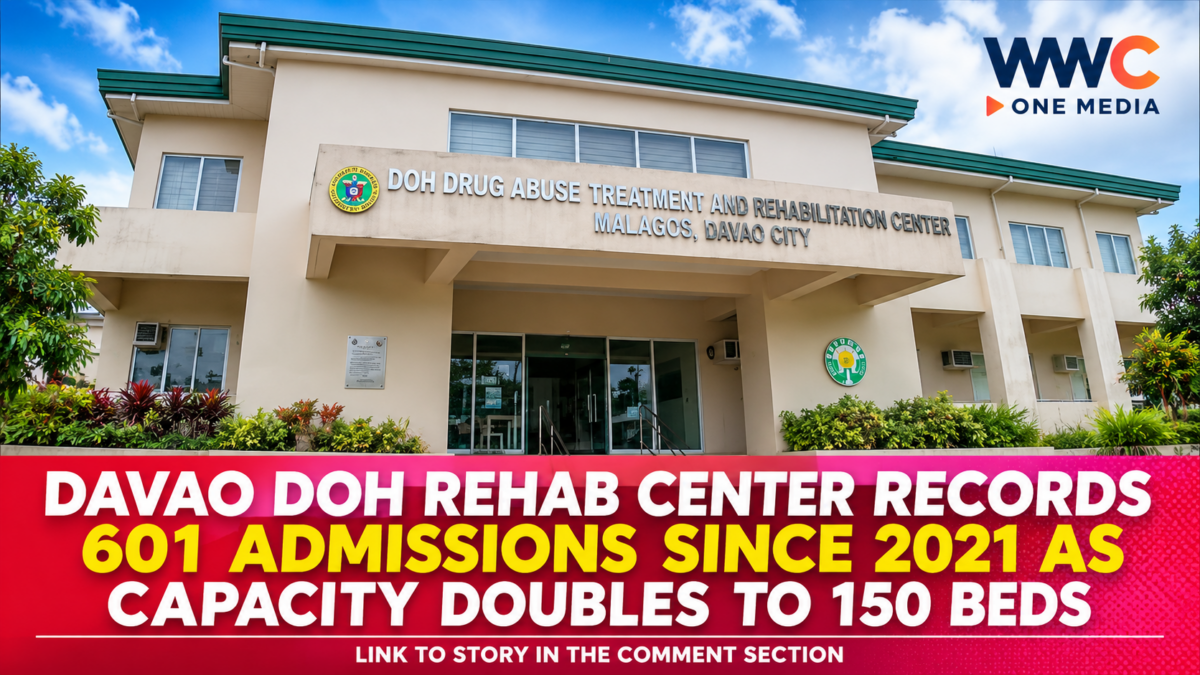
DAVAO CITY, Philippines — The Department of Health (DOH)-operated Drug Abuse Treatment and Rehabilitation Center in Barangay Malagos has recorded 601 admissions since beginning operations in 2021, reflecting the facility’s expanding role in providing treatment and recovery services across the Davao Region.
Karl Anthony Ebol, officer-in-charge of the center’s Outpatient and Aftercare Division, disclosed the figures during a DOH media engagement in Davao City on October 30, ahead of the observance of Drug Abuse Prevention and Control Week.
The facility initially operated with approximately 75 residential beds. Its capacity has since increased to 150 beds as the center expanded its services to accommodate more people requiring professional treatment.
Ebol said most of the individuals previously admitted are now receiving aftercare support, while others have already completed their rehabilitation programs.
Outpatient and aftercare services expand
Beyond residential treatment, the center has strengthened its support system through outpatient and aftercare services.
Its outpatient program, which began in 2026, has already recorded approximately 267 clients across the region. The center also has around 487 aftercare clients, according to Ebol.
The figures represent different service categories and should not be treated as a combined total of unique individuals.
Aftercare is an important part of the recovery process. Clients attend monthly sessions focused on relapse prevention and undergo random drug testing as part of the monitoring program.
The center also coordinates with clients’ employers and involves family members in psychoeducation sessions to help build a supportive environment beyond the rehabilitation facility.
Ebol emphasized that families play an important role in supporting individuals as they return to their communities.
Around 80 aftercare clients were scheduled to graduate on November 19 at the Malagos facility as part of the week’s activities. After graduation, they are expected to maintain coordination with their respective barangays and local anti-drug abuse councils.
Treatment depends on professional assessment
Ebol clarified that admission to rehabilitation is not determined simply by whether someone has tried drugs once or twice.
A proper screening and examination must take place, with a DOH-accredited physician responsible for diagnosing a substance use disorder.
The center handles severe cases requiring residential treatment, while moderate cases may be accommodated through outpatient services. Many mild cases are managed through community-based rehabilitation programs.
Local programs can also refer individuals to the DOH facility when they need a higher level of professional care.
The approach is intended to match treatment and support to each person’s assessed needs rather than automatically directing everyone to residential rehabilitation.
Government treatment available without charge
Ebol said treatment and rehabilitation services at DOH-run facilities are free for individuals who cannot afford private treatment.
The support covers the treatment process through aftercare, making government services an important option for people who need professional assistance but face financial limitations.
He also stressed that the center’s 601 admissions do not represent the total number of people experiencing substance-use problems throughout Davao Region. The figure covers only those who sought professional help through the facility.
For Ebol, more people seeking assistance may indicate that stigma and discrimination surrounding substance-use disorders are gradually being addressed.
Community programs also support recovery
The DOH facility is not the only government-supported rehabilitation service operating in the region.
Ebol identified other government facilities in Barangay Bago Oshiro, managed by the Davao City Government, and in New Corella, under the Davao del Norte Provincial Government. DOH-accredited private rehabilitation centers also operate in the region.
In Davao City, approximately 7,400 clients are enrolled in the Tabangan Atong Reformists Aron Naay Asenso, or Tara Na, program. The initiative is managed by the Davao City Anti-Drug Abuse Council and provides community-based rehabilitation and aftercare support.
The range of services highlights the importance of cooperation among national agencies, local governments, healthcare professionals, families, and community organizations.
Recovery requires support beyond rehabilitation
The increase in residential capacity and the introduction of outpatient services show how the Malagos center has broadened its role since opening in 2021.
However, the work does not end when a person completes residential treatment. Continued monitoring, family involvement, community support, and access to appropriate services remain important parts of long-term recovery.
As Davao Region strengthens its rehabilitation network, the challenge will be ensuring that people who need help can receive professional, accessible, and sustained support without facing discrimination.