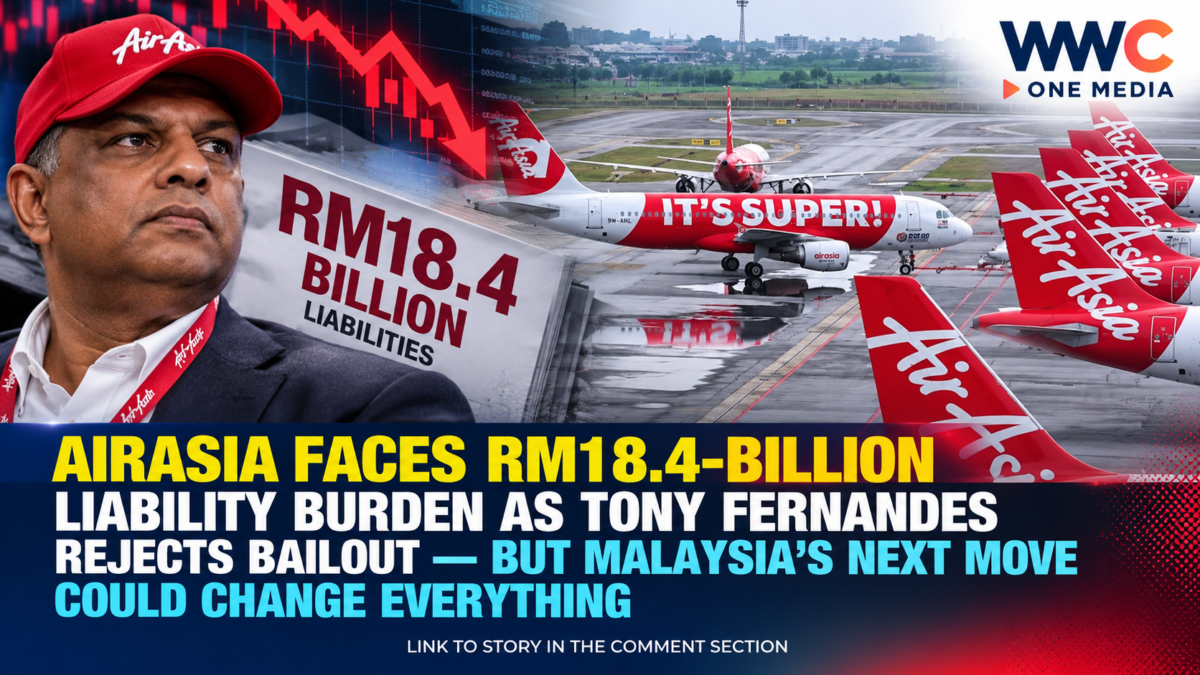
KUALA LUMPUR, MALAYSIA — AirAsia is confronting mounting financial pressure as soaring jet fuel prices, heavy liabilities and refinancing requirements raise concerns about the future of one of Southeast Asia’s most important budget airline networks.
The situation has renewed debate over whether Prime Minister Anwar Ibrahim’s government should provide financial support to the carrier led by entrepreneur Tony Fernandes.
But Malaysia’s Finance Ministry has made its position clear: no commitment to provide financial assistance to AirAsia has been made.
In a commentary published by Channel NewsAsia on October 22, columnist Leslie Lopez argued that AirAsia’s importance to the Malaysian economy creates a legitimate case for carefully designed government assistance — but not an unrestricted bailout.
The distinction matters.
AirAsia carries an estimated 60% of Malaysia’s domestic passengers and supports connectivity, tourism and employment across the region. A serious disruption could affect airports, businesses and communities beyond the airline itself.
However, public financial support could also expose Malaysian taxpayers to losses if the carrier’s restructuring fails.
The government now faces a difficult policy question: how to preserve essential air connections without repeating the costly corporate rescues of the past.
AirAsia’s Financial Position: The Numbers Behind the Concern
KEY AIRASIA FINANCIAL FIGURES — REPORTED 2026
Current liabilities
RM18.4B
Cash and bank balances
RM954M
Second-quarter net loss
RM830.5M
Reported equity
RM483M
Figures reported in CNA’s October 22 commentary, reflecting the airline group’s financial disclosures. Liabilities are not equivalent to an immediate cash payment or proof of insolvency.
The airline’s financial position explains why investors and analysts are watching its fundraising efforts closely.
At the end of June 2026, AirAsia reported RM18.4 billion in current liabilities against approximately RM954 million in cash.
Current liabilities include obligations expected to be settled within a year or the normal operating cycle. They do not necessarily all require repayment simultaneously.
Even so, the contrast underscores the importance of refinancing, cash generation and the airline’s ability to maintain access to lenders.
AirAsia also recorded a quarterly loss of approximately RM830.5 million, reflecting pressure from higher aviation fuel costs and foreign-exchange movements.
The carrier’s liabilities do not establish that it is about to cease operations. They do, however, help explain why additional financing has become a significant priority.
CNA
+1
Tony Fernandes Insists AirAsia Does Not Need a Rescue
Fernandes has pushed back against suggestions that the company is seeking a conventional government bailout.
He acknowledged meeting officials from Malaysia’s finance and transport ministries but said the discussions focused on ways to reduce aviation costs, including fuel and airport-related charges.
The AirAsia co-founder has expressed confidence in the company’s ability to navigate the difficult operating environment.
He has also pointed to strong passenger demand and the possibility of improved earnings as conditions change.
However, Fernandes has indicated that the airline would not reject government assistance if it were offered.
That position leaves open the possibility of government-backed measures while rejecting the characterization that AirAsia requires an emergency rescue.
There is an important difference between a government grant, a guaranteed loan, a temporary reduction in charges and a restructuring arranged entirely through private lenders.
Each option carries different costs and risks for the airline, creditors and taxpayers.
Reuters
+1
AirAsia Is Trying to Raise Fresh Financing
The carrier is pursuing significant refinancing as it works to strengthen its financial position.
Reuters reported that AirAsia was seeking approximately US$1 billion from international debt markets, alongside around RM700 million in local loans.
The financing efforts are aimed at supporting operations and addressing existing obligations.
But raising funds during a period of higher operating costs can be difficult.
Lenders may demand stronger collateral, higher interest rates, additional guarantees or stricter financial conditions.
AirAsia’s share price has also come under pressure, reflecting investor concerns about the business outlook and its funding requirements.
The company remains an important participant in Southeast Asian aviation, but its access to financing will be critical to the pace and effectiveness of its recovery.
Malaysia’s Government Says No Bailout Has Been Approved
On October 20, Malaysia’s Finance Ministry publicly clarified that the government had not agreed or committed to providing financial support to AirAsia.
The ministry said any request for assistance would be assessed according to the national interest, fiscal sustainability and protection of public money.
That clarification is particularly important because earlier reports suggested discussions were taking place about possible government backing for the airline’s fundraising.
Discussions about support do not amount to an approved financing package.
As of the latest verified statements, no direct government bailout, loan guarantee or other specific assistance package has been formally committed to AirAsia.
Why Malaysia Cannot Easily Ignore AirAsia’s Problems
AirAsia is more than a single airline serving popular tourism destinations.
Its extensive network connects cities and communities across Malaysia and other Southeast Asian markets.
The company has an estimated 60% share of Malaysia’s domestic passenger market and employs approximately 26,000 people, according to Reuters.
A severe disruption to the airline could therefore have consequences for tourism businesses, airports, workers and regional connectivity.
It could also affect consumers if competing airlines cannot quickly replace lost capacity.
These are among the reasons some observers believe the government should consider limited intervention.
But the economic importance of a company does not automatically justify the government absorbing its commercial losses. The cost, conditions and allocation of risks would determine whether any intervention protects the public interest.
Why Malaysia’s History of Corporate Bailouts Matters
CNA columnist Leslie Lopez highlighted Malaysia’s long record of supporting major national companies during financial distress.
Previous interventions included Bank Bumiputra, national automaker Proton and Malaysia Airlines.
In some cases, government assistance helped preserve operations, employment or strategic assets. In others, repeated financial support imposed significant costs without permanently resolving underlying business problems.
The commentary cited the following historical examples:
| Company | Historical government intervention |
|---|---|
| Bank Bumiputra | Repeated rescue measures estimated at approximately RM11 billion before its eventual absorption into CIMB’s predecessor structure |
| Proton | Years of state support and protection before China’s Geely acquired a 49.9% stake |
| Malaysia Airlines | Government support in 2002 and an approximately RM6 billion restructuring and delisting exercise in 2014 |
These examples help explain why a fresh debate over supporting AirAsia is politically and financially sensitive.
They are historical comparisons, not evidence that AirAsia’s business model or current situation is identical to those companies.
CNA
Malaysia’s Public Finances Limit Its Options
The commentary also pointed to fiscal constraints facing Malaysia.
MALAYSIA — FISCAL FIGURES CITED IN CNA COMMENTARY
Direct federal debt
RM1.38T
Certain off-budget obligations and guarantees
RM195B
Reported public spending to settle 1MDB-related debts
RM42B
These figures describe different categories of fiscal obligations and should not be added together as though they were a single measure of government debt.
The argument advanced by Lopez is that Malaysia’s existing fiscal commitments make another open-ended corporate rescue especially difficult to justify.
That is an assessment rather than a formal government decision.
A loan guarantee, for example, may not require an immediate public cash payment, but it can create a contingent liability if a borrower fails to repay.
This is why the design of any possible government-backed financing arrangement matters as much as its headline amount.
A Possible Alternative: Government Guarantees With Strict Conditions
One solution discussed in CNA’s commentary is a limited government guarantee covering part of AirAsia’s proposed refinancing.
Such an arrangement could encourage private lenders to participate by reducing a portion of their credit risk.
Rather than supplying an unconditional cash injection, Malaysia could potentially offer a backstop structured on commercial terms.
The commentary also suggested conditions that might accompany assistance, including restrictions on shareholder dividends and executive bonuses while government guarantees remain in force.
These are policy proposals discussed by the columnist and industry sources, not approved terms of a government assistance program.
A precedent exists.
In 2021, government-linked guarantee institution Danajamin Nasional arranged a RM500 million financing facility for AirAsia. According to CNA’s commentary, AirAsia ultimately did not draw on the facility because of objections to certain conditions.
That episode illustrates both the potential usefulness and difficulty of conditional financial support.
CNA
The Airline Still Has to Solve Its Operating Problems
Government backing would not automatically resolve the factors weakening AirAsia’s finances.
Higher jet fuel costs remain a substantial burden. Foreign-exchange fluctuations can also affect aircraft leases, maintenance, financing and other expenses denominated in international currencies.
The airline has already responded by adjusting fares, reducing capacity and removing unprofitable routes, according to analyst commentary cited by CNA.
Those actions may improve financial performance, but they can also affect ticket affordability, destinations and flight frequency.
A sustainable recovery would ultimately depend on the airline’s ability to generate adequate operating cash flow, manage liabilities and obtain financing on workable terms.
What This Means for Passengers in the Philippines and Across ASEAN
AirAsia operates across multiple Southeast Asian markets, including the Philippines.
Any significant financial disruption affecting its regional operations could have implications for passengers, tourism businesses and aviation competition.
However, the reported funding discussions concern the airline group’s financial position. They do not establish that Philippine AirAsia has suspended flights, that existing tickets have become invalid or that passengers should expect immediate cancellations.
Travellers should continue using official airline channels for current flight and booking information.
For regional aviation markets, the larger concern is whether sustained high fuel prices could place further pressure on low-cost airlines that depend on operating efficiency and high passenger volumes.
The Central Question: What Kind of Assistance Would Be Justified?
The debate is not limited to a choice between a full taxpayer-funded rescue and doing nothing.
Possible responses range from temporary cost relief and commercially priced guarantees to purely private refinancing.
Each option involves trade-offs.
A government guarantee may help protect connectivity while exposing the state to losses. Refusing all assistance may preserve public finances while leaving an economically important carrier facing higher financing costs.
The appropriate outcome would depend on financial disclosures, commercial terms and safeguards for public money.
The bottom line: AirAsia is under serious financial pressure, and its refinancing plans could have significant consequences for Southeast Asian aviation. Tony Fernandes rejects the idea that the airline needs a bailout, and Malaysia has not committed public financial support. The unresolved issue is whether the government might ultimately offer a limited, conditional form of assistance.